I recognized Robert’s handwriting before I opened the envelope.
Chapter 3
I recognized Robert’s handwriting before I opened the envelope.
For nearly an hour, I left it unopened on the coffee table, afraid it might contain another accusation or demand.
But when I finally opened the letter, the first sentence stole the air from my lungs.
“Mom, you were right.”
Robert wrote that those were the hardest words he had ever put on paper. He told me he was working fourteen-hour days—one job in construction and another unloading deliveries at night. His exhaustion reminded him of my double shifts, and every bill forced him to understand what my sacrifices had cost.
“I am ashamed,” he wrote. “Ashamed that I closed the door in your face. Ashamed that I called only when I needed money. Ashamed that I treated the woman who gave me everything as if she were nothing.”
He told me Holly had finally confessed the truth. She had always been jealous of the way he spoke about me.
She believed a man could not deeply love his mother without loving his wife less, so she had pushed me away one complaint at a time. She made visits uncomfortable, criticized my gifts, and turned every mention of me into an argument. Robert admitted that he had allowed it because keeping Holly calm was easier than defending me.
He did not excuse himself.
That mattered.
He wrote about Ethan too. Martha had shown the boy my photograph. Ethan kept a copy of his card beside his bed and asked questions about the grandmother he had never met. Robert had found the family album hidden in a closet. Now he showed Ethan the photographs at night—the magnolia tree, the farmers market, the birthday cakes, the school awards, and the life I had built around one little boy.
“Your no taught me more than all your yeses,” Robert wrote. “Your absence showed
me what your presence was worth. I am trying to become the man you raised, not the man I became.”
He did not ask for money.
He did not ask me to rescue him.
He did not even ask me to forgive him.
He simply ended the letter with: “I think about you every day. With love and shame, Robert.”
I cried until the words blurred. Not because I felt victorious. A mother does not celebrate her child’s suffering. I cried because the boy beneath the magnolia tree was not completely gone. Somewhere beneath the arrogance, fear, and selfishness, he was still alive—and finally taking responsibility.
I placed Robert’s letter beside Ethan’s card in the photo album.
Then I waited three months before answering.
I needed my reply to come from clarity, not loneliness.
“Son,” I wrote, “I forgive you. I forgive Holly. I also forgive myself for every time
I accepted less than I deserved. But forgiveness is not the same as forgetting, and a relationship cannot be rebuilt by one letter. It must be rebuilt through time, respect, and consistent actions.
“If you want us to be family again, do not return with promises. Return with proof. I will not sit here waiting. I will continue living my life, and I will be happy whether you are part of it or not. When you are ready to look me in the eyes with humility and respect, I will listen.
“Tell Ethan his grandmother loves him. Tell him there is no rush. Love that is real can wait without begging.”
I mailed the letter and continued living.
I spent time with friends, joined a book club, and stopped checking Robert’s social-media pages. My days finally belonged to me.
Six months passed without a call.
The silence did not frighten me anymore.
Then, on a Sunday morning, the doorbell rang.
I was watering plants on the patio. I wiped my hands on my skirt and opened the door.
Robert stood on the porch.
He looked older. Thinner. Gray touched his temples. His hands were rough, and the expensive confidence he once carried had been replaced by something quieter.
Beside him stood an eight-year-old boy with wide brown eyes and a backpack pressed to his chest.
“Hi, Mom,” Robert said.
His voice trembled.
I could not answer.
“I know I should have called,” he continued. “I know I have no right to arrive like this. But Ethan turns eight next week, and he asked for one gift.”
The boy stepped forward.
“Are you Grandma Elellanena?”
I knelt until we were eye to eye.
“Yes, my love. I am.”
He opened his backpack and pulled out the crayon card Martha had given me a copy of.
“Dad said you saved yours,” he said. “I saved mine too.”
“I treasure it.”
He studied my face as if searching for proof that I belonged to him.
“Can I hug you?”
I opened my arms.
Ethan ran into them.
He smelled like chocolate, soap, and sunshine. He held me with the fearless strength of a child who did not understand why adults had wasted so much time. I buried my face in his hair and wept into the shoulder of the grandson I had loved before ever touching him.
When I stood, Robert was crying too.
“Holly didn’t come,” he said. “She’s ashamed. She asked me to tell you she is sorry, but she is afraid you will reject her.”
“I do not hate Holly,” I said. “But I will not chase her. When she is ready to take responsibility, she knows where I live.”
Robert nodded.
“And you?” I asked. “Why are you here?”
“Because I’m tired of being the man who closes doors. I want to learn how to keep showing up, even when it is uncomfortable. I’m not asking you to trust me today. I’m asking for the chance to earn it.”
I stepped aside.
“Come in. I have coffee, hot cocoa, and biscuits.”
That first afternoon was awkward but real. Robert struggled to meet my eyes, while Ethan filled the room with questions about his father’s childhood.
I brought out the album. Robert sat beside his son while I told stories he had forgotten. When Ethan saw the photograph beneath the magnolia tree, he laughed.
“Dad looks exactly like me.”
Robert touched the edge of the picture.
“I used to be better than I remembered,” he said quietly.
“You can still become better,” I replied.
Before leaving, Ethan hugged me again.
“Can I come next Sunday?”
“Yes.”
He came the next Sunday, and the Sunday after that.
Sometimes Robert brought him. Sometimes they stayed for dinner. Trust returned in small pieces—not through dramatic speeches, but through ordinary consistency. Robert called when he said he would. He listened when I spoke. He stopped defending Holly’s past behavior. When he made a mistake, he apologized without adding excuses.
Months later, he returned the framed photograph of himself at six.
“I hid it because I could not bear to look at the boy I disappointed,” he said. “But it belongs with you.”
I held the photograph without pain.
“You cannot give me back the lost years,” I told him. “But you can stop wasting the years ahead.”
“I will.”
This time, I believed him because his actions had already begun fulfilling the promise.
Holly had not visited. I did not pressure her; accountability had to be her choice.
One Sunday, Ethan asked, “Grandma, Mom says you’re mean. Are you?”
I smiled.
“What do you think?”
“I think you’re strong. My teacher says being strong sometimes means saying no, even when it hurts.”
“Your teacher is wise.”
“Will Mom ever like you?”
“I don’t know. But I do not need everyone to like me. I need to respect myself and treat others honestly.”
“I like you.”
“And I love you more than you can imagine.”
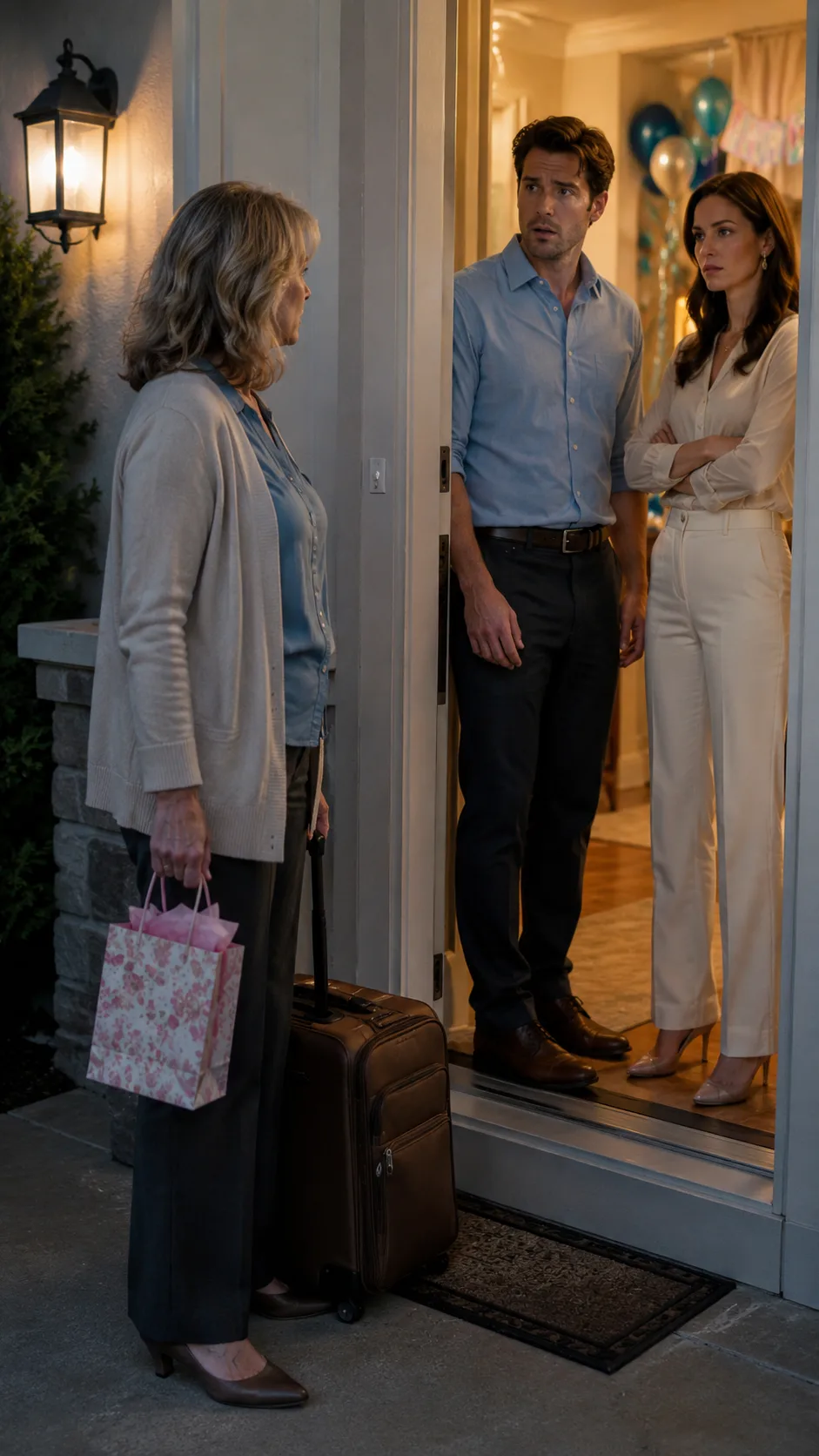
Nearly two years have passed since the night Robert sent me away from Ethan’s birthday. I do not regret refusing the money. My no did not destroy my family. It stopped me from helping them destroy themselves.
Robert learned to work, sacrifice, and be present. Ethan gained a grandmother. I regained a son—not the perfect boy from the photograph, but a flawed man willing to grow. Most importantly, I regained myself.
I learned that kindness is not weakness, and a mother’s love must never become permission for disrespect.
This morning, Ethan is coming over so I can teach him to bake the biscuits I once made for Robert. I will teach him about flour, patience, and family stories. But I will also teach him something greater: love must include boundaries, respect, and reciprocity.
The doorbell rings.
I rise with my head held high and walk toward the future—not as a woman begging for a place in someone else’s life, but as a woman who finally reclaimed her place in her own.
THE END
Chapter complete
You have reached the end of this chapter.
Continue reading
A few more worlds to get lost in after this chapter.




