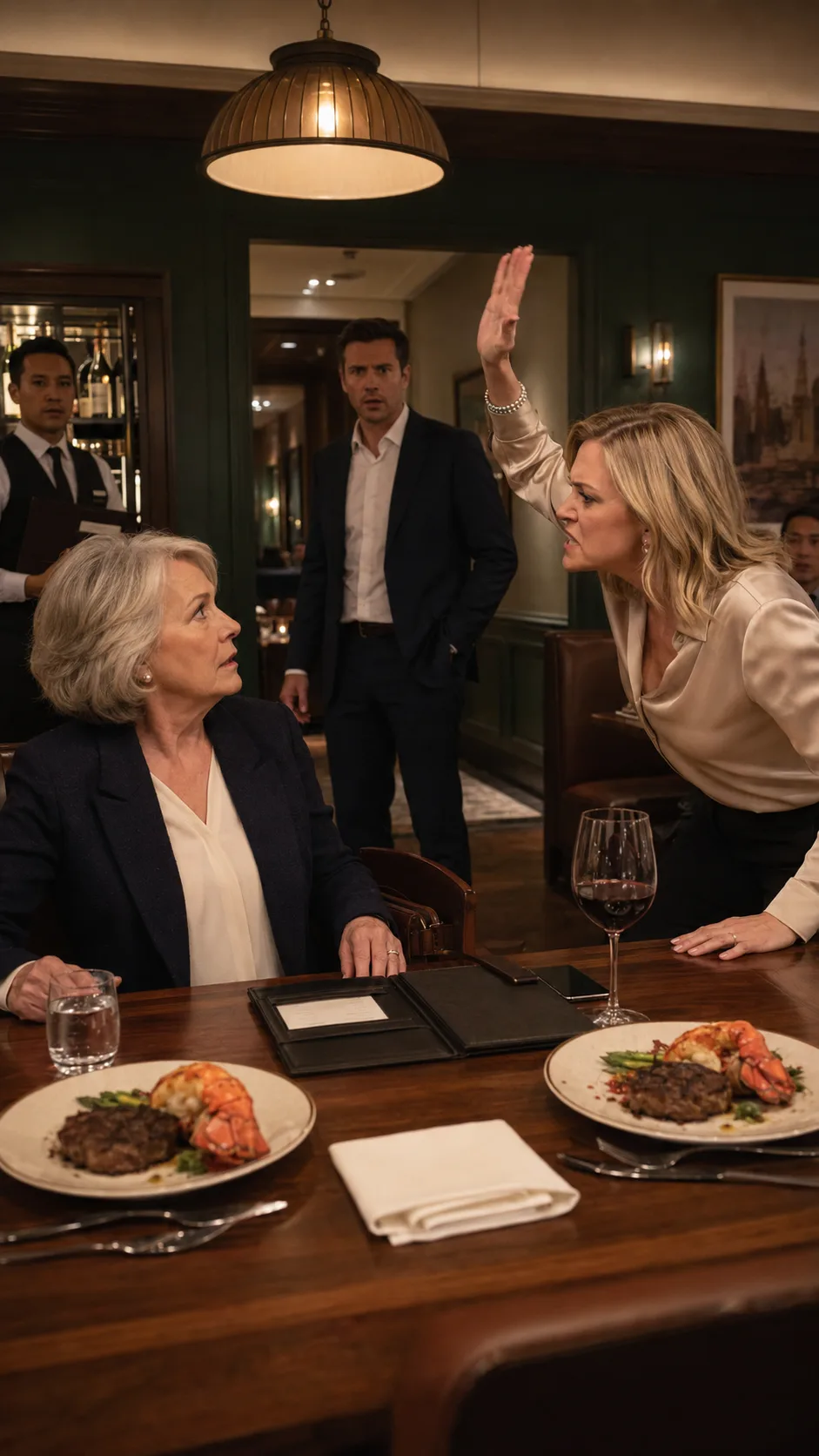
Madison read the first page three times.
Chapter 3
Madison read the first page three times.
I could tell because her eyes kept returning to the same line, the one that made her lips part and her fingers tighten around the paper.
Daniel stood behind her, no longer pretending to be calm.
“Madison,” he said quietly, “give it to me.”
She ignored him.
The diamond bracelet on her wrist slid down as she lifted the envelope closer to her face. The same hand that had struck me now shook so badly the paper rattled.
“This says you’re terminating the occupancy agreement,” she said.
Her voice had lost its sharp edge.
Good.
Sharp things were only frightening when the person holding them believed they could not be cut.
I folded my hands in my lap.
“That is correct.”
Daniel stepped closer.
“Mom, we can discuss this privately.”
I looked at him.
“We could have discussed it privately when you stopped paying the monthly amount you promised.”
His
face tightened.
“We were catching up.”
“No,” I said. “You were ignoring me.”
Madison turned on him.
“Monthly amount?”
Daniel reached for her elbow, but she pulled away.
“What monthly amount, Daniel?”
He looked at me then, and there it was—the look he used as a child when he wanted me to rescue him from consequences. The same wide, pleading eyes he gave me after he dented Robert’s truck at seventeen. The same expression he wore when he called me from college after overdrawing his account. The same helpless face that had once made me reach for my purse before he finished asking.
But he was not seventeen anymore.
He was thirty-nine years old, standing in a fine-dining restaurant while his wife held a legal notice about a house he had lied about.
I did not rescue him.
Madison’s voice rose. “You told me the house was basically ours.”
Daniel’s
mouth opened.
Nothing came out.
That was his talent.
Silence, polished until it looked like innocence.
I turned toward Madison.
“The house is in my name. It has always been in my name. Daniel and I signed an agreement four years ago. He and his family could live there below market rent while he rebuilt his business. In return, he would pay a small monthly amount, maintain the property, and stop asking me for additional money.”
Madison stared at him.
“You said she gave it to us.”
Daniel rubbed one hand over his mouth.
“I said eventually—”
“No,” I said. “You said whatever made her comfortable enough to spend money like she owned it.”
Madison’s face flushed.
For a second, I thought she might throw the envelope.
Instead, she looked down at the table.
The bill sat open beside the legal notice. Seven hundred eighty-six dollars. It looked almost ridiculous
now.
Her anger shifted direction.
“You let me renovate that kitchen,” she said to Daniel.
He whispered, “Madison—”
“You let me tell people it was our house.”
I remembered the kitchen.
White marble counters Madison chose after calling my old oak cabinets “depressing.” Brass fixtures she posted online with captions about “building our forever home.” A breakfast nook she painted sage green without asking me because, in her words, “Helen doesn’t really understand modern style.”
I had said nothing then.
I had told myself young couples needed room to build a life.
But there is a difference between giving people room and letting them erase your name from the door.
Madison looked back at me.
Her eyes were wet now, but not with remorse.
With panic.
“You can’t evict us. We have Lily.”
At the mention of my granddaughter, my chest tightened.
Lily was six. She still drew suns with smiling faces and kept a pink toothbrush at my house because she liked sleepovers.
“My attorney has already arranged proper notice,” I said. “Lily will not be put on the street. But I will not keep funding a home where I am insulted, lied to, and struck.”
The word struck made Madison flinch.
For the first time, she looked at my cheek.
Really looked.
The red mark had deepened. I could feel the pulse of it beneath my skin.
The waiter approached carefully.
“Ma’am,” he said to me, his voice low, “would you like assistance?”
Madison snapped, “We’re fine.”
I turned to him.
“Yes. Please ask the manager to call security if necessary. And please split the bill. I will pay for my own meal only.”
Daniel’s head jerked up.
“Mom, don’t do this.”
There it was again.
Not “I’m sorry.”
Not “Madison was wrong.”
Not “I should have stopped her.”
Just don’t do this.
I reached for my water glass and took one slow sip. My hand was steadier than I expected.
“Daniel,” I said, “when your father died, I promised myself I would not become bitter. I promised I would help you as long as helping you did not cost me my self-respect.”
His eyes reddened.
“I’m your son.”
“Yes,” I said. “That is why this took so long.”
Madison lowered herself into the chair across from me. The rage had gone out of her posture. Without it, she looked smaller. Not innocent. Just exposed.
“You’re really going to make us leave?” she asked.
“I am going to make you stand on your own.”
Daniel pulled out the chair beside her and sat down heavily.
The restaurant sounds began returning in cautious pieces. A fork touched a plate. Someone whispered. The kitchen door swung open and closed.
The manager arrived, a woman in a black suit with calm eyes.
“Is everything all right here?”
I looked at the open check folder, the legal envelope, my silent son, and the woman who had struck me because she thought my money was easier to reach than my dignity.
“No,” I said. “But it will be.”
Madison pushed the envelope back toward me.
“I’m sorry,” she said.
The apology came too quickly. It landed flat.
I looked at her hand, the one that had hit me.
“Are you sorry you slapped me,” I asked, “or sorry the house is still mine?”
Her mouth opened, then closed.
That answered me.
Daniel leaned forward, elbows on the table.
“Mom, please. We can fix this.”
I studied him for a long moment.
He looked tired. Older than I remembered. Afraid in a way I had never wanted my child to be afraid.
But love, I had learned, could not be allowed to behave like a thief simply because it shared your blood.
“You can start by paying your bill,” I said.
Madison looked at the receipt.
Daniel looked at the receipt.
Neither of them moved.
So I opened my wallet, took out enough cash for my own meal, added a proper tip for the waiter who had witnessed more than he should have, and placed it neatly beside my plate.
Then I stood.
My cheek still burned. My knees felt stiff. But I did not shake.
Daniel stood too.
“Mom.”
For the first time that night, he sounded like my little boy.
I wanted to turn around.
I wanted that voice to mean what it used to mean.
Instead, I picked up my purse and tucked the legal envelope safely back inside.
“You watched,” I said. “That is what I will remember.”
He swallowed hard.
Madison stared at the table, her face pale under the warm restaurant light.
I walked past the waiter, past the wine cabinet, past the diners who quickly looked away. At the entrance, the manager held the door for me.
The evening air outside was cold, clean, and honest.
Behind me, through the glass, I could see Daniel still standing beside the table, one hand covering his mouth while Madison sat frozen in front of the bill.
For years, I had mistaken peace for silence.
That night, I finally understood the difference.
Peace was walking out with my name, my house, and my dignity still mine.
THE END
Chapter complete
You have reached the end of this chapter.
Continue reading
A few more worlds to get lost in after this chapter.




