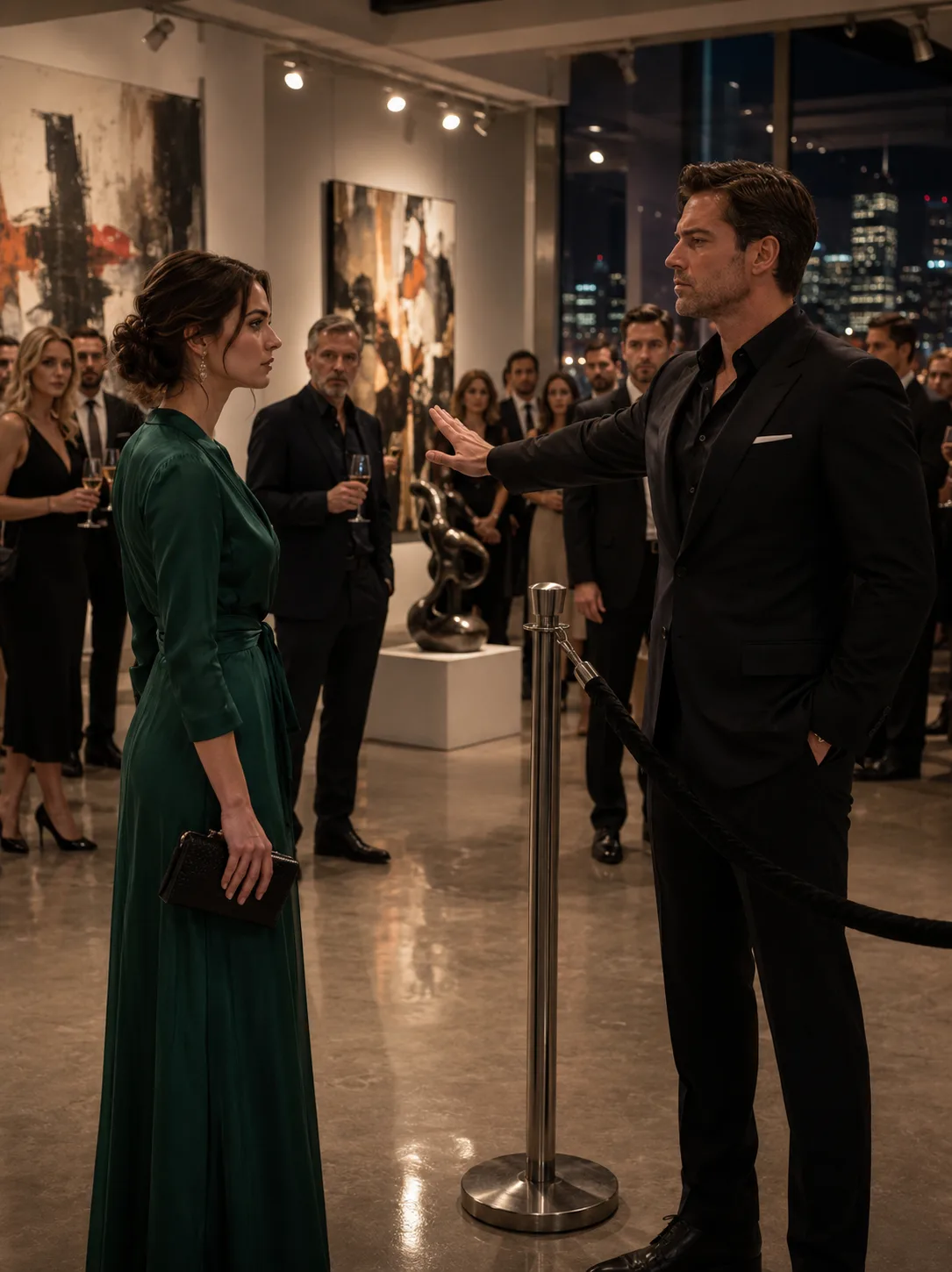
He Told Her This Section Was for Important Guests and Never Knew She Could End His Empire Before Sunrise
“Your grandfather’s last safeguard.”
Jackson stared at it.
Chapter 1
“Your grandfather’s last safeguard.”
Jackson stared at it.
“I’ve never seen it.”
“No,” Arthur said. “You were not meant to.”
The case was old but spotless, with a biometric lock and a keypad beneath it. Arthur’s hands trembled slightly as he touched the lid.
“Everett told me once that if the company ever began to rot from within, he had placed its bones somewhere safe. I thought it was metaphor. It wasn’t.”
Jackson frowned. “Open it.”
“I can’t.”
“Then find someone who can.”
Arthur met his eyes.
“There is only one person alive who can.”
Jackson knew before Arthur said her name.
Still, hearing it made something in him harden.
“No.”
“Jackson.”
“I said no.”
Arthur leaned forward, and for the first time in Jackson’s memory, the old man looked angry.
“Your grandfather trusted Maya Whitfield more than his own blood because he feared exactly the man you became in that ballroom.”
Jackson stood so fast his chair
struck the glass wall behind him.
Arthur did not flinch.
“You can hate her,” he said. “You can resent her. You can tell yourself she tricked you. But by morning, three hundred million dollars in payroll obligations are due across five states. If you do not go to her, thousands of people who never stood in your VIP section will pay for your pride.”
That landed.
Not cleanly. Not gently.
But it landed.
The next morning, Jackson Caldwell walked into Whitfield Capital without an entourage.
The lobby was warm, bright, filled with plants and quiet voices. No one bowed. No one panicked. The receptionist looked at him politely and said Ms. Whitfield would be with him when she was available.
He waited forty-seven minutes.
Every minute felt intentional.
When Maya finally received him, she did not stand.
She sat behind a glass desk in a cream blouse, her hair pulled
back, the skyline of lower Manhattan behind her. She looked not like a woman holding a grudge, but like a judge who had already read the evidence and was waiting to see whether the accused would lie.
Jackson placed the black case on her desk.
“My grandfather left this,” he said. “Arthur believes only you can open it.”
Maya looked at the case. Then at him.
“You came yourself.”
“Yes.”
“Why?”
The answer should have been simple. Because the company needed it. Because she demanded ceremony. Because Arthur forced him.
But none of those words came out.
“Because,” Jackson said slowly, “it matters.”
Something in her expression shifted. Not approval. Attention.
She placed her finger on the biometric pad, then entered a series of numbers.
The case clicked open.
Inside were documents, digital drives, signed trust instruments, and a letter written in Everett Caldwell’s unmistakable hand.
As Maya read, Jackson
watched the color drain from Arthur Bell’s face.
The truth emerged piece by piece.
Years before his death, Everett Caldwell had quietly moved Caldwell Dominion’s most critical assets into a private trust: patents, land rights, shipping contracts, logistics software, voting shares, and controlling interests. If company leadership triggered specific moral and financial thresholds, those assets would lock automatically.
Fraud.
Cruelty.
Reckless disregard for workers.
Attempts to hide injury claims.
Abuse of power by executive leadership.
The freezing accounts were not an attack.
The failed contracts were not random.
The empire was not being destroyed from the outside.
It was protecting itself from Jackson.
Maya lifted her eyes.
“Your grandfather built a locked room beneath your throne,” she said. “Then he gave me the key.”
Jackson sank slowly into the chair across from her.
“He gave you control of my company.”
“No,” Maya said. “He gave me authority to decide whether you are fit to lead it.”
For a long moment, Jackson heard only the hum of the room.
“What do you want?” he asked.
It was the only question he knew how to ask.
Maya stood and walked to the window.
“Everett did not ask me to save your empire,” she said. “He asked me to decide whether it deserves saving. There is a difference, Mr. Caldwell. And the difference is everything.”
She turned back.
“I have not decided yet.”
Part 2
The terms arrived the next morning in a plain envelope.
No letterhead. No flourish. No threat.
Just a single sheet of paper and fifteen names.
At the top, Maya had written one sentence.
If you want to understand what you are about to lose, start with the people who were never invited upstairs.
The first name was Dolores Morales.
Jackson stared at it.
Arthur Bell stood across from his desk, waiting.
“Who is she?” Jackson asked.
Arthur’s disappointment was quiet. “She has cleaned this floor for twenty-nine years.”
Jackson looked through the glass wall toward the hallway. A woman in a blue uniform was emptying a trash can outside the legal department. He did not know whether it was Dolores.
He hated that he did not know.
“Send HR,” he said.
Arthur did not move.
Jackson exhaled sharply. “Fine.”
Dolores Morales lived in Queens, in a brick apartment building above a bakery that made the sidewalk smell like butter. Jackson climbed four flights of stairs because the elevator was broken. By the time he reached her door, he was irritated, sweating slightly, and aware that his Italian shoes had never been designed for real stairs.
Dolores opened the door and nearly dropped the towel in her hand.
“Mr. Caldwell?”
“I’m not here to fire you,” he said, because fear had already crossed her face.
She looked more frightened, not less.
He stood in the narrow hallway with no script, no lawyers, no assistant whispering background notes in his ear.
“I’m here to ask how long you’ve worked for my family.”
Dolores stared at him. “Since your grandfather still came in on Saturdays.”
Something softened in her eyes.
“Mr. Everett knew everybody’s name. He brought coffee to the night crew during the blizzard of ’96. Black, two sugars for me. He remembered that for twenty years.”
Jackson had no answer.
She invited him in because she was too polite not to. He sat at a kitchen table covered with a plastic floral cloth and drank coffee from a chipped mug while Dolores told him about Everett Caldwell.
Not the legend.
The man.
The founder who carried boxes when the loading dock was short-staffed. The boss who paid for a janitor’s son’s surgery and never told anyone. The billionaire who would stop a meeting if he saw someone standing too long and ask them to sit.
“He said,” Dolores told him, “a building is held up by people no one photographs.”
Jackson looked down at his coffee.
He had spent his entire adult life inside buildings held up by people he never saw.
When he left, Dolores handed him a paper bag of warm pastries from the bakery downstairs.
“For Mr. Bell,” she said. Then, after a pause, “And for you.”
Jackson sat in his car for twelve minutes before telling the driver to move.
The second name was Marcus Reed, a former delivery supervisor in Newark. He had lost his job after a routing automation Jackson approved reduced the department by seventeen percent. Marcus had a wife, twins, a mother with diabetes, and no interest in making Jackson comfortable.
“You want me to make you feel better?” Marcus asked across a diner booth.
“No.”
“Good. Because I won’t.”
Jackson sat still while Marcus told him what a severance letter looked like when rent was due. What it felt like to train a software system that would replace you. How Caldwell Dominion gave press statements about innovation while men in their fifties quietly sold trucks, tools, wedding rings.
“You signed my layoff on a Tuesday,” Marcus said. “My daughter’s birthday was Friday.”
Jackson tried to remember. He could not.
The third name was Caroline Price, whose husband had been injured in a Caldwell warehouse outside Allentown after two safety repair requests were denied as “cost inefficient.” Her husband, Wade, had survived, but he walked with a brace now and woke up screaming three nights a week.
Caroline did not yell.
That made it worse.
She placed copies of the repair requests on her kitchen table, each one stamped and ignored.
“My husband gave that company eighteen years,” she said. “Somebody decided the machine was worth more than his spine.”
Jackson read the forms. His own approval code appeared at the bottom of the budget reduction.
He had not read the details.
He had approved the savings.
That night, Jackson returned to his penthouse above Columbus Circle and poured a drink he did not drink. The city stretched beneath him, bright and obedient-looking.
But it no longer looked small.
It looked full of rooms he had never entered.
For eight days, he followed Maya’s list.
By day nine, shame had begun to curdle into anger.
Not because the people were lying.
Because they were not.
Because every story was a mirror, and Jackson Caldwell had never been forced to stand in front of one this long.
On the tenth night, he threw the list across his desk.
“She is humiliating me,” he said.
Arthur sat in the corner, silent.
Jackson paced. “She thinks she can send me door to door like a schoolboy.”
“She is showing you the company.”
“I know the company.”
“No,” Arthur said. “You know its numbers.”
Jackson turned on him.
“I will not be judged forever by a woman who walked into my life with a dead man’s signature and decided she owned my future.”
Arthur’s face hardened.
“Then prove she doesn’t.”
Jackson’s eyes narrowed.
That was what pride wanted to hear.
Within hours, his lawyers began searching for a way to challenge Everett’s trust. Investigators were hired to dig into Whitfield Capital. Old associates were contacted. Donations were traced. Competitors were approached.
If Maya Whitfield had a buried body, Jackson intended to find it.
But Maya had expected this.
Naomi Ellis entered Maya’s office three days later with a folder.
“He’s testing the walls,” she said. “Trust lawyers. Private investigators. Someone offered your former CFO money for damaging information.”
Maya did not look surprised.
“Of course he did.”
“You’re not angry?”
“He is using the tools he has. That is what frightened men do.”
Naomi set the folder down. “What if he finds something?”
Maya smiled faintly. “Then I would have built a very poor life.”
The investigators found clean records, sealed audits, charitable trusts, and one spectacularly boring compliance history. Every trail led somewhere legitimate. Every whisper dissolved under daylight. The former CFO not only refused Jackson’s money, she sent Maya a recording of the meeting.
The lawyers found something worse.
A clause.
If any Caldwell executive attempted to remove, challenge, intimidate, defame, or materially undermine the trustee, the locked assets would transfer permanently to a network of worker pensions, public hospitals, and education funds.
Not freeze.
Transfer.
Forever.
The senior attorney delivered the news with the expression of a man announcing his own funeral.
“Your grandfather anticipated this exact response.”
Jackson sat very still.
“He knew I would fight her.”
Arthur, standing by the window, said nothing.
The silence became unbearable.
“He knew,” Jackson whispered.
That night, Jackson drove alone to Woodlawn Cemetery in the Bronx, where Everett Caldwell was buried beneath a simple gray stone that said less about him than most quarterly reports. Rain darkened Jackson’s coat as he stood before the grave.
For the first time since childhood, he spoke to his grandfather without performing.
“You trusted her because you knew I would try to destroy her,” he said.
The wind moved through the trees.
Jackson thought of Dolores and the chipped mug. Marcus Reed and his daughter’s birthday. Caroline Price laying out repair requests like evidence at a trial.
Then he thought of Maya standing in the ballroom, surrounded by laughter, asking who decided who mattered.
“I don’t know how to be what you wanted,” he said, his voice rough. “I don’t even know where to start.”
The grave did not answer.
But by morning, Jackson did.
He went to Whitfield Capital with no appointment, no security, no case, and no excuse.
The receptionist offered him a chair.
He remained standing.
Four hours passed.
At last, Maya came down herself. The lobby had gone quiet. People pretended not to watch.
Jackson looked exhausted. Not messy, exactly. Men like him were trained from birth never to be messy. But something polished had cracked.
“I tried to break you,” he said.
Maya said nothing.
“I failed.”
Still, she waited.
“I deserved to fail.” His jaw tightened. “My grandfather was right about me. So were you. I inherited everything except the part of him that made the rest of it worth having.”
For the first time since they met, his voice held no command.
“I’m asking you to teach me. Not because I want the assets unlocked. Not because I want forgiveness. Because I don’t know how to lead without fear, and I think if I keep leading the way I have been, then maybe the company should die.”
Maya studied him for a long time.
She had seen rich men apologize when money was on the table. She had seen powerful men cry when prison was mentioned. She had seen reputations fall to their knees and call it remorse.
But Jackson did not ask for the company.
He did not ask for mercy.
He asked for instruction.
“That,” Maya said, “is the first honest thing you have said to me.”
The lessons began that afternoon.
They were not gentle.
Maya made him sit in meetings he used to skip. Worker grievances. Safety audits. Severance appeals. Vendor disputes. Environmental risk briefings. Complaints from warehouse staff whose managers had buried reports because bad news made quarterly numbers look inconvenient.
She made him read every document before signing it.
Actually read it.
The first scandal surfaced in a safety file from Allentown. A senior operations director named Paul Renshaw had denied multiple repair requests, then buried the injury report after Wade Price was crushed by the faulty machine. His department had saved $480,000 that quarter. Jackson had praised him publicly.
Jackson called an emergency board meeting.
Renshaw arrived smiling.
He left pale.
Jackson read every denied repair aloud. Every warning. Every email. Every budget note. Then he placed Wade Price’s medical report on the conference table and looked at the board.
“This is not an accident,” Jackson said. “This is a decision we made with another man’s body.”
Renshaw tried to speak.
Jackson cut him off.
“You are terminated for cause. Your bonus is revoked. Your stock options are frozen pending legal review. And Caldwell Dominion will pay every dollar owed to the Price family before I leave this room.”
No one moved.
For the first time in his life, Jackson used fear on behalf of someone who had none.
The company felt it.
Not immediately. Not like applause.
More like a building shifting onto stronger beams.
Then the real enemy made his mistake.
It began with leaked files.
Three newspapers received confidential documents suggesting Caldwell Dominion had hidden debt in offshore subsidiaries. At the same time, two warehouses were attacked outside Baltimore. Trucks were burned. Guards were beaten. A port contract in Norfolk vanished overnight.
Arthur believed it was the rival Vale Syndicate, a private equity group famous for buying wounded companies and selling them for parts.
Jackson believed it was Paul Renshaw getting revenge.
Maya believed both were wrong.
She spread the documents across her conference table at two in the morning, sleeves rolled to her elbows, coffee untouched beside her.
“Look at the dates,” she said.
Jackson leaned over the table.
Naomi pointed to one column. “The leaks started before Renshaw was fired.”
“And the debt files?” Maya asked.
Arthur adjusted his glasses. “Some are real. Some are altered.”
“Exactly.”
Jackson frowned. “Someone is making collapse look inevitable.”
“No,” Maya said. “Someone has been preparing for collapse for years. They used Everett’s safeguard as cover. Every lock looked like weakness. Every weakness invited predators. But when I arrived with the key, the timeline changed.”
Jackson understood slowly.
“Because you could stop it.”
Maya nodded.
Naomi’s phone buzzed.
She glanced down, and the color left her face.
“Maya,” she whispered.
The message contained one photo.
A black SUV outside Maya’s hotel.
Taken from across the street.
The caption had only six words.
Keys can be taken from hands.
Jackson felt the room tilt.
Part 3
Maya did not scare easily.
Fear, to her, was information. It told you where the danger stood, what shape it had, how quickly it was moving. Panic wasted the information. Maya had not survived boardrooms, backrooms, grief, racism, sexism, poverty, and men like Jackson Caldwell by wasting anything useful.
So when the threat arrived, she changed her route, doubled security, notified federal contacts, and kept working.
Jackson wanted her in a safe house.
Maya refused.
“I am not disappearing because someone wants me invisible,” she said.
“Maya.”
It was the first time he had used her first name without calculation.
She noticed.
So did he.
“If they reach you,” Jackson said, “the company falls.”
Her eyes narrowed.
“If that were the only reason you were worried, you would sound different.”
He looked away first.
That was answer enough.
The abduction happened three nights later in the underground garage of Maya’s hotel.
It took nine seconds.
A camera loop. A service elevator held open. Naomi shoved against a concrete pillar hard enough to crack her phone screen and knock her unconscious. A black van pulling out through a maintenance ramp that should have been locked.
By the time Jackson’s phone rang at 2:13 a.m., Maya Whitfield had been gone for forty-one minutes.
He did not remember dressing.
He remembered Arthur’s voice, old and shaking.
He remembered Naomi in the emergency room, furious through a concussion, saying, “She counted them. I saw her counting.”
He remembered standing in Caldwell Dominion’s command center while security feeds, police calls, traffic cameras, and private contacts flooded the screens.
“Find her,” Jackson said.
His voice broke.
Everyone heard it.
No one mentioned it.
For the first time, the people in that room did not move because they feared him. They moved because they believed him.
But Maya Whitfield had not waited to be rescued.
They had taken her to an abandoned freight warehouse near Red Hook, one of the properties Caldwell Dominion had quietly lost influence over months earlier. Her wrists were bound. Her phone was gone. Her left shoulder ached from the way they had shoved her into the van.
Four men.
One driver.
Two guards.
One leader who spoke like a lawyer pretending not to be afraid.
Maya listened.
Within an hour, she knew the younger guard was named Tyler, had not been paid in two weeks, and hated the older guard, Vince. She knew Vince drank from a flask hidden in his jacket. She knew the leader answered to someone he called Mr. Hale.
Hale.
Not Vale.
Hale meant something.
Everett Caldwell’s younger nephew was named Preston Hale Caldwell. He had spent fifteen years on the board smiling like a loyal cousin while quietly voting for whatever made Jackson look reckless. Maya had met him twice. Both times, he had been forgettable in a way that felt rehearsed.
That was the thing about truly dangerous men.
The loud ones wanted the room.
The quiet ones wanted the exits.
When Vince stepped outside to smoke, Maya looked at Tyler.
“He’s going to kill you when this is done.”
Tyler snorted, but his eyes shifted.
Maya kept her voice calm. “You’ve seen faces. You’ve heard names. Men who kidnap trustees do not leave hourly workers alive out of gratitude.”
“I’m not hourly,” Tyler muttered.
“No,” Maya said. “You’re unpaid.”
That hit.
In the next room, the leader cursed into a phone.
Maya leaned back against the chair.
“I control more money than Preston Hale has stolen in his entire life,” she said softly. “I can put you somewhere warm by sunrise. Or you can keep standing next to a man who will leave your body in the harbor because you know too much.”
Tyler swallowed.
Maya said nothing else.
Silence did the rest.
She freed her wrists against a rusted bolt under the chair twenty minutes later. Skin tore. She did not stop. Pain was also information. It told her she was still able to move.
When Vince came back, Tyler was staring too hard at the floor.
Vince noticed.
“What did she say to you?”
“Nothing.”
“What did she say?”
The first punch was Vince’s.
The second was Tyler’s.
The warehouse erupted exactly the way Maya had predicted.
By the time Jackson’s security team breached the south entrance, following a traffic camera hit and Naomi’s remembered partial plate, two kidnappers were unconscious, Vince was zip-tied to a railing with his own restraints, and Tyler had fled with a burner phone full of messages he would later trade for federal protection.
Maya was sitting on a wooden crate, pressing a bloody napkin to her wrist.
Jackson ran in with a gun in one hand and terror all over his face.
He stopped when he saw her.
“You’re late,” Maya said.
For a second, he could not breathe.
He had imagined her broken. He had imagined begging, blood, helplessness. Instead, he found the room dismantled around her.
“I came to save you,” he said hoarsely.
“I know.”
Her expression softened, just enough.
“That matters. Not because I needed saving. Because you came.”
He lowered the gun.
Something in his face changed then. Fully. Finally.
He had spent their first meeting deciding she was beneath his notice. He had spent the next days trying to buy her, then beat her, then survive her. Only now did he understand that the key had never been the most powerful thing about Maya Whitfield.
The woman was.
“Do you want to stand there staring,” she asked, “or do you want to bring down the man who ordered this?”
Together, they did.
Tyler’s phone led to Preston Hale Caldwell. Preston had been feeding information to Vale Capital for years, weakening Caldwell Dominion from inside while waiting for Everett’s trust to lock. His plan had been elegant in its cruelty. Let Jackson’s arrogance trigger the safeguard. Let the company bleed. Let rivals circle. Then, when the assets appeared unreachable and confidence collapsed, Preston would force a sale through panic, debt, and public scandal.
Maya’s arrival ruined him.
She could unlock what he needed dead.
So he tried to remove her.
Maya refused to let the arrest happen quietly.
Two weeks later, Caldwell Dominion held an emergency shareholder assembly in the Beaumont Grand Hotel’s Crystal Room, the same ballroom where Jackson had humiliated her in front of two hundred people.
This time, every camera was invited.
The room was packed. Directors. Investors. Politicians. Union representatives. Journalists. Workers from Caldwell facilities in New Jersey, Pennsylvania, Maryland, and Georgia. Dolores Morales sat in the third row in her best navy dress. Marcus Reed stood near the aisle with his wife. Caroline Price sat beside Wade, whose brace was visible beneath his suit pants.
Preston Hale arrived smiling.
He stopped smiling when Maya walked to the podium.
She did not raise her voice.
She did not need to.
One by one, she laid out the evidence. The falsified debt reports. The leaked contracts. The warehouse attacks. The payments to shell companies. The connection to Vale. The kidnapping order.
Preston tried to stand.
Federal agents met him at the row.
The room erupted, but Maya lifted one hand, and somehow the room obeyed.
Then Jackson stepped forward.
He looked at Preston, then at the shareholders, then at the workers his family had once treated like footnotes.
“This happened because I built a company culture where fear traveled faster than truth,” Jackson said. “Preston betrayed us. But I made betrayal easy. I signed what I did not read. I praised savings without asking who paid for them. I mistook obedience for respect.”
Arthur Bell bowed his head.
Jackson continued.
“That ends today.”
He announced full restitution for injured workers, an independent safety board with worker representation, restored jobs where automation had been used dishonestly, and a permanent profit-sharing fund for employees below the executive level.
No one clapped at first.
The promises were too large, too specific, too unfamiliar.
Then Dolores Morales stood.
One by one, the room followed.
The applause was not glamorous. It did not sound like the applause rich people gave themselves at galas. It was heavier. Truer.
Maya watched Jackson through it all.
He did not smile like a victor.
He looked like a man accepting a debt.
After Preston was led out and the room settled, Arthur placed Everett Caldwell’s final letter on the podium.
Maya had kept it sealed until that morning.
Jackson looked at it with something like fear.
Arthur’s voice shook as he read.
My grandson was born above the shop floor, but that does not mean he cannot learn where the foundation is. If the day comes when he bows his pride before someone he once looked down upon, then he may finally understand what leadership costs. Do not save the company for him. Make him become a man who can save it for others.
Arthur stopped reading.
Maya stepped to the control station where the trust documents waited for her signature.
Every person in the room understood what that meant.
One signature could restore Caldwell Dominion’s locked assets.
One refusal could leave the company broken beyond repair.
Jackson approached her quietly.
“If you decide against me,” he said, “I won’t fight you.”
“I know.”
“I would have, before.”
“I know that too.”
His eyes searched hers. “Are you sure?”
Maya looked at him for a long moment.
Then she looked at Dolores. Marcus. Caroline. Wade. Arthur. Naomi, standing at the back with a bruise fading along her cheek. The workers, the drivers, the cleaners, the people who had carried the company while men in high rooms called themselves builders.
Finally, she looked at Jackson.
“Your grandfather didn’t ask me to replace you,” she said. “He asked me to find out whether you could change.”
“And?”
Maya signed.
The screen behind her shifted from red to white.
Unlocked.
A sound moved through the room. Not cheering at first. Relief. Shock. Breath returning to a body that had nearly died.
Caldwell Dominion’s frozen accounts thawed. Its patents released. Its controlling shares restored. Its contracts stabilized. The bones Everett had hidden beneath the empire rose back into place.
Jackson closed his eyes.
When he opened them, they were wet.
Maya handed him the pen.
“The company is yours,” she said. “Now earn it every day.”
The celebration came one month later.
Jackson insisted it be held in the same ballroom.
Maya almost refused, but Arthur told her Everett would have appreciated symmetry, and Naomi told her the emerald dress deserved a better memory.
So Maya returned to the Beaumont Grand Hotel on a clear May night, wearing the same color she had worn when the room laughed at her.
Only this time, no one laughed.
When the double doors opened, conversation stopped.
Two hundred people stood.
Slowly.
Not because a program told them to. Not because cameras pointed at them. Because every person in that room knew what had happened there. They knew how they had laughed. They knew what they had misjudged. They knew that the woman they had watched walk out alone had come back holding the truth about all of them.
Maya crossed the marble floor.
The young security guard from that first night stood beside the velvet rope. His name was Daniel Brooks. She knew because he had come to her office to apologize, twisting his cap in both hands, and she had told him he had done his job with more respect than the men giving orders.
Tonight, Daniel unclipped the rope before she reached it.
Jackson came down from the VIP platform.
The same platform.
The same steps.
The same glittering room.
He stopped in front of Maya while cameras watched, while board members watched, while employees watched, while every person who remembered his sneer held their breath.
Then Jackson Caldwell bowed.
Not a quick nod.
Not a polished gesture.
A full, deep bow.
The kind proud men do only when pride has finally become too heavy to carry.
Gasps rippled through the ballroom.
Jackson stayed bowed long enough for everyone to understand that it was not theater.
When he straightened, his voice carried clearly.
“The first time Maya Whitfield entered this room, I told her this section was for important guests only.”
No one moved.
“I was wrong about the section,” he said. “I was wrong about importance. I was wrong about power.”
He turned and gestured toward the elevated platform.
“This section is for important guests,” he said.
The room held its breath.
Then Jackson looked back at Maya.
“And tonight, there is no one in this room more important than the woman who taught me that an empire without humility is only a taller kind of ruin.”
Applause broke like thunder.
But Maya did not move toward the steps right away.
Instead, she turned to Daniel Brooks, the security guard, and held out her hand.
“Walk with me,” she said.
Daniel froze. “Ma’am?”
“You stood at this rope the night everyone laughed,” Maya said. “You were the only one who looked ashamed. Walk with me.”
His eyes filled.
Together, Maya Whitfield and the security guard walked up the VIP steps while Manhattan’s most powerful people stood below them and applauded.
Jackson watched from the foot of the stairs.
Not above her.
Not blocking her.
Beside the people he was still learning to see.
At the top, Maya turned and looked out across the Crystal Room. She saw wealth, yes. Influence. Ambition. Fear. Hunger. Shame. Hope.
But she also saw Dolores smiling through tears. Marcus Reed clapping with his daughter on his shoulders. Caroline holding Wade’s hand. Naomi standing tall. Arthur Bell looking toward the ceiling as if giving an old friend the news.
Maya allowed herself one small smile.
She had not come to take an empire.
She had come to answer a dying man’s question.
Could a man born above everyone else learn to stand among them?
Against every expectation, Jackson Caldwell had.
Not perfectly.
Not easily.
Not without falling back into old instincts and being dragged out by truth.
But he had changed where it mattered most.
He had learned that power is not proven by the doors you can close.
It is proven by the people you finally choose to let in.
And from that night on, no one at Caldwell Dominion ever used the words important guests the same way again.
THE END
Chapter complete
You have reached the end of this chapter.
Continue reading
A few more worlds to get lost in after this chapter.




