PART 2 — THE DAY I CHOSE SELF-RESPECT
She left, closing the door behind her.
Chapter 2
PART 2 — THE DAY I CHOSE SELF-RESPECT
She left, closing the door behind her.
I sat alone with that box, with that black uniform that smelled of new plastic and humiliation. Memories flooded back—memories of when Ethan was small, maybe four or five, when we had so little money. I’d sewn from home doing alterations for neighbors, working late into every night. One afternoon, Ethan had run into my workspace holding a drawing of me at my sewing machine, my gray dress painted blue because he said blue was my color.
“Mommy, you’re the prettiest mommy in the whole world,” he’d said, hugging me with the unselfconscious strength children have before they learn to lie with their bodies. “You know what I’m going to do when I grow up? I’m going to be rich and buy you a huge house with a yard, and you’ll never have to work so hard again.”
I’d stroked his hair, crying where he couldn’t see. “I don’t need
a huge house, sweetie. I just need you to be happy and to be a good man.”
That boy who’d made me promises—where was he now?
I remembered when Robert died, how Ethan had cried silently beside me at the funeral, barely twelve years old in a suit too large for his small frame, squeezing my hand. “Mom, I’m going to take care of you. I promise.” And I’d believed him.
I’d worked double and triple shifts after that. Taken jobs that humiliated me with clients who treated me as if I knew nothing. Nights without sleep, days without proper meals—all so Ethan could study, could have opportunities better than mine. When I opened my first small factory, Ethan had come with me on opening day. “Someday this will all be yours,” I’d told him. “Everything I’m building is for you.”
He’d smiled and hugged me. “Thank you, Mom, for
everything.”
At what moment had he changed? When did he stop being the boy who’d drawn me in blue dresses and become a man who could watch his wife humiliate me without protest?
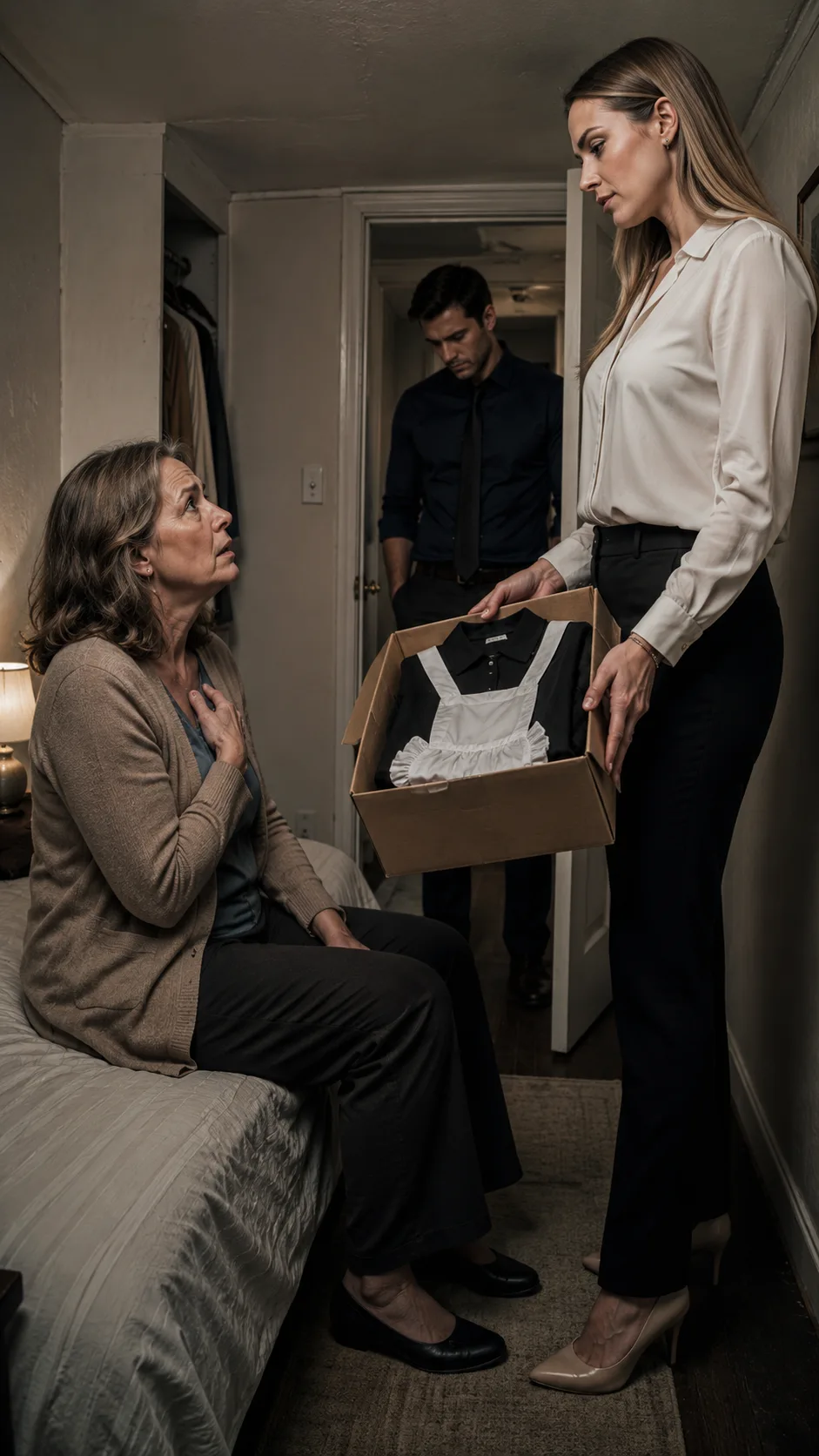
I took the uniform out of the box and spread it across the bed—black, starched, with lace trim on the white apron. A maid’s uniform for the woman who’d built a company from nothing, who’d raised a son alone, who’d worked until her fingers bled. I touched my mother’s gold ring, the only valuable possession I’d saved. My mother had been a domestic worker her entire life, cleaning houses where some people treated her well and others treated her as if she were invisible.
“Promise me you’ll have a different life,” she’d said when giving me the ring. “Promise me you’ll study, that you’ll be somebody.”
I had been somebody. And now I was here, being asked
to wear a servant’s uniform in my own son’s house.
I pushed the box under the bed. I wasn’t going to wear it. I didn’t know yet what I would do, but not that.
I went to the kitchen where Vanessa was drinking coffee and checking her phone. “Did you try on the uniform yet?” she asked without looking up.
“I need to speak to Ethan.”
“Ethan already left for work, and he agrees with this arrangement. It was both our idea.”
I sat down, my legs shaking. “Vanessa, I’ve always treated you with respect. From day one, I’ve never interfered in your marriage or criticized anything. Why are you doing this to me?”
She set down her phone and looked directly into my eyes. “Because I can.”
Three words that laid bare the truth: this wasn’t about housework or contributing. This was about power, about humiliation, about putting me firmly in my place.
“Besides, Martha, let’s be honest. What else do you have? You lost your company. You lost your house. You have no money, nowhere to go. Here you have a roof and food. It’s not so bad, is it?”
I stood up, my hands shaking so violently I had to grip the table. “I’d rather sleep on the street.”
“Don’t be so dramatic, Martha.”
I returned to my room and started packing my three suitcases, hands moving mechanically even though I had no plan, no destination. But I knew I couldn’t stay here. When I heard the front door open and Ethan’s voice, I came out with my bags.
“Mom, what’s wrong?” He looked tired, already loosening his tie.
“Your wife gave me a maid’s uniform. She told me if I want to live here, I have to work as a servant.”
I waited for surprise, for anger, for any sign that this wasn’t what he wanted. Instead, his expression barely changed. “Mom, you’re not contributing to the household. We work hard. The house is big. We need help with upkeep.”
“I am your mother, Ethan. Not your employee.”
“Nobody’s treating you like an employee. We’re just asking you to help out. The uniform is so you don’t ruin your regular clothes.”
I couldn’t believe what I was hearing. My son—my own son—was defending this, justifying it with calm rationalization.
“Do you actually agree with this?”
He rubbed his face tiredly. “Mom, look. You lost everything. I’m giving you a place to live. The least you can do is help maintain the house. It’s not that complicated.”
“The least I can do.” As if thirty-two years of sacrifice didn’t matter. As if the sleepless nights and endless work so he could attend private university meant nothing.
“You know what, Ethan? You’re absolutely right. I did lose everything—my company, my house, my savings. But there’s something I will not lose.”
“What?”
“My self-respect.”
I walked toward the door with my three suitcases, my mother’s ring, and the tattered remains of my dignity. Vanessa called from behind me: “When you get tired of living on the street, you know where your uniform is.”
I didn’t turn around. The sun was setting as I stood on their front steps with nowhere to go and approximately three hundred dollars in my bank account. I called my sister Lucy, though we hadn’t spoken in months. She let me stay on her couch for three days, but her husband Robert made his resentment clear through the thin walls of their small apartment.
“She never helped us when we needed it,” I heard him tell Lucy one night. “Why should we support her?”
I left the next morning, telling Lucy I’d found a place even though I hadn’t.
Over the following weeks, I discovered what rock bottom actually felt like. I found work at a dry cleaner for three hundred fifty dollars a week, working from eight in the morning until seven at night, six days a week. I rented a four-square-meter room in a rundown building for four hundred dollars monthly—a space with a sunken bed, damp-stained walls, and a single light bulb hanging from the ceiling.
But something shifted inside me during those dark weeks. Somewhere between the exhaustion and the humiliation, I found something cold and clarifying: rage. Not at Ethan or Vanessa, but at myself for accepting scraps, for believing love alone could sustain a relationship built on disrespect.
I’d spent my life giving and sacrificing and putting myself last. For what? To end up here, invisible and discarded?
No. This wouldn’t be my ending.
I took out an old notebook and wrote: “Things I know how to do: sew, design patterns, manage, sell, survive.”
I’d built a company once from nothing. I could do it again.
To be continued… Click “PART 3” to read the final part: 👉 PART 3 👈
Chapter complete
You have reached the end of this chapter.
Continue reading
A few more worlds to get lost in after this chapter.




