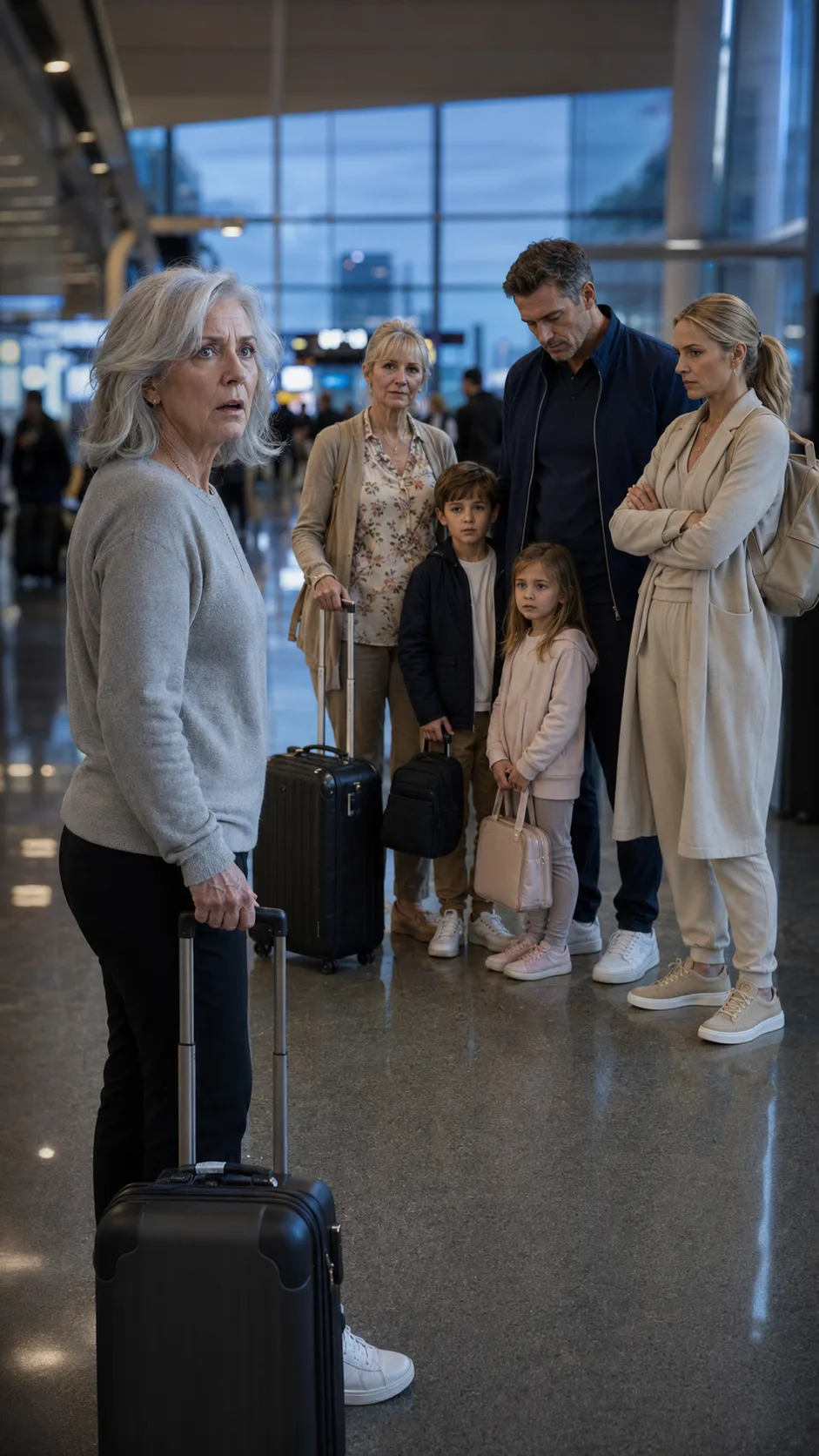
PART 3 — I CANCELED EVERYTHING AND CLOSED THE PIPELINE
“Your current will,” she said, slipping on reading glasses, “leaves your entire estate to Kevin.
Chapter 3
“Your current will,” she said, slipping on reading glasses, “leaves your entire estate to Kevin.
Current estimated value, approximately five-point-eight million dollars, not including future growth. This new will completely disinherits him. He will receive nothing. Everything goes to the charities you specified. With the language I’ve included, it will be very difficult for him to contest.”
“Good,” I said.
“I’m also dissolving the education trust you established for Tyler and Emma,” she continued. “That’s five hundred thousand dollars returning to your general estate.”
“I’m aware,” I said. My voice didn’t even wobble on the number.
“And,” she said, “you’re revoking all powers of attorney. Which means Kevin will have no legal authority over your medical decisions, financial decisions, anything, if you become incapacitated.”
“That’s exactly what I want,” I said.
Patricia took off her glasses and studied me for a long moment.
“Margaret, you’re one of the most rational people I know,” she said. “But I still have to ask. Are you sure you’re
not making this decision in the heat of the moment? In my line of work, I’ve seen people punish themselves long-term because of a short-term explosion.”
“This isn’t an explosion,” I said.
I picked up the pen she’d placed by the first signature line.
“This is an autopsy.”
She tilted her head. “Go on.”
“That airport incident didn’t cause this decision,” I said. “It clarified it. For thirty-eight years, I’ve put Kevin first. I raised him alone after Thomas died. I took extra shifts. I drove an old car so I could pay for his new textbooks. I paid his college tuition—one hundred eighty thousand dollars. His medical school tuition—three hundred twenty thousand. I helped with his down payment—one hundred fifty thousand. I supplement his mortgage every month. I pay his kids’ private school tuition. On average, I send him eight thousand dollars a month in help and emergency money.”
I signed the first document.
“And this morning,” I continued, “when I needed him to stand beside me—not even to yell, not to create a scene, just to say ‘Mom paid, Mom comes’—he looked at the floor and agreed with his wife that I should go home. That I’m too old. That my grandchildren love someone else more.”
I signed the next page.
“That moment didn’t come out of nowhere,” I said. “It was the final data point in a forty-year study. It showed me the truth about our relationship. It’s not a relationship. It’s a pipeline. Me giving, him taking. And I am closing the pipeline.”
I signed the final page with a firm stroke.
Patricia gathered the documents, flipping through to make sure every line was signed.
“This will is ironclad,” she said. “You’re clearly of sound mind; we’ll document that with a memo and, if necessary, a
psychiatrist’s evaluation. We have witnesses. The language explicitly disinherits him and explains why. If he tries to contest it, he will almost certainly lose.”
“Good,” I said again. The word felt clean in my mouth.
I stood.
“Now,” I said, “I need you to arrange for a locksmith to come to my house today. Kevin has keys. I want all locks changed. And I need a security system upgrade—cameras, motion sensors, something that alerts the police if he tries to enter.”
“I’ll arrange it immediately,” Patricia said, already making notes.
“One more thing,” I added. “Draft a formal cease-contact letter. Kevin is no longer welcome at my home. All financial support is terminated. Any attempt to pressure or harass me will be documented.”
Patricia nodded.
“Done,” she said. Then, softer: “Margaret, are you sure you don’t want to at least hear him out? People do terrible things when they’re under the influence of a spouse. Sometimes—”
“There’s no explanation that matters,” I said. “He made his choice at that gate. Now I’m making mine.”
I left her office, rode the elevator down with two men in expensive coats arguing about a merger, and stepped out onto the street.
The late-afternoon light bounced off the river and the glass buildings. The wind off the water cut through my wool coat. A young couple hurried past, laughing, a to-go coffee in each hand.
I pulled my scarf tighter around my neck and realized something strange.
For the first time in a very long time, my shoulders weren’t up by my ears.
I felt… lighter.
Not happy. Not yet.
But lighter.
The next morning, I woke up at seven, made coffee, and sat in my sunroom overlooking the small backyard garden I’d tended for years. The tulips were just starting to push through the soil.
At 7:30, there was pounding on my front door.
I glanced at the new security monitor installed above my kitchen counter. The image flickered and then sharpened.
Kevin, standing on my front porch, looking exhausted and desperate. He was still in the clothes he’d worn the previous day, hair mussed, dark circles under his eyes.
He pounded again.
“Mom!” His voice echoed through the speaker. “Mom, I know you’re in there. Please, we need to talk.”
I pressed the intercom button.
“Kevin, you’re trespassing,” I said. “I’ve changed the locks. If you don’t leave immediately, I’m calling the police.”
“Mom, please,” he said. “Just let me explain.”
“There’s nothing to explain,” I said. “You made yourself very clear yesterday. Now leave.”
“The vacation is canceled,” he said, like this was new information. “Everything. The hotel, the flights, all of it. The kids are devastated. Jessica is—”
“I don’t care about Jessica,” I said. “And I’m sorry the children are disappointed, but that’s not my problem. It’s yours. You chose to give my ticket to Linda. Now deal with the consequences.”
“Mom, I’m sorry,” he said. “Jessica didn’t mean it the way it sounded.”
“Yes, she did,” I said. “And you stood there and let her say it. That tells me everything I need to know. Now get off my property.”
“Mom—”
I picked up my phone and held it up so he could see it through the camera.
“I’m dialing 911,” I said.
His eyes widened.
“Fine,” he said. “Fine. I’m leaving. But we need to talk.”
“No,” I said. “We don’t. Goodbye, Kevin.”
He stood there for another moment, shoulders slumped, then turned and walked back to his car.
I watched him drive away, then called Patricia.
“He came to my house,” I said. “I need that restraining order filed.”
“I’ll have it done today,” she replied.
Over the following week, Kevin tried everything.
He sent flowers. I had them delivered straight to the hospital where I used to work and asked the nurses to put them in the waiting room.
He sent letters. I returned them unopened.
He had the children call my number. Once, I heard Tyler’s voice on the voicemail.
“Grandma, please call us back,” he said. “We miss you.”
My heart broke.
But I didn’t call back.
Because the issue wasn’t with Tyler and Emma.
It was with their parents.
Kevin left voicemail after voicemail. The early ones were angry. The later ones were pleading. The last one I heard, by accident, came when I was checking messages from my book club.
“Mom,” he said, his voice broken and exhausted. “I know you won’t call back. I know you’ve made up your mind, but I need you to know… I understand now. I understand what I did, what I didn’t do at the airport. I should have stood up for you. I should have told Jessica she was wrong. I should have… I should have been your son. And I wasn’t. I chose to avoid conflict instead of protecting you, and I’ll regret that for the rest of my life.”
There was a long pause.
“I’m not calling to ask you to change your mind,” he continued. “I’m calling to tell you I’m sorry and that I love you and that I understand if you never want to see me again.”
He hung up.
I sat with my phone in my hand for a long moment.
He sounded genuinely sorry.
But “sorry” doesn’t undo what happened.
“Sorry” doesn’t erase the memory of standing at that airport, suitcase in hand, being told I was being replaced by someone else’s mother.
“Sorry” doesn’t change the fact that for thirty-eight years, I’d been giving and giving and giving, and the one time I needed basic respect, he couldn’t give it to me.
I deleted the voicemail and went back to my book.
One month after the airport incident, I was having lunch with my friend Barbara, a fellow retired cardiologist, at a little bistro in the West Loop that caters to lawyers and medical professionals.
“So, what happened with the Hawaii trip?” she asked, stirring her iced tea. “How was it?” She’d known how excited I’d been about taking the whole family.
“I didn’t go,” I said.
“What? Why not?” she asked.
I told her the story.
All of it.
Her face went through a progression of expressions—shock, anger, disbelief.
“Jessica said what to you?” she demanded. “That her mother was going instead of you because the children love her more? And Kevin just stood there?”
“He stood there and agreed with her,” I said.
“Margaret, I’m so sorry,” she said. “That’s horrible.”
“Don’t be sorry,” I replied.
Because in the month since the airport, something interesting had happened.
I’d started living for myself.
I booked a trip to Paris. First class on a nonstop flight out of O’Hare. A luxury hotel in the 7th arrondissement with a view of the Eiffel Tower. Two weeks in September.
I joined a book club at a local independent bookstore in Lincoln Park, the kind with creaky floors and handwritten staff recommendations.
I signed up for an art class at the Chicago Cultural Center, where I discovered that my hands, which had been steady enough to perform delicate procedures in the cath lab, were also capable of painting surprisingly decent landscapes.
I started dating a lovely man named Robert, a retired architect I’d met at a hospital fundraiser years ago and run into again at the Art Institute. He treated me with respect and genuine interest, listened when I talked about my work, and never once implied I was “too old” for anything.
I reconnected with friends I’d lost touch with because I’d been so focused on being available for Kevin and the grandchildren.
I realized something:
I had been using “family” as an excuse not to live my own life.
“You know what?” Barbara said, squeezing my hand across the table. “You look happier than I’ve seen you in years.”
“I am happier,” I said.
“I’m sad about losing my relationship with Tyler and Emma. That breaks my heart. But the rest of it? I’m relieved.”
“What about Kevin?” she asked. “Do you think you’ll ever forgive him?”
I thought about that.
“I don’t know,” I said. “Maybe someday. But forgiveness doesn’t mean letting him back into my life. It doesn’t mean going back to how things were. That relationship was unhealthy. I was giving everything and getting nothing. That’s not love. That’s enabling.”
“What did he lose when you cut him off?” Barbara asked.
“Not just the inheritance,” I said.
She raised an eyebrow.
“The inheritance?” she prompted.
“My estate is worth about five-point-eight million dollars,” I said. “He knew he was inheriting it. He’s known for years. I think that’s partly why he felt so comfortable taking advantage of me. He knew the money would eventually be his anyway. But now, now it’s all going to charity. Forty percent to the American Heart Association. Forty percent to medical scholarships for underrepresented minorities. Twenty percent to women’s shelters across the Midwest.”
Barbara’s eyes widened.
“Five-point-eight million,” she repeated. “And he lost all of it?”
“Yes,” I said.
“But it’s not just the inheritance,” I added. “I was giving him eight thousand dollars a month in various support. Mortgage help. The kids’ private school tuition. Car payments. ‘Emergencies.’ That’s ninety-six thousand dollars a year. Gone.”
Barbara whistled softly.
“He must be struggling,” she said.
“I imagine so,” I said. “But that’s not my problem anymore.”
And it wasn’t.
Two months after the airport incident, I heard through mutual friends at the hospital and at church that Kevin and Jessica had pulled the kids out of private school and were selling their four-bedroom house in a leafy suburb with good commuter train service into the city.
Three months after, I heard Jessica had taken a job in retail at a big-box department store off a highway interchange, because they couldn’t make ends meet on Kevin’s salary alone.
Four months after, I heard their marriage was struggling. They fought constantly. Jessica blamed Kevin for “ruining everything.” Kevin blamed Jessica for “pushing it too far.”
I felt no satisfaction hearing this.
But I felt no guilt either.
They’d made choices.
They were living with consequences.
Just like I was living with my choice to finally put myself first.
Six months after the airport incident, I received a letter.
Not from Kevin.
From the children.
The envelope was addressed in childish handwriting, Tyler’s blocky letters, our Chicago ZIP code slightly crooked. There were dinosaur stickers on the back.
I almost didn’t open it.
But I did.
Inside was a letter written on lined notebook paper.
“Dear Grandma,” it began. “We miss you so much. We don’t understand why you won’t see us anymore. Daddy says he made a big mistake and you’re very sad. Mommy cries a lot now. We had to move to a smaller house and we go to a new school now. But it’s okay actually because we made new friends. We want you to know we love you the most. Not Grandma Linda. You. We didn’t know what Mommy said at the airport would make you so sad. We thought you were just going home. We didn’t know you weren’t coming back. Can we please see you? We miss your hugs and your stories and how you make pancakes with chocolate chips. We know Daddy was wrong. Can you forgive him so we can see you again? We love you, Tyler and Emma.”
I read that letter three times.
Then I cried.
For the first time since the airport, I let myself cry.
I cried because those children were innocent in all of this. They hadn’t asked for their parents to be cruel and thoughtless. They hadn’t asked to lose their grandmother.
They were collateral damage in a conflict that had nothing to do with them.
I sat with that letter for two weeks, reading it every night before bed, thinking about what I wanted to do. Thinking about what was right.
Finally, I called Patricia.
“I want to see my grandchildren,” I said.
“Margaret, are you sure?” she asked.
“I’m sure,” I said. “But on my terms. Kevin and Jessica need to accept certain conditions.”
“What conditions?” she asked.
“First,” I said, “the will stays as it is. Kevin inherits nothing. That’s not negotiable.”
“Understood,” she said.
“Second,” I continued, “no financial support. Ever. They’re on their own. I don’t pay for anything. Not school, not mortgage, not emergencies. Nothing.”
“Agreed,” she said.
“Third,” I said, “I see the children at my house only, not at theirs. I control the visits. If Tyler and Emma want to see me, Kevin brings them here and picks them up. No hanging around. No conversations beyond basic logistics.”
“What about Jessica?” Patricia asked.
“Jessica is not welcome in my home,” I said. “If she wants to see me, she can apologize in writing first. And even then, I make no promises.”
“That’s fair,” Patricia said.
“Fourth,” I said, “if Kevin or Jessica violates any of these terms—if they try to manipulate me, if they ask for money, if they disrespect me in any way—then all contact ends permanently. One strike, and they’re out.”
“I’ll draft the agreement and make it legally binding,” Patricia said. “I’ll have them sign it.”
“Do it,” I said.
Three days later, Patricia called me back.
“I sent the agreement to Kevin,” she said. “He called me twenty minutes later. He said he’ll sign anything. He’s desperate to get you back in the kids’ lives.”
Click the blue “PART 4” below to read the final part:
Chapter complete
You have reached the end of this chapter.
Continue reading
A few more worlds to get lost in after this chapter.




