PART 3 — THE SON WHO BECAME A STRANGER
The police arrived thirty minutes later.
Chapter 3
PART 3 — THE SON WHO BECAME A STRANGER
The police arrived thirty minutes later.
They photographed the damage, took statements, and examined the envelope. William told them about Jessica, Brenda, Michael, and the offshore account.
One officer looked at me seriously.
“Ma’am, you cannot stay here alone tonight. Whoever left this knows where you live.”
“She will stay with me,” William said immediately. “My home has security.”
I did not want to leave my house.
I did not want criminals pushing me out of the place Arthur and I had built.
But I was not foolish.
Someone had been inside.
Someone had threatened me.
While packing a small bag, I found another envelope under my pillow.
This one was smaller.
My name was written in Arthur’s hand.
Inside was a short letter.
My beloved Margaret, if you are reading this, I failed to protect you in time. There are things I did not tell you because I did not want to worry you. Michael
has gambling debts. More than two hundred thousand dollars. He came to me four months ago asking for help. I gave what I could, but it was not enough. Then he and Jessica offered me a solution. A solution I rejected. I believe that is why I am in danger. Be careful with our son. He is no longer the boy we raised. He has become a stranger capable of anything. I love you always, Arthur.
Tears blurred the page.
My own son.
William read the letter and looked grim.
“That explains the fake insurance policy. Five hundred thousand dollars split between Michael, Jessica, and Brenda. Enough to pay his debts and keep the rest.”
“And the solution Arthur rejected?” I asked, though I already knew.
William did not answer.
He did not need to.
Then an officer came from the back garden.
“Mrs. Miller, we found something near the
rosebush.”
We followed him outside.
Next to the rosebush Arthur had planted for our fortieth anniversary was a freshly dug patch of earth.
Inside was a suitcase.
The police opened it.
Bundles of cash.
Fake passports with Jessica’s and Michael’s photographs.
Plane tickets to the Cayman Islands dated for the previous day.
“They were going to run,” I said.
“They planned to collect the insurance and disappear,” William said. “And they likely intended to make you look involved.”
The officers counted nearly eighty thousand dollars.
One officer told me the danger was real. If Michael owed dangerous people money and the fake policy failed, they would come looking for the funds he had promised.
“So they wanted me gone too,” I whispered.
Not only Arthur.
Both of us.
A plan to erase parents for money.
I sat on the porch steps, unable to stand.
William sat beside me and put
an arm around my shoulders.
“I will not let anything happen to you,” he said. “Arthur was my brother. You are my family now. And I protect my family.”
That night, I stayed at William’s house.
It was a mansion on the outskirts of the city, with electric gates, cameras, guards, and gardens trimmed so perfectly they looked painted.
The guest room was larger than my living room and kitchen combined. Ivory sheets. A private bathroom. Windows overlooking the lit garden.
Everything was beautiful.
And I felt completely out of place.
“Rest,” William said from the doorway. “Tomorrow will be difficult. Michael arrives at nine. Detectives will be here. A lawyer too. We will confront him with everything.”
I nodded.
After he left, I tried to sleep.
I could not.
Every time I closed my eyes, I saw Michael as a child.
His first steps.
His first backpack.
His graduation.
The boy who used to run into my arms now felt like a stranger standing behind a locked door.
At three in the morning, I gave up and went downstairs for water.
William was in the kitchen, sitting at the marble counter with a glass of whiskey and papers spread before him.
“Can’t sleep either?” he asked.
I sat beside him.
“I keep thinking about Michael. Where did we fail?”
William looked at me.
“You did not fail. Sometimes people choose greed. That choice belongs to them.”
“He was my baby.”
“I know.”
“He had Arthur’s smile when he was little.”
William’s expression softened.
“Arthur told me. He spoke about Michael with love, even after everything began to go wrong.”
That made it worse.
Arthur had loved his son until the end.
The next morning, Michael arrived at William’s house wearing a wrinkled travel suit and a face arranged into grief.
“Mom,” he said, reaching for me.
I stepped back.
His hands froze.
William stood beside me.
Detectives waited in the living room. Robert Vance sat with a folder on his lap. Susan was there too, quiet but steady.
Michael looked around.
“What is this?”
“A conversation,” William said. “One you cannot avoid.”
Michael tried to laugh.
“I came for my father’s funeral. Why are police here?”
“The funeral was yesterday,” I said.
He blinked.
Then his face hardened slightly.
“I couldn’t get a flight.”
“You did not sound surprised when William told you your father was gone,” I said.
Michael looked at me.
“Mom, I was in shock.”
William placed documents on the table.
“Jessica transferred fifty thousand dollars to an account in your name. Arthur left a letter about your gambling debts. Police found fake passports and tickets hidden at Margaret’s house. Would you like to explain?”
Michael’s mouth tightened.
“I don’t know anything about that.”
Detective Harris, the woman from the cemetery, leaned forward.
“Your wife is already speaking. Brenda is speaking too. The timeline is closing.”
Michael’s eyes flickered.
“Jessica lies.”
“She does,” William said. “But bank records do not.”
For several minutes, Michael denied everything.
Then William played an audio recording Jessica had given detectives in an attempt to save herself.
Michael’s voice filled the room.
Dad won’t sign. He is going to ruin everything. We need to move faster.
My knees almost gave out.
Michael went white.
“That is taken out of context.”
Another recording played.
If Mom finds out, we deal with her later.
I stared at him.
“You were going to deal with me later?”
He looked at the floor.
“Mom, you don’t understand. I was desperate. I owed money. Bad people. They would have ruined me.”
“Your father tried to help you.”
“He did not help enough!” Michael shouted.
The room went silent.
There it was.
The truth.
Not remorse.
Not grief.
Entitlement.
“He had money,” Michael said. “The house. The policies. The savings. He could have fixed it, but he wanted to teach me a lesson.”
“So you chose to destroy him?”
“I did not mean for it to go that far.”
But he had.
Everyone in the room knew it.
The detectives arrested him that morning.
As they led him away, he turned to me.
“Mom, please. You cannot let them do this to me.”
I looked at my son.
The boy I had raised was gone.
The man standing before me had helped plan his father’s ruin.
“You did this to yourself,” I said.
His face twisted with anger as they took him out.
I thought that would be the end.
It was not.
That afternoon, Detective Harris returned to William’s house.
“We have a problem,” she said. “Michael’s debt was not only to gambling sites. It was to a man named Frank Russo. Loan shark. Organized criminal ties. We believe Frank expected repayment from the insurance money.”
William’s jaw tightened.
“Does he know Margaret is the real beneficiary?”
“We think so,” she said. “And we believe he may try to reach her.”
William increased security immediately.
More guards.
More cameras.
Police patrols outside the gate.
I tried to convince myself I was safe.
But fear has a sound.
That night, every creak in the house sounded like footsteps.
Every shadow looked like someone waiting.
Around four in the morning, alarms erupted.
A loud crack split the silence.
Then another.
Shouting outside.
Glass breaking.
Footsteps thundered down the hallway.
William had moved me to a secure guest room, but the door shook as someone slammed into it.
Once.
Twice.
Three times.
The frame cracked.
I crawled beneath the bed, covering my mouth with both hands.
The door burst open.
Two pairs of boots entered.
One man searched the bathroom.
The other stopped beside the bed.
He crouched.
Our eyes met.
He smiled.
“There you are, Grandma.”
He dragged me out by the arm.
I screamed, but he covered my mouth.
They pulled me downstairs through a house that looked like a battlefield. Furniture overturned. Glass across the floor. Guards shouting outside.
In the foyer stood a short man in an immaculate black suit, gold rings on his fingers, expression calm and empty.
Frank Russo.
“Mrs. Margaret Miller,” he said politely. “Finally.”
His politeness was more frightening than shouting.
“Your son owes me money. Since he cannot pay, and since your late husband’s policy belongs to you, we need to discuss business.”
“I have nothing to do with Michael’s debts,” I said.
Frank smiled.
“Mothers always say that. But money is money.”
William appeared at the top of the stairs, a bruise on his face, escorted by another armed man.
“Let her go,” he said.
Frank looked amused.
“Mr. William Miller. The rich brother. I wondered when you would join us.”
“You will not get a cent.”
Frank sighed.
“I dislike unnecessary drama. The widow signs the insurance money over to me, and everyone lives. She refuses, and this becomes unpleasant.”
I looked at William.
His eyes told me to stay calm.
Frank placed papers on the foyer table.
“Sign.”
My hand shook as he pushed a pen toward me.
Then red and blue lights flashed through the windows.
Frank turned.
A voice boomed outside.
“Police! Drop your weapons!”
Everything happened quickly.
William lunged at the man holding him.
A guard tackled another intruder near the stairs.
Frank grabbed my arm, but I struck his hand with the heavy brass lamp from the table. He cursed and released me.
Detectives and officers stormed inside.
Frank tried to run through the side hall.
Detective Harris intercepted him.
Within minutes, he was on the floor in handcuffs, his expensive suit wrinkled, his dead eyes finally showing fear.
William came to me.
“Are you hurt?”
I shook my head, but I was trembling too hard to stand.
He held me while police filled the house.
By dawn, Frank Russo and his men were gone.
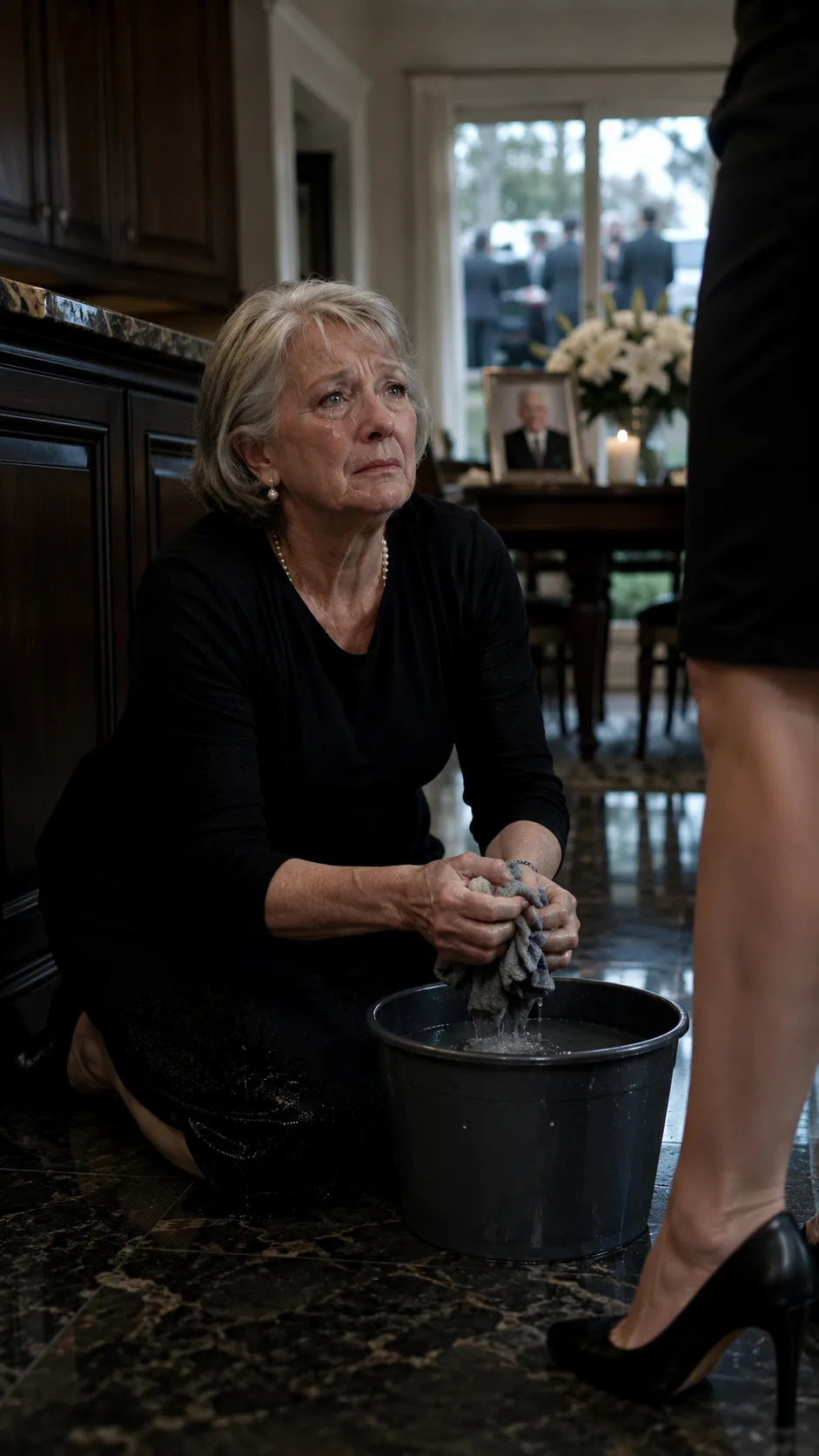
The nightmare that began with Jessica’s command to scrub a floor had reached its final hidden corner.
But there was still one person I needed to face.
A few days later, I visited Michael in jail.
He sat behind the glass in an orange uniform, looking smaller than I remembered. Not sorry. Just angry.
“You came,” he said.
“I came to say goodbye.”
His eyes narrowed.
“You are my mother.”
“I was your mother,” I said softly. “I loved the boy you were. But I do not know the man you became.”
He leaned toward the glass.
“You think William cares about you? He only feels guilty about Arthur.”
“William stood beside me when you tried to take everything from me.”
Michael’s face hardened.
“I needed help.”
“Your father helped you. We both did. You repaid him by choosing greed.”
“I did not put the pills in his hand.”
“No,” I said. “But you helped build the plan. You accepted the money. You were going to run.”
He looked away.
For the first time, I felt no urge to comfort him.
“You are no longer my responsibility,” I said. “Your father loved you until the end. I hope one day you understand what you destroyed.”
He smiled bitterly.
“You will regret abandoning me.”
I stood.
“No, Michael. I regret not seeing the truth sooner.”
I left that room lighter than I entered.
William waited outside with coffee.
“How do you feel?” he asked.
“Free,” I said, surprising myself. “For the first time in months, I feel free.”
The following weeks became a storm of hearings, statements, and headlines.
A life insurance scheme exposed.
A son accused in his father’s death.
A daughter-in-law’s lies unraveled.
Jessica accepted twenty-five years in exchange for testimony.
Brenda received twenty years for her role.
Frank Russo received thirty years for extortion, attempted harm, and related charges.
His men received long sentences too.
Michael received life imprisonment without the possibility of parole.
The charges were endless.
Premeditated murder.
Conspiracy.
Fraud.
Forgery.
The judge said he had rarely seen betrayal so calculated inside a family.
When the sentence was read, Michael looked at me, perhaps expecting tears, pleas, or mercy.
I gave him none.
I looked back calmly.
He had chosen his path.
Now he would live with it.
Three months after Arthur’s funeral, I finally had a quiet day.
William helped me renovate the house.
New locks.
A new security system.
Fresh paint.
Repaired doors.
Clean windows.
It felt like removing Jessica’s fingerprints from my life.
I stood in the garden, planting flowers beside Arthur’s rosebush, when Susan came through the gate carrying tres leches cake.
“My favorite,” I said.
She smiled.
“You look good, Margaret. Stronger.”
“I feel different,” I admitted. “As if I walked through fire and came out burned, but still standing.”
“Arthur would be proud.”
The tears came, but they were different now.
Not desperate.
Not helpless.
They were tears of memory.
Of gratitude.
Of love.
The insurance money was eventually released to me.
Two hundred thousand dollars.
I did not want it at first. It felt stained by everything that had happened. But William told me Arthur had paid those premiums for years to protect me.
“Use it,” he said. “Live well. Do something worthy of him.”
So I donated half to a rehabilitation center for people trapped by gambling addiction, hoping someone like Michael might be saved before reaching the point of no return.
The rest I divided between organizations helping victims of family manipulation and elder abuse.
People like me.
People who had been made to feel powerless by those who were supposed to love them.
William visited every week.
We became real family.
He told me stories about Arthur as a boy, before they were separated. I told him about the man Arthur became. In sharing those memories, we rebuilt the brotherhood that had been stolen from them.
Six months after the funeral, William arrived with a large box.
“I have something for you,” he said.
Inside was an oil painting.
Arthur and William together, painted from photographs.
Two brothers smiling, arms around each other’s shoulders, reunited in the only way still possible.
I cried when I saw it.
“It is perfect.”
We hung it above the fireplace.
Now, when I sit in the armchair where Arthur used to read the newspaper, I look at that portrait and feel peace.
Evil tried to destroy my family.
But it did not win.
Arthur’s love left clues.
His courage left a path.
His truth saved me.
On the first anniversary of his passing, William and I visited the cemetery together.
I brought fresh flowers.
I knelt beside Arthur’s grave and touched the stone.
“I miss you,” I whispered. “Every day.”
The breeze moved softly through the trees.
“I should have listened sooner. I should have seen more. But you protected me even when you were afraid. Thank you for loving me that much.”
William stood by the car, giving me time.
When I rose, he opened the door for me.
“Ready?” he asked.
I looked once more at Arthur’s name.
Then I nodded.
“Ready.”
That night, back in my home, I sat beneath the portrait of the two brothers.
The house was quiet.
Not empty.
Quiet.
There is a difference.
I had learned that family is not always the people who share your blood.
Sometimes family is the person who walks into a room, sees you on your knees, and decides your dignity matters.
Sometimes it is a neighbor carrying an old letter.
A lawyer telling the truth.
A friend bringing cake to your garden.
A brother who arrives thirty years late but still keeps his promise.
I learned that love leaves evidence.
In letters.
In hidden accounts.
In rosebushes.
In old photographs.
In the courage to speak when silence would be easier.
And I learned that justice may arrive late, but it does arrive.
Jessica paid.
Brenda paid.
Frank paid.
Michael paid.
I lost the love of my life.
I lost the son I thought I knew.
But I gained myself back.
I am Margaret Miller.
I am sixty-seven years old.
I am a widow.
I am a survivor.
And my story did not end with me crying on a kitchen floor.
It ended with me standing in my own house, under my husband’s portrait, finally free.
*** THE END.***
Chapter complete
You have reached the end of this chapter.
Continue reading
A few more worlds to get lost in after this chapter.




