PART 4 — MARIANNE, WHENEVER SHE PLEASES
Not the pretty kind of crying people do in movies with one tear and soft music.
Chapter 4
Not the pretty kind of crying people do in movies with one tear and soft music.
I cried the way older women cry when the house is finally quiet and nobody needs dinner, nobody needs manners, nobody needs a softened version of the truth.
I cried for Daniel.
I cried for the years we spent making that cottage beautiful enough for someone else to covet.
I cried for Bradley, who had become smaller in his marriage than I wanted to admit.
And yes, I cried for myself.
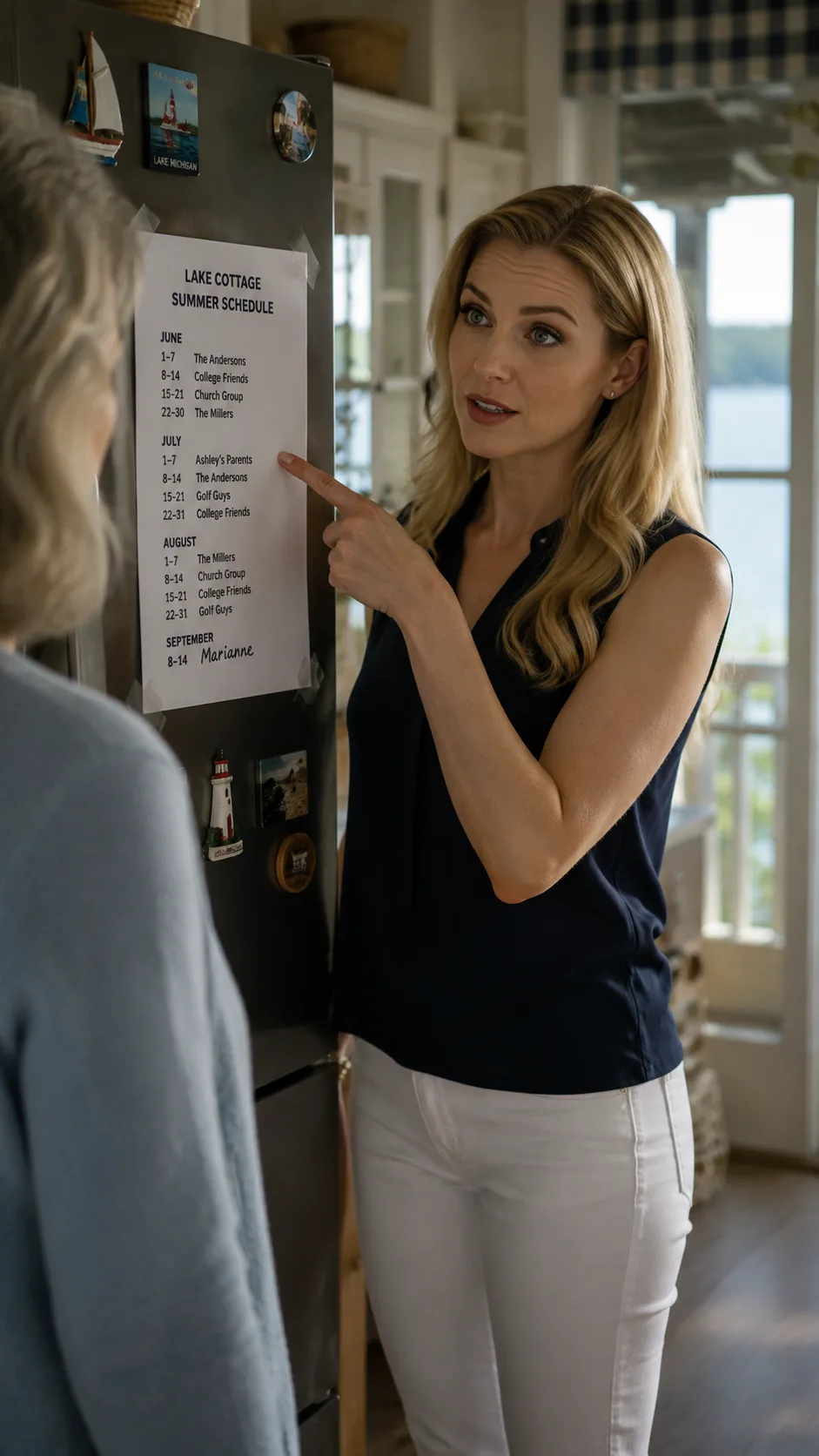
For standing in my own kitchen with my name in pencil.
The next morning was Sunday.
I woke early, as I always did at the cottage. Habit is stronger than age. Daniel used to say retirees woke early because they were afraid the day might start without them.
I made coffee in the old drip machine and drank it on the porch.
At eight-thirty, my phone buzzed.
A text from Bradley.
Mom, Ashley sent the refund list to Mr.
Fenwick. I know that doesn’t fix it. I’m sorry. I should have stopped this a long time ago.
I stared at the message.
Then another came.
She told people we were managing the cottage for you. I didn’t correct her. That’s on me.
I set the phone down.
That second message mattered more than the first.
A real apology does not hide behind “we.”
At ten, I went to church in town because I needed to sit somewhere no one expected me to explain myself. The little lakeside church had white walls, wooden pews, and a pastor who preached too long but meant well.
After the service, women gathered around folding tables with coffee and donut holes.
A woman named Carol, who owned a cottage two roads over, touched my arm.
“You all right, Marianne? You look tired.”
That was the thing about small communities. They noticed. They also pretended
not to, when kindness required it.
“I had a long Saturday.”
She nodded.
“Those happen.”
I almost told her everything.
I did not.
Not because I was ashamed.
Because the story was still settling inside me, and some truths need to become yours again before you let other people hold them.
When I returned to the cottage, there was a voicemail from Ashley’s mother.
Her voice was stiff.
“Marianne, this is Linda. Ashley told me there was a misunderstanding about the Fourth. I do wish you had spoken to us before involving legal paperwork. We’re family.”
I played it twice.
Then I deleted it.
Family.
People loved that word when they needed access.
They respected it less when it required boundaries.
By Monday, Richard had everything organized.
Ashley had collected “cleaning and supply contributions” from eight different people. The amounts were not enormous, but the principle was ugly. Two hundred
dollars here. Three hundred there. Enough to make people feel they had a right to show up with coolers and towels.
Richard made her return all of it.
He also sent a written notice to every name on the schedule, polite but firm. The property was private. No stays were authorized. Any future request had to come directly through Marianne Whitcomb.
By Wednesday, my phone stopped buzzing.
By Friday, the lake was quiet again.
Then came the Fourth of July.
For thirty-one years, that holiday had been Daniel’s favorite at the cottage. He loved the flags on porches, the smell of charcoal, the boats gathering offshore for fireworks. He loved corn on the cob and cheap paper plates and sitting on the dock with a sweatshirt after dark.
That morning, I woke expecting loneliness.
Instead, I felt room.
Not happiness exactly.
Room.
There is a difference between being alone because people pushed you aside and being alone because you chose peace.
I drove to the farm stand and bought cherries, sweet corn, tomatoes, and a small blueberry pie. At the grocery, I bought one steak because Daniel always said holidays deserved steak even if it was just the two of us.
When I came back, there was a car in the driveway.
For one sharp second, my body went cold.
Then I saw it was Carol from church.
She stood beside her Subaru holding a covered dish.
“I made too much potato salad,” she said.
I looked at the little glass bowl in her hands.
“No one makes too much potato salad by accident.”
She smiled.
“No. But some people know when to pretend.”
So she stayed.
Then Tom Haskins stopped by with two ears of corn and a story about his granddaughter’s softball tournament.
Then Mrs. Alvarez from three cottages down came over with lemonade because she had heard from Carol that I was “not doing much,” which was apparently old-lady code for needing company without being pitied.
By six o’clock, there were five of us on the deck.
No one sat in Daniel’s chair until I told Tom he could.
No one opened a cabinet without asking.
No one made me feel like a guest.
We ate off mismatched plates and watched the lake darken.
At dusk, fireworks began popping far down the shore.
My phone buzzed.
Bradley.
I almost ignored it.
Then I answered.
“Hi, Mom.”
His voice sounded rough.
“Hi.”
“I’m not calling to ask to come over.”
I appreciated that being his first sentence.
“Okay.”
“I just wanted to say happy Fourth.”
“Happy Fourth.”
A pause.
“I keep thinking about Dad.”
I looked at the empty place near the porch railing where Daniel used to stand with his hands in his pockets.
“So do I.”
“He would be ashamed of me.”
I closed my eyes.
This was the part motherhood makes hard. The child hurts you, then shows you his wound, and every instinct says cover it.
But I was learning.
“He would be disappointed,” I said. “Ashamed is something you decide what to do with.”
Bradley was quiet.
Then he said, “I don’t know how we got here.”
That sentence nearly softened me too much.
So I told the truth carefully.
“You got here one silence at a time.”
He breathed in.
“I know.”
“Do you?”
“Yes.”
Across the deck, Carol glanced over but politely looked away.
Bradley said, “Ashley and I are having some hard conversations.”
“I hope they are honest ones.”
“They are.”
I did not ask if Ashley was sorry.
Some questions are just invitations to be lied to.
Bradley cleared his throat.
“Could I come see you sometime? Just me. Not to stay. Just to talk.”
I watched a firework open red and gold over the lake.
“Not this weekend.”
“Okay.”
“Maybe next month. In Grand Rapids. Lunch somewhere neutral.”
“Neutral,” he repeated softly.
“Yes. Your mother is not a battlefield, and the cottage is not a negotiation table.”
He gave a broken little laugh.
“No. It’s not.”
After we hung up, I sat very still.
Carol touched my arm.
“You okay?”
I looked at the lake, the fireworks, the people sitting on my deck because they wanted my company, not my calendar.
“I think I am.”
Later that night, after everyone left and the dishes were washed, I took a fresh sheet of paper from the desk drawer.
I stood in front of the refrigerator.
For a while, I only looked at the clean white space where Ashley’s schedule had been.
The tape had left four faint marks.
I rubbed them away with warm water and the edge of a dish towel.
Then I wrote my own summer schedule.
Not in blue ink.
Not in pencil.
In Daniel’s old black pen.
July 5 — Coffee on porch.
July 6 — Read by lake.
July 7 — Replace porch fern.
July 8 — Do absolutely nothing.
I smiled.
Then, under September, I wrote:
Marianne — whenever she pleases.
I taped that paper to the fridge with one small magnet.
No clear tape.
No corners pinned down.
Nothing forced.
The following month, I met Bradley for lunch at a diner in Grand Rapids with cracked vinyl booths and waitresses who called everyone honey.
He looked older when he walked in.
Not dramatically. Just enough.
Guilt ages people differently than time does.
He kissed my cheek.
I let him.
Ashley was not with him.
We ordered coffee. He stirred his too long. I waited.
Finally, he said, “I let her take over because it was easier than fighting.”
I said nothing.
He looked at me.
“And because part of me liked not having to ask you. I liked feeling like we already had a claim.”
That honesty cost him something.
I could see it.
So I gave him respect, not rescue.
“Thank you for saying that.”
His eyes filled.
“I hate that I made you feel alone.”
“You did make me feel alone.”
“I know.”
Outside the diner window, traffic moved along the wet street. A man helped an older woman step around a puddle. Somewhere behind the counter, plates clattered.
Bradley took an envelope from his jacket.
“My key,” he said. “To your house in Grand Rapids. You gave it to me for emergencies. I don’t want any key from you until you trust me again.”
I looked at the envelope.
Then at my son.
That was the first moment I believed he might understand.
I did not take the envelope right away.
“Trust is not a porch light, Bradley. You don’t flip it back on because you’re sorry.”
“I know.”
“It’s more like that old dock your father rebuilt. One board at a time.”
He smiled through tears.
“Dad hated that dock.”
“No,” I said. “He loved complaining about that dock. Different thing.”
For the first time in months, we laughed like family.
Not fixed.
But real.
I took the envelope.
When lunch ended, Bradley walked me to my car. He did not ask about the cottage. He did not mention September. He did not ask if Ashley could apologize.
He simply said, “I’ll call next week.”
“Do that.”
And he did.
Not perfectly. Not every time with the right words. But he called.
Ashley sent a letter two weeks later.
Not a text.
A letter.
That surprised me.
Her handwriting was smaller than I expected, neat but pressed hard into the paper.
She said she was sorry for assuming.
She said she had let the compliments people gave her about “organizing everything” matter more than the fact that nothing belonged to her.
She said returning the money had been humiliating.
Then, to her credit, she wrote:
I needed to be humiliated. I had confused access with ownership.
I read that line three times.
I did not forgive her that day.
But I kept the letter.
Sometimes accountability begins as ink before it becomes behavior.
By late August, the cottage settled into itself again.
The mornings cooled. The lake grew moodier. The summer people started packing up their inflatable rafts and porch signs. School supplies appeared in grocery aisles. The roads quieted.
September came.
My penciled week.
The week Ashley had left me like a scrap.
On September eighth, I woke at the cottage before sunrise.
The air was cool enough for Daniel’s windbreaker. I made coffee and carried it down to the dock.
The boards creaked under my feet, solid now, rebuilt straight.
Mist hovered over the water.
For a moment, I could almost see Daniel at the end of the dock, hands in his pockets, shoulders slightly hunched against the morning chill.
“You were right,” I whispered.
The lake moved softly against the pilings.
I sat in the chair we kept near the water and watched the sun lift.
That week turned out to be beautiful.
Not leftover beautiful.
Not second-choice beautiful.
September beautiful.
Clear mornings. Empty beach. Soft light on the water. No screaming kids, no crowded restaurants, no one asking where the extra towels were.
Bradley came up one afternoon near the end of the month.
Alone.
He brought no cooler, no overnight bag, no expectation.
Just a small bunch of grocery-store flowers and a bag of cherries, though cherry season was long past and they were probably expensive and not very good.
“I know they’re not the same,” he said.
I took them anyway.
We sat on the porch.
For a while, we talked about ordinary things. His work. My neighbor’s knee surgery. The price of furnace filters. Safe subjects.
Then he looked toward the lake.
“I miss Dad here.”
“So do I.”
“I think I tried to act like having access to this place was the same as having him.”
That sentence opened something in me.
Not because it excused him.
Because it was true enough to be useful.
“You can miss your father without taking from your mother,” I said.
He nodded.
“I’m learning that.”
Before he left, he asked if he could walk down to the dock.
I said yes.
He did not ask for a key.
I watched him stand at the end, shoulders shaped like Daniel’s in the late sun, and I let myself feel both grief and love without forcing either one to win.
That is what no one tells you about family.
Sometimes the people who hurt you are not strangers with villain faces.
Sometimes they are your own child, weak in the wrong moment.
Sometimes they are your daughter-in-law, polished and smiling, convinced that if she uses the language of fairness, no one will notice the theft underneath.
And sometimes you are the older woman in the kitchen, expected to keep peace because everyone is counting on your manners.
But peace without dignity is just silence with better lighting.
I learned that from a piece of paper taped to my refrigerator.
I learned it from a county record.
I learned it from my husband’s letter.
Mostly, I learned it from the sound of my own voice when I finally stopped asking to be considered and started acting like the owner I had always been.
The cottage is still not fancy.
The porch boards need repainting again. The screen door still complains if you close it too fast. Sand finds its way inside no matter how often I sweep. In November, the wind off Lake Michigan still rattles the windows like loose teeth.
But the roof holds.
The dock stands straight.
The coffee tastes better on the porch than anywhere else in the world.
And on my refrigerator, there is still one small calendar.
Most of the squares are blank.
People who do not understand might think blank means empty.
I know better now.
Blank means open.
Blank means peaceful.
Blank means no one has written my name in pencil beneath everyone else’s plans.
Sometimes Bradley visits, when invited. He brings groceries, fixes what I ask him to fix, and leaves before dinner unless I ask him to stay. He is learning the difference between being welcome and assuming access.
Ashley has not been back to the cottage.
Not yet.
Maybe one day she will sit at my kitchen table and apologize without defending herself. Maybe one day I will believe her enough to pour coffee into a mug and listen.
But I am in no hurry.
At seventy-one, I no longer confuse urgency with importance.
I have paid enough bills, survived enough storms, buried the love of my life, and watched enough people mistake kindness for weakness to know this:
A home remembers who fought for it.
And so does a woman.
That summer, Ashley thought she had organized my cottage.
All she really did was remind me where I had put the papers.
THE END.
Chapter complete
You have reached the end of this chapter.
Continue reading
A few more worlds to get lost in after this chapter.