PART 2 — THE PAPERS DANIEL LEFT BEHIND
At first, Ashley was careful.
Chapter 2
PART 2 — THE PAPERS DANIEL LEFT BEHIND
At first, Ashley was careful.
She called the cottage “adorable.” She brought lemon bars the first summer and said she could see why Daniel loved the place. She took pictures of the porch, the lake, the little stone path, even the wooden fish sign Daniel had carved and hung near the back door.
Then the questions started.
“You really come up here alone?”
“You don’t get nervous in storms?”
“Do you think it’s too much for one person to maintain?”
I answered politely because that is how women of my generation were trained to survive uncomfortable conversations. We smiled. We poured coffee. We pretended not to hear the thing underneath the thing.
After Daniel died, the questions changed shape.
Ashley began saying “we” when she talked about the cottage.
“We should really update the upstairs bathroom.”
“We need better outdoor furniture.”
“We ought to think about a summer calendar so nobody overlaps.”
At first, I
let it pass.
Grief makes you tired in strange places. Not just your heart, but your spine. Your hands. The part of you that used to correct people.
Bradley was my only child. He had taken Daniel’s death hard, at least in the beginning. He cried at the funeral. He held my elbow at the cemetery. He came to the cottage the following spring and stood on the dock for a long time without speaking.
So when Ashley started organizing little things, I told myself she was helping.
She replaced the dish towels.
She bought matching baskets for the mudroom.
She labeled the shelves in the pantry.
I did not love the labels, but I swallowed my irritation. Younger women liked systems. Maybe that was all it was.
Then she asked for a key “just in case.”
Daniel had always said a spare key was like a spare promise. You
gave it only to someone who understood what it meant.
But Bradley was my son.
So I gave him one.
Not Ashley.
Bradley.
I remember pressing it into his palm on the porch. It was late May, the lake rough and gray behind him.
“This is for emergencies,” I said.
He kissed my cheek.
“Of course, Mom.”
That was three years before the schedule appeared on my refrigerator.
Three years was apparently all it took for “emergency” to become “everybody’s turn.”
Ashley had a gift for making selfishness sound practical.
Nobody was taking over. They were “making things fair.”
Nobody was using me. They were “keeping the cottage in the family.”
Nobody was pushing me aside. They were “helping me enjoy retirement.”
That Saturday morning, she arrived with Bradley a little after ten. I had just taken blueberry muffins out of the oven. The windows were open, and the lake
breeze moved the curtains over the sink.
I thought they had come for breakfast.
I was foolish enough to be pleased.
Bradley kissed my forehead and said, “Smells good.”
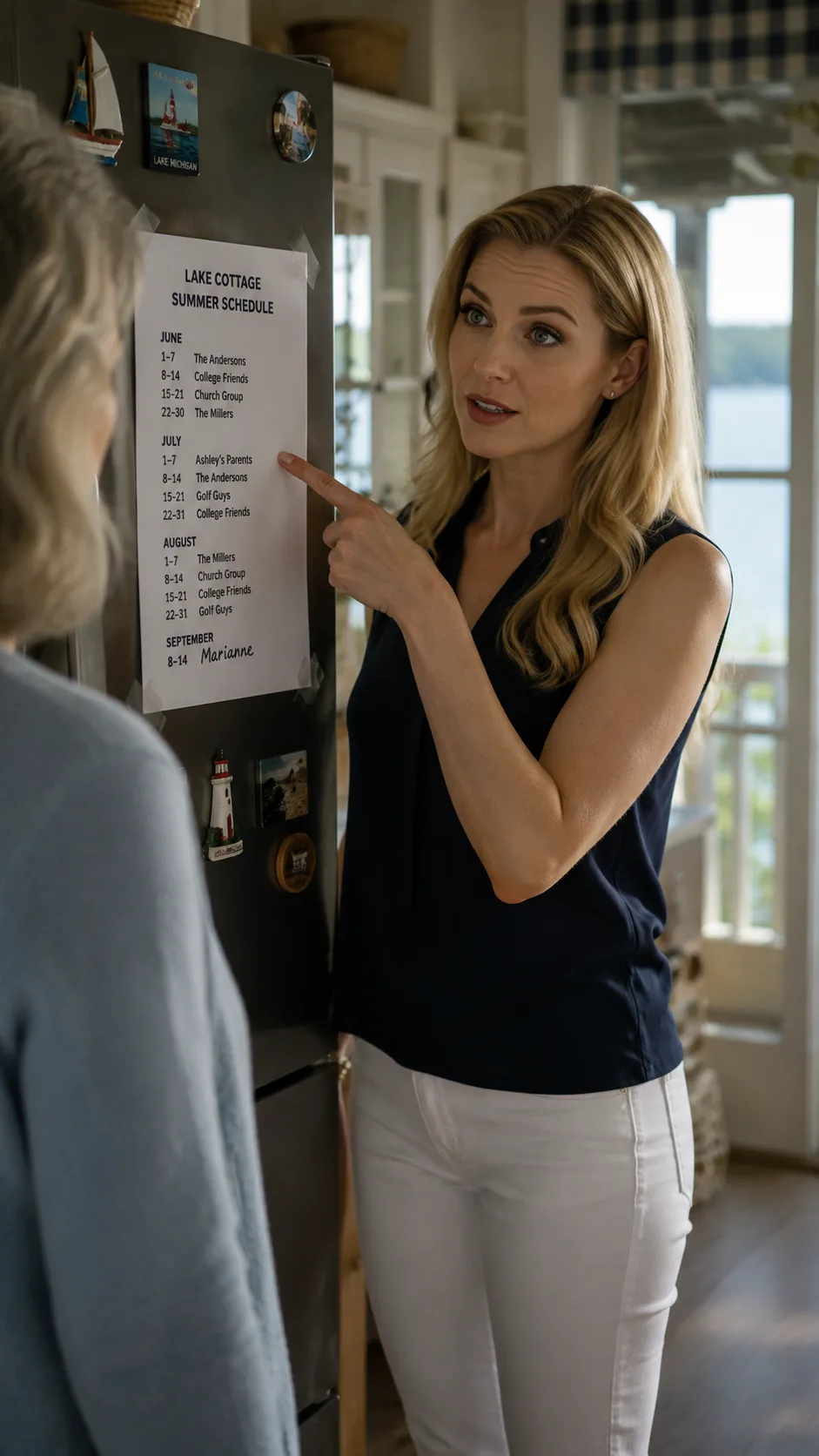
Ashley set a leather tote on the kitchen chair and pulled out a folder, the tape, and that printed calendar.
I watched her line it up on my refrigerator over a magnet from Traverse City and an old photo of Daniel holding a walleye.
“June is crazy,” Ashley said. “But I think this works.”
I stood with the oven mitt still on one hand.
“What works?”
“The cottage schedule.”
I looked at Bradley.
He kept his eyes on the lake.
Ashley spoke quickly, like a woman who believed speed could turn presumption into fact.
“My parents have been asking to come up for the Fourth forever, and Brad promised his golf friends a weekend last year, and the kids from our church youth program need a quiet retreat before school starts. It’s only four nights. They’re wonderful people.”
“The kids from your church,” I repeated.
“Well, the leadership team. Adults, mostly.” She smiled. “Don’t worry. I’ll make sure they understand the house rules.”
House rules.
My house.
My towels.
My husband’s coffee mug.
My name on the tax bill tucked in the desk drawer.
I felt a strange calm settle over me, the kind of calm that comes when shock has not caught up yet.
Ashley kept talking.
“And of course, you’ll have September. Honestly, that’s the nicest time for someone your age. Quieter. Less traffic. Cooler. No screaming kids on the beach.”
Someone your age.
Bradley shifted his weight.
I saw him hear it.
That was important later.
He heard it, and he still said nothing.
I stepped closer to the refrigerator.
My name looked small near the bottom. It had been written in pencil, not blue ink like everyone else.
I lifted my hand and touched the paper.
Ashley’s smile tightened.
“It’s fair,” she said. “You’re retired, Marianne. You can come anytime. The rest of us have schedules.”
The rest of us.
I had raised Bradley through ear infections, braces, baseball injuries, college applications, and that dreadful winter when Daniel was out of work for eleven weeks and we all pretended rice and beans were a fun dinner.
I had hosted Thanksgiving when Ashley’s mother “couldn’t handle the mess.”
I had mailed birthday checks to grandchildren who now mostly texted thank-you with no punctuation.
I had never once told them my time mattered less because I was older.
But there I was, standing in my own kitchen, being informed that everyone else had lives and I had leftovers.
I turned to Bradley again.
“Did you know about this?”
He opened his mouth.
Ashley answered for him.
“We discussed it as a family.”
I looked at him until he finally met my eyes.
His face had the soft, guilty look of a man hoping the women would settle things without requiring him to have a spine.
“Mom,” he said, “Ash put a lot of work into this.”
That sentence cracked something in me.
Not loudly.
Not all at once.
Just a quiet little snap in a place that had been bending for too long.
I thought of Daniel in that kitchen on a stormy October night years ago, sleeves rolled up, rainwater dripping into a bucket near the pantry, saying, “One day this place will be worth more than people think. Promise me you won’t let anybody make you feel like a guest here.”
I had laughed then.
“Who would?”
He had not laughed back.
Daniel saw things I did not want to see.
Maybe because he had grown up poor. Maybe because he knew how quickly family affection could become family expectation once property entered the room.
Ashley noticed my silence and gave a small laugh.
“Please don’t make this dramatic.”
There it was.
The little warning women use on older women when they want obedience wrapped in good manners.
I took the corner of the schedule and slowly peeled the tape away.
Ashley blinked.
“What are you doing?”
I removed the second piece of tape.
The paper loosened.
Bradley set his coffee down.
“Mom.”
I folded the schedule once.
Then again.
The creases made sharp lines through all those stolen weekends.
I put it into my purse.
“I won’t make it dramatic,” I said.
Ashley’s cheeks flushed.
“It’s just a calendar.”
“No,” I said. “It’s not.”
The kitchen went still except for the soft tick of the old wall clock and the gulls crying somewhere beyond the porch.
Ashley crossed her arms.
“Marianne, we are not trying to hurt you. We’re trying to keep this place from becoming a burden.”
“A burden to whom?”
“To everyone,” she said, too quickly. “You know what I mean.”
I did know.
That was the problem.
I had heard versions of it for three years.
The yard was too much for me.
The stairs were too steep.
The lake storms were dangerous.
The bills were complicated.
The cottage needed “younger energy.”
Funny how my age made me too fragile to make decisions, but not too fragile to keep paying the insurance.
I picked up my purse from the chair.
Bradley stepped toward me.
“Where are you going?”
“Into town.”
“Now?”
“Yes.”
Ashley gave him a look that said, Handle your mother.
Bradley lowered his voice.
“Mom, can we just talk about this?”
“We just did.”
“That wasn’t talking.”
“No,” I said. “That was informing. You both informed me.”
Ashley sighed, the way busy people sigh at slow cashiers.
“We can revisit September if that’s what this is about.”
I almost smiled.
She still thought I was bargaining for a better week.
That told me everything.
I walked past them into the mudroom and took Daniel’s old navy windbreaker from the hook. I did not need it. The day was warm. But his jacket still smelled faintly of cedar and lake air, and I wanted his courage close to my shoulders.
My car sat under the maple tree, dusty from the sandy road.
As I backed out, I saw Bradley standing on the porch with one hand raised halfway, like he might wave or stop me or apologize.
He did none of those things.
The drive into Ludington took twenty-five minutes.
It was the kind of Michigan summer day that tricks people into thinking life is simple. Blue sky. White clouds. Families towing boats. Kids licking ice cream outside a walk-up window. American flags lifting in the breeze outside cottages with screened porches and flower boxes.
I passed the little grocery where Daniel used to buy worms and cheap sunglasses. I passed the pharmacy where I filled his blood pressure pills. I passed the diner where we once split a piece of cherry pie because neither of us wanted a whole slice and both of us regretted sharing.
By the time I parked near the county building, my hands had stopped shaking.
The Mason County office was quiet for a Saturday service window, with fluorescent lights, beige floors, and a bulletin board covered in notices about property assessments, dog licenses, and public meetings.
A young clerk in a navy cardigan looked up from her computer.
“Can I help you?”
Her voice was kind.
That nearly undid me.
Cruelty is easier to meet with a straight back. Kindness can reach the bruise.
I took the folded schedule from my purse and set it on the counter.
Then I took out my driver’s license, the latest property tax receipt, and the old envelope Daniel had made me keep in the cottage desk drawer.
On the front, in his square handwriting, he had written:
For Marianne, if anyone ever forgets.
The clerk glanced at the envelope but did not ask.
Smart girl.
“I need current certified copies of the deed and any recorded trust documents tied to my property,” I said.
She typed the address.
The computer hummed softly.
Her expression shifted after a moment. Not shock, exactly. Recognition.
The kind of look people get when a few lines on a screen suddenly explain the woman standing in front of them.
“Whitcomb Cottage Trust?” she asked.
“Yes.”
“And you are Marianne Elaine Whitcomb?”
“Yes.”
She looked at my license again, then nodded.
“It may take me a few minutes to print everything cleanly.”
“I can wait.”
While she worked, I sat on a hard wooden bench beneath a framed photograph of the courthouse from 1912. Daniel would have liked that picture. He loved old buildings and old maps and anything built to outlast weather.
I ran my thumb over the edge of his envelope.
I had never opened it after his funeral.
Not really.
I knew what was inside in a general way. Our attorney, Richard Fenwick, had explained the documents. The cottage was in a trust. I was the sole trustee while I lived. Bradley was not an owner. Ashley was not an owner. No one had the right to rent it, schedule it, pledge it, list it, loan it, or restrict my access.
Daniel had insisted on plain language.
“Legal paper is only useful if Marianne can read it when she’s upset,” he told Richard.
Richard had chuckled.
Daniel had not.
After he got sick, he became almost stern about the cottage. At the time, I thought it was because he knew I would need the place after he was gone.
Now I wondered if he had seen Ashley’s hunger before I did.
The clerk returned with a small stack of papers and a yellow sticky note.
“I’m not an attorney,” she said carefully, “so I can’t advise you. But this is the recorded trustee certification. And this page here confirms sole authority.”
She tapped one line with her fingernail.
No person other than Marianne Elaine Whitcomb, Trustee, shall possess authority to convey, lease, assign, schedule, license, or restrict use of the property during her lifetime without her written consent.
I stared at the sentence until the words blurred.
Daniel.
Stubborn, careful Daniel.
Ugly places just needed someone stubborn enough to stay.
The clerk slid the sticky note toward me.
“You may want to call the attorney listed on the certification before you go back.”
On the note, she had written Richard Fenwick’s office number.
I almost told her I knew it by heart.
Instead, I thanked her.
Outside, I sat in my car with the windows down and called Richard.
He was mostly retired by then, but he still answered on the fourth ring.
“Fenwick.”
“Richard, it’s Marianne Whitcomb.”
His voice softened immediately.
“Marianne. Are you all right?”
That question did it.
I looked down at the folded schedule in my lap.
“No,” I said. “But I’m about to be.”
I told him everything.
I told him about the fridge calendar. Ashley’s parents. The golf friends. The church group. My name penciled in September. Bradley standing there, saying Ashley had worked hard.
Richard did not interrupt.
That was one reason Daniel trusted him.
When I finished, the line stayed quiet for a moment.
Then Richard said, “Do you still have Daniel’s envelope?”
“It’s in my hand.”
“Open it.”
I looked through the windshield at a family crossing the street with beach towels over their shoulders. A little girl skipped ahead in pink sandals.
I opened the envelope carefully.
Inside were three things.
A copy of the trust certification.
A signed cottage access agreement from six years earlier, when Bradley and Ashley had asked for a key.
And a letter from Daniel.
My name was written at the top.
Marianne,
If you are reading this because someone made you feel like you need permission to stand in our cottage, I want you to take a breath before you do anything else.
You do not need permission.
Not from Bradley. Not from his wife. Not from anybody with opinions and no receipts.
We paid for that place with tired backs and ordinary paychecks. You carried as much of it as I did. Maybe more.
Do not let politeness steal what sacrifice built.
Richard knows what to do.
I had to stop reading.
For a minute, I was not seventy-one years old in a parked car outside the county building. I was forty again, standing on a ladder beside Daniel, laughing because paint had dripped into his hair. I was fifty-six, sitting next to him on the dock with our shoes off. I was sixty-eight, holding his hand in a hospital bed while he whispered that he wished he could see the lake one more time.
“Marianne?” Richard said gently.
“I’m here.”
“Good. Listen to me. That access agreement Bradley and Ashley signed is very clear. Their key was permissive. Revocable. No scheduling. No guests without your written approval. No collecting fees. No organized groups. No restriction of your use.”
I closed my eyes.
“Collecting fees?”
“I don’t know if they did,” he said. “But the agreement forbids it either way. Do you have any indication?”
I thought of Ashley’s phrase: The rest of us have schedules.
I thought of the church group. The golf buddies. Her parents. The way she had looked so sure of herself.
“I don’t know,” I said.
“Then we won’t accuse. We will notify.”
Click the blue “PART 3” below to read the next part:
Chapter complete
You have reached the end of this chapter.
Continue reading
A few more worlds to get lost in after this chapter.