HER EX MOVED IN AS THE MANNY—THEN HER DAUGHTER CALLED HIM DAD
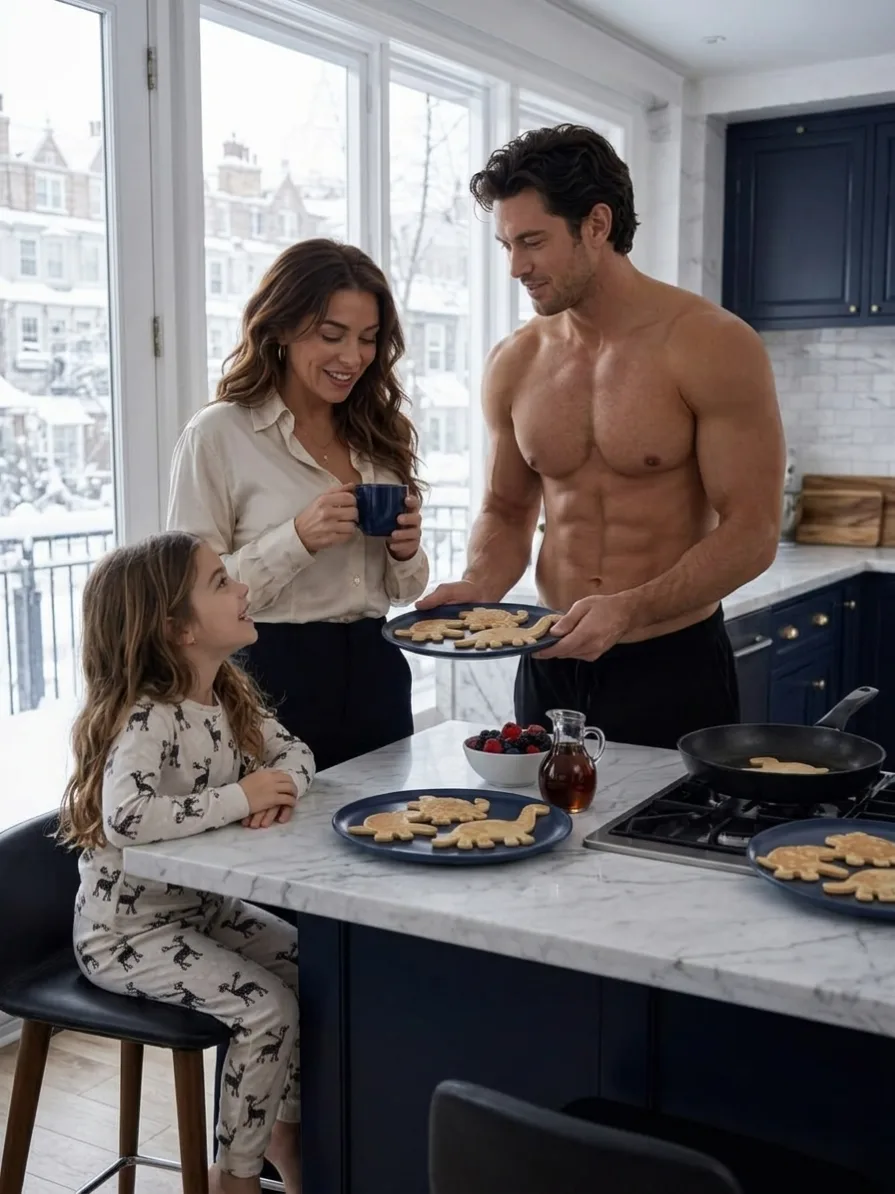
The first night my ex moved into my house, my seven-year-old daughter found him shirtless in the kitchen and asked if Santa had finally brought us a dad.
Chapter 1
The first night my ex moved into my house, my seven-year-old daughter found him shirtless in the kitchen and asked if Santa had finally brought us a dad.
I nearly inhaled a mouthful of coffee.
Max Calder looked down at his bare chest, then at the little girl wearing reindeer pajamas.
“I’m not sure,” he said solemnly. “Your mother returned me twelve years ago.”
Poppy gasped.
“Why?”
His eyes found mine across the kitchen.
“She thought I didn’t want a family.”
I tightened my grip on the mug.
“You said you didn’t.”
Max’s expression changed.
“No, Holly. I said I was afraid I’d destroy one.”
The room went silent.
Somewhere upstairs, my son shouted that the toilet was overflowing.
The smoke alarm began screaming.
And just like that, the man I had spent twelve years trying to forget was standing in the middle of my disaster, looking at me as though I had misunderstood the most important sentence of our lives.
The sensible thing would have been to ask him to leave.
Instead, I handed him a plunger.
That was how Max Calder became my live-in manny.
That was how Christmas ruined everything.
And that was how the man I had once exiled from my future became the center of my family.
Before Max arrived, my life operated at the precise point where chaos became a medical condition.
My alarm rang at three forty-five every morning.
By four fifteen, I was inside the kitchens of the Langford Hotel, turning butter, sugar, and flour into things wealthy people photographed before pretending not to count the calories.
By seven, I was calling my children to make sure they were awake.
By seven fifteen, I was calling again because they weren’t.
My son, Finn, was ten and considered clean socks a form of government oppression.
Poppy was seven, deeply theatrical, and unable to eat toast unless it had been cut into a
seasonal shape.
Their father, Daniel, was supposed to have them three mornings a week.
Daniel was also supposed to pay child support on time and remember school holidays.
Daniel’s relationship with responsibility was aspirational.
The nanny before Max lasted nine days.
She resigned after Finn’s pet gecko escaped into her handbag.
The nanny before her became an influencer and moved to Dubai.
The one before that said our household had “an emotionally unstable energy.”
She wasn’t wrong.
Two weeks before Christmas, Daniel canceled his entire holiday schedule because his new girlfriend had surprised him with a ski trip.
“You understand,” he said over the phone. “It’s nonrefundable.”
“I also produced two nonrefundable children.”
“That’s not the same.”
“No. Mine require food.”
“I’ll make it up to them.”
“You’ve been making it up to them for three years.”
He sighed as though I were the difficult one.
“Holly, don’t turn this
into a drama.”
I looked across the kitchen.
Finn was eating dry cereal from the box because we had no clean bowls. Poppy was cutting snowflakes from an electricity bill. Something in the oven smelled like melted plastic.
“I wouldn’t dream of competing with your personality.”
I ended the call.
Then my best friend, Tessa, sent me a message.
Found you a temporary manny. Qualified teacher. First-aid certified. Needs somewhere to stay through Christmas. Please don’t be weird about the fact he’s hot.
I responded:
I have not slept more than four consecutive hours since 2017. He could have antlers. Send him.
She sent the name.
Max Calder.
I stared at the screen until the letters blurred.
There were some names your body remembered before your brain permitted it.
Max.
The boy who had kissed me behind the cinema at nineteen.
The man who had known I hated thunderstorms and loved burnt toast.
The person I had planned to marry until I told him I wanted children and he said:
I can’t give you that life.
Three months later, I left.
A year after that, I married Daniel.
Twelve years later, Max arrived on my doorstep carrying a duffel bag, a toolbox, and the same devastating mouth.
He had changed.
Of course he had.
His shoulders were broader. His jaw was rougher. There were faint lines beside his eyes and a scar near his chin that I had never kissed.
Not that I intended to kiss anything.
He wore worn jeans, a dark jumper, and the expression of a man who knew exactly what his presence was doing to me.
“Holly.”
“Max.”
Behind me, the smoke alarm began shrieking.
He glanced past my shoulder.
“Are you cooking?”
“I’m a pastry chef.”
“That wasn’t my question.”
He walked in without waiting for permission, turned off the oven, and removed a plastic lunchbox Poppy had placed inside “to see if it would become a sleigh.”
Then Finn appeared holding the escaped gecko.
“Are you the manny?”
Max crouched.
“I’ve been called worse.”
“Can you play football?”
“Yes.”
“Can you make pancakes?”
“Excellent ones.”
“Can you defeat a crocodile?”
“Depends on the crocodile.”
Finn considered him.
“You’ll do.”
Poppy arrived next and looked him over with alarming seriousness.
“Are you married?”
“No.”
“Do you have a girlfriend?”
“No.”
“Why?”
Max’s eyes met mine.
“I made a mistake a long time ago.”
I folded my arms.
“You’ll stay in the spare room.”
His mouth tilted.
“Good to see you too.”
“This is temporary.”
“I understand.”
“You work for me.”
“I understand.”
“There will be boundaries.”
“Of course.”
He walked past me toward the stairs.
As he did, his shoulder brushed mine.
Every nerve in my body woke up furious.
Max glanced back.
“Which room?”
“The one at the end.”
“The one beside yours?”
“It was the only room available.”
His smile was slow and entirely inappropriate.
“Of course it was.”
That should have been my first warning.
The second arrived the next morning, when I found him shirtless in my kitchen.
Max claimed he had removed his shirt because Poppy had spilled orange juice on it.
I suspected he had removed it to destroy my remaining peace.
He stood at the stove making pancakes while December light moved across his back.
Twelve years had been extremely kind to Max Calder.
His body had once been lean and beautiful.
Now it was broad, muscled, and covered in enough ink to make me wonder what else had happened while I was gone.
Not gone.
Living.
Marrying someone else.
Having children with someone else.
I had made my choice.
So why did seeing him in my kitchen feel like discovering my old life had continued without me?
“You’re staring,” Max said.
“I’m assessing an employee uniform violation.”
“I’m not wearing a uniform.”
“That’s becoming alarmingly obvious.”
He turned, spatula in hand.
“You could ask me to put on a shirt.”
“Put on a shirt.”
His eyes held mine.
“Ask nicely.”
“I pay you.”
“You barely pay me.”
“I provide accommodation.”
“In a room beside yours.”
Heat climbed my neck.
“That is geography, not seduction.”
“Everything sounds dirty when you say it while looking at my chest.”
“I am not looking at your chest.”
Poppy entered wearing one sock.
“You are.”
I closed my eyes.
Max laughed.
I had forgotten that laugh.
Deep, warm, slightly crooked.
It had once been the safest sound in my world.
Poppy climbed onto a chair.
“Max made dinosaur pancakes.”
“Traitor,” I muttered.
“I heard that,” Finn called from the hallway.
“I meant Max.”
“I know.”
Within four days, Max had transformed our mornings.
Uniforms appeared before anyone asked.
Lunches contained actual fruit.
The children reached school before the doors closed.
He repaired the loose stair rail, cleaned the refrigerator, and created a chart that somehow convinced Finn to brush his teeth without negotiating hostage terms.
He was annoyingly competent.
Worse, he remembered me.
On the fifth morning, he handed me a travel mug as I rushed toward the door.
I took one sip and stopped.
Tea. Strong. One sugar. A small splash of milk.
Exactly right.
“You remember?”
Max leaned against the counter.
“I remember everything.”
His voice had lost its teasing edge.
“That’s the problem.”
For one dangerous moment, neither of us moved.
Then Finn called from upstairs.
“Max! Poppy glued her hand to the angel costume!”
Max sighed.
“Coming.”
He walked away.
I stood in the kitchen holding a cup made by a man who had not forgotten how I took my tea in twelve years.
Daniel had forgotten our anniversary while we were still married.
It was not a comparison I wanted to make.
My mind made it anyway.
The first week might have remained manageable if Max had been bad with the children.
He wasn’t.
Poppy adored him because he listened to every story as though each one had a plot.
Finn admired him because Max never spoke to him like a little boy.
When Finn asked how to respond to a classmate who called him “weird,” Max didn’t say to ignore it.
He asked, “Do you think you’re weird?”
Finn shrugged.
“I like insects.”
“That doesn’t answer the question.”
“Yes.”
Max nodded.
“Good.”
Finn frowned.
“Good?”
“Normal is a setting on a washing machine.”
Poppy looked up from her drawing.
“What’s abnormal?”
“Your mother’s bedtime rules.”
I threw a tea towel at his head.
The children laughed.
And for the first time in years, our house sounded less like a place I was failing to manage and more like a home.
That terrified me.
So I created stricter rules.
No family photographs with Max.
No pretending he was anything more than an employee.
No interfering with my dating life.
That final rule became relevant when Marcus Whitfield asked me to dinner.
Marcus was a divorced architect with excellent teeth and the emotional energy of an expensive waiting room.
We had met twice for coffee. He was pleasant, stable, and unable to provoke any physical reaction stronger than mild gratitude.
Exactly what I needed.
I came downstairs wearing a green dress and found Max decorating the Christmas tree with the children.
He looked at me.
Then he stopped moving.
Finn followed his gaze.
“Mum has a date.”
“So I gathered,” Max said.
His voice was flat.
Poppy frowned.
“Are you marrying him?”
“No.”
“Then why are you wearing shiny legs?”
“They’re tights.”
Max’s gaze moved slowly down those tights.
My body remembered far too much.
I picked up my coat.
“I’ll be back by eleven.”
“Will you?” Max asked.
I glared at him.
“Is that a childcare question?”
“No.”
“Then it’s none of your business.”
His jaw tightened.
“Understood.”
Marcus arrived carrying flowers.
Max opened the door before I could reach it.
They looked at each other.
Men could conduct entire wars without changing their expressions.
Marcus extended his hand.
“Marcus.”
“Max.”
“Friend of Holly’s?”
“Something like that.”
“He’s the manny,” I said quickly.
Max’s eyes cut to mine.
Marcus smiled.
“Good for you. More men should enter caregiving roles.”
Max returned the smile.
It wasn’t friendly.
“More men should.”
He took my coat and held it open.
As I slipped my arms inside, his fingers brushed the back of my neck.
A shiver moved through me.
Marcus noticed.
Max noticed him noticing.
“Have her home by eleven,” Max said.
I turned.
“I am not sixteen.”
“No.”
His eyes moved over me.
“You definitely are not.”
The date lasted ninety minutes.
Marcus spoke about sustainable roofing while I wondered whether Max was still wearing the gray shirt that fitted too tightly across his shoulders.
When Marcus leaned across the table and asked whether I wanted dessert, I said no.
I was a pastry chef.
I always wanted dessert.
That was how I knew the date was doomed.
When I returned home, the lights were low.
Max sat alone near the Christmas tree.
“You’re early.”
“You’re awake.”
“I live here.”
“You work here.”
His gaze lifted.
“There’s that fence again.”
“What fence?”
“The one you put up every time you remember we used to love each other.”
My heart stumbled.
“We were twenty-four.”
“I was twenty-five.”
“Ancient.”
“I knew what I felt.”
“You knew you didn’t want children.”
Max stood.
The room changed.
“I told you I was terrified of becoming my father.”
“You said you couldn’t give me a family.”
“At twenty-five.”
“You never said you might change.”
“You never gave me the chance.”
I laughed in disbelief.
“I waited six months.”
“You moved out after three.”
“Because every time I brought up the future, you shut down.”
“Yes.”
His voice rose for the first time.
“I was wrong.”
The admission silenced me.
Max dragged a hand through his hair.
“I thought if I said no firmly enough, I could stop you from waiting for me. I thought I was protecting you.”
“Men love deciding what women need for their own protection.”
He flinched.
“You’re right.”
I hated how easily he said it.
I wanted him defensive. Arrogant. Unchanged.
Instead, he looked like a man who had spent twelve years learning the shape of his mistake.
“You married Daniel less than a year later,” he said.
“That has nothing to do with this.”
“It had everything to do with this.”
His voice dropped.
“I watched you build the life I thought I would poison.”
My anger faltered.
“Max…”
“You had two children. Christmas cards. A house. Photographs of family holidays.”
“You watched me?”
“I tried not to.”
Pain moved across his face.
“I was outside the life I wanted before I understood I wanted it.”
The room felt too small.
“Why didn’t you call?”
“Because you looked happy.”
I almost laughed.
Not because it was funny.
Because sadness sometimes emerged wearing the wrong face.
“You should know better than anyone,” I whispered, “that photographs lie.”
Max stepped toward me.
“And you should know better than anyone that silence does too.”
We stood an arm’s length apart.
Twelve years filled the space between us.
Then Poppy appeared on the stairs holding her blanket.
“Mum, I feel sick.”
Every old wound vanished beneath the immediate terror of motherhood.
I ran to her.
Max was beside me before I reached the first step.
Poppy had a stomach virus.
By two in the morning, Finn was sick too.
By four, I was sitting on the bathroom floor with a bucket in one hand and Poppy’s hair in the other.
Max cleaned sheets, fetched water, and disinfected every surface without being asked.
Daniel did not answer his phone.
At six, Max found me shaking beside Poppy’s bed.
“You’re freezing.”
“I’m fine.”
“You have a fever.”
“I have work in an hour.”
“You’re not going.”
“It’s the hotel’s Christmas tasting.”
“You can’t stand.”
“I can stand.”
I attempted to prove it.
The room tilted.
Max caught me before I hit the floor.
His arms closed around me.
Every part of my body recognized him.
“Put me down.”
“No.”
“I’m your employer.”
“You’re delirious.”
“Still technically in charge.”
“You once tried to fight a parking meter while feverish.”
“It stole my money.”
“It was out of order.”
“A criminal defense.”
He carried me to my bedroom.
Being held by him should have felt embarrassing.
Instead, it felt like returning to a place I had once known in the dark.
He put me under the blankets and brought medicine, water, and the old ceramic bowl I always used when sick.
I stared at it.
“You found that?”
“Bottom cupboard.”
“You remember?”
“You used to refuse every other bowl because that one was blue.”
“I was twenty-two.”
“You were difficult at twenty-two.”
“I’m difficult now.”
His gaze softened.
“I know.”
I woke an hour later shaking violently.
Max sat in the chair beside the bed.
“Cold,” I whispered.
He added another blanket.
It wasn’t enough.
My teeth chattered.
He touched my forehead, then started to stand.
I caught his wrist.
“Stay.”
He froze.
“I’m here.”
“No.”
My fever had destroyed the small remaining part of my judgment.
“Come here.”
His eyes searched mine.
“Holly, you’re ill.”
“I’m cold.”
He understood.
Too quickly.
Max removed his shoes and climbed onto the bed above the blankets, keeping his body carefully apart from mine.
It didn’t help.
“Closer,” I whispered.
His jaw tightened.
“You may hate me tomorrow.”
“I’ve had twelve years of practice.”
A broken laugh left him.
Then he moved behind me.
His body curled around mine through the blankets. Heat surrounded me. His arm rested lightly at my waist, loose enough for me to move away.
I didn’t.
I moved closer.
Max stopped breathing.
“You smell the same,” I murmured.
“You have a fever.”
“That isn’t an answer.”
His mouth was near my hair.
“So do you.”
The room went quiet.
“You left the morning after I told you,” I whispered.
“I know.”
“I waited for you to stop me.”
His arm tightened slightly.
“I waited for you to turn around.”
Tears filled my eyes.
“You didn’t say anything.”
“Neither did you.”
There it was.
The tragedy of us.
Two proud people standing on opposite sides of a departure, each mistaking the other’s silence for certainty.
“I thought you didn’t love me enough,” I said.
Max’s breath shook.
“I loved you so much I thought letting you go was the decent thing.”
“That was stupid.”
“The stupidest thing I’ve ever done.”
I turned inside his arms.
Our faces were inches apart.
His eyes moved to my mouth.
Mine did the same.
“Max.”
He closed his eyes.
“You’re sick.”
“I’m aware.”
“You’re vulnerable.”
“I’m also thirty-six and capable of consent.”
His gaze darkened.
“But you are ill.”
The restraint in his voice wrapped around me more securely than his body.
He touched my cheek.
“When I kiss you again, you’ll be healthy enough to regret it properly.”
I should have been offended.
Instead, I fell asleep smiling against his chest.
The mean mothers appeared at the school Christmas market.
Every school had them.
Women who wore cream coats around children holding hot chocolate. Women whose hair remained smooth in rain. Women who volunteered for charity events primarily to photograph themselves volunteering.
Their leader was Amelia Harcourt.
Amelia had disliked me since I refused to create six hundred free macarons for a fundraiser she described as “good exposure.”
She found me beside the tombola stall.
“Holly, darling.”
Nothing good ever followed darling in that tone.
“I heard Daniel canceled Christmas with the children.”
“News travels.”
“People worry.”
“No, people gossip. Worry usually brings casseroles.”
Her friends laughed behind gloved hands.
Amelia glanced toward Max, who was helping Finn set up a game.
“And you hired a male nanny.”
“I did.”
“How progressive.”
“I try.”
“He’s certainly… attentive.”
Her gaze lingered on him.
Jealousy flashed through me before I could stop it.
Amelia noticed.
Of course she did.
“Isn’t it confusing for the children?” she asked. “Men moving in and out?”
The cruelty was wrapped in concern.
I opened my mouth.
Max appeared beside me.
His arm slid around my waist.
He did it slowly enough that I could move away.
I didn’t.
“Moving out would be difficult,” he said. “Holly’s become very attached.”
Amelia blinked.
“To your services?”
Max’s hand settled against my hip.
My pulse jumped.
“To several things.”
The women went silent.
I turned toward him.
His face was perfectly innocent.
“Max.”
“Yes, love?”
That single word hit like a match.
Amelia’s eyes narrowed.
“I thought you were the nanny.”
“Manny,” Max corrected. “Although my duties recently expanded.”
His fingers moved once against my waist.
A tiny, devastating touch.
“Expanded how?” Amelia asked.
He looked at me.
“Should I tell her?”
“No.”
“Wise.”
He lowered his mouth toward my ear.
“She’s very private.”
Amelia left three minutes later.
The moment she was out of sight, I pushed Max behind a wooden stall.
“What was that?”
“You looked cornered.”
“So you groped me?”
His eyebrows lifted.
“I placed my hand on your waist.”
“Your thumb was doing things.”
“My thumb has independent ambitions.”
I tried not to laugh.
Failed.
His expression softened.
Then the humor vanished.
“You didn’t tell me Daniel canceled Christmas.”
“It wasn’t relevant.”
“It’s relevant to Finn and Poppy.”
“I’m handling it.”
“You don’t have to handle everything alone.”
The sentence irritated me because I wanted to believe it.
“I did for years.”
“I know.”
“Stop saying that.”
“What?”
“That you know. You don’t.”
Max stepped closer.
“I know Daniel missed Finn’s football final. I know Poppy stopped asking when he was coming because being disappointed exhausted her.”
My throat tightened.
“I know you’re working yourself sick because asking for help feels like admitting you chose the wrong life.”
The words struck deep.
“You have no right.”
“No.”
His voice softened.
“But I’m still right.”
I hated him for that.
I hated myself more for wanting to lean into him.
“Was all that just for Amelia?” I asked.
His gaze dropped to my mouth.
“No.”
The noise of the market faded around us.
“Then why did you do it?”
“Because she was looking at you like you were unwanted.”
He moved closer.
“And I wanted her to understand how wrong she was.”
My heart pounded.
“Max…”
“I also disliked the way she looked at me.”
I stared.
“You were jealous on my date.”
“Yes.”
“You’ve been unbearable since.”
“Yes.”
“You don’t get to act like my boyfriend.”
His hand rose, brushing a strand of hair from my face.
“Then stop looking at me like you remember how.”
His mouth hovered near mine.
I could have kissed him.
I wanted to.
Then Finn shouted from across the field.
“Max!”
We sprang apart.
Finn stood beside a knocked-over table.
A larger boy was laughing while Poppy cried.
Max’s entire body changed.
He crossed the distance in seconds.
The boy’s name was Tyler Grant.
He was eleven, large for his age, and had spent months calling Finn strange because Finn preferred insects and astronomy to football.
That afternoon, he knocked Finn’s handmade solar-system model into the mud.
Finn punched him.
By the time I reached them, a teacher was separating the boys.
Tyler’s mother demanded Finn be suspended.
Finn stared at the ground, fists clenched.
“What happened?” I asked.
“He hit my son,” Tyler’s mother said.
“I asked Finn.”
My son said nothing.
Max crouched beside him.
“Look at me.”
Finn’s chin trembled.
Max waited.
Finally, Finn whispered, “He said Dad left because I’m weird.”
My heart broke.
Tyler’s mother flushed.
“I’m sure he misunderstood.”
“I didn’t,” Finn said.
Max’s voice remained calm.
“Did you hit him because of what he said?”
Finn nodded.
“Was that the best choice?”
“No.”
“Were you wrong to be angry?”
Finn looked confused.
“No?”
“No.”
Max rested a hand on his own knee, not touching Finn without invitation.
“You’re allowed to be angry. But hitting gives someone else control over what happens next.”
Finn looked at Tyler.
“He deserved it.”
“Maybe.”
Tyler’s mother gasped.
Max continued.
“But you deserve better than becoming cruel because someone else was cruel first.”
Finn’s shoulders lowered.
The school gave both boys detention and required apologies.
In the car, Finn was silent.
Then he said, “Dad did leave because of me.”
“No,” I said immediately.
“He went skiing instead of having Christmas.”
“That is a decision about him. Not you.”
Finn looked at Max in the front seat.
“Would you leave?”
The question sucked all the air from the car.
Max looked at me in the mirror.
Then he turned toward Finn.
“I won’t lie to you.”
My stomach tightened.
“I don’t know what happens after Christmas,” Max said. “Your mum hired me temporarily.”
Finn looked down.
“But,” Max continued, “adults should not make children promises they haven’t discussed.”
His eyes met mine again.
“And adults should never disappear without saying goodbye.”
The words were for Finn.
They were also for me.
“I can promise this,” he said. “You did nothing to make your father unreliable. You cannot earn someone’s staying by becoming less yourself.”
Finn wiped his eyes.
“Even if I’m weird?”
“Especially then.”
That night, I stood outside Max’s bedroom for ten minutes before knocking.
He opened the door wearing low sweatpants and nothing else.
Of course.
“Do you own shirts?”
“Several.”
“Could you develop an interest in them?”
“No.”
I tried to remember why I was there.
“Thank you for today.”
His expression softened.
“Finn’s a good kid.”
“He listens to you.”
“He listens to you too.”
“Not like that.”
“You’re his mother. Children save their worst behavior for the people they trust most.”
“That sounds invented.”
“It is. But it’s probably true.”
I laughed quietly.
Then neither of us spoke.
“I heard what you said in the car,” I whispered.
“I assumed.”
“You won’t disappear.”
“No.”
“Why?”
Max leaned against the doorframe.
“Do you want the safe answer or the true one?”
“The true one.”
“Because I’m already attached.”
My heart began beating too fast.
“To the children?”
“Yes.”
Something in my face must have changed.
His eyes darkened.
“And to their mother.”
I took one step closer.
“Max…”
“You don’t get to ask for honesty and then look frightened when I give it.”
“I’m not frightened.”
“You are.”
He touched my wrist.
“Your pulse always gives you away.”
“You remember that too?”
“I told you.”
His thumb moved against my skin.
“I remember everything.”
I kissed him.
No judge.
No mean mothers.
No fever.
No one to convince.
Max froze for half a heartbeat.
Then his hands came to my waist.
He pulled me into his room and kissed me like twelve years had been waiting behind his teeth.
His mouth was familiar and entirely new.
I gripped his shoulders. He backed me against the door, then stopped abruptly.
“Tell me.”
“What?”
“That you want this.”
I stared at the man who had once let silence speak for both of us.
“I want this.”
“Tomorrow too?”
“Yes.”
His forehead touched mine.
“You have no idea how long I’ve waited to hear you say that.”
I kissed him again.
Later, lying beside him beneath tangled blankets, I felt more terrified than I had before entering his room.
Because desire was easy.
Morning was the dangerous part.
Morning demanded a name for what we had done.
Poppy found us at six twenty.
She opened the bedroom door, saw me under Max’s blanket, and grinned.
“I knew it.”
I bolted upright.
“Why are you awake?”
“Finn said you were missing.”
Max pulled a pillow over his face.
“I was not missing.”
“You were in Max’s bed.”
“Yes.”
“Why?”
I opened my mouth.
Nothing emerged.
Max lowered the pillow.
“Your mum got cold again.”
Poppy looked delighted.
“Did you warm her with your body?”
I wished for death.
Max coughed into the pillow.
“Breakfast,” I announced. “Immediately.”
At the table, Finn stared at us with the weary expression of a child who understood too much.
“Are you dating now?”
“No,” I said.
“Yes,” Max said.
I kicked him under the table.
Poppy gasped.
“Can we have matching pajamas?”
“No,” I said.
“Absolutely not,” Max agreed.
Finn looked at him.
“Are you still leaving after Christmas?”
Silence fell.
Max did not look at me this time.
“That depends on your mum.”
Four faces turned toward me.
Pressure rose in my chest.
This was exactly what I had feared.
The children were attached.
Max was attached.
And I had no idea whether he wanted a family or simply wanted us because we were temporarily available.
“We need to discuss that privately,” I said.
After school drop-off, I confronted him in the kitchen.
“You shouldn’t have said it depends on me.”
“It does.”
“You’re employed until January.”
“I’m not discussing employment.”
“You came here because you needed somewhere to stay.”
“And you needed childcare.”
“Exactly.”
“That stopped being the whole truth weeks ago.”
I wrapped my arms around myself.
“What happens when you remember you never wanted children?”
Pain flashed across his face.
“There it is.”
“What?”
“The same sentence you decided for me twelve years ago.”
“You said it.”
“I said it then.”
“You don’t get to revise history because you like dinosaur pancakes.”
He went very still.
“This isn’t about pancakes.”
“Then what is it about?”
“Years of therapy.”
The answer stopped me.
Max leaned against the counter.
“My father hated being a parent. He reminded me every day that I had ruined his life.”
I knew parts of this.
Not all.
“I thought the cruelty was inside me too,” he continued. “I believed wanting children would make me selfish because eventually I would resent them.”
His voice tightened.
“Then my sister died.”
I stared at him.
I had heard about the accident five years earlier.
I had sent a card.
He had never responded.
“Her daughter came to live with me,” he said. “Sophie was thirteen. Angry. Grieving. She barely spoke for months.”
“You raised her?”
“I helped.”
His eyes held mine.
“She’s at university now. She calls me when she’s frightened. She comes home for Christmas. She is not mine, but loving her changed what I believed about myself.”
My throat tightened.
“Why didn’t you tell me?”
“When?”
The question was gentle.
“During your marriage? After your divorce, when you ignored my message? At the school gate while you were trying not to look at me?”
“I didn’t know.”
“No.”
He came closer.
“You didn’t ask.”
That hurt because it was true.
“I won’t tell you I want a family simply because I want you,” he said. “That would be another performance.”
His voice deepened.
“I want the noise. The interruptions. Finn leaving science projects everywhere. Poppy climbing into bed at dawn. I want to argue with you about discipline and burn pancakes on Saturdays.”
My eyes filled.
“I want this family.”
His hand touched my cheek.
“But wanting it does not make me their father. And loving them does not give me the right to step into that role without time, trust, and your consent.”
A tear slipped free.
Max wiped it away.
“I changed, Holly.”
His voice cracked.
“The tragedy is that you weren’t there to see it.”
I stepped back.
“And the tragedy for me is that I don’t know whether I can survive believing you.”
He lowered his hand.
“Then don’t decide today.”
But we both knew Christmas was approaching.
And temporary arrangements always came with endings.
Three days before Christmas, Max received a call.
I heard only part of it.
“January?”
A pause.
“New Zealand is a long way.”
Another pause.
“Yes. I understand.”
He saw me in the hallway and turned away.
That evening, I found an email open on the kitchen tablet.
DIRECTOR OF YOUTH PROGRAMS — WELLINGTON
A job offer.
A good one.
Housing included.
Start date: January fifteenth.
My chest hollowed out.
He had known.
Maybe before he kissed me.
Maybe before he told the children he was attached.
I did what I had always done when terrified.
I decided the ending before he could.
At dinner, I said, “You should take the job.”
Max stopped eating.
Finn looked between us.
“What job?”
“Nothing,” Max said.
“It’s not nothing,” I replied. “It’s in New Zealand.”
Poppy’s face fell.
“You’re leaving?”
Max’s eyes remained on me.
“I haven’t decided.”
“You should.”
“Holly.”
“It’s an excellent opportunity.”
Finn pushed back his chair and left.
Poppy followed, crying.
Max waited until their doors slammed upstairs.
Then he stood.
“What the hell are you doing?”
“I’m being realistic.”
“You’re making the decision for all of us.”
“There is no all of us.”
The words emerged sharp and terrified.
Max looked as if I had struck him.
“This was temporary,” I continued. “You needed somewhere to stay. I needed help.”
“And everything since?”
“A mistake.”
His face closed.
I hated myself immediately.
But fear kept talking.
“The children are confused. I’m confused. The sooner we return to reality, the better.”
Max stared at me for a long moment.
Then he nodded.
“There it is.”
“What?”
“The door closing.”
He stepped closer.
“Twelve years ago, I watched you leave because I thought loving you meant letting you choose.”
His voice shook.
“This time, I’m going to say it clearly.”
My heart pounded.
“I love you.”
I closed my eyes.
“I love Finn. I love Poppy. I want to stay.”
“Then why apply for New Zealand?”
“I applied eight months ago.”
He gestured toward the tablet.
“They finally responded.”
“You didn’t tell me.”
“I received the offer today.”
“You were considering it.”
“I was considering how to turn it down without setting fire to my professional life.”
I opened my eyes.
Max’s face was full of fury and hurt.
“You saw one line of one conversation and decided I had already left.”
“You always wanted a life beyond this town.”
“I wanted a life that meant something.”
He looked toward the stairs.
“This means something.”
I wanted to believe him.
That was the problem.
Belief made loss possible.
“What happens when family becomes difficult?” I asked. “When Finn gets suspended? When Poppy hates you at thirteen? When I’m exhausted and unfair?”
“Then it becomes difficult.”
“And you stay?”
“I stay.”
“You can’t promise that.”
“No one can promise a feeling.”
His voice softened.
“But I can promise what I do with it.”
Tears burned my eyes.
“You left before.”
“No.”
He shook his head.
“You did.”
The words landed hard.
“You packed. You moved out. You married someone else.”
“You told me there was no future.”
“And instead of asking what I meant, you exiled me from yours.”
The title/theme lands. We need continue.
Silence filled the kitchen.
Max picked up his suitcase from beside the stairs.
I hadn’t noticed it there.
“You packed?”
“I’m going to Tessa’s.”
Panic rose.
“You said you wouldn’t disappear.”
“I’m not.”
He held my gaze.
“I’m telling you where I’m going. I’m telling the children goodbye. And I’m giving you space because staying in this house while you call us a mistake will destroy me.”
He went upstairs.
I stood alone in the kitchen while the Christmas lights blinked around me.
For the first time, I understood what I had done twelve years ago.
I had mistaken fear for certainty.
And now I was doing it again.
Christmas Eve arrived without Max.
The house felt wrong.
Finn barely spoke.
Poppy refused to hang Max’s stocking.
“It’s stupid,” she said.
“It has his name on it.”
“He doesn’t live here.”
The words hurt because they sounded like mine.
Daniel called at noon from a ski resort.
He spoke to the children for six minutes.
When Finn asked when he was coming home, Daniel said, “We’ll plan something amazing in January.”
After the call, Finn carried his plate upstairs.
I found him packing the green jumper Max had given him into a backpack.
“What are you doing?”
“I’m going to find him.”
“You can’t walk to Tessa’s.”
“Then drive me.”
“Finn—”
“You made him leave.”
The accusation was quiet.
More devastating than a shout.
“I was trying to protect you.”
“From what?”
I had no answer.
Poppy appeared behind us.
“Max doesn’t shout.”
“I know.”
“He doesn’t forget.”
“I know.”
“He checks under my bed even when I know monsters aren’t real.”
My throat closed.
“People can leave even when they love you.”
Finn’s eyes filled.
“Then why don’t you ask them to stay?”
The question broke the last piece of my defense.
Because I had spent my entire life believing that asking someone to stay gave them the power to abandon me.
Because Daniel had trained me to expect disappointment.
Because Max had once told me he couldn’t give me a family, and I had built an entire future around never needing to hear those words again.
But this was not twelve years ago.
Max was no longer twenty-five.
I was no longer the girl who walked out hoping silence would chase her.
I picked up my coat.
“Get your shoes.”
We found Max at the town Christmas concert.
He stood near the back of the crowd beneath falling snow, watching Sophie sing with the choir.
He was outside the circle of light.
Of course he was.
Max had spent years believing that was where he belonged.
Poppy saw him first.
She ran.
He crouched as she threw herself into his arms.
Finn reached him next and hugged him without pretending it was accidental.
Max looked at me over their heads.
His face was guarded.
I walked toward him.
The choir began a carol behind us.
People turned to watch.
For once, I didn’t care.
“I was wrong,” I said.
Max remained silent.
“I saw a sign that you might leave, and instead of asking, I pushed you out first.”
His jaw tightened.
“I have done that before.”
Snow caught in his hair.
“Holly…”
“No. Let me finish before I lose my nerve.”
I took a breath.
“I loved you when I left.”
Pain moved across his face.
“I loved you through half my marriage, though I hated myself for it. I loved you every morning you made the children laugh and every night you pretended not to notice me staring.”
A few people nearby became very still.
Tessa openly began recording.
“I am terrified,” I continued. “Not because you don’t want this family.”
My voice broke.
“Because you do.”
Max stepped toward me.
I shook my head.
“Losing a dream hurts. Losing something real is worse.”
He stopped.
“But I don’t want fear to make this decision.”
I looked at Finn and Poppy.
Then back at the man I had once left without turning around.
“Stay.”
Max’s eyes closed briefly.
When he opened them, they were wet.
“Say it again.”
“Stay.”
“Not because you need childcare.”
“I can hire childcare.”
“Not because the children love me.”
“They do.”
“I know.”
A faint smile touched his mouth.
“But I need to hear your reason.”
I moved closer.
“Stay because I love you.”
His breath broke.
“Stay because this house feels wrong without you.”
I took his hand.
“Stay because twelve years ago, we both watched the other person leave and called it love.”
My fingers tightened around his.
“This time, I’m choosing something braver.”
Max pulled me against him.
He kissed me beneath the Christmas lights while the children cheered and the choir attempted to continue singing.
His mouth was warm, desperate, and familiar.
When he pulled back, his forehead rested against mine.
“I turned down New Zealand.”
“You did?”
“This morning.”
“What if I hadn’t come?”
“I still would have turned it down.”
“Why?”
His eyes moved toward Finn and Poppy.
“Because wanting a family changed my plans before I knew whether the family would choose me.”
Poppy tugged on his coat.
“Does this mean you’re our dad?”
Max crouched.
“No.”
Her face fell.
He continued gently.
“You already have a dad. I’m Max.”
“What are you, then?”
He looked at me.
“Something we’ll figure out together.”
Finn nodded.
“That sounds fair.”
Poppy considered it.
“Can you still make pancakes?”
“Yes.”
“Then you can come home.”
Max laughed.
He looked at me.
“Do I still have a job?”
“No.”
His eyebrows rose.
“I’m sleeping with the employer. It’s an ethical disaster.”
“What position is available?”
I leaned closer.
“Boyfriend.”
“Terrible benefits.”
“Shared bed.”
“Competitive.”
“Two children who may enter without knocking.”
“There it is.”
I smiled.
“The family package.”
Max kissed me again.
“I’ll take it.”
One year later, our house was still chaotic.
The kitchen was still messy.
Finn still believed laundry baskets were decorative.
Poppy had developed an interest in musical theatre and communicated primarily through dramatic reprises.
Daniel remained unreliable, though he had started attending family counseling and had become marginally better at showing up.
Max never tried to replace him.
He did something harder.
He stayed in his own role while the role slowly grew.
He attended school meetings.
He learned the names of Poppy’s imaginary friends.
He helped Finn build a model volcano that destroyed half the dining table.
He moved from the spare bedroom into mine, though Poppy continued calling it “the warming arrangement.”
And on Christmas morning, he made pancakes shaped like reindeer.
They looked like diseased dogs.
No one mentioned it.
After breakfast, he handed me a small box.
Inside was an old brass key.
I looked at him.
“What is this?”
“The key to the house.”
“You already have one.”
“I know.”
He reached into his pocket and removed a second box.
My heart stopped.
Inside was a ring.
Not enormous.
Not dramatic.
Perfect.
Max did not kneel immediately.
He sat beside me on the kitchen floor while the children argued over wrapping paper.
“Twelve years ago,” he said, “I believed loving someone meant protecting them from the worst parts of me.”
His hand closed around mine.
“I know now that love means telling the truth and letting them decide.”
My eyes burned.
“I want this family. Not the polished version. Not the Christmas-card version.”
He glanced toward the children.
“Finn is currently wearing a cardboard box.”
“It’s a spaceship,” Finn shouted.
“Obviously.”
Max looked back at me.
“I want the noise, the fear, the work, the ordinary mornings, and the difficult nights.”
His thumb moved over my fingers.
“I want to keep choosing you when neither of us feels romantic.”
Poppy appeared beside us.
“Are you proposing?”
“I’m attempting to.”
“You should kneel.”
“Thank you, Poppy.”
“It’s traditional.”
Max lowered himself onto one knee.
Finn abandoned his spaceship.
I started laughing and crying at the same time.
“Holly Bennett,” Max said, “will you marry me?”
I looked at the man who had once believed himself incapable of becoming part of a family.
Then at the children who had taught us both that love was not a perfect performance.
It was breakfast.
Bedtime stories.
Apologies.
Showing up.
Staying after the music ended.
“Yes.”
Poppy screamed.
Finn shouted, “I knew it!”
“You absolutely did not,” Poppy argued.
Max slid the ring onto my finger and stood.
I wrapped my arms around his neck.
Before he kissed me, he whispered, “No more leaving without words.”
“No more deciding what the other person means.”
“No more exile?”
I smiled against his mouth.
“No more exile.”
He kissed me while our children argued around us and one of the reindeer pancakes began smoking in the toaster.
Nothing about the moment was elegant.
Nothing about our family was perfect.
But this time, when love stood at the door asking to come inside, neither of us remained silent.
We opened it together.
Chapter complete
You have reached the end of this chapter.
Continue reading
A few more worlds to get lost in after this chapter.




