PART 2 — I TOOK BACK EVERYTHING I HAD PAID FOR
I poured myself a cup when it was ready, added cream the way I like it, and carried it over to the kitchen table.
Chapter 2
PART 2 — I TOOK BACK EVERYTHING I HAD PAID FOR
I poured myself a cup when it was ready, added cream the way I like it, and carried it over to the kitchen table.
I sat down in my usual chair, the one facing the window where I could see the bird feeder in the backyard.
A cardinal landed on it as I watched, bright red against the pale morning sky. It pecked at the seeds for a moment, then flew away.
I sipped my coffee slowly, letting the warmth spread through me.
And for the first time in a very long time, I let myself think clearly—really, truly clearly—not about what I should feel, or what a good mother would do, or how I should react to keep the peace.
Just what was actually true.
And the truth was this.
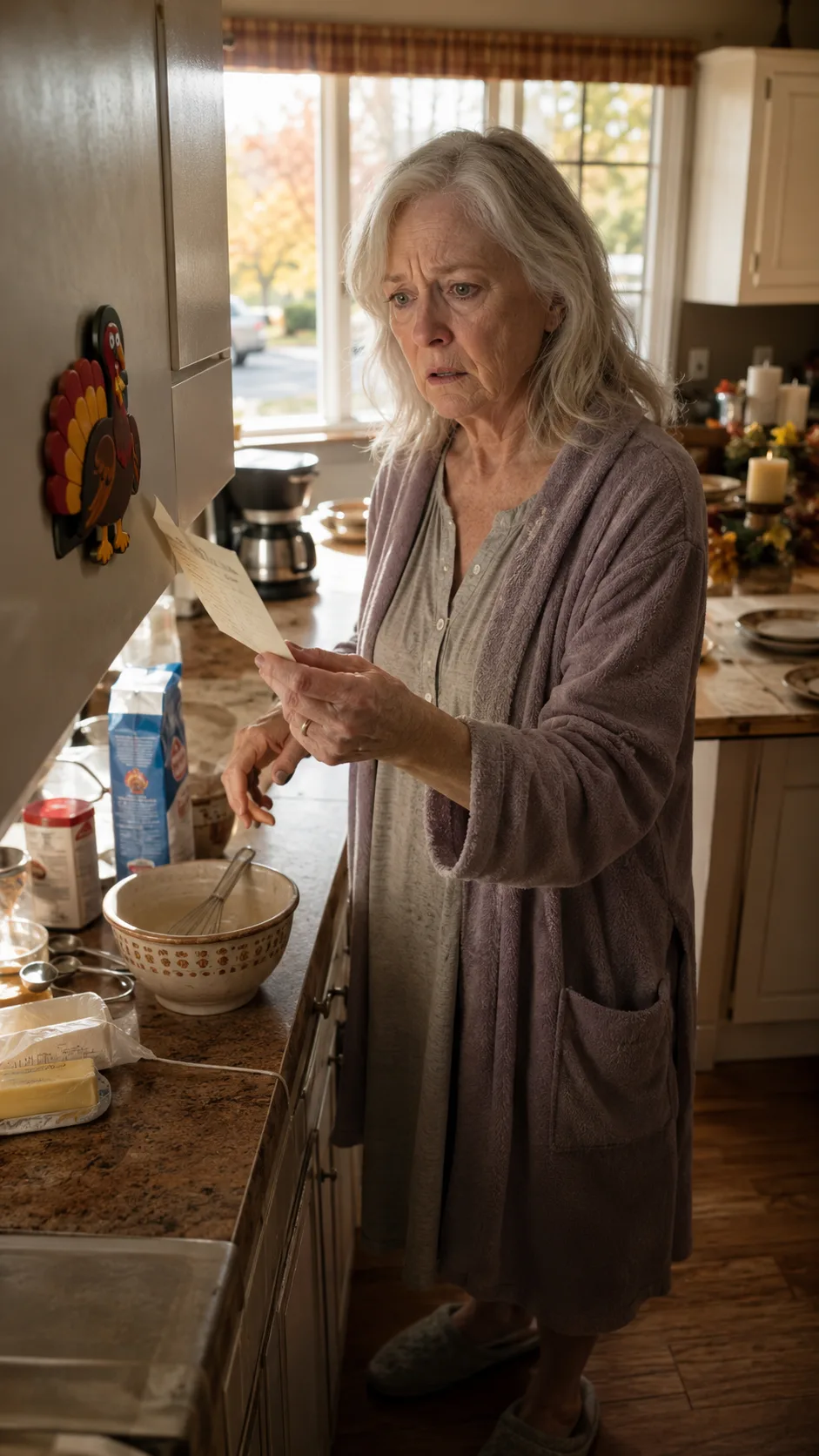
I was sitting alone in a house on Thanksgiving morning, drinking coffee I’d made myself after my son and his family had flown to Hawaii without telling me.
They’d left a note, not made a phone call, not invited me, not even had
the decency to tell me to my face.
A note.
I set my coffee cup down and looked around the kitchen at the refrigerator I’d bought when they said their old one wasn’t big enough. At the new curtains I’d sewn because Amanda wanted something more modern. At the table where I’d shared hundreds of meals, always making sure everyone else had seconds before I took any for myself.
And sitting there in that silent house with that note on the counter and an empty driveway outside, something inside me shifted.
I didn’t cry.
I just started thinking.
Sitting there with my coffee, my mind drifted back—not to escape what had just happened, but to understand how I’d arrived at this moment.
It started three years ago when my husband Harold passed away.
We’d been married for 48 years. He went peacefully in his sleep, which everyone said was a
blessing.
And maybe it was.
But peaceful or not, losing him left a hole in my life that I didn’t know how to fill. Our little house—the one we’d bought when Michael was just a baby—suddenly felt too big and too empty all at once.
I remember standing in our bedroom a few weeks after the funeral, looking at Harold’s side of the closet, his shirts still hung there, pressed and waiting. I couldn’t bring myself to touch them yet.
That’s when Michael showed up.
He’d been checking on me regularly, calling every day, stopping by with groceries I hadn’t asked for. At first, I was grateful. It felt good to know someone cared, that I wasn’t completely alone in the world.
One evening, he sat me down at my kitchen table, the same table where Harold and I had shared thousands of meals.
“Mom,” he said, his voice gentle,
concerned, “I’ve been thinking. You shouldn’t be alone right now. It’s not healthy.”
I told him I was managing just fine, and I was. Grief is hard, but I’d learned over the years that being alone and being lonely are two different things.
But Michael persisted.
“Amanda and I have been talking. We have that extra room downstairs. The kids would love having you closer. And honestly, Mom, we could use your help. Amanda’s working full-time now, and daycare is so expensive.”
The way he said it made it sound like we’d both be helping each other, like it was a partnership.
“You could stay in your house,” he continued. “But wouldn’t it be nice to wake up to the sound of the grandkids, to have family around?”
When he put it that way, how could I say no?
I thought about those quiet mornings in my empty house, making coffee for one, eating dinner alone while the television hummed in the background. The idea of being surrounded by life again—by laughter and noise and purpose—felt like exactly what I needed.
So I said yes.
Michael was thrilled. He hugged me tight and promised it would be wonderful.
“We’re going to take such good care of you, Mom.”
What he didn’t mention right away was that he needed help with the down payment on a bigger house.
The one they were renting was too small, he explained. But if we pooled our resources, we could get something really nice, something with room for everyone.
I had the money.
Harold had been careful with our savings, and the life insurance policy had been generous. Michael said I could think of it as an investment in our family’s future.
I wrote the check without hesitation.
Looking back now, I can see how it all unfolded. But at the time, I was just a widow who wanted to feel needed again.
The first few months in the new house were exactly what Michael had promised. I’d wake up to the sound of my grandchildren giggling in the next room. Amanda would ask my advice about recipes. Michael would sit with me in the evenings and tell me about his day at work.
I felt useful again.
I took care of the kids while Michael and Amanda worked. I’d pack their lunches, help with homework, read bedtime stories.
When Amanda mentioned the old washing machine was broken, I bought a new one. When Michael said they were struggling with the electric bill one winter, I quietly took over the utilities.
It felt good to help—to be the kind of mother and grandmother who could ease their burdens.
They called me a blessing.
That word came up a lot.
“You’re such a blessing, Mom.”
“We’re so blessed to have you here.”
I wore that word like a warm coat.
But somewhere along the way, things shifted.
It happened so gradually that I didn’t notice at first. The requests for help became expectations. The gratitude became assumptions.
When I suggested maybe I’d like to visit my friend Dorothy one weekend, Amanda looked surprised.
“But who will watch the kids?”
When I mentioned I was tired one evening and might skip cooking dinner, Michael seemed annoyed.
“We were counting on you, Mom.”
The phrase, “We were counting on you,” came up more and more.
I started to feel less like family and more like staff.
But I told myself I was being sensitive. They were busy, stressed, working hard. Of course, they relied on me. That’s what family does.
We help each other.
Then came the moment that should have woken me up sooner.
It was about six months ago.
I wasn’t feeling well—just a spring cold—and I’d gone to lie down early. I was in my room with the door cracked open when I heard Amanda on the phone in the hallway.
“I know, I know,” she was saying to someone, her voice carrying that tone people use when they’re venting. “She means well, but she’s so set in her ways. Everything has to be done her way, and honestly, sometimes it’s just easier to work around her.”
There was a pause while the person on the other end spoke.
“Oh, we can’t ask her to leave,” Amanda continued. “Michael would never forgive himself. Plus, she helps with so much. The bills, the kids. We’d be lost without her money. Honestly—her money, not her—her money.”
I lay very still in my bed, staring at the ceiling, feeling something cold settle in my chest.
She kept talking.
“But between you and me, sometimes I just want my house back. You know what I mean? Like, it’s nice having the help, but I miss having our own space.”
Our own space.
As if I was intruding.
As if this wasn’t the house I’d helped buy.
I didn’t confront her. I didn’t mention what I’d heard. I just filed it away in some quiet corner of my mind and kept going because what else could I do?
Where else would I go?
I convinced myself I’d misunderstood. That Amanda was just having a bad day. That she didn’t really mean it the way it sounded.
But after that, I started noticing other things.
The way they’d make plans without asking if I wanted to join. The way Amanda would reorganize the kitchen after I’d cooked, moving things to where she preferred them. The way Michael would talk about his house and his mortgage, even though my name was on half the paperwork, and I’d paid far more than half the bills.
I was living in their space, cooking in their kitchen, helping raise their children.
But I was doing it with my money.
On my time.
With my energy.
Sitting at that kitchen table on Thanksgiving morning, holding my coffee, and staring at that note, all of those memories arranged themselves into a pattern I couldn’t ignore anymore.
I hadn’t been invited to live with them because they loved me.
I’d been invited because I was useful.
And the moment I wasn’t useful—the moment I might be inconvenient—they’d left me behind without a second thought.
I finished my coffee and stood up slowly.
For three years, I’d convinced myself this was my home.
But it wasn’t.
It was their house—one I’d been paying for while pretending I belonged.
And as I rinsed my cup in the sink and placed it carefully in the dish rack, I realized something that should have scared me but didn’t.
I was done pretending.
I picked up that note again. My fingers traced over Amanda’s handwriting, smooth and confident. She’d probably written it quickly, maybe while packing her suitcase, squeezing it in between choosing swimsuits and booking excursions.
You wouldn’t have liked the flight.
That sentence bothered me more than the rest. Not because it was cruel, but because it was so casual, so certain, as if she knew me well enough to decide what I would or wouldn’t enjoy without ever asking.
Had I ever said I didn’t like flying?
I couldn’t remember.
Harold and I had flown to visit his sister in Arizona years ago. It was fine. A little cramped maybe, but nothing I couldn’t handle.
But that wasn’t really the point, was it?
The point was that they’d made a choice.
A family vacation.
Hawaii.
Thanksgiving week.
And somewhere in all that planning—all those excited conversations about beaches and resorts and luaus—they decided I didn’t fit.
I folded the note and set it down.
My hands felt steady.
My mind felt clear.
I walked through the living room slowly, my slippers shuffling against the hardwood floor I’d paid to have refinished last year. The morning light was stronger now, pouring through the windows and illuminating everything with that particular brightness that makes dust particles visible in the air.
I stopped in front of the 65-inch television mounted on the wall.
Michael had wanted it for the Super Bowl two years ago. Amanda had thought it was too big, too extravagant.
But when I offered to buy it as a Christmas gift, suddenly it was perfect.
I ran my hand along the back of the sofa—cream colored, modern, the kind with clean lines and firm cushions that look beautiful but aren’t particularly comfortable. Amanda had seen it in a catalog and fallen in love.
Three thousand dollars.
I’d paid for it without blinking.
The coffee table, the end tables, the lamps, the bookshelf—all mine.
I moved into the kitchen, opening cabinets one by one. The dishes. The glasses. The set of copper pots Amanda had admired at a kitchen store. I’d bought those for her birthday, watching her face light up as she opened the box.
The refrigerator hummed beside me.
Stainless steel.
French doors.
Ice maker built into the door.
Their old one had worked just fine, but Amanda wanted something that matched her vision for the kitchen.
I’d made that vision possible.
The washer and dryer in the laundry room.
The patio furniture on the back deck.
The lawn mower in the garage.
The router that kept their internet running.
Even the fancy blender that sat on the counter, the one Amanda used every morning for her smoothies.
I’d paid for all of it.
Not because they’d asked, really.
They’d mentioned needs, expressed wishes, made comments about how nice it would be to have this or that.
And I’d stepped in.
Opened my wallet.
Solved the problem.
Because that’s what I thought love looked like.
I walked back to my bedroom and sat on the edge of my bed.
On my nightstand was a photograph of Harold taken maybe ten years before he died. He was smiling at something outside the frame, his eyes crinkled at the corners the way they always did when he laughed.
“What would you think about all this?” I asked his picture softly.
Harold had always been practical—generous, but clear-eyed. He would have seen what was happening long before I did. He probably would have pulled me aside months ago and asked me gently why I was working so hard to buy affection.
I touched the frame, then opened the drawer of my nightstand.
Inside was a blue folder, the kind with pockets and a little elastic band to keep it closed.
I’d always been organized, the type of person who kept receipts and warranty cards and instruction manuals filed away neatly. Harold used to tease me about it.
“You keep track of everything,” he’d say, shaking his head with amusement.
I pulled out the folder and opened it.
Page after page of receipts.
Every major purchase I’d made since moving into this house, each one with my name printed clearly at the top.
Some were years old, the paper starting to yellow at the edges.
Others were recent, still white and crisp.
Television.
Sofa.
Appliances.
Furniture.
I even had the receipt for the down payment on the house itself—the cashier’s check made out with my signature at the bottom.
I flipped through them slowly, not reading every word, just remembering.
Each piece of paper represented a moment when I’d thought I was helping. When I’d believed I was being a good mother, a good grandmother, a valued member of the family.
But looking at them now, they felt different.
They felt like proof.
I closed the folder and held it in my lap, feeling its weight. Not heavy, really, but substantial.
Important.
“It’s all mine anyway,” I whispered to the empty room.
The words surprised me.
Not because they weren’t true, but because saying them out loud made something shift inside my chest. Something that had been tight for a very long time loosened just a fraction.
I stood up and walked to my closet, pulling out my phone from where I’d left it charging overnight. I didn’t use it much, mostly just to call Dorothy or check the weather, but I knew how to look things up when I needed to.
I typed slowly, my fingers not quite used to the small keyboard.
Moving company near me.
Several results appeared.
I scrolled through them, reading reviews, looking at ratings.
One had particularly good comments.
Family-owned, people said.
Professional, respectful.
I tapped the phone number.
It rang three times before someone answered.
A man’s voice, friendly and alert despite the early hour.
“Good morning, Prestige Moving Services. How can I help you?”
I took a breath.
“Good morning. I need to schedule a move tomorrow, if possible.”
There was a brief pause.
“Tomorrow? That’s Thanksgiving, ma’am. We do work holidays, but there’s an additional fee.”
“That’s fine,” I said, my voice calm and certain. “I can pay whatever it costs.”
“All right, then.” I could hear him clicking on a keyboard. “Can I get your name and address?”
I gave him the information, speaking clearly, taking my time.
“And how much are we moving? Full house or just a few items?”
I looked around my bedroom, then thought of the living room, the kitchen, the garage.
“Quite a bit,” I said. “I’ll have a list ready for you when you arrive.”
“Perfect. We can have a crew there by 8:00 in the morning. Does that work?”
“That works beautifully,” I said.
We finished the details and I hung up.
The house was still quiet around me, but the silence felt different now.
Not empty.
Not sad.
Just waiting.
I walked to my desk and pulled out a notepad and pen.
At the top of the first page, I wrote: items to move.
Then I started writing every single thing I’d ever paid for.
I sat at my desk for the rest of that morning, the blue folder open beside me, my pen moving steadily across the paper.
It’s funny how much you can forget when you’re not paying attention.
But when you sit down and really look—really remember—it all comes back.
The television came first on my list. That was easy. I could picture Michael’s face when I told him I wanted to get it for Christmas. He tried to protest, said it was too much, but his eyes had lit up in a way that told me he wanted it desperately.
Next, the sofa set. I remembered the day Amanda and I went shopping for it. She’d walked through that furniture store like a woman on a mission, pointing at different pieces, sitting on them, testing them. When she finally found the one she loved, she’d turned to me with this hopeful expression.
“It’s beautiful, isn’t it?” she’d said.
And it was—still is, really—even if I’ve never found it comfortable.
I wrote it down, then added the matching armchair and ottoman, the coffee table that went with the set.
The kitchen appliances took up half a page by themselves.
The refrigerator had been Amanda’s idea after they moved in. She’d said the one that came with the house was outdated. Didn’t match her vision.
I’d suggested maybe we could get it painted or add new handles, something simple.
But she’d pulled up pictures on her phone showing me these sleek, modern refrigerators with water dispensers and special temperature zones.
“Wouldn’t it be wonderful, Mom?” she’d asked, to have something really nice.
So I’d bought it.
Had it delivered and installed while they were at work, wanting to surprise them.
The microwave.
The stand mixer.
The food processor.
The espresso machine Michael had mentioned wanting just once in passing, and that I’d ordered online the next day.
I remembered the blender particularly well.
Amanda had seen it at a friend’s house and talked about it for weeks. Top of the line. Commercial grade. The kind that could pulverize anything.
Six hundred dollars.
I’d bought it for her birthday and wrapped it myself, watching her unwrap it with genuine joy.
“You’re too good to me, Mom,” she’d said, hugging me.
At the time, I’d felt warm all over, proud, happy to make her happy.
Now, writing it down on my list, I felt something different.
Not quite sadness.
More like recognition.
The washer and dryer were next.
Their old set had broken down about a year ago, and Michael had been stressed about the cost of replacing them. He’d started researching secondhand options, talking about how maybe they could make do with going to the laundromat for a while.
I told him not to worry.
Told him I’d take care of it.
The new set I bought wasn’t secondhand.
It was top of the line with all the settings and features Amanda had admired at her sister’s house.
Steam clean.
Delicate cycle.
Extra capacity.
“This is too much, Mom,” Michael had said when they were delivered.
But he’d accepted them anyway.
I flipped to the next receipt in my folder.
The lawn mower.
The patio furniture.
The grill Michael used every summer weekend.
Page after page of purchases, each one connected to a memory, a moment, a feeling.
The thing about giving is that it can feel so good in the moment. You see someone you love light up with happiness, and you think, yes, this is what I’m supposed to do. This is how I show I care.
But there’s a difference between giving freely and giving because you’re afraid of what will happen if you stop.
I’d crossed that line somewhere.
And I hadn’t even noticed.
By the time I got to the utility bills, my hand was starting to cramp.
I’d taken over the electric bill about eighteen months ago. Michael had mentioned one month that it was higher than expected—something about the air conditioning running constantly during a heat wave. I’d offered to cover it. Just that once, just to help.
But once became twice.
Twice became always.
The water bill followed.
Then the internet.
Then the home insurance premium.
Michael never asked directly.
He’d just mention casually that money was tight, that things were expensive, that they were doing their best, but sometimes it was hard.
And I’d step in.
Every time.
I looked at my list, now covering three full pages in my neat handwriting.
Each line represented money I’d spent.
Yes.
But more than that, it represented a piece of myself I’d given away while believing I was building something.
A family.
A home.
A place where I mattered.
I set down my pen and flexed my fingers, looking at the blue folder with its diminishing stack of receipts still to go through.
But I had enough.
More than enough.
The afternoon sun was slanting through my bedroom window now, warm and golden.
I checked the time.
2:30.
I’d been at this for hours.
My stomach rumbled quietly, reminding me I hadn’t eaten anything since that early cup of coffee.
I gathered my papers, tucked them back into the folder along with the receipts, and stood up. My knees protested, stiff from sitting so long, but I made my way downstairs.
The kitchen felt different now.
Not sad.
Not angry.
Just neutral.
A space I was moving through rather than living in.
I opened the pantry and scanned the shelves.
Amanda kept it well organized, everything labeled and arranged by category.
My eyes landed on a can of pumpkin puree, pushed toward the back.
Pumpkin pie.
My favorite.
I’d planned to make three of them today. One for dinner, one for Michael to take to work next week, one to send home with my grandchildren.
That had been the plan back when I thought I’d be spending today surrounded by family.
Now, I decided I’d make just one.
A small one.
For me.
I pulled out the ingredients, setting them on the counter one by one.
Flour.
Sugar.
Eggs.
Cream.
The spices—cinnamon and nutmeg and ginger—their containers worn from years of use.
My hands moved through the familiar motions, mixing the dough, rolling it out, pressing it into the pie tin.
The filling came together easily, smooth and fragrant.
As I slid the pie into the oven and set the timer, the kitchen filled with the scent of baking spices—rich and comforting, and entirely mine.
I poured myself a glass of water and sat at the table, watching through the oven door as the pie began to set, its edges turning golden.
For the first time in three years, I was cooking just for myself.
Not thinking about whether Michael would want seconds, or if Amanda preferred less cinnamon, or if the grandkids would eat their vegetables if I promised them dessert.
Just me.
My pie.
My kitchen.
My choice.
When the timer went off, I pulled the pie out and set it on the cooling rack.
It looked perfect.
The filling set just right.
The crust flaky and golden brown.
I didn’t wait for it to cool completely.
I cut myself a generous slice, plated it, and carried it to the table.
The first bite was still warm, melting on my tongue with all those familiar flavors—sweet and spiced and perfect.
I ate slowly, savoring every bite.
And when I was done, I felt full in a way I hadn’t in a long time.
Not just my stomach.
Something deeper.
That night, I slept soundly.
No tossing.
No waking at odd hours.
No lying in the dark wondering if I’d done enough, been enough, given enough.
Just deep, peaceful sleep.
Because tomorrow, everything was going to change.
I woke up Friday morning at 5:30, just like always.
But unlike every other morning in this house, I felt energized.
Ready.
I showered, dressed in comfortable clothes, and went downstairs to make breakfast—a proper one. Scrambled eggs, toast, a fresh pot of coffee.
While I ate, I reviewed my list one more time, checking it against the receipts still spread across the table.
Everything was in order.
At 7:30, I heard the truck pull into the driveway.
I looked out the window and saw a large white moving van with blue lettering on the side.
Three men climbed out, all young, probably in their twenties or thirties.
They wore matching blue shirts and work gloves.
I’d made cookies the night before—after my pie, chocolate chip, because they’re easy and everyone likes them.
I arranged them on a plate and put on a fresh pot of coffee, then opened the front door before they could knock.
“Good morning,” I said, smiling warmly. “You must be from Prestige Moving.”
The tallest one with sandy hair and a kind face stepped forward.
“Yes, ma’am. I’m Jason. This is Marcus and Tyler. We’re here for your move.”
“Wonderful. Please come in. I’ve made coffee and cookies. You’ll need your energy today.”
They exchanged glances, probably surprised to be greeted with refreshments at 8 in the morning on Thanksgiving.
But they followed me inside, wiping their feet carefully on the mat.
“This is very kind of you,” Jason said, accepting a cup of coffee. “Most people are usually stressed on moving day.”
“Oh, I’m not stressed at all,” I said pleasantly. “I’ve been planning this very carefully.”
Tyler—the youngest, with freckles scattered across his nose—took a cookie and bit into it.
His eyes widened.
“These are really good, ma’am.”
“Thank you, dear. My late husband always said my chocolate chip cookies were the best he’d ever tasted.”
I set down the plate and picked up my folder.
“Now, let me explain how this is going to work. I have a list of items to be moved, and I have receipts for each one. I want to make sure we’re all on the same page.”
Jason set down his coffee cup, suddenly more business-like.
“Receipts?”
“Yes. You see, everything we’ll be moving today belongs to me. I purchased it all myself. I just want to be thorough so there’s no confusion.”
I handed him the list and he scanned it, his eyebrows rising slightly as he read.
“This is quite a lot of furniture and appliances.”
“I know. I’ve been generous over the years,” I said, smiling softly. “But now it’s time for these things to come with me to my new place.”
Marcus, who had been quiet until now, looked around the living room.
“So we’re taking the TV, the couch, the tables… everything in here.”
“Everything on the list,” I confirmed. “Would you like to see the receipts as we go? I find it helps to be organized.”
Jason looked at me for a long moment, and I could see the wheels turning in his head. He was smart enough to understand that this wasn’t a typical moving job.
But I’d been nothing but polite, had all my documentation ready, and was clearly in complete control of the situation.
“That won’t be necessary, ma’am,” he said finally. “If you say it’s yours, that’s good enough for us. We just move what you tell us to move.”
“Perfect. Let’s start with the living room, shall we?”
They got to work, and I settled into the one chair I wasn’t taking, watching them with my folder in my lap.
Jason directed the other two with quiet efficiency.
They wrapped the television carefully in blankets, securing it with tape.
Tyler disconnected all the cables, coiling them neatly.
Marcus helped lift the TV onto a dolly, and together they wheeled it out to the truck.
Next came the sofa.
It took all three of them to maneuver it through the doorway, tilting it at angles, communicating in that shorthand way people develop when they work together regularly.
“On three.”
“One, two, three.”
I watched them work, occasionally checking items off my list.
Each piece of furniture that disappeared through that door felt like taking a breath after holding it too long.
The coffee table.
The end tables.
The lamps.
The bookshelf with all of Amanda’s decorating books still on it.
I’d bought the bookshelf.
The books could stay.
By 9:30, the living room was empty except for the chair I sat in.
The space looked bigger somehow.
The walls bare where frames had hung.
The floor marked with indentations where furniture legs had rested.
Sunlight streamed through the windows, illuminating dust particles floating in the air, making patterns on the hardwood floor.
“Kitchen next?” Jason asked, wiping sweat from his forehead despite the cool morning.
“Yes, please. The refrigerator, microwave, and all the small appliances on the counter. Oh—and there’s a stand mixer in the pantry.”
Tyler’s eyes widened when he opened the refrigerator and saw how full it was.
“Ma’am, there’s a lot of food in here.”
“I know. Just leave it on the counter. They’ll have to deal with that themselves.”
They emptied the refrigerator’s contents onto the counter—an odd assortment of leftovers, condiments, and ingredients.
Then they disconnected it and wheeled it out, leaving a dark rectangular space where it had stood.
Marcus unplugged the microwave.
The espresso machine.
The blender.
Each appliance joined its companions in the truck.
By eleven, they’d moved to the bedrooms.
My furniture.
My linens.
My clothes.
The washer and dryer from the laundry room.
Even the vacuum cleaner I’d bought last spring.
The house was becoming a skeleton of itself.
I made them stop for lunch, insisting they sit and eat the sandwiches I’d prepared.
They were grateful for the break, their shirts damp with sweat despite the mild temperature.
“You’re handling this really well,” Jason said between bites. “Most people get emotional when they move.”
“I’m not most people,” I said simply. “And I’m not sad to leave. Sometimes you have to know when it’s time to go.”
He nodded slowly, understanding passing between us without more words needed.
By noon, the truck was packed.
The house stood empty around us, echoing with each footstep.
Bare walls.
Bare floors.
Bare counters.
Only the bones of it remained.
I walked through each room one final time, not saying goodbye, just witnessing.
This had been my home for three years.
But it had never really been mine.
In the kitchen, I stopped at the counter.
Amanda’s note still sat there, held down by the turkey magnet.
I left it exactly where it was.
Next to it, I placed the stack of bills that had arrived in the mail that morning—electric, water, internet—all in Michael’s name now, since I’d called each company earlier in the week and had the accounts transferred.
They’d figure it out eventually.
Then I did something that made me smile.
I took my house keys off my key ring, both copies, and set them beside the note and bills.
From my purse, I pulled out a spool of red ribbon I’d bought years ago for Christmas presents.
I tied the keys together with a neat bow, the ribbon bright and cheerful against the metal.
A gift of sorts.
Jason appeared in the doorway.
“We’re all loaded up, ma’am. Ready when you are.”
“Just one moment.”
I looked around the kitchen one last time—at the empty space where the refrigerator had been, at the bare counters, at the naked windows without curtains.
Then I picked up my purse, tucked my folder under my arm, and walked toward the door.
I didn’t look back.
Jason held the door open for me, and I stepped outside into the cool November air.
The sky was clear, bright blue, the kind of day that makes you grateful to be alive.
I pulled the door closed behind me, hearing the lock click into place.
The sound felt final.
Complete.
“Where to, ma’am?” Jason asked gently.
I gave him the address of my new apartment, then climbed into my car.
As I pulled out of the driveway, I glanced in the rearview mirror just once.
The house stood there empty and waiting, like a theater after the show has ended.
The moving truck pulled out behind me, and together we drove away toward something new.
Toward something mine.
The Metobrook Senior Living Complex sat on a quiet street lined with maple trees.
It wasn’t fancy—just a low brick building with neat flower beds and a parking lot that actually had spaces available.
I’d visited twice before signing the lease, walking through the halls, peeking into the community room, making sure it felt right.
It did.
The building manager, a woman named Patricia with silver hair and a warm smile, met me in the lobby. She’d been expecting me, had my keys ready and waiting.
“Welcome home, Mrs. Patterson,” she said, handing me a small envelope. “You’re in unit 2B, second floor. The elevator is just down that hall. If you need anything at all, my office is right here.”
“Thank you, Patricia. The movers should be arriving shortly.”
“Perfect. I’ll make sure the service elevator is available for them.”
I rode up to the second floor alone, the elevator humming quietly.
When the doors opened, I found myself in a clean hallway with soft beige carpet and wall sconces that cast a gentle light.
Unit 2B was the third door on the right.
I slid the key into the lock and turned it, pushing the door open slowly.
The apartment was smaller than what I’d left behind.
But it was mine.
Completely.
Entirely.
Sunlight poured through the windows in the living room, illuminating honey-colored wood floors.
The kitchen was compact but functional, with white cabinets and newer appliances.
There was one bedroom, one bathroom, and a little balcony that overlooked the courtyard below.
I walked through it slowly, opening cabinets, testing the faucet, standing on the balcony and breathing in the cool air.
It smelled like fresh paint and possibility.
The movers arrived twenty minutes later, and I directed them where to place everything.
The television went against the living room wall.
The sofa faced it with the end tables on either side.
My bed in the bedroom.
My dresser against the opposite wall.
Everything fit perfectly, like pieces of a puzzle finally in their right places.
Jason and his crew worked quickly, and by mid-afternoon, the truck was empty and my apartment was full.
“You need anything else, ma’am?” Jason asked as they prepared to leave.
“No, dear. You’ve all been wonderful. Thank you.”
I tipped them generously, pressing cash into each of their hands despite their protests.
They’d earned it.
And more than that, they’d been kind.
In my experience, kindness deserves to be rewarded.
After they left, I stood in the center of my living room and just breathed.
Silence surrounded me, but it was different from the silence in that house yesterday morning.
This wasn’t absence.
This was peace.
I started unpacking slowly, taking my time.
I hung Harold’s photograph on the wall beside my television, right where I could see it from the sofa.
In the picture, he was laughing at something, his eyes bright with joy.
It had been taken at our 40th anniversary party, just two years before he passed.
“Well, Harold,” I said softly to the picture. “We’re starting fresh. What do you think?”
Of course, he didn’t answer, but I like to think he’d be proud.
To be continued… Click “PART 3” to read the final part: 👉 PART 3 👈
Chapter complete
You have reached the end of this chapter.
Continue reading
A few more worlds to get lost in after this chapter.




