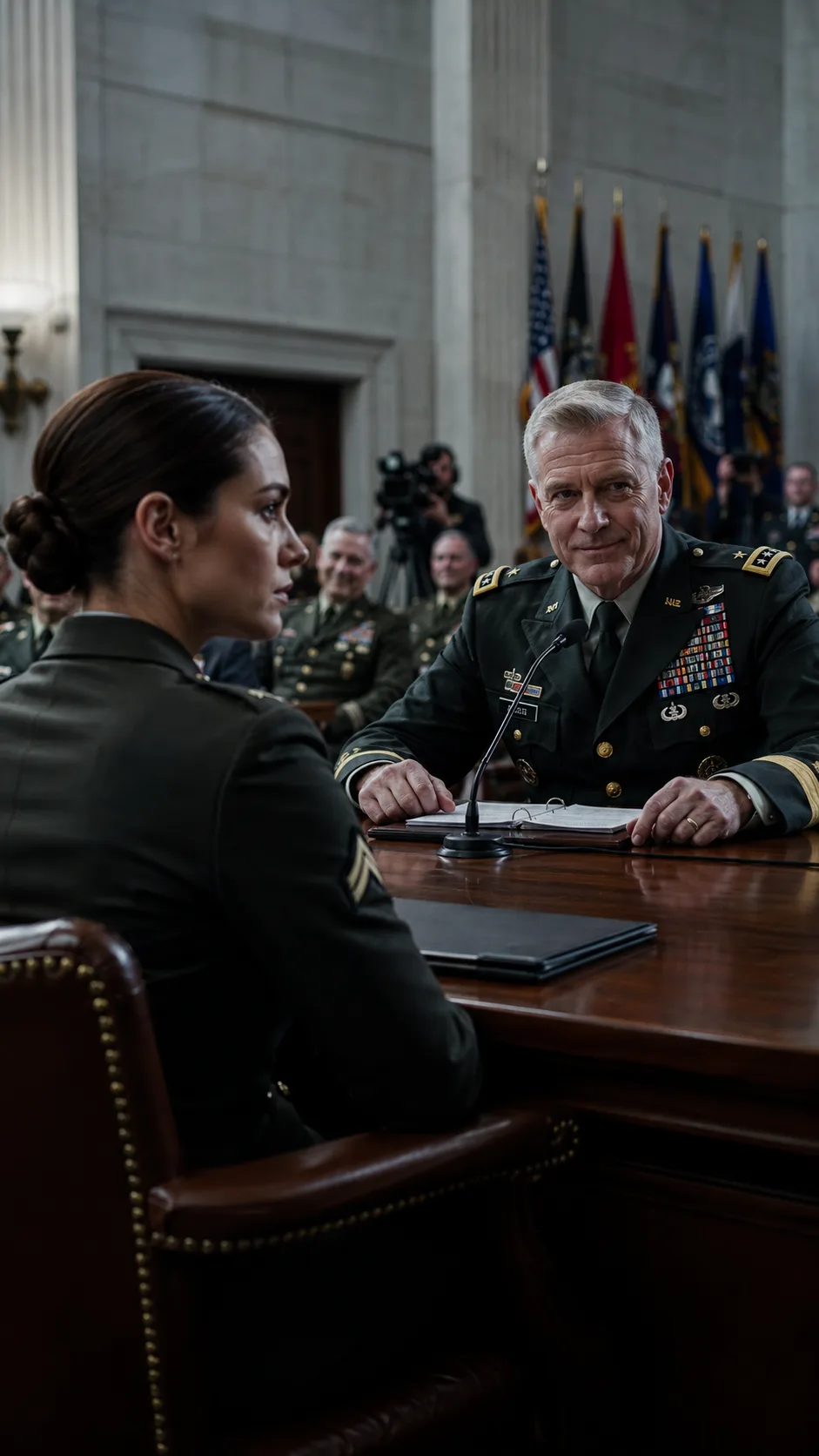
Merrick was escorted toward the doors.
Chapter 4
Merrick was escorted toward the doors.
As he passed Elara, he whispered, “You think this makes you a hero?”
Elara looked at her father.
Then her mother.
Then the seventy-three names scattered across the table.
“No.”
She looked back at Merrick.
“It makes them visible.”
The doors closed behind him.
For several seconds, the room remained silent.
The hearing chamber that had begun with smug laughter no longer felt like the same place.
General Harlan Voss stood beside the table where Elara’s folder had been opened.
The medals on his chest suddenly seemed less important than the worn photographs and old rescue reports lying beneath them.
He approached Thomas Kane.
For several seconds, neither man spoke.
Then Voss extended his hand.
“You carried me three miles.”
Thomas looked at the hand.
“Three point four.”
For the first time that morning, Voss laughed without cruelty.
Thomas shook his hand.
Voss’s expression changed again.
Not the humiliation of
being proven wrong.
Something quieter.
Something heavier.
“Why didn’t you leave me?”
Thomas looked at him as though the answer were obvious.
“You were still breathing.”
The words settled over the chamber.
There was no speech about honor.
No dramatic declaration.
No attempt to make himself larger than the moment.
To Thomas Kane, there had never been a complicated reason.
A man was alive.
So he carried him.
The camera drifted back.
Elara stood between the parents she thought she had lost.
Only minutes earlier, she had been sitting alone at the table while officers laughed at her.
Now Maria’s hand was wrapped around hers.
Thomas stood at her other side.
The room that had begun with mockery slowly rose to its feet.
One officer.
Then another.
Then the press.
Then Voss.
No command was given.
No one needed one.
The entire chamber stood for Thomas Kane, Maria Kane, and
the daughter who had spent her life finishing what they started.
Elara looked around the room.
She had imagined moments like this before.
Not this exact moment.
She had imagined finding the truth.
Finding the people responsible.
Finding out why her father disappeared.
But she had never allowed herself to imagine that one day she might stand between both of her parents again.
For years, she had trained herself not to hope for impossible things.
Hope hurt more than certainty.
Certainty had told her that Thomas Kane was gone.
Certainty had told her Maria Kane was dead.
Certainty had told her that the people who disappeared from her childhood would remain ghosts.
And yet they were standing beside her.
Voss looked at Elara.
“Sergeant Kane.”
“Yes, sir?”
He glanced at the open folder.
“I owe you an apology.”
Elara shook her head.
“No, sir.”
He looked surprised.
She closed the
folder gently.
“You owe seventy-three people the truth.”
Voss stared at her for a moment.
Then nodded.
“You’re right.”
His eyes moved across the pages.
Seventy-three names.
For years, the story of Red Harbor had been reduced to reports, political calculations, sealed documents and carefully constructed lies.
But each line in that folder represented something more ordinary.
Someone had gone home.
Someone had opened a front door.
Someone had hugged a child.
Someone had returned to a classroom, a hospital, an office, a farm, a kitchen table.
Someone had lived long enough to become a parent.
A grandparent.
A friend.
A stranger passing through an ordinary life with no idea how close that life had come to ending.
Thomas Kane had counted those people.
Elara had learned to do the same.
She looked at her father.
He was older than the man in the photographs.
The years had carved themselves into his face.
His hair had gone white.
One leg needed a cane.
But the eyes were unmistakable.
Thomas smiled.
“So what’s your count now?”
Elara blinked.
“My count?”
He pointed toward himself.
“You brought me home.”
Then toward Maria.
“And her.”
Elara’s eyes filled.
Thomas smiled wider.
“Seventy-five.”
Elara laughed through her tears.
“No.”
It was the first sound she had made all morning that carried no defense inside it.
No discipline.
No calculation.
Just relief.
She took both her parents’ hands.
The camera pulled slowly back through the chamber, rising above the polished table, the discarded papers, the photographs, and the officers who no longer looked at Elara with contempt.
Her voice followed softly.
“Seventy-three were missions.”
She looked at her mother.
Then her father.
“These two were miracles.”
For the first time in twenty years, Staff Sergeant Elara Kane walked out of a military building without wondering why her family had disappeared.
She walked out between them.
Her father’s cane struck the floor softly with every few steps.
Her mother kept one hand wrapped around Elara’s.
None of them moved quickly.
They did not need to.
For twenty years, time had been the thing taken from them.
Now, for the first time, they were allowed to waste some of it together.
Behind her, General Harlan Voss remained beside the folder that had destroyed one lie and restored dozens of forgotten lives.
The press was still recording.
Officers were still talking quietly.
Military police had already taken Merrick from the chamber.
But Voss seemed not to hear any of it.
He reached down and picked up the first photograph.
The younger version of himself looked back at him.
Twenty years younger.
Dust on his face.
Uniform torn.
Alive only because a soldier he had never remembered had refused to leave him behind.
Voss turned the photograph over.
On the reverse, beneath the faded words—
SUBJECT 01 — RECOVERED ALIVE—
someone had written one more line.
Voss read it silently.
Then his eyes filled.
It said:
“No one gets left behind—not even the people who may never remember your name.”
Voss lowered the photograph.
For most of his career, service records had been numbers.
Deployments.
Commendations.
Promotions.
Operations.
Targets.
Victories.
Losses.
He had spent decades believing a soldier’s worth could be measured by the evidence displayed on a uniform.
Medals.
Ribbons.
Badges.
Rank.
That morning, Elara Kane had entered the chamber with almost none of the things he expected greatness to look like.
And he had laughed.
Now the table in front of him held a different kind of record.
Names.
Photographs.
Families.
People who had gotten another morning because somebody chose to keep carrying them.
That was the moment General Harlan Voss finally understood what a true service record looked like.
Not bodies.
Not medals.
Not victory reports.
People who were still alive because someone had refused to stop carrying them home.
THE END.
Chapter complete
You have reached the end of this chapter.
Continue reading
A few more worlds to get lost in after this chapter.




