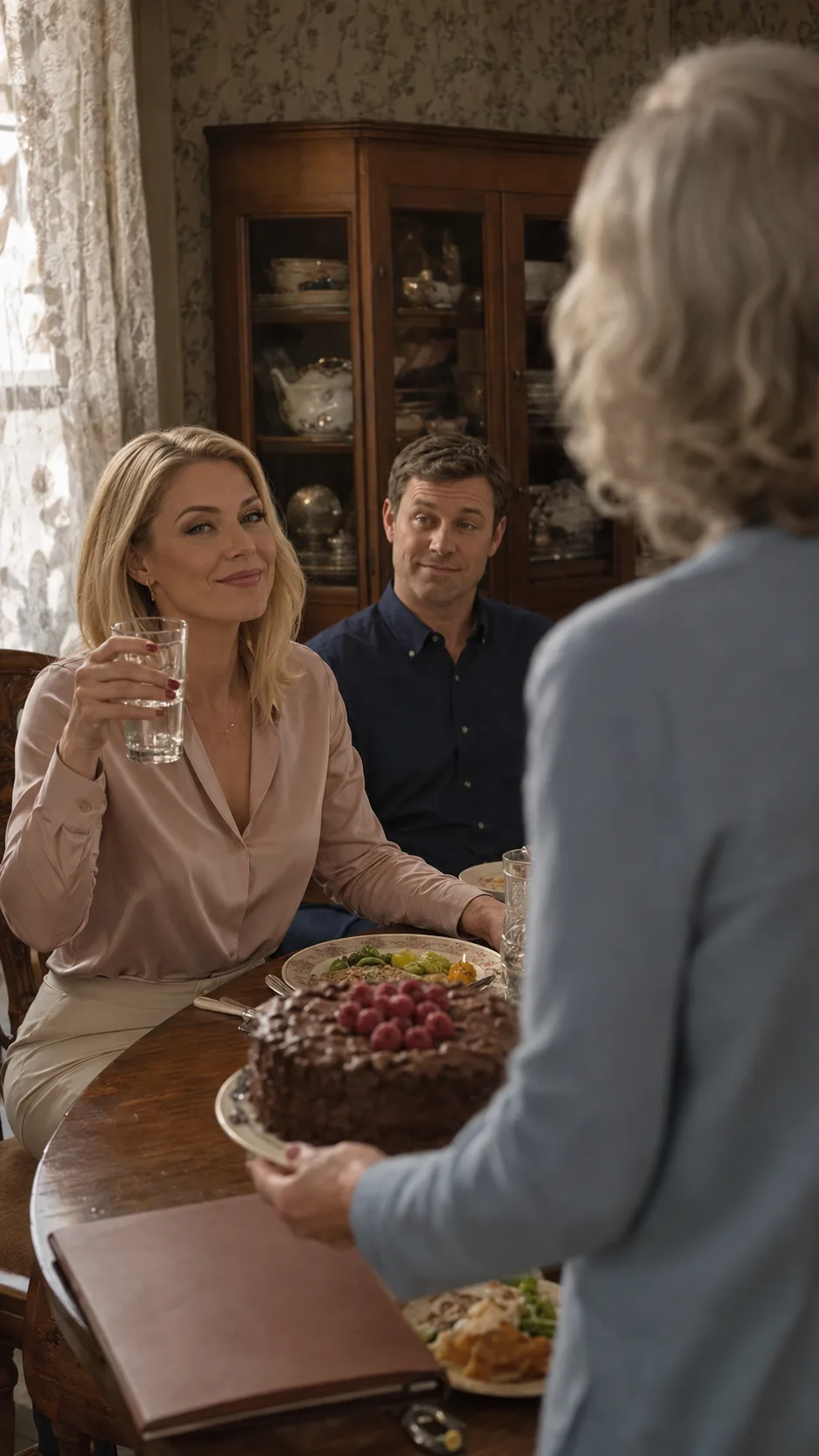
PART 4 — The Price of Getting My Home Back
He placed the signed agreement on the table.
Chapter 4
PART 4 — The Price of Getting My Home Back
He placed the signed agreement on the table.
The notary record.
The ledger.
The receipts.
The text Nicole sent about destroying their future over money.
Then he said, “My client is prepared to file suit and seek a recorded judgment. Your clients are scheduled to close on a home purchase they cannot complete with this unresolved liability.”
Nicole’s attorney stopped saying “family misunderstanding.”
They took a break.
Through the office wall, I could hear Nicole’s voice rise once.
Then Danny’s.
Then silence.
When they came back, Nicole’s lipstick looked freshly applied, but her eyes were red at the corners.
The agreement was simple.
They would pay $72,000 immediately from their house savings.
They would sign a repayment plan for the remaining balance, secured by a consent judgment if they missed payments.
They would move out within twenty-one days.
They would cover my attorney fees.
They would make no public accusations about me.
And they would remove every personal
account, subscription, delivery service, and mailing address from my home.
Nicole signed first.
This time, she read every page.
Danny signed after her.
When it was done, Nicole looked at me for the first time that day.
“I hope you’re happy,” she said.
It was meant to wound me.
It did not.
“I hope someday you understand the difference between happy and done,” I said.
Their new house fell through.
I did not celebrate that part.
But I did not mourn it either.
The builder kept a portion of their deposit. The rest, along with much of Nicole’s savings, came to me by cashier’s check.
The house with white cabinets and quartz counters went back on the market.
Nicole and Danny moved into a two-bedroom apartment near a busy road where trucks rumbled past at night. For the first time in their marriage, they paid rent, utilities, internet, renter’s insurance,
and groceries out of their own pockets.
Nicole’s mother called me two weeks after the settlement.
I almost did not answer.
“Margaret,” Barbara said, and her voice was not proud anymore. “I owe you an apology.”
I stood in the kitchen, looking at the clean counter.
“You don’t have to do that.”
“Yes,” she said. “I do. I laughed at your table. I should have stopped her.”
There are apologies that arrive too late to fix anything but still matter.
“Thank you,” I said.
She was quiet for a moment.
“Nicole told us you were living off Danny,” she said. “She said they paid everything.”
I closed my eyes.
Of course she had.
That is how people like Nicole survive. They tell the story first and hope nobody asks to see the receipts.
“Well,” I said, “now everyone has seen the receipts.”
Barbara gave a sad little laugh.
“She isn’t
speaking to us either.”
“I’m sorry.”
“I’m not sure I am,” she said.
After they moved out, the house felt strange.
Not empty.
Strange.
For years, every surface had carried proof of other people’s comfort. Nicole’s catalogs on the coffee table. Danny’s shoes by the door. Their laundry in the hallway. Their leftovers in the refrigerator, labeled with Nicole’s initials like she lived in an office break room.
Then one Saturday, it was all gone.
The silence came back.
But it was not the old silence from after Thomas died.
This silence had sunlight in it.
I changed the locks.
I canceled the extra internet package.
I lowered the thermostat.
I bought groceries for one person and nearly cried in the checkout line when the total came to less than sixty dollars.
I hired a young man from the neighborhood to mow the lawn.
I paid off the furnace.
I fixed the crack in the dining room ceiling.
Then I did something I had not done in years.
I invited people over.
Not Danny.
Not Nicole.
People who did not need anything from me.
Ruth from the hospital came first, bringing a lemon pie and gossip about three nurses I barely remembered.
Mr. Donnelly and his wife came the next week, and he complimented the cake like a man smart enough to know dessert is serious business.
A widow from church named Ellen started stopping by on Thursdays after her pharmacy run. We drank coffee at the kitchen table and talked about books, aches, recipes, and the strange freedom of not asking permission in your own house.
One evening, while Ellen helped me wash dishes, she noticed the faint pencil mark under the counter where Danny had written his name as a child.
“Are you going to paint over it?” she asked.
I looked at that crooked little D.
For years, I had kept it like a shrine.
“No,” I said. “But I’m not going to kneel in front of it either.”
The payments came every month.
Sometimes on the first.
Sometimes on the third.
Once, on the fifth, with a note from Nicole’s attorney apologizing for the delay.
They never missed one.
Consequences made them more reliable than love ever had.
Three months after they left, Danny wrote me a letter.
Not a text.
A letter.
The envelope sat in my mailbox between a grocery flyer and the county property tax notice.
I made tea before I opened it.
His handwriting had not changed much since high school.
Mom,
I don’t know how to say this without sounding like I’m only sorry because we got caught. Maybe at first, I was. I was angry and scared and embarrassed. But the apartment is quiet, and I’ve had time to think.
I let Nicole talk about you like you were a problem because it was easier than admitting I had become one too.
You took care of me after Dad died. I turned that into a habit. Then I let my wife turn it into a plan.
I don’t expect you to forgive me right now.
I just want you to know I see it.
I should have protected you.
I should have protected you from me.
Danny
I read it twice.
Then I folded it and placed it in a different folder.
Not the brown one.
That folder was for debts.
This one, I decided, would be for possibilities.
I did not invite him to Sunday dinner.
Not then.
But I agreed to meet him at a diner near the old hospital, the one with cracked red booths and waitresses who call everyone honey.
Danny arrived early.
He stood when I came in.
That small courtesy nearly undid me.
We sat across from each other beneath a framed photograph of the Ohio State fair from 1974.
He did not ask for money.
He did not ask me to call the title company.
He did not ask me to talk to Nicole.
He ordered coffee and said, “I was wrong.”
A full sentence.
No “but.”
No “you know how Nicole is.”
No “I felt caught in the middle.”
Just wrong.
I stirred cream into my coffee.
“I love you,” I said. “That has not changed.”
His eyes filled.
“But love is not access,” I continued. “And being my son does not give you the right to use me.”
He nodded.
“I know.”
“You can earn visits,” I said. “Not by paying me back. That is already handled. You earn visits by telling the truth, respecting my home, and never again bringing cruelty to my table.”
He swallowed hard.
“Yes, ma’am.”
I almost smiled.
He had not called me ma’am since he was fourteen and trying to get out of trouble.
We began slowly.
Coffee once a month.
Then lunch.
Then he came by one Saturday to clean the gutters, and when I offered him a sandwich, he washed his hands first and asked where I wanted him to sit.
That may sound small.
It was not.
Nicole never came back to my house.
I heard, through Barbara, that their marriage became “difficult.” That was the word she used, which in Midwestern language can mean anything from sharp silence at breakfast to separate bedrooms.
I did not ask for details.
Nicole was no longer my weather.
One year after the Sunday dinner, I hosted Easter lunch.
Ruth came.
Ellen came.
Barbara came too, which surprised us both, carrying a casserole and wearing the careful expression of a woman trying to step over old shame without tracking it through the room.
Danny came alone.
He brought flowers from the grocery store and a chocolate rabbit like he was eight years old again.
When he walked into the dining room, his eyes went to the sideboard.
Maybe he remembered the cake.
Maybe he remembered the folder.
Maybe he remembered his wife’s speech.
Good.
Some rooms should teach you.
We ate ham, scalloped potatoes, green beans, and rolls warm from the oven.
Nobody made a toast.
Nobody thanked me for being useful.
Nobody told me what I owed them.
After lunch, Danny stood and began clearing plates without being asked.
Barbara helped.
Ruth wrapped leftovers.
Ellen filled the coffee cups.
I stood in the doorway between the kitchen and dining room and watched other people carry the weight for once.
The brown folder was no longer in my desk.
I had moved it to a metal file box in the closet, behind Thomas’s old tackle box and a stack of Christmas linens.
I did not need it at the table anymore.
But I liked knowing it existed.
Not because I wanted revenge.
Because for a long time, I had mistaken kindness for surrender.
That folder reminded me that a woman can be generous and still keep records.
She can love her child and still lock her door.
She can forgive slowly without handing the knife back.
After everyone left that Easter, Danny stayed behind.
He stood by the porch steps, looking at the lilac bush Thomas and I had planted decades earlier.
“It’s blooming,” he said.
“Yes.”
“Dad loved that bush.”
“He did.”
Danny put his hands in his pockets.
“I miss him.”
“So do I.”
He looked at me then, not like a boy asking to be rescued, but like a man finally understanding the cost of being loved well.
“I think he’d be ashamed of me,” he said.
I looked toward the street, where the evening light rested on the old mailboxes and a neighbor’s flag moved gently in the wind.
“Maybe,” I said. “But he’d also expect you to do better.”
Danny nodded.
“I’m trying.”
“I see that.”
It was the most I could give him honestly.
And honesty, I had learned, is worth more than comfort.
That night, after he left, I cut myself the last slice of chocolate raspberry cake and carried it to the porch.
The air smelled like lilacs and rain.
Across the street, a little girl rode her bicycle in circles while her grandfather clapped from the driveway. Somewhere down the block, a lawn mower started. The world went on in all its ordinary, stubborn ways.
For years, I had been afraid of being left alone.
But there is something worse than an empty house.
A house full of people who only love the doors you open, the meals you cook, the bills you pay, and the silence you swallow.
Nicole thought she was leaving me behind in a falling-apart old ranch house.
She never understood.
That house was never the thing falling apart.
I was.
And the day she thanked me for being easy to use was the day I finally stopped.
I still bake the chocolate raspberry cake.
Not as often.
Not for people who come hungry and leave entitled.
I bake it for friends who bring containers for leftovers and insist on washing their own forks.
I bake it for quiet afternoons when the rain taps the window and I want to remember Thomas without drowning in the past.
Sometimes I bake it when Danny visits.
He always clears the table now.
He always asks before opening the refrigerator.
And he never sits in his father’s chair unless I tell him he may.
That is not a perfect ending.
Life rarely gives those.
But it is a fair one.
Nicole got her clean boundaries.
Danny got the truth.
And I got my home back.
Not just the walls.
Not just the deed.
My home.
The place where my name is not a favor.
The place where my kindness is not a contract waiting to be exploited.
The place where no one laughs politely while I disappear.
And every spring, when the lilacs bloom and the afternoon light hits the raspberry glaze just right, I set the cake on the table, pick up the knife, and cut the first slice for myself.
THE END.
Chapter complete
You have reached the end of this chapter.
Continue reading
A few more worlds to get lost in after this chapter.




