_PART 2 — THE HOUSE, THE PARTNERSHIP, AND THE INVITATION SHE NEVER WANTED_
So Theo grew up in a perfectly ordinary house in a perfectly ordinary neighborhood in suburban Cleveland.
Chapter 2
_PART 2 — THE HOUSE, THE PARTNERSHIP, AND THE INVITATION SHE NEVER WANTED_
So Theo grew up in a perfectly ordinary house in a perfectly ordinary neighborhood in suburban Cleveland.
A three-bedroom ranch with beige carpet, a stubborn furnace, and a maple tree in the front yard that dropped leaves faster than anyone could rake them.
He went to public school.
He took the bus.
He packed his own lunch by seventh grade because I told him I was not running a restaurant.
At sixteen, he got a part-time job scooping ice cream at a place called Mickey’s. He came home smelling like sugar and waffle cones, with his forearms sticky from rinsing metal scoops. When he wanted a car, I made him save half the down payment.
He complained, of course.
Teenage boys complain the way birds sing. It is simply what they do.
But he saved.
He bought an old Honda with one door that had to be kicked from the inside to open, and he loved that car because it was partly his.
That mattered to me.
He went to Ohio State on a partial scholarship and partial loans. I let him take the loans. I watched him sign the paperwork with a serious face, trying not to look scared, and I kept my mouth shut.
After he graduated, I paid them off in secret.
He still does not know that.
He thinks he paid them himself, and that belief is important to him. I have decided, rightly or wrongly, to let him keep it.
He met Camille in his second year of law school.
She was bright. I will give her that without hesitation.
Bright and quick and sharp as a paring knife.
Top of her class. Full ride at Northwestern. The kind of young woman who entered a room already scanning for the most important person in it.
Her family came from a small town in Indiana, the kind of place where everybody knew who
had gotten divorced, who had changed churches, and whose son had been stopped for speeding on County Road 6. Her father ran a hardware store with a bell over the door. Her mother handled the books and knew exactly which customers were buying paint for a nursery before they announced a baby.
Good people.
I liked her parents from the first time I met them.
They came to the wedding in their Sunday clothes and looked nervous the whole evening, as if one wrong fork might expose them. At the end of the reception, her father tipped the waiter twenty dollars, then leaned toward me and whispered, “That’s probably too much, isn’t it?”
I told him it was just right.
He smiled like I had handed him back his dignity.
Camille was different from them.
I noticed it the first time Theo brought her home for Thanksgiving.
She stepped inside
my little ranch house wearing a cream sweater, dark jeans, and boots that looked expensive in a way that did not need to announce itself. She handed me a bottle of wine and said all the proper things.
But while Theo was taking off his coat, I watched her eyes move around my living room.
The countertops.
The carpet.
The framed school pictures.
The old recliner Walter used to sit in.
The appliances in the kitchen, still working because I believed in repairing things that could be repaired.
Her eyes did the math.
Women like Camille are very good at math that does not involve numbers.
By dessert, she had decided who I was.
A nice old lady with a modest life.
Theo’s mother.
Someone to tolerate kindly.
Someone to thank for the turkey.
Someone to ignore when larger conversations began.
I knew it then.
I also knew Theo loved her.
So I said nothing.
That was eight years ago.
They have been married for six. They have a daughter named Poppy, who was two when all of this happened and is the light of my life. Poppy has a laugh that begins in her stomach and takes over the whole room. She is probably the only reason I tolerated Camille as long as I did.
Two years before the promotion party, Theo called me on a Sunday afternoon.
I remember because I had just taken banana bread out of the oven, and the whole kitchen smelled like cinnamon and walnuts. My phone buzzed on the counter, and when I saw his name, I wiped my hands on a dish towel before answering.
“Hi, honey.”
“Hey, Mom.”
He sounded careful.
Theo has a careful voice. I have known it since he was a boy. It is the voice he used when he was about to tell me he had broken the garage window with a baseball, or when he wanted permission for something he already knew I might question.
I knew before he said it.
“Mom, Camille and I have been looking at houses.”
“That’s nice, honey.”
“There’s one we really love in Shaker Heights.”
I smiled to myself.
Shaker Heights. Of course.
“It’s a beautiful area,” I said.
“It is. It’s just…” He paused. I heard him move away from someone, probably Camille. “It’s a stretch.”
“How much of a stretch?”
He told me.
“Six hundred eighty thousand.”
I did not react. Mothers learn not to react too quickly. If you react too quickly, your children stop telling you things.
“That is a serious house,” I said.
“It is. But we’ve been careful. We have about two hundred saved between us.”
Mostly his, I knew, because Camille was carrying student loans the size of a small mortgage already.
“We can handle the payments,” he said. “The issue is the down payment. We’re just a little short of where we need to be.”
He did not ask.
Theo never asked.
But I heard it.
I could hear his pride standing between every sentence, trying to keep him upright.
I told him I had a little put aside from when his father died. I told him I had been saving for him and could give them $80,000, no strings.
The silence on the other end of the line was so long I thought the call had dropped.
Then he said, very quietly, “Mom, I can’t let you do that.”
“You can,” I said. “And you will.”
“I’ll pay you back.”
“We’ll call it a loan on paper,” I told him. “For everyone’s comfort. But between us, honey, I’m your mother.”
He tried to argue.
He was Walter’s son. Of course he tried to argue.
I told him there was one thing I wanted.
“Please don’t tell Camille it’s a gift. Tell her it’s structured as a loan. I don’t want her parents to feel awkward at family gatherings, and I don’t want anyone feeling beholden.”
That was only half true.
The other half was that I already knew Camille.
Theo was so grateful he almost cried on the phone. I could hear him cover the receiver and tell her. I could hear Camille in the background, though not clearly enough to catch every word.
But I heard the one sentence that mattered.
“From your mom?”
It was not the words.
It was the tone.
Surprise first.
Then disbelief.
Then something that landed lower and meaner.
And I knew exactly what would come next.
They got the house.
For the next year, I watched Camille change toward me in small ways that anyone else might have missed.
But I had been a woman in business for too long to miss small things.
Small things are where the truth hides.
At family dinners, she started speaking to me slower. Louder. The way people speak to children or to elderly relatives they have decided cannot follow the conversation.
When we went out to restaurants, she began ordering for me.
“She’ll have the salmon,” she would tell the waiter, even while I sat there holding a menu.
The first time, I thought perhaps she was trying to be helpful.
The second time, I told myself not to make trouble.
The third time, I folded my menu, looked at the waiter, and said, “Actually, I’ll have the steak.”
Camille laughed too brightly and said, “Hazel knows what she likes.”
As if I had performed a trick.
At parties, she began referring to me as Theo’s sweet little mother.
Sweet little mother.
I am five foot eight, by the way.
There is nothing little about me except, apparently, the size of the life Camille had assigned to me.
I let it go.
I let a lot of things go.
I let them go because Theo loved her. Because Poppy was on the way. Because I had decided long ago that my pride was a smaller thing than my son’s marriage.
That sounds noble when I say it now.
At the time, it was mostly cowardice dressed up as patience.
Then, last March, Camille made partner at Drysdale, Hewitt & Marsh.
It was the biggest law firm in Cleveland and one of the most prestigious in the Midwest. Their name was on glass doors, charity boards, museum galas, and lawsuits that made local business reporters use words like landmark and consequential.
Camille had been working toward partnership for six years.
Brutal hours.
Late nights.
Weekends stolen from family.
Phone calls taken during birthday dinners.
I will say this honestly because truth matters even when you are angry with someone: Camille earned it on her merits.
She was a good lawyer.
She was good at her job.
What she did not know, what Theo did not know, and what almost no one knew except me, my attorney Geraldine, and three other people on my board, was that Drysdale, Hewitt & Marsh had been part of a real estate and investment trust I quietly held controlling interest in since 2014.
I owned the building they leased their offices in.
Through a holding company called Lakeshore Glen LLC, I also owned a 46 percent stake in the firm itself.
I bought in when one of the founding partners died and his widow needed to liquidate quickly. It was an investment. Nothing more at first. I had no operational involvement. I did not attend meetings. I did not make staffing decisions. I did not involve myself in the politics of lawyers, which, in my experience, are worse than the politics of church committees.
The managing partners did not even know my real name.
They knew Lakeshore Glen.
They knew the checks cleared.
That was the whole of our relationship.
Drysdale, Hewitt & Marsh’s policy on partner promotions, which I had read once years earlier and forgotten until that March, required approval from majority stakeholders for any new partner compensation package over a certain threshold.
Camille’s package crossed that threshold.
By quite a bit.
So one Tuesday afternoon in early March, Geraldine called me.
Geraldine has been my attorney for 22 years. She is the kind of woman who can make silence sound expensive. She has silver hair, red glasses, and a habit of saying my name before delivering bad news or interesting news, which often sound the same in her voice.
“Hazel,” she said, “you’re going to want to see this.”
I was in my kitchen, slicing an apple over the sink.
“What is it?”
“Drysdale, Hewitt & Marsh sent over a partner compensation package requiring stakeholder approval.”
“That happens.”
“It does,” she said. “This one is for Camille Marsh.”
I stopped cutting.
Geraldine corrected herself. “Sorry. Camille Voorhees Marsh. Soon-to-be partner.”
For one second, the whole kitchen seemed to go quiet around me.
Then I laughed.
Not a polite laugh.
Not a small laugh.
I sat down at the kitchen table with the knife still in my hand and laughed until my eyes watered.
Geraldine waited me out.
She knew better than to interrupt.
Finally, she said, “How would you like to proceed?”
I wiped my eyes with the back of my hand.
“Approve it,” I said.
“No comment?”
“No comment. No flag. Nothing unusual.”
“You’re sure?”
“I’m sure.”
I looked out the window at the maple tree in my yard, the same one Theo had climbed as a boy and fallen out of once, breaking his wrist and scaring ten years off my life.
“Let it go through,” I said. “Let my daughter-in-law walk into her promotion party not knowing that the woman she calls sweet little mother personally signed the papers that made it possible.”
I did not plan what happened next.
I want that understood.
Later, people made it sound as if I had sat in my little ranch house plotting some elegant revenge. As if I had arranged the party, invited the Hendersons, chosen Camille’s dress, poured the champagne, and placed myself in the exact corner of the kitchen where the truth would ignite.
I did not.
I am not that kind of woman.
I am not vindictive by nature. I am not cold. The older I get, the less appetite I have for drama. I want people to be kind. I want dinner to be warm. I want children to be safe. I want my tea before bed and my granddaughter’s sticky hand in mine.
I had no plan.
What happened happened because of what Camille did.
Not because of me.
The promotion party was on a Saturday in late March.
Theo called me the Wednesday before.
“Mom?”
There was that careful voice again.
“Yes, honey.”
“I know things have been a little weird with Camille.”
I almost smiled at that.
A little weird.
That is what good men call it when the women they love wound other people in ways they do not want to examine.
“But she’d like you to come Saturday,” he said. “It would mean a lot to me. To both of us.”
Really, it would not mean a lot to Camille.
Theo was lying, or Camille had lied to him.
Either way, I said yes.
I told him I would love to come.
“What should I bring?”
“Nothing, Mom. Just yourself.”
“I’ll bring a casserole.”
He laughed. “You don’t have to.”
“I know.”
“But you’re going to.”
“Of course I am. I was raised properly.”
I made my mother’s chicken and wild rice casserole. The good one. The one with mushrooms sautéed in butter, not from a can. The one Walter used to eat straight from the dish standing at the counter if I did not watch him.
I only made it for things that mattered.
That Saturday, I spent longer getting dressed than I wanted to admit.
I chose a navy blue dress I had owned for 15 years. It was not stylish, but it fit well, and the color was kind to my skin. I wore sensible shoes because I no longer believed suffering made an outfit better.
Then I opened the small jewelry box on my dresser and took out the string of pearls Walter had given me on our tenth anniversary.
They were not the most expensive pearls I owned.
They were the ones that mattered.
Walter had saved for them without telling me. He had hidden the receipt in a coffee tin in the garage, which was a terrible place to hide anything from a woman who cleans. I pretended not to know until he gave them to me over dinner, so pleased with himself that his hands shook a little when he fastened them around my neck.
I wore those pearls to Camille’s party.
Then I covered the casserole with foil, placed it carefully on the passenger seat of my old Buick, and drove to Shaker Heights.
The house looked beautiful in the evening light.
I will not pretend it did not.
Brick front. Tall windows. Warm porch lights. A lawn already greening at the edges from spring. The kind of house young couples imagine will make them into the people they want to be.
I parked behind a Range Rover, a Tesla, and an Audi.
My Buick looked like someone’s aunt had wandered into the wrong neighborhood.
I carried the Pyrex dish up the steps and rang the bell.
A young man I did not know opened the door.
He looked me up and down.
It was quick, but not quick enough.
I knew that look. I had seen it in banks, boardrooms, charity luncheons, car dealerships, and once from a young man selling custom windows who thought a widow in a ranch house could not understand financing.
I was wearing my navy dress, my pearls, and my sensible shoes.
He saw none of it correctly.
“Are you the housekeeper?” he asked. “Catering’s around back.”
For a moment, I thought of Walter.
I thought of how he would have turned that sentence into a joke and somehow made the boy apologize without realizing he had been corrected.
But Walter was gone.
So I simply said, “No. I’m Theo’s mother.”
The young man’s face went red so fast I almost felt sorry for him.
Almost.
“I’m so sorry,” he stammered. “I didn’t mean— I’m sorry. Please, come in.”
I later learned he was Camille’s brand-new associate.
That explained a lot.
The party was already in full swing.
Forty, maybe fifty people filled the first floor. Lawyers mostly. Some spouses. A few neighborhood people I recognized by face but not name. The room smelled of perfume, wine, expensive candles, and food no one had cooked in that kitchen.
Camille stood near the center of it all in a black dress that probably cost a thousand dollars and looked like it had been made for her. She held a flute of champagne in one hand and laughed at something one of the senior partners had said.
She looked beautiful.
I can admit that.
Ambition can make a person shine under the right lights.
Then she saw me.
I will remember her face for the rest of my life.
Not because the expression lasted long.
It didn’t.
That was the point.
For one bare instant, before she could rebuild herself, irritation crossed her face.
Not surprise.
Not joy.
Irritation.
As if someone had placed the wrong centerpiece on the table.
Then the polished smile slid back into place.
“Hazel,” she said, crossing the room.
She air-kissed me twice, two inches from each cheek.
“You came.”
“I did.”
“You brought a casserole.”
“I did.”
“How sweet.”
Sweet.
That word again.
“It’s chicken and wild rice,” I said.
“Mm. I’ll have one of the boys take that to the kitchen.”
One of the boys.
As if the young associates were footmen and I was a delivery.
She turned and waved vaguely toward someone, then leaned closer to me.
Her smile stayed in place.
Her voice did not.
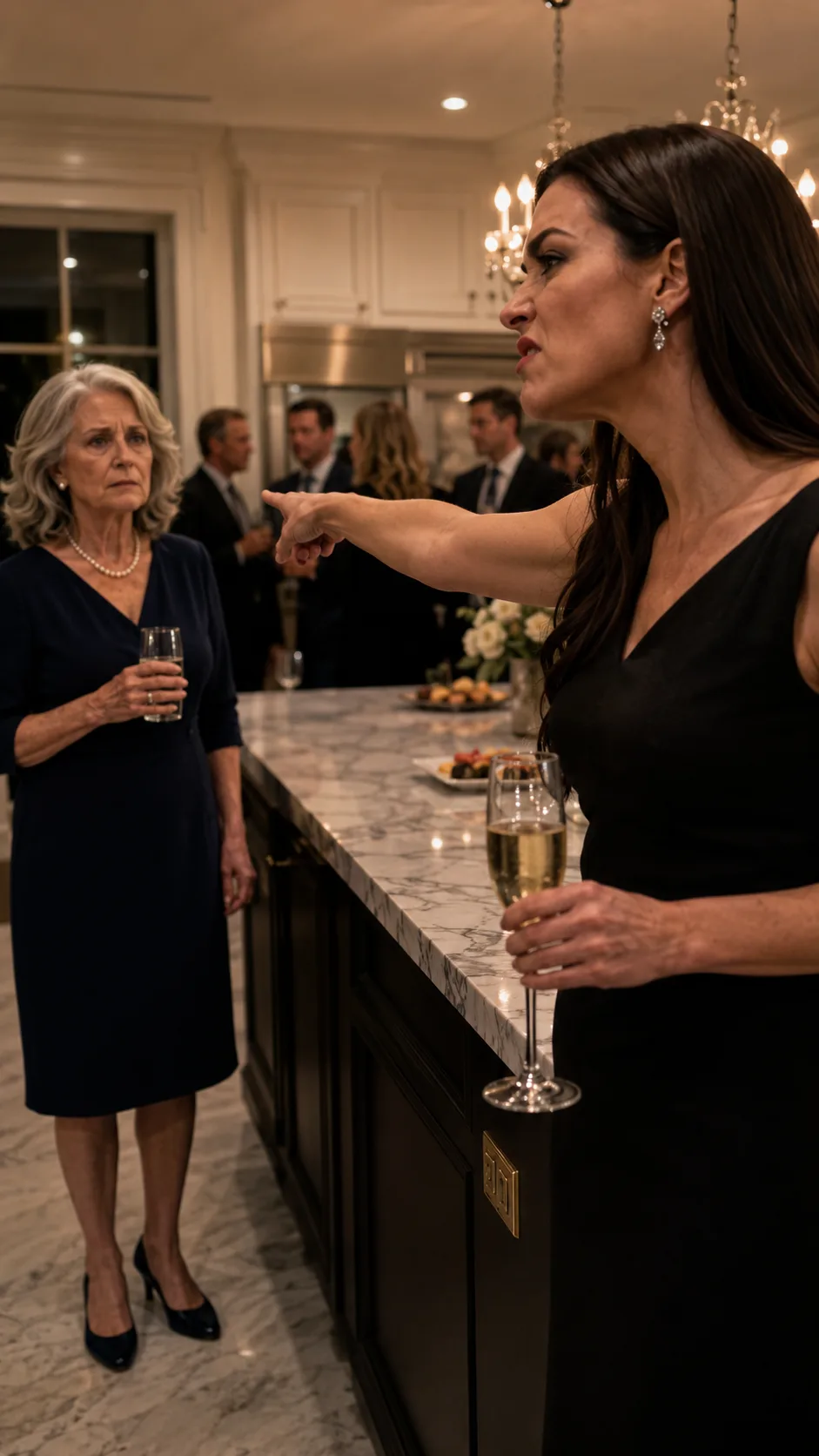
“I told Theo not to invite you,” she said, low enough that no one else could hear. “Please try not to embarrass me. Just stay near the food and don’t talk to the Hendersons.”
Every word landed clean.
Sharp things often do.
The Hendersons were partners from her old firm. She had been trying to recruit them for two years, according to Theo, who had mentioned it once while slicing roast chicken at my house.
I looked at Camille’s face.
Not the party face.
The face under it.
Then I said, “I’ll do my best, dear.”
She patted my arm.
Actually patted it.
Then she drifted back toward the room that mattered.
I carried my casserole to the kitchen island and set it among catered platters that looked like they had been arranged with tweezers. I poured myself a glass of water. I stood near the food, as instructed.
Theo found me a few minutes later.
He looked handsome in a blue shirt with the sleeves rolled up, carrying himself with the tired pride of a husband who wanted everything to go well.
“Mom,” he said, hugging me.
He smelled like aftershave and stress.
“You okay?”
“I’m wonderful.”
He kissed the top of my head.
That used to annoy me when he became taller than I was. Now I mostly let him.
“Camille’s been pulled in every direction tonight,” he said. “You know how these things are.”
“I do.”
“She’s glad you’re here.”
“No, she isn’t.”
I did not say it.
I thought it.
He squeezed my shoulder and went back to refilling drinks.
He did not see what was happening.
He almost never sees what is coming when love is standing in front of it.
_Click the blue “PART 3” below to read the next part: 👉 PART 3 👈_
Chapter complete
You have reached the end of this chapter.
Continue reading
A few more worlds to get lost in after this chapter.