PART 2 — THIRTY DAYS TO LEAVE MY HOUSE
She answered on the second ring.
Chapter 2
PART 2 — THIRTY DAYS TO LEAVE MY HOUSE
She answered on the second ring.
“Candace? It’s late.”
“No,” I said, because she had asked if everything was okay before I could stop her. “It’s not.”
I told her what had happened.
Not just the television. I told her about the four years before that, because once I began, the pattern became impossible to ignore. Lorraine moving the canned goods and calling my system outdated. Lorraine replacing the floral curtains James and I had chosen together because they were too heavy and made the room look older. Lorraine sliding into my kitchen, my holidays, my shopping lists, my routines, always under the banner of helping. Samuel nodding along or saying nothing or offering those soft, cringing excuses weak men manufacture when they want peace more than they want decency.
Grace let me speak.
When I finished, she said, “Do they pay rent?”
“No.”
“Written lease?”
“No.”
“Utilities?”
“In my name. Everything.”
“And the deed?”
“Only
mine. James left the house to me. It’s free and clear.”
I could hear papers shifting on her end. Grace had always sounded like she was organizing the world while she spoke. “All right,” she said. “Then this is not a family disagreement. It’s an occupancy issue. You gave them permission to stay. You can revoke it.”
My throat tightened. “Even if it’s my son?”
“Especially if it’s your son,” she said. “Strangers know they’re crossing lines. Family convinces you the lines shouldn’t exist at all.”
I sat down on the edge of the bed. “What do I do?”
“You come to my office at eight tomorrow. I’ll prepare a notice terminating their right to occupy the property and a formal demand to vacate within thirty days. My associate Marcus Carter will serve it. After that, all communication goes through me.”
“Thirty days.”
“Yes.”
Thirty days sounded both swift and
impossibly long. Thirty days to undo four years. Thirty days to break the arrangement I had been too ashamed to question because it was built out of my own son’s dependence.
Grace must have heard something in my silence because her voice softened a fraction.
“Candace,” she said, “I need you to listen carefully. Protecting what belongs to you is not cruelty. It is not selfishness. And it is not a moral failure because the people taking advantage of you share your last name.”
I closed my eyes.
From somewhere deep in memory, James’s voice rose up as clearly as if he were beside me: Don’t confuse kindness with surrender, honey. They aren’t cousins.
I swallowed. “All right.”
“Good. Get some sleep. Tomorrow will be ugly.”
After she hung up, I ordered a turkey club, fries, and coffee from room service because I suddenly realized I was hungry in the
way people are hungry after shock, not just for food but for proof that they are still a person with appetites and choices.
I ate in bed while the local late news played at the exact volume I wanted.
No one came in and changed the channel.
That mattered too.
—
I was at Grace’s office on North Duke Street before eight.
Her waiting room had dark leather chairs, a ficus tree that looked as if it had been thriving under threat for twenty years, and a receptionist named Dana who offered me coffee in a white porcelain cup instead of paper. Grace came out exactly three minutes past the hour with a thick folder under her arm and the expression of a woman already planning three moves ahead.
She hugged me once, briefly, which surprised me.
Then she got practical.
The documents she laid out across her conference table were cleaner and more precise than the anger boiling under my ribs. Termination of permissive occupancy. Notice to vacate within thirty days. Notice that all future communication regarding the property would be directed to counsel. She explained each page, each deadline, each possible response Samuel and Lorraine might attempt.
“They may try to argue tenant rights,” she said. “But they never paid rent. They may try guilt. That one usually lands harder.”
I let out a dry laugh. “Guilt has been doing their heavy lifting for years.”
“Then we take that away too.”
I read every line before signing.
I had spent thirty-three years in county records. I knew what sloppy paperwork could cost people. I also knew the power of clean documentation. My signature on those pages did not feel vindictive. It felt clarifying. Like scrubbing a window that had gone cloudy over time until you could finally see what was on the other side.
Candace Montgomery.
Candace Montgomery.
Candace Montgomery.
My name looked stronger every time I wrote it.
When I finished, Grace slid the papers into a folder and handed another copy to Marcus Carter, who had joined us halfway through. He was in his thirties, sharp navy suit, quiet eyes, the kind of man who had built a career on staying calm while other people panicked.
“I’ll serve them this morning,” he said.
I nodded. “They’ll scream at you.”
He almost smiled. “I’m a lawyer, Ms. Montgomery. It’s not my first front porch.”
After Marcus left, Grace folded her hands and looked at me over the table.
“What now?” I asked.
“Now you do not pick up the phone unless you want to,” she said. “Now you do not explain. Now you do not apologize for using the law the way it is intended to be used. And if you want my honest advice, you begin separating every practical thing they’ve been leaning on that belongs to you.”
“Utilities.”
“Yes.”
“Credit cards.”
“Yes.”
“Internet.”
She held my gaze. “Candace. Stop subsidizing the people removing you from your own life.”
I went back to the hotel and did exactly that.
I called the internet provider first. Suspended service at the house effective by afternoon. Canceled cable completely, including the sports package Lorraine insisted was essential for her “client entertainment” even though most of her clients appeared to be women she met for brunch and then described online as professional collaborators. The landline too.
Then I logged into my bank account.
Samuel’s supplementary card had been added seven years earlier after he called me from the side of Route 283 with a dead battery and an empty checking account. “Just for emergencies, Mom,” he had said. And because mothers have a special talent for hearing the child under the man, I had believed him.
Groceries. Gas. Restaurants. A television. A standing mixer Lorraine swore would pay for itself because she was “building a food content brand.” There it all was, transaction after transaction, little conveniences that together formed a lifestyle.
I removed his access.
Then I called the bank and placed a flag on the account so no new credit could be opened using my address without direct verbal authorization from me. Paula from fraud prevention handled it in the calm tone of someone who had seen every flavor of family collapse money could trigger.
“Would you like an additional watch note on property-based lending tied to your address?” she asked.
“Yes,” I said immediately.
She added it.
By noon, I had shut off more than utilities.
I had shut off assumption.
—
The first call from Samuel came at 9:37 a.m., less than twenty minutes after Marcus reached the house.
I let it ring four times before answering.
“Mom, what the hell is going on?” he blurted.
In the background I could hear Lorraine’s voice, high and sharp, saying, “Don’t take anything from him. Tell him she can’t do this. This is illegal.”
I pictured Marcus on my front porch, folder in hand, looking exactly as unbothered as he had promised.
“The man at the door is Marcus Carter,” I said. “He is serving you formal notice. You and your wife have thirty days to leave my house.”
A beat of stunned silence.
Then Samuel said, “Mom, come on.”
Not I’m sorry. Not How did we get here. Not Lorraine never should have said that.
Come on.
The phrase landed like an insult.
“Where,” I asked quietly, “did you expect me to go yesterday?”
“What?”
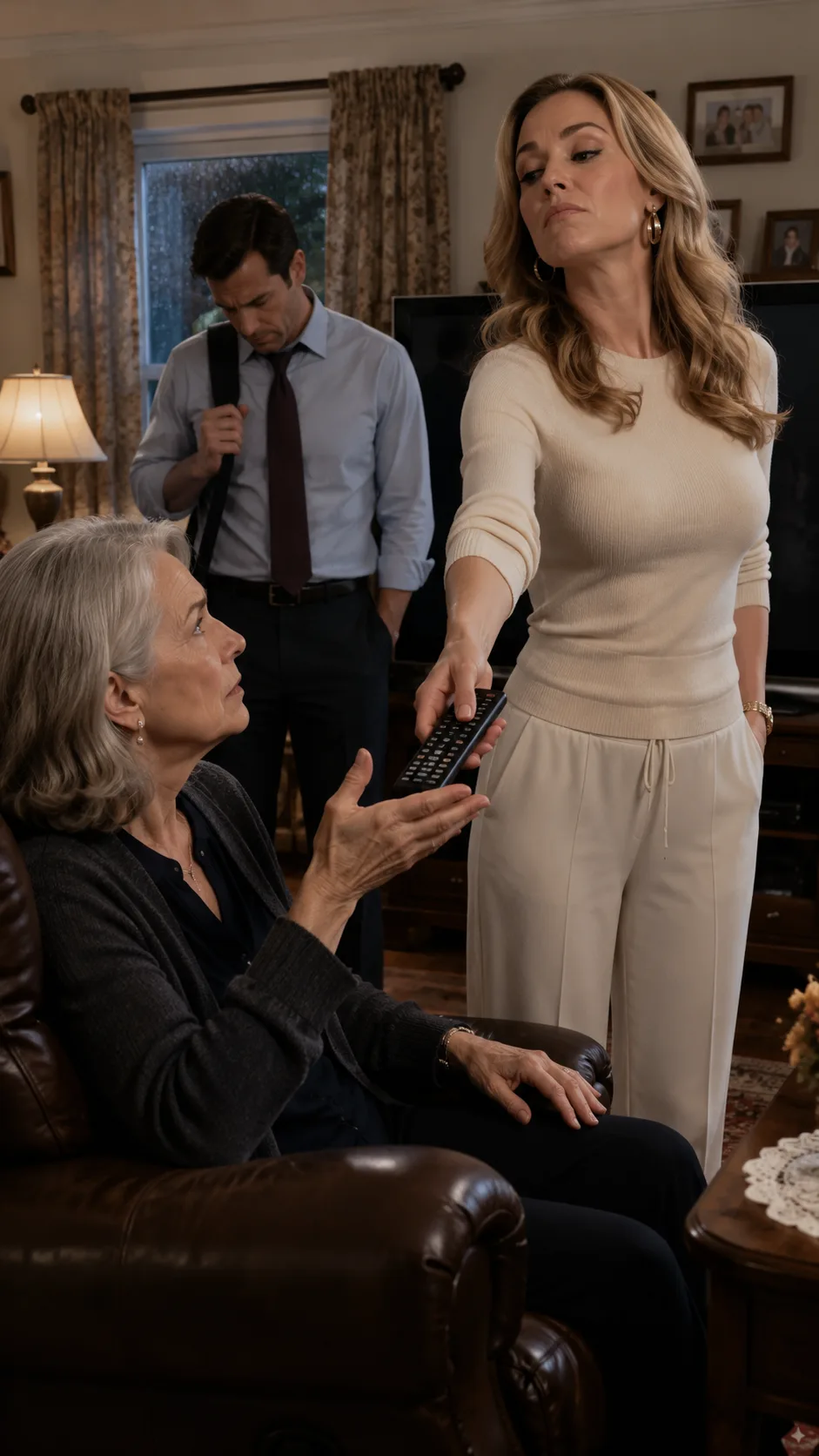
“When Lorraine told me the family room was hers now and I could watch TV in my bedroom, where exactly did you think that was headed for me?”
“Mom, you’re blowing that out of proportion.”
“Am I?”
More muffled noise. Lorraine again, louder now. “Tell her the internet’s off. Ask her what she thinks she’s doing.”
I took a slow breath. “Lower your wife’s voice,” I said. “Marcus is doing his job.”
“This is insane,” Samuel snapped. “The internet just went down and the card got declined at the grocery store.”
“Yes,” I said. “I know.”
Another silence, but this one was different. This one held the first crack of understanding.
“You did that?” he said.
“I stopped paying for your life.”
“Mom—”
“You have thirty days,” I said. “Talk to Grace Hartwell’s office if you have questions.”
Then I hung up and turned my phone face down on the table beside my coffee.
My breakfast was getting cold. Eggs, toast, fruit. It looked absurdly elegant against the chaos of my life. I sat by the hotel window and forced myself to finish half the plate while downtown traffic moved in careful ribbons below.
My heart was racing. My hands were not.
That distinction would matter later.
Around one, I walked to a department store on King Street and bought myself armor.
That was not what the saleswoman called it, of course. She called it a blazer.
But when she handed me a structured camel jacket, a crisp white blouse, navy trousers, and a pair of leather pumps with a low enough heel to mean business without courting pain, I knew exactly what I was purchasing. Not youth. Not reinvention. Not revenge.
Authority.
In the dressing-room mirror I did not look younger. I looked legible. Like a woman whose signature mattered.
On my way back to the hotel, my phone lit up with a bank alert.
Transaction declined: $92.14.
Merchant: Premium Meats.
I stood on the sidewalk in front of a boutique that sold decorative wreaths and laughed out loud for the first time in two days.
Lorraine had tried to buy expensive steak with a card that no longer belonged to her life.
Good.
Let dinner be awkward.
—
Samuel came to the hotel that evening.
He called first.
“I’m downstairs,” he said, sounding as though he had aged three years in one day. “Please. I just need ten minutes.”
I almost refused.
Then I thought of all the years I had spent receiving people in my house as if access to me were automatic. This time, I would choose the setting.
“Five,” I said. “Lobby.”
I changed into the new clothes before going down.
That may sound theatrical. Maybe it was. But grief and anger can make a woman feel shapeless, and I needed every seam on that blazer to remind me where I began and ended. When I stepped into the lobby, Samuel looked up from his chair and blinked.
“Mom,” he said. “You look…”
“Different?”
He nodded.
“I am.”
We sat in a corner near a potted plant with leaves too glossy to be real. A jazz standard played quietly over the speakers. Somewhere behind the bar, glasses clinked. Ordinary hotel life went on while my son tried to negotiate his way back into dependence.
“Turn the internet back on,” he said immediately. “Lorraine needs it for work.”
I folded my hands in my lap. “No.”
“Mom, be serious.”
“I am serious.”
He dragged a hand through his hair. “We don’t have the money right now to just set everything up somewhere else.”
I watched his face while he said it.
No performance. No calculation. Just strain.
That shook me more than I wanted it to.
“You’ve lived in my house for four years,” I said. “No rent. No utilities. No mortgage. Samuel, where is your money?”
He stared at me. “What?”
“You work full-time. Lorraine works, supposedly. You’ve had almost no overhead for four years. Where is the money?”
He looked away first, which was answer enough.
“It’s invested,” he said.
“In what?”
“Things Lorraine’s been managing.”
There it was.
Not just passivity. Abdication.
“She said we were building something,” he added weakly.
I felt a rush of pity so sharp it almost knocked the anger out of me. My son, forty-one years old, sitting in a hotel lobby asking his mother to restore his internet because his wife had apparently “managed” his adulthood on his behalf.
Then he made his mistake.
“Mom,” he said, lowering his voice, “we were going to tell you soon, but we’ve been talking about starting a family. Lorraine’s looking at cribs. Don’t you want to be part of that? Don’t you want to know your grandchild?”
The words entered me like a key seeking an old lock.
For one dangerous second I saw it all. A crib in the spare room. A baby carried down my hallway. James’s smile in another face. The future, tender and redemptive and easy.
Then I looked at Samuel more closely.
He was not offering me joy.
He was offering me bait.
“Is Lorraine pregnant?” I asked.
He hesitated.
“No. But we’re trying.”
“Then do not use a child who does not exist to negotiate with me.”
His face changed. Hurt. Shame. Irritation at being caught.
“That’s not what I’m doing.”
“That is exactly what you’re doing.”
He leaned back in the chair as if I had slapped him.
I stood.
“Tomorrow at ten,” I said. “You and Lorraine will meet me at Grace Hartwell’s office with every bank statement, brokerage statement, loan document, and credit-card bill you have. If your wife has been managing your finances, we’re going to find out what that means in actual numbers.”
“Mom, we don’t need lawyers—”
“Yes,” I said. “We do.”
I turned toward the elevator.
Behind me his voice broke. “If we lose the house, Lorraine says she’ll leave me.”
I stopped and looked back.
“If your marriage depends on my square footage,” I said, “that is not a marriage. That’s a hostage note.”
Then I got in the elevator and left him standing there.
When I reached my room, I locked the door and cried so hard my ribs hurt.
Not because I wanted to reverse anything.
Because I finally understood how much there was to reverse.
—
That night was the closest I came to surrender.
I sat on the edge of the bed in the yellow hotel lamplight with my phone in my hand and Grace’s name open on the screen. One call and I could soften this. Delay it. Rephrase it. Offer terms that looked more maternal and less brutal. Turn the cable back on. Reinstate the card. Call Samuel and say we had all overreacted and could sit down at the house like civilized people.
I knew exactly what that script would sound like because I had delivered versions of it my whole life.
Smooth. Reasonable. Self-erasing.
The problem was that once you see the machinery clearly, stepping back into it becomes its own kind of violence.
I put the phone down and took James’s photo out of my wallet.
It was a small picture from our twenty-fifth anniversary dinner at a steakhouse on the edge of York. He was in his good charcoal suit, smiling at the camera with the easy confidence of a man who expected life to be difficult sometimes and still believed that decency was worth maintaining. I had carried that photo for years and almost never looked at it because grief, unlike movies, is not softened by repetition. Sometimes it gets sharper.
I remembered a conversation from years earlier.
I had been upset about a fraudulent transfer at work, one of those cases where an elderly woman signed papers she did not understand because the person holding the pen was someone she loved. I had come home sick about it, telling James I hated how ugly money made families.
He had been tightening a hinge on a kitchen cabinet at the time.
Without even looking up, he said, “Selfish is taking what isn’t yours, Candace. Protecting what is yours is just common sense. Don’t let people blur that on you because they know you hate feeling hard.”
I sat with that memory until it settled.
Then I texted Grace: I’ll be there tomorrow. No changes.
Her response came less than a minute later.
Good.
I slept badly, but I did sleep.
Sometimes survival is nothing more glamorous than that.
—
Grace’s conference room was all leather chairs, walnut table, city view, and consequence.
I got there early because I could not bear the idea of arriving flustered. Grace had water set out and files arranged in neat stacks. Marcus joined us with a padfolio and two extra pens. At 9:58, the door opened.
Samuel came in first.
He looked hollowed out. Shirt wrinkled. Stubble he had missed along one side of his jaw. Eyes swollen the way men’s eyes get when they have spent the night arguing and still somehow tell themselves the argument is not the real problem.
Lorraine came in behind him wearing dark jeans, expensive sneakers, and a sweatshirt that said curated life in small script across the chest.
The irony almost made me laugh.
She sat down across from me and did not bother with greeting.
“This is ridiculous,” she said. “We’ve lived there for years. You can’t just decide we’re out because you got upset over a misunderstanding.”
Grace folded her hands. “Mrs. Montgomery, the homeowner has revoked permission for you to occupy the property. My client’s position is clear.”
Lorraine gave a short, humorless laugh. “Position? We have rights. We’ve established residency. There are protections.”
“Residency,” Grace said evenly, “is not the same thing as ownership.”
“We can fight this.”
“You can attempt to.”
Lorraine leaned forward. “Maybe we should talk about why she’s suddenly acting like this.”
There it was. I heard it before she finished the sentence.
That old, ugly tactic in a younger woman’s lipstick.
“She’s sixty-seven,” Lorraine said, turning to Grace with performative reluctance. “She’s been alone a long time. Isolated. Lately she’s been… forgetful. Suspicious. Making things into attacks that aren’t attacks. I’m honestly worried there’s something going on cognitively.”
Samuel did not interrupt her.
He did not back her up either.
He simply sat there in the middle, which was where he had always preferred to be when something cowardly needed room to bloom.
My stomach dropped, but not from surprise.
From confirmation.
“People your age can get fixed ideas,” Lorraine continued, her voice full of false gentleness. “I don’t want to be cruel. I just think maybe we should be discussing an evaluation instead of an eviction.”
“Stop,” I said.
The word cracked across the room harder than I intended.
Lorraine blinked.
I opened my briefcase, took out a single stapled packet, and slid it across the table to her.
“What is this?” she asked.
“Read it.”
Grace glanced at me, then leaned back with the smallest flicker of approval in her eyes.
Lorraine scanned the first page. Color drained from her face so fast it looked theatrical.
The packet was a full cognitive assessment from Dr. Gerald Reeves, a neurologist Grace had recommended the morning after I left the house. I had scheduled it not because I doubted myself, but because I had spent too many years watching adult children turn age into legal leverage. The report was thorough, clinical, and devastatingly clear: intact memory, intact executive function, excellent reasoning, no evidence of impairment, decision-making capacity fully preserved.
At the bottom, Dr. Reeves had written in his own hand: Ms. Montgomery demonstrates above-average mental acuity and strong insight. No concerns.
Lorraine put the pages down as if they might stain.
“I had that evaluation done last week,” I said. “Because I knew exactly what a woman like you would try once she realized I had stopped being easy.”
No one spoke.
Marcus wrote something on his pad.
Grace broke the silence. “Let the record reflect that any insinuation regarding my client’s competency is unsupported and directly contradicted by medical documentation.”
Samuel closed his eyes.
For one brief second, he looked less like a husband defending his wife than a man finally seeing the floor open under him.
Then Grace turned a page and said, “Now. Finances.”
That was where the meeting stopped being emotional and started being fatal.
—
I had not spent the previous evening crying only to arrive unprepared.
While Samuel and Lorraine slept, fought, or lied in my house, I had called in every skill I had built over decades of noticing how paper trails behaved when people were desperate. Grace had subpoenaed nothing yet. She did not need to. Samuel had sent over enough in a panicked email before dawn to make the outline visible, and what his documents didn’t show, my own accounts did.
I placed the first stack of statements on the table.
“Four years ago,” I said, “when you moved in, Samuel had approximately twenty-eight thousand dollars in savings. Correct?”
Samuel rubbed his eyes. “Around that.”
“You both told me you were saving for a down payment.”
Lorraine said nothing.
“You have lived in my house for four years. No rent. No water bill. No electric bill. No mortgage. No property tax. No cable bill. No grocery bill a lot of the time either, if we’re being honest.”
I slid over a printout Grace and I had prepared the night before.
“Conservatively,” I said, “two thousand dollars a month in saved housing costs alone. Over forty-eight months, that is ninety-six thousand dollars.”
The number sat there between us.
Ninety-six thousand.
The kind of number that should have bought stability. The kind of number that had instead bought me replacement curtains and disrespect.
I added another page.
“Combined estimated income over the same period, after taxes and after modest personal expenses? Enough that you should have had over one hundred ten thousand dollars liquid even if you were careless.”
Samuel looked at Lorraine. “We had that, right?”
She still did not answer.
Grace pushed forward the brokerage statement.
Margin account.
Leveraged positions.
Liquidations.
Losses.
Samuel stared at the pages as though they were written in another language.
“What is this?” he said.
Lorraine sat straighter. “It’s not what it looks like.”
“It looks,” Grace said mildly, “like someone with no meaningful risk tolerance and no capital cushion decided she was a day trader.”
“That’s unfair.”
“Is it inaccurate?”
Lorraine’s jaw tightened.
I placed the next document down: a personal loan for fifteen thousand dollars.
“Home improvement,” I read from the line item. “What home improvement, Lorraine?”
Her eyes flicked toward me. “Furniture. Décor. Things for the house.”
“My house,” I said.
Another statement. High-end stores. Boutique home accessories. Restaurant tabs big enough to feed six people. Sports subscriptions. Cosmetics. Clothing. A weekend spa package in the Poconos billed to a card Samuel apparently thought was paying off monthly out of income that did not exist.
With each page, his face lost more color.
At last Grace set down the final printout.
Current account balance: $347.12.
Liabilities exceeding assets.
“You’re not building a future,” I said quietly. “You’re underwater.”
Samuel made a sound I had never heard from him. Not quite a gasp. Not quite a curse. The sound of a man seeing his own life from outside it and not liking the view.
Lorraine’s eyes filled with tears, but anger stayed behind them like a flame.
“I was trying to make us more,” she said. “I was trying to elevate our life. I was trying to create something better than your little small-town survival mentality.”
There was so much naked contempt in that sentence that for one suspended second even Samuel seemed to forget to breathe.
“My small-town survival mentality,” I repeated.
“Yes,” she snapped, now too far into herself to stop. “All you ever think about is bills and rules and keeping things exactly the same. Some of us want more than canned soup on a top shelf and cable news at six o’clock.”
I should have been wounded.
Instead I felt an almost miraculous calm.
Because there it was. Unvarnished. The truth that had been hiding under all those polite improvements.
She had never wanted to share my home.
She had wanted to graduate out of me.
Grace cleared her throat. “Mrs. Montgomery,” she said, meaning me, “state your terms.”
I looked at my son. Then at his wife. Then at the neat stack of papers that had turned their marriage into arithmetic.
“Thirty days,” I said. “No extensions. Utilities remain off. No access to my accounts. Marcus will coordinate retrieval of my personal belongings from the house. If there is damage, destruction, or harassment, we add claims. If anyone attempts to encumber the property, we involve law enforcement. You will leave quietly or you will leave with the sheriff.”
Samuel’s mouth moved before sound came out. “Mom… where are we supposed to go?”
That question would have broken me a month earlier.
Now it only made me tired.
“I don’t know,” I said. “And it is no longer my responsibility to solve that for adults who had four years to prepare.”
I stood.
Lorraine stood too, chair scraping hard against the floor. “You’ll regret this,” she hissed. “Everyone will know what kind of mother you are.”
“Then tell them,” I said. “Make sure you include the loan documents.”
I walked out before either of them could answer.
Behind me, I heard Lorraine begin to cry.
It sounded furious.
—
Samuel called from the parking lot fifteen minutes later.
I almost let it go to voicemail. Then I answered.
“Mom,” he said, and his voice was so broken it startled me. “I didn’t get in the car with her.”
I leaned against the hallway wall outside Grace’s office. “What do you mean?”
“She’s downstairs. She’s screaming. She hit the steering wheel so hard I thought she’d break it.” He inhaled shakily. “I told her I needed a minute. I walked away.”
I closed my eyes.
For the first time in days, I felt something other than anger and grief.
Not forgiveness.
Possibility.
“I called Kevin,” he said. “I didn’t know who else to call. And he told me something.”
Kevin was Samuel’s college friend, the one with the barbecue every Labor Day and the wife who sent Christmas cards in matching sweaters whether anybody deserved it or not.
“What?” I asked.
A pause.
“Lorraine told people the house was ours,” he said. “She told everyone you lived with us because you couldn’t afford to be on your own. Said we took you in. That you were staying there out of kindness.”
My grip tightened on the phone.
“She said that?”
“Apparently for a while. Kevin said people have been telling him what a good son I am for supporting you. He thought I knew. Mom, I didn’t know.” His voice cracked again. “I swear to God, I didn’t know.”
The humiliation of it rolled through me slow and poisonous. Women at church. Neighbors. People in line at Central Market maybe looking at me with pity and me never understanding why. My own invisibility had been turned into their charity performance.
Samuel exhaled hard into the receiver. “I’m filing for divorce.”
The sentence landed between us like glass set carefully on a table.
“Are you sure?” I asked.
“Not because of the money,” he said quickly. “Or not just because of that. Mom, when she tried to make you sound confused in there, I almost…” He stopped. “I almost let her. I almost sat there and let my wife build a case that my mother didn’t know her own mind because it was easier than calling her a liar in the moment. I don’t know how to live with that if I stay.”
I listened to him breathing.
There are moments when motherhood asks for comfort and moments when it asks for truth. This was the second kind.
“Seeing it late is not the same as never seeing it,” I said. “But do not confuse regret with repair. You still have a lot to do.”
“I know.”
“Where are you?”
“In the lot. By my car.”
“Go anywhere else,” I said. “Not back to the screaming. Call Kevin again. Get a room. Sleep. Tomorrow we can have coffee, but not as if nothing happened.”
He made a sound that might have been a laugh or a sob. “Okay.”
“And Samuel?”
“Yeah?”
“We are not returning to the version of me that made your life easier.”
His silence this time held understanding instead of avoidance.
“I know,” he said.
—
I met him the next morning at a coffee shop near Franklin & Marshall.
It was one of those places with reclaimed wood tables, earnest chalkboard menus, and students tapping on laptops as if caffeine were a moral virtue. Samuel looked worse in daylight. He had spent the night on Kevin’s couch and wore the same wrinkled shirt from the day before.
I brought my own spine with me.
He started apologizing before we sat down.
I held up a hand. “Sit first.”
We ordered coffee. Black for me, because that was how I liked it when no one was around to call it too strong. Something overly sweet for him that he barely touched.
Then I let him speak.
He told me pieces I had not known. Lorraine had managed all their savings because she was “better with money.” He had let her. She had framed every concern as negativity, every question as disloyalty. When she told friends the house was theirs, she said it so casually he assumed she meant emotionally, not literally. When she redecorated, controlled menus, repositioned me in my own home, he told himself marriage required taking his wife’s side on domestic matters.
“Domestic matters,” I repeated. “Samuel, she turned me into an accessory.”
His eyes flooded. “I know.”
“No,” I said, softer now. “You know now.”
That distinction mattered.
He wiped his face with both hands. “I loved her.”
“I believe that.”
“And I think I was scared of what it meant if I admitted who she really was.”
“I believe that too.”
He looked at me across the table with the lost, appalled honesty of a boy who had just realized adults could ruin themselves voluntarily.
“What happens now?” he asked.
“For you?”
He nodded.
“You find a lawyer. You separate your money. You stop lying to yourself. You get an apartment you can afford. You learn how many things you outsourced because being passive felt gentler than being responsible.”
A humorless half-smile pulled at one side of his mouth. “That sounds expensive.”
“It is,” I said. “Adulthood often is.”
He looked down at his cup. “What about us?”
That was the only question I had dreaded.
Not because I didn’t know the answer.
Because I did.
“We are not finished,” I said. “But we are not repaired either. You do not get your key back. You do not move in when things get hard. You do not become my dependent with better manners. If we have any relationship after this, it will be between two adults who understand that love does not erase boundaries.”
He swallowed. “Okay.”
“Can you live with that?”
He looked up at me. “If the alternative is losing you entirely? Yes.”
That was not forgiveness.
But it was the first honest bargain he had offered me in years.
—
By the end of the first week, Lorraine had taken to social media.
Beverly, my next-door neighbor for nineteen years and the kind of woman who always knew which tree on the block had to come down before the township noticed, texted me a screenshot.
You need to see this before someone else shows you, she wrote.
Lorraine’s post was careful in the way malicious things often are. No names. No dates. A pale-filtered selfie with sad eyes and the caption: Sometimes the people who should love you most are the ones who abandon you when you need compassion.
The comments were full of sympathy.
Praying for you.
Some mothers don’t deserve their children.
You and Samuel are saints.
A second post followed the next day, then a third. Elder abuse goes both ways. Hard seasons reveal people’s true hearts. Family isn’t always safe.
The language was vague enough to dodge immediate consequences and specific enough to stain.
I called Grace.
“She’s being strategic,” Grace said after I sent the screenshots. “Not actionable yet. Save everything. Do not respond publicly.”
“She is lying about me to people I know.”
“Yes,” Grace said. “And if you jump into the mud with her, she gets the theater she wants.”
So I waited.
Waiting, I would learn, is not the same thing as doing nothing.
Beverly came by the hotel that evening with a bakery box from La Dolce Vita and enough righteous anger to power a small town.
“She has some nerve,” she said before she was even fully inside. “Posting like she’s some persecuted little orphan while she’s been parked in your house rent-free like a raccoon in a chimney.”
I laughed despite myself. “Beverly.”
“I mean it.” She set the box on the desk. “People are whispering. Margaret Fisher asked me at Weis if you’d had some kind of breakdown. I told her if anybody’s breaking down, it’s because they finally found out you’re not soft enough to rob forever.”
I sat down on the chair by the window and looked at my friend.
Sometimes support does not arrive tenderly.
Sometimes it arrives wearing a fleece vest and bringing cannoli.
“Thank you,” I said.
Beverly sat on the bed and crossed her arms. “You know what really has me wild? I’ve seen women do this before. My sister-in-law practically moved room by room through my mother’s house after her hip surgery. Replaced things, moved things, called everything old-fashioned until my mother started asking where she was allowed to keep her own teacups.”
The sentence sat between us.
Then another truth emerged from it.
I was not an isolated disaster.
I was a pattern.
That realization did not comfort me.
It galvanized me.
—
The public reversal came on day twelve.
Samuel posted the truth.
I did not ask him to. In fact, I didn’t know he planned to until my phone began buzzing with screenshots from Beverly, Patricia, and three people I had not spoken to in months.
His statement was plain, unspectacular, and devastating.
My mother did not abandon me, he wrote. She asked my wife and me to leave her home after four years of us living there without paying rent while our finances were mismanaged. The house was always hers. Recent posts suggesting otherwise are false. I am separating from my wife and taking responsibility for my own part in what happened.
That was it.
No flourish. No blame shifting. No plea for sympathy.
Just fact.
The effect was immediate.
Lorraine’s posts disappeared within hours. Her friends went quiet. People who had admired her online image of stylish self-possession suddenly had to reconcile it with free housing, debt, and a mother-in-law turned into furniture. There is nothing the internet hates more than being made an accomplice in someone else’s performance.
For the first time since I walked out of the house, the social air shifted in my direction.
Then the bank called.
Day eighteen.
Paula again from fraud prevention.
“Ms. Montgomery,” she said, “we received an application for a home equity line of credit using your property as collateral. We flagged it because of the restrictions on your account.”
I sat up so quickly the coffee on my nightstand sloshed.
“I didn’t apply for anything.”
“We know. The applicant listed herself as Lorraine Montgomery and represented herself as an owner or co-owner.”
For a second my vision blurred.
Not from confusion. From rage so clean it almost felt medicinal.
“She is neither,” I said. “She is currently under notice to vacate.”
Paula’s tone turned colder. “Then we’re marking this as attempted fraud and forwarding the documentation per protocol. You should notify your attorney immediately.”
Grace was already drafting a cease-and-desist letter by the time I reached her.
“If she touches one more corner of this,” Grace said, “I will stop being civil.”
The loan application stain hit Lorraine where it hurt. Her credit report. Her rental prospects. Her carefully managed image of competent adulthood. It turned out that performing prosperity is much easier than surviving the paperwork generated by fraud.
Consequences have their own kind of elegance.
—
On the thirtieth day, Marcus called at 4:17 p.m.
“They’re out,” he said.
Just like that.
No orchestra. No thunderclap. No final screaming scene on the lawn. Just three words from a steady man in a navy suit.
“They left the keys on the kitchen counter. I already had the locks changed. There’s some wall damage, scuffs on the hardwood, and frankly terrible curtain choices, but nothing catastrophic.”
I sat very still on the spa lounge chair where I had been pretending to enjoy herbal tea while another woman talked too loudly about Pilates. “And Samuel?”
“He was there for the final handoff,” Marcus said. “He stayed quiet. Helped load boxes. He left separately.”
I thanked him, ended the call, and drove straight to the house.
I stopped first at Lowe’s for cleaning supplies, garbage bags, a basic toolkit, and a new welcome mat because symbolism has practical uses too. The teenage cashier asked if I needed help out to the car and I nearly told him he had no idea what a kind question that was.
Dusk had begun to settle by the time I turned into the driveway.
My house stood exactly where it always had, brick front damp from an afternoon mist, porch light catching the new brass of the lock. The sight of it made my chest ache in a place beyond easy naming. Grief. Relief. Fury at what had been done inside it. Gratitude that I still had the legal power to walk up and open the door.
The key turned smoothly.
Inside, the house smelled like stale air freshener, dust, and the ghost of someone else’s taste.
I set my bags down in the entryway and listened.
Silence again.
Not hotel silence.
Home silence.
I walked through the family room first. Of course I did.
The gray curtains Lorraine had installed still hung there, making the room look like a corporate waiting area. The sofa was gone. So were the decorative trays, fake greenery, and the cursive wall sign that said gather as if the word itself created warmth. My old brown recliner remained, pushed too far into one corner, as if they had tried to exile even the furniture that belonged to me.
I crossed the room and put my hand on one arm of the chair.
Then I laughed, once, quietly.
“Still here,” I said aloud.
The sound of my own voice in that room felt like the first real blessing it had heard in years.
I opened every window in the house.
November air came through like judgment.
Then I worked.
I stripped beds, emptied cabinets, wiped shelves, threw away expired food Lorraine had bought because it looked aspirational and never cooked because aspiration, unlike soup, does not sustain anyone. I took down the gray curtains and boxed them for donation. I found my old floral ones in the linen closet where I had hidden them to avoid an argument and rehung them before midnight, standing on a step stool with my back aching and tears threatening for no dignified reason at all.
The kitchen was worst.
Not because it was dirty.
Because it was arranged like a stranger’s logic had replaced mine. Glasses where mixing bowls belonged. Spices alphabetized but nowhere near the stove. My cast-iron skillet shoved behind baking pans Lorraine never seasoned properly. I fixed it shelf by shelf until my body remembered what my mind had been denied.
Canned goods on the top shelf.
Coffee mugs second row.
Flour where I could reach it without moving six decorative things first.
Order is underrated until someone takes yours away.
At one in the morning, I made coffee in my own kitchen and carried it to the family room. I sat in my recliner, looked at the dark television screen, and set the remote on the table beside me.
No one told me where to watch it.
The room was still bruised, but it was mine.
That was enough for one night.
—
Three days later, Samuel knocked on the front door.
Knocked.
Not walked in.
Not used a key.
Knocked like a visitor.
I stood in the hallway for one full breath before opening it.
He looked smaller somehow. Not physically—though maybe a little thinner—but morally rearranged, as if shame had forced him to take up less air. He held a bakery box in one hand and kept the other jammed in his coat pocket against the cold.
“Hi, Mom.”
“Hi, Samuel.”
We stood there for half a heartbeat, then I stepped aside.
He came in slowly, glancing around as if entering a house he had known in childhood and was not sure he deserved to remember. The fresh sage-green paint in the family room caught his attention immediately.
“You painted it back,” he said.
“It was always meant to be this color.”
He nodded, because there was nothing to say to that.
In the kitchen, I made tea and cut slices of sweet potato pie I had baked that morning. The ordinary domesticity of it almost undid me. For years I had cooked as if apologizing for existing in the same space. Now I moved around my own counters with the automatic ease of ownership. Kettle on. Plates out. Sugar bowl where it belonged.
Samuel watched all of it.
“I forgot,” he said quietly, “how different this house feels when it’s just… yours.”
I set his plate in front of him. “That’s because it should never have felt any other way.”
He took the correction without flinching.
That, too, was new.
We talked for almost two hours.
He had rented a studio apartment on the north side. Small. Bad heat. Upstairs neighbor who apparently enjoyed moving furniture at midnight. He had separated his finances, hired a divorce attorney, and started tracking every bill himself because, in his words, “I’m forty-one and apparently needed a financial collapse to learn what an electric bill actually costs.”
I let that sit.
He deserved the embarrassment.
Then he said, “I’m sorry,” and this time he did not rush past it.
To be continued… Click “PART 3” to read the final part: 👉 PART 3 👈
Chapter complete
You have reached the end of this chapter.
Continue reading
A few more worlds to get lost in after this chapter.




