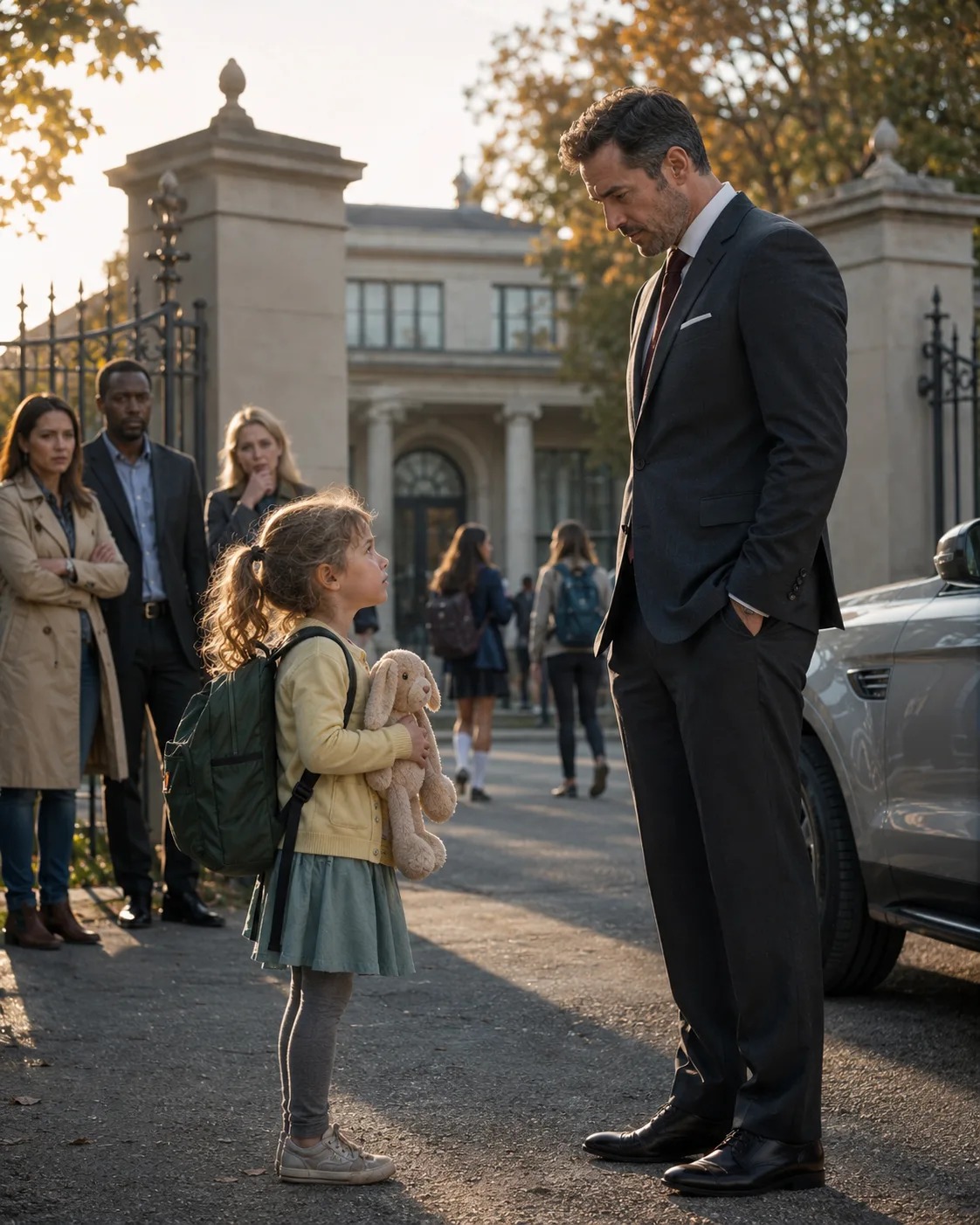
A little girl asked a billionaire stranger to be her dad at the school gate and his answer exposed the cruelty everyone had ignored
Ava looked back.
Chapter 1
Ava looked back.
“You said you watch the gate,” Ethan continued. “Why ask me today?”
For the first time, the steadiness in her face cracked.
“Because today they said it again.”
“Who said what?”
“The girls in my class.” She swallowed. “They said I don’t have a dad because nobody wants my mom. They said we’re poor because she can’t keep a man.”
Lily’s mouth fell open.
Ethan felt something ancient and furious rise in him.
Ava said it flatly, not dramatically. That was how he knew it had been said too many times.
“I used to cry,” she added. “But they like it when I cry, so I stopped.”
Ethan turned toward the school building.
“Where is the office?”
Ava blinked. “Why?”
“Because no child should have to stand alone at a school gate and ask a stranger to become her father just to make cruelty stop.”
Ava stared at him.
Lily
slipped her small hand into Ava’s.
“My daddy sounds serious,” she whispered. “That means people are in trouble.”
The school office smelled of paper, coffee, and old carpet.
Mrs. Grant, the receptionist, looked up as Ethan entered with both girls. Her expression shifted immediately from routine politeness to alarm when she saw Ava.
“Mr. Caldwell, is everything all right?”
“I’d like to understand the after-school arrangement for Ava Parker.”
Mrs. Grant’s eyes moved to Ava, then back to Ethan. “Ava’s mother works until four most days. We let Ava wait here when we can.”
“When you can?”
“It isn’t an official program,” Mrs. Grant said carefully. “We’re short-staffed after dismissal.”
“How long has this been happening?”
Mrs. Grant hesitated.
Ava answered. “Since second grade.”
Ethan looked at the girl. “That’s three years.”
“Yes.”
His jaw tightened.
Mrs. Grant folded her hands. “Mr. Caldwell, her mother is doing her best.”
“I
didn’t suggest otherwise.”
“She’s a very good mother.”
“I believe that.”
The receptionist seemed surprised by his answer.
“I’d like you to call Ava’s mother,” Ethan said. “Please tell her Ava is safe and nothing bad has happened. Tell her someone wants to speak with her about something important, but not frightening.”
Mrs. Grant studied him for a moment. She knew who he was. Most people in Denver did. The Caldwell Foundation had donated to three public libraries and funded a pediatric wing at Saint Anne’s Hospital. But Ethan could see her trying to determine whether his presence would help Ava or complicate her life.
Finally, she picked up the phone.
Marissa Parker arrived at 4:12 with rain in her hair and panic in her eyes.
She came through the door in black work pants, a dark green cleaning-company polo, and sneakers worn smooth at the heel. She was beautiful
in a way exhaustion had not managed to erase, but what struck Ethan first was not her beauty. It was the way she searched the room for her daughter before she looked at anyone else.
“Ava.”
The relief in her voice nearly broke him.
Ava stood from the plastic chair.
“I’m sorry, Mama.”
Marissa crossed the room and placed both hands on her daughter’s shoulders. “Are you hurt?”
“No.”
“Did something happen?”
Ava looked at the floor.
Marissa turned to Ethan. Her expression became guarded so quickly it was almost violent.
“What did she do?”
“Nothing,” Ethan said. “She didn’t do anything wrong.”
Marissa clearly did not believe him. Or rather, she did not believe the world allowed poor single mothers to be called into school offices for positive reasons.
Mrs. Grant spoke softly. “Marissa, this is Mr. Caldwell. Lily’s father.”
Marissa’s eyes sharpened.
Of course she knew him.
Everyone knew men like Ethan Caldwell. They were on billboards for charity events and in society-page photographs beside senators and actresses. Men like him did not usually stand in school offices with women like her unless something had gone terribly wrong.
“What happened?” she asked.
Ethan looked at Ava.
“I think Ava should tell you,” he said. “Not me.”
Marissa knelt immediately. “Baby?”
Ava’s chin trembled.
“I asked him if I could call him Dad.”
Marissa went still.
The room shrank around them.
“You asked a stranger that?” she whispered.
Ava burst into tears.
“I’m sorry,” she sobbed. “They said it again today. About nobody wanting you. About us being poor because you can’t keep a man. I just wanted it to not be true anymore.”
Marissa closed her eyes.
For one second, she looked as if someone had struck her. Then she pulled Ava into her arms so fiercely the girl disappeared against her chest.
“You listen to me,” Marissa said, her voice shaking but steady. “You never have to be sorry for telling me where it hurts.”
Ava cried harder.
“I didn’t want you to be sad.”
“I’m your mother,” Marissa whispered. “I can be sad and still hold you. That’s my job.”
Ethan looked away. Not because he did not care, but because the moment belonged to them.
Lily stood beside him, quiet for once, her fingers curled around his coat.
When Marissa finally stood, her eyes were bright, but her posture had rebuilt itself into steel.
“Thank you,” she said to Ethan, though the words sounded like they cost her. “For bringing her inside.”
“Of course.”
“I’ll take her home now.”
Outside, the rain had become heavy. Ethan saw Marissa glance through the window toward the parking lot, then toward the road beyond it.
“Where’s your car?” he asked.
“Two streets over.”
“In this rain?”
“It’s fine.”
Ava wiped her eyes with her sleeve. Lily looked horrified.
“Daddy,” she whispered, “we have to drive them.”
Marissa heard her. “That’s kind, but we’re fine.”
Ethan recognized the tone. It was not pride. It was survival.
He lowered his voice.
“Let me drive you home. No questions. No conditions. No speech.”
Marissa looked at him.
He added, “I will drop you off, make sure you get inside safely, and leave.”
She wanted to refuse. He could see it.
Then Ava leaned against her side, exhausted.
Marissa looked at her daughter and surrendered.
“Okay,” she said. “Thank you.”
The ride was mostly quiet.
Lily and Ava sat in the back, gradually recovering into the strange resilience of children. Within ten minutes, they were discussing whether dragons counted as animals if they could talk. Ava argued no. Lily argued yes, because “talking doesn’t make you not an animal, it just makes you bossy.”
Marissa sat in the front, hands folded tightly in her lap.
Ethan did not fill the silence.
He had built a company from a family inheritance everyone expected him to waste. He had learned when to speak, when to wait, when a person’s dignity was the only thing they had left to control.
Marissa directed him to a three-story apartment building on the edge of an older neighborhood. The brick exterior was cracked near the stairs. The lobby light flickered.
When he parked, she unbuckled her seatbelt.
“Thank you for not making a scene at the school.”
“She wasn’t asking for a scene,” Ethan said. “She was asking for help.”
Marissa’s face tightened.
“She shouldn’t have to be brave like that. She’s eight.”
“No,” Ethan said. “She shouldn’t.”
Marissa looked toward the building.
“I work two jobs. I pack her lunch. I wash her uniforms. I show up as fast as I can. But I can’t give her a father by Tuesday. I can’t give her a bigger apartment by Tuesday. I can’t make other people stop looking at us like being alone is something I did wrong.”
Her voice did not break, and somehow that made it worse.
“I can give her dinner,” she said. “Clean clothes. A locked door. A mother who comes back every night no matter how tired she is. That’s what I have.”
Ethan looked at her.
“That is not nothing.”
“It feels like nothing when your child asks a stranger to be her dad.”
He nodded slowly.
“My wife left when Lily was two.”
Marissa turned to him.
He did not usually say that out loud. People knew Amelia Caldwell had left. They knew she lived in Paris now and sent Lily expensive gifts twice a year. They did not know the rest. They did not know Ethan had once sat on the bathroom floor with a toddler crying for a mother who had decided motherhood felt like a cage.
“Different circumstances,” he said. “Same fear. That what you give won’t be enough.”
Marissa studied him.
For the first time since she had entered the school office, she looked at him not as a billionaire, not as a possible threat, but as a parent.
“Is it?” she asked quietly.
“Enough?”
“Yes.”
Ethan looked in the rearview mirror. Lily was laughing at something Ava had said.
“Some days no,” he answered. “Most days yes. And on the days it isn’t enough, you show up again the next day anyway.”
Marissa looked down at her hands.
“I can do that,” she said.
“I know.”
She got out of the car, then helped Ava out. Ava waved shyly at Lily.
Before Marissa closed the door, Ethan said, “Ava was wrong about one thing.”
Marissa stiffened.
“She said nobody wants you,” he said. “That is not what I saw today.”
Marissa stared at him through the rain.
“What did you see?”
“A mother who ran through a storm to reach her child.”
For a moment, she had no answer.
Then she closed the door and walked inside with Ava.
Ethan drove home slowly, with Lily asleep in the back seat and Ava’s question echoing in his mind.
Can I call you Dad?
He had said no.
But somehow, deep inside a place he had spent years keeping closed, the answer had already begun to change.
Part 2
Ethan did not see Marissa and Ava for two weeks, but he thought about them constantly.
He thought about Ava’s careful little voice. He thought about Marissa kneeling in the school office and telling her daughter she never had to apologize for pain. He thought about the girls in Ava’s class who had learned cruelty from adults and sharpened it into playground weapons.
Most of all, he thought about how easy it would have been not to notice.
That thought bothered him.
Because Ethan Caldwell had spent years building systems to notice things. Numbers. Revenue drops. Staffing problems. Guest complaints before they became lawsuits. Market shifts before competitors saw them coming.
Yet a child had stood outside his daughter’s school for three years, waiting too long in the cold, and no one with power had done anything meaningful.
Not the school.
Not the parents.
Not him.
On Thursday morning, Lily dropped her spoon into her cereal and announced, “Ava should come to my birthday.”
Ethan looked up from his coffee. “Your birthday is in two months.”
“I know.”
“That seems early.”
“She might think I forgot if I wait.”
Ethan set the coffee down.
“Did she say people forget her?”
Lily nodded. “She said quiet people get forgotten because they don’t make a fuss.”
Ethan felt the sentence land heavily.
“Then we’ll invite her now.”
That evening, he called the school and asked Mrs. Grant to pass his number to Marissa. He refused to ask for hers. Privacy mattered. Choice mattered more.
Marissa called him two hours later.
“This is Marissa Parker.”
“Ethan Caldwell,” he said. “Lily’s father.”
“I know.”
Her tone was polite, cautious.
“Lily would like to invite Ava to her birthday party. It’s not for two months, but she insisted on asking now.”
There was a pause.
“Ava would like that,” Marissa said. “Thank you.”
“How is she?”
“Embarrassed. She thinks she made a fool of herself.”
“She didn’t.”
“I told her that.”
“I’d like to tell her myself,” Ethan said.
Silence.
Then Marissa said, “Why?”
“Because I’m the one she asked. I answered honestly, but maybe not fully.”
“She’s eight, Mr. Caldwell.”
“Ethan.”
“She’s eight,” Marissa repeated. “She attaches quickly to anyone who makes her feel seen. I need you to understand that before you do something kind and then disappear.”
“I understand.”
“I’m serious.”
“So am I.”
Her breath shifted through the phone.
“I’m not looking for charity,” she said.
“I’m not offering charity. I’m asking if I can take you and Ava to lunch somewhere simple, so she knows her question did not make me think less of her.”
Another long silence.
“Saturday,” Marissa said finally. “One lunch.”
“One lunch.”
“And nothing fancy.”
“I was thinking burgers.”
“My daughter will judge you if the fries are bad.”
“I’ll take that risk.”
The diner Ethan chose sat near a park and had vinyl booths, paper menus, and fries that arrived in red baskets lined with wax paper. He wore jeans instead of a suit. Marissa arrived in a blue sweater, dark jeans, and a coat that had seen several winters. Ava wore a yellow dress under her jacket, carefully ironed.
She slid into the booth across from him and looked around.
“Lily’s not here?”
“Not today,” Ethan said. “This lunch is for you.”
Ava’s shoulders tensed.
“Am I in trouble?”
“No. Not even a little.”
Marissa sat beside her daughter, watching Ethan the way a person watched a bridge they were not sure would hold.
Ethan folded his hands on the table.
“Ava, I’ve thought a lot about what you asked me.”
Her eyes dropped to the menu.
“I shouldn’t have said it.”
“Yes, you should have.”
She looked up.
“I said I couldn’t be your dad that day because I didn’t know you or your mother,” Ethan continued. “That was true. But I never meant that your question was wrong.”
Ava frowned slightly. “What’s the difference?”
“One is about timing. The other is about whether you had the right to ask for something your heart needed.”
Marissa blinked hard and looked out the window.
“You had the right to ask,” Ethan said. “Adults spend years pretending they don’t need things because they’re afraid someone will say no. You were brave enough to ask anyway.”
Ava studied him.
“But you did say no.”
“I said not that way. Not that day.”
“That sounds like no.”
“It was no to pretending. It was not no to caring.”
Ava considered this as seriously as if he had handed her a legal document.
“The girls say nobody wants Mama.”
Marissa’s hand tightened around her water glass.
Ethan looked directly at Ava.
“I have met your mother twice. Both times, she was tired enough to sit down and cry if she wanted to. Both times, she thought about you first. She works until her feet hurt so you can eat. She runs through rain to reach you. She protects your feelings even when hers are breaking. That is not a woman nobody would want.”
Ava’s eyes filled.
“Then why did my dad leave?”
The question struck the table like a dropped plate.
Marissa whispered, “Ava.”
Ethan did not look away.
“Because some people leave when things get hard,” he said gently. “That tells the truth about them. It does not tell the truth about the people they leave behind.”
Ava wiped at her cheek.
“So it wasn’t because of me?”
“No.”
“Or Mama?”
“No.”
Marissa covered her mouth for half a second, then lowered her hand.
“No,” she said firmly. “Not because of you. Not because of me.”
The food arrived, saving all of them from the size of the moment.
After that, conversation moved slowly toward easier ground. Ava liked art. She drew animals with dramatic eyelashes because “plain animals looked unfinished.” She wanted to be either a veterinarian, a painter, or a judge, depending on the day. She believed unicorn parties were overdone but could be redeemed if there were enough cupcakes.
By the end of lunch, she was laughing.
Not politely.
Actually laughing.
Ethan watched Marissa watch her daughter and understood something. This woman did not need rescue. She needed room. Room to breathe. Room to be more than tired. Room to become what life had forced her to postpone.
In the parking lot, while Ava ran ahead to admire a golden retriever, Marissa turned to him.
“You didn’t have to do that.”
“I wanted to.”
“People usually want to help for about an afternoon.”
“I’m not people.”
Her eyebrow lifted.
He winced. “That sounded terrible.”
“It did.”
“I meant I keep my promises.”
Marissa looked at him for a long moment.
“I hope so,” she said. “Because she’ll remember.”
“I know.”
The bullying did not stop after lunch.
It got worse.
Ava had been seen getting into Ethan Caldwell’s car. That was enough to give cruel children new material and cruel parents new gossip.
Phoebe Whitman, the loudest girl in Ava’s class, cornered her near the playground fence the following week.
“My mom says Mr. Caldwell probably felt sorry for you,” Phoebe said, loud enough for others to hear. “She says rich people do that sometimes. They help sad cases so they can feel good about themselves.”
Ava stared at the ground.
Phoebe smiled.
“Did you ask him to buy you a new dad too?”
Several children laughed.
Then a small voice cut through the noise.
“That’s not true.”
Everyone turned.
Lily Caldwell stood with her pink lunchbox in one hand and absolute fury in her face.
Phoebe blinked. “Who asked you?”
“Nobody,” Lily said. “But you’re wrong.”
“You’re in first grade.”
“And you’re mean in fourth grade, so I guess age doesn’t fix everything.”
A few kids gasped.
Ava looked up.
Lily stepped closer.
“My dad doesn’t say things he doesn’t mean. If he said he cares about Ava, then he cares. And if your mom says mean things about people who work hard, then maybe your mom should be in trouble too.”
Phoebe’s face reddened.
“You can’t talk about my mom.”
“You talked about hers.”
The playground went quiet.
A teacher finally hurried over, but the damage had already been done. Not to Ava. To Phoebe’s power.
That night, Marissa called Ethan.
“Your daughter defended mine today.”
Ethan closed his laptop. “Lily told me.”
“I don’t know what you’re teaching her, but thank you.”
“I think she came with most of that built in.”
“No,” Marissa said quietly. “Children learn who is worth defending by watching who their parents notice.”
Ethan did not know what to say.
So he said the truest thing.
“Ava is worth defending.”
Marissa’s breath caught.
“Yes,” she said. “She is.”
Over the next months, Saturday lunch became routine.
Then homework afternoons.
Then occasional dinners.
Trust did not arrive like lightning. It arrived like footsteps. Small, consistent, unglamorous footsteps.
Ethan came when he said he would. He asked before helping. Mostly. When Ava’s winter coat became too thin, he did not buy her a designer one. He asked Marissa if Lily could give Ava one she had outgrown, even though he knew perfectly well Lily had worn it twice.
Marissa accepted after inspecting it like evidence in court.
When Marissa’s car died outside school, Ethan did not pretend it was nothing. He drove them home, then asked if he could send his mechanic to look at it.
She refused.
The next morning, he saw Ava climb into the old car and heard the engine cough like it was making a final confession.
He sent the mechanic anyway.
Marissa found out three days later.
She arrived at Ethan’s front door after picking Ava up, holding the repair invoice in her hand.
“There was no warranty,” she said.
Ethan had been expecting this.
“No.”
“You paid.”
“Yes.”
“You lied.”
“I did.”
Her eyes flashed. “I told you I don’t want charity.”
“And I told myself your car was a safety issue, not charity.”
“That wasn’t your decision.”
“No,” he said. “It should have been yours.”
That stopped her.
He continued, “I was wrong to lie. I should have told you the truth and let you be angry at the truth instead of making you discover it.”
Marissa crossed her arms.
“But would you do it again?”
“If your car was unsafe and Ava was riding in it?” Ethan said. “Yes. But I would tell you first.”
She looked furious.
Then, against all expectation, she laughed once. Not because it was funny. Because she was tired and angry and maybe relieved.
“You are the most frustrating man I’ve ever met.”
“I’ve been called worse.”
“I bet you have.”
They stood in silence.
Then Marissa looked past him into the warm light of his house, where Ava and Lily were arguing over whether homework required glitter.
“I made stew,” she said abruptly. “Too much.”
Ethan blinked. “Are you inviting me to dinner while mad at me?”
“I’m still mad.”
“Understood.”
“But Ava asked if you could come.”
He softened.
“And you?”
Marissa looked away.
“I didn’t say no.”
Her apartment was small but spotless, every surface cared for. The stew was rich and smoky, served with cornbread she had made from scratch. Ethan took one bite and stopped.
Marissa frowned. “What?”
“This is incredible.”
“You don’t have to flatter me.”
“I employ three executive chefs. I know when food is incredible.”
Ava beamed. “Mama used to cook in a real restaurant.”
Marissa’s expression shifted.
“Ava.”
“What? You did.”
Ethan looked at Marissa. “Where?”
“It was years ago.”
“Where?”
She sighed. “Rowan & Fifth. Downtown. Before it became impossible.”
Rowan & Fifth was one of Denver’s most respected restaurants.
“You cooked there?”
“Line cook. Then sous chef for six months.”
“What happened?”
Marissa looked at Ava, who had suddenly become very interested in her spoon.
“I got pregnant. Ava’s father left when she was eight months old. Restaurant hours don’t work when daycare costs more than rent and you have no backup. Cleaning offices paid less, but it gave me mornings with her and some control over pickup.”
“Do you miss it?”
She was quiet so long he thought she would not answer.
“Every day.”
Ethan said nothing then.
But three weeks later, the head of culinary development for Caldwell House called Marissa Parker and asked if she would consider interviewing for the executive chef position at a new restaurant opening inside the Caldwell Denver hotel.
Marissa called Ethan immediately.
“Did you do this?”
“I mentioned your name.”
“Ethan.”
“I did not tell them anything personal. I did not ask them to hire you. I asked them to taste your food.”
“You put your thumb on the scale.”
“I opened a door,” he said. “You decide whether to walk through it. They decide whether you belong in the kitchen.”
“I haven’t cooked professionally in nine years.”
“You cooked stew last week that made me question every expensive meal I’ve had since Christmas.”
“That’s not the same thing.”
“No,” he said. “It’s harder. You made something unforgettable in a kitchen the size of my pantry after working a ten-hour shift.”
Silence.
“What if I fail?”
“Then Ava sees her mother try.”
Marissa exhaled.
That was the answer that got her.
She went to the interview.
She got the job.
Not because Ethan told anyone to give it to her.
Because she walked into a professional kitchen with borrowed confidence, tied on an apron, and turned ordinary ingredients into food that made the tasting panel go silent. She made roasted chicken with lemon, thyme, and pan sauce so clean it tasted like memory. She made cornbread with honey butter and charred scallions. She made a dessert from bruised peaches no one else had wanted.
The culinary director asked, “Where have you been for nine years?”
Marissa lifted her chin.
“Raising my daughter.”
When she called Ethan from the parking lot, she was crying.
“I got it.”
He closed his eyes.
“I knew you would.”
“I’m going to cook again,” she said, laughing through tears. “In a real kitchen. With a real team. Ethan, I don’t know how to say thank you.”
“You earned it.”
“I wouldn’t have been in the room without you.”
“You wouldn’t have gotten the job without you.”
She was quiet.
Then she said, “I’m starting to trust you, and that scares me.”
“I know.”
“No,” she whispered. “I don’t think you do.”
Ethan looked across his office at a framed photograph of Lily on his desk.
“I know what it feels like to be left holding a life you thought someone else would help you carry.”
Marissa’s breathing changed.
“I’m not asking you to carry mine,” she said.
“I know.”
“Good.”
“I’m asking if you’ll let me walk beside it.”
The silence that followed was not empty.
It was full of every reason she had to say no.
And, quietly, the first reason she wanted to say yes.
Part 3
Marissa’s new job changed everything.
It gave her back a part of herself she had buried under bills, bus schedules, and exhaustion. It also created a new problem.
Restaurant hours meant late nights. Late nights meant Ava needed somewhere safe after school.
This time, Ethan did not fix it behind Marissa’s back.
He asked.
“Ava can come here after school,” he said one evening while the girls built a blanket fort in his living room. “Lily would love it. Mrs. Alvarez is here until six. I work from home two days a week, and on the other days I’m ten minutes away.”
Marissa stood by the kitchen island in her chef’s jacket, smelling faintly of rosemary and smoke.
“That’s a lot to ask.”
“You didn’t ask. I offered.”
“That doesn’t make it smaller.”
“No,” Ethan said. “But it makes it honest.”
She looked toward the living room, where Lily was telling Ava that all proper forts needed a courtroom.
“Why a courtroom?” Ava asked.
“So we can make laws.”
“What laws?”
“No boys unless they bring snacks.”
Ava laughed so loudly Marissa’s face softened.
“I’ll pay you,” Marissa said.
“No.”
“Ethan.”
“No,” he repeated. “But you can feed us sometimes.”
“That’s not equal.”
“I promise you, if you feed us, I win.”
She tried not to smile.
“I need to think about it.”
“I know.”
She took three days.
Then she agreed.
The arrangement did what all good arrangements do. It became life.
Ava and Lily became inseparable with the fierce certainty of children who had decided friendship was too small a word. They did homework at Ethan’s kitchen table. They drew animals with eyelashes. They made up detective games in which Ethan was always the suspect because “rich people in movies are suspicious.”
Ethan learned Ava liked hot chocolate with cinnamon. She hated peas but would eat them if they were “hidden in something respectful.” She read slower than she wanted to and drew better than anyone expected. She still flinched sometimes when adults spoke sharply, but less often now.
At school, the bullying did not disappear overnight. But something had changed.
Ava no longer stood alone.
Lily stood beside her.
And slowly, so did others.
The day everything finally broke open was a Friday in April.
Brightwood Elementary hosted its spring family picnic, the kind of event that looked wholesome on flyers and exhausting in reality. Parents spread blankets across the field. Children ran wild with juice boxes. Teachers smiled with the haunted bravery of people responsible for too many small humans.
Marissa arrived late from the restaurant, still in black pants and clogs, her hair pinned messily beneath a scarf. She carried a tray of mini peach hand pies she had baked after service the night before because Ava had asked if she could bring “something that tastes like Mama.”
Ethan saw her the moment she crossed the field.
So did several other parents.
He noticed the whispers before she did.
He had spent enough time in boardrooms to recognize people pretending not to look while making sure everyone saw them looking.
Phoebe Whitman’s mother, Caroline, stood near the lemonade table with two other women. She wore white linen, oversized sunglasses, and the kind of smile that existed only when there was an audience.
“Well,” Caroline said loudly, “isn’t that sweet? The help brought dessert.”
Marissa stopped.
The field noise seemed to lower around them.
Ava heard it.
So did Lily.
Ethan set down the cooler he had been carrying.
Caroline smiled wider. “Oh, I’m sorry. Did I say that wrong? I just meant it’s nice when everyone contributes what they can.”
Marissa’s face went still.
Ethan knew that look now. It was the look she wore when she was deciding whether to swallow humiliation so Ava would not have to watch a scene.
But Ava was watching.
And for once, swallowing it would teach the wrong lesson.
Ethan started toward them, but Lily moved first.
Six years old. Purple sneakers. Juice mustache. Absolutely fearless.
“She’s not the help,” Lily said.
Caroline looked down, startled. “Excuse me?”
“She’s Ava’s mom. And she’s a chef. A real one. Her food is better than the hotel food, and my dad owns the hotel.”
Several parents turned.
Caroline flushed. “Children should not interrupt adults.”
“Adults should not be mean at school picnics,” Lily replied.
Ava stepped beside Lily. Her hands trembled, but her voice did not.
“My mom made these after working all night,” she said. “She didn’t have to. She did it because I asked her.”
Caroline’s smile thinned.
“That’s very nice, dear.”
“I’m not your dear.”
The sentence landed with shocking force.
Marissa inhaled sharply.
Ava looked close to crying but did not stop.
“You told your daughter my mom was poor because nobody wanted her,” Ava said. “Phoebe told everyone. She said it for three years. But my mom is not unwanted. She is tired. She is working. She is raising me. And you don’t get to make that ugly just because you have more money.”
Nobody spoke.
Then Ethan arrived beside Marissa.
He did not raise his voice.
That was why everyone listened.
“Mrs. Whitman,” he said, “I fund the after-school arts program at Brightwood. I also sit on the district advisory board. I have spent the last few months reviewing parent conduct complaints at this school, and I’ll be asking the board to take a much closer look at how adult behavior becomes child cruelty.”
Caroline’s face drained.
“I’m sure there’s no need to be dramatic.”
“I agree,” Ethan said. “There was no need for you to humiliate a working mother at a school picnic. Yet here we are.”
One of the teachers stepped forward, pale but determined. “Mrs. Whitman, I think it would be best if we spoke with Principal Harris.”
Caroline looked around for support.
She found none.
The parents who had laughed quietly for years suddenly became fascinated by the grass, their cups, their children, anything but the woman whose cruelty had finally become inconvenient to witness.
Marissa stood frozen.
Ava turned to her mother.
“I’m sorry.”
Marissa dropped to her knees in the grass and took Ava’s face in her hands.
“No,” she said fiercely. “Not today. You do not apologize for telling the truth.”
Ava’s mouth crumpled.
Ethan looked away just long enough to give them privacy.
Then Lily tugged his sleeve.
“Daddy?”
“Yes, baby?”
“I think Ava needs a pie.”
Ethan laughed softly despite everything.
“I think we all do.”
By Monday, the story had spread through the school.
By Wednesday, Principal Harris sent a formal letter about parent conduct, bullying, and new reporting procedures. For the first time, it named the problem instead of hiding behind words like kindness.
By Friday, Caroline Whitman had removed Phoebe from Brightwood.
Ethan did not celebrate that part. A child was still a child, even if she had learned cruelty at home. But he did notice Ava breathing easier.
Months passed.
Marissa flourished.
The restaurant opened to glowing reviews. Critics praised the warmth of her menu, the confidence of her flavors, the way she made food feel both refined and personal. Nobody reviewing her knew she still packed Ava’s lunch at midnight or kept emergency hair ties in every pocket because Ava always lost hers.
Ethan knew.
He knew because he was there.
Not always in grand ways. Mostly in ordinary ones.
He attended Ava’s art show and bought nothing because Ava told him buying from children was “not how galleries worked.” Instead, he stood in front of her drawing of a fox for ten full minutes and discussed brush technique until she glowed.
He picked up Lily and Ava from school when Marissa had inventory. He learned which grocery store carried the cinnamon Ava liked. He stood in Marissa’s kitchen and chopped onions badly until she took the knife away and told him billionaires should not be allowed near vegetables unsupervised.
And somewhere in the middle of all that ordinariness, love arrived.
Not like a movie.
Like a key finally fitting a lock.
One Tuesday night, Marissa came to collect Ava after a late shift and found Ethan in the kitchen making grilled cheese for both girls. One sandwich was burned. One was undercooked. Lily was chanting, “Daddy tried,” as if defending him in court.
Marissa laughed so hard she leaned against the counter.
Ethan looked at her, flour on one sleeve from some earlier kitchen disaster, his tie loosened, his daughter giggling beside Ava, and realized he wanted this every day.
Not perfection.
This.
Marissa’s laughter faded when she saw his face.
“What?”
“I love you,” he said.
The room went very quiet.
Ava and Lily froze at the table like two spies caught listening.
Marissa stared at him.
Ethan did not rush to soften it.
“I love you,” he said again. “Not because you need me. You don’t. Not because Ava asked me something at a school gate. Because you are the strongest person I know, and somehow you still make room for tenderness. Because you scare me when you hold a chef’s knife, and you make my house feel less like a house and more like somewhere people are supposed to come home to.”
Marissa’s eyes filled.
“I’m terrified,” she whispered.
“I know.”
“I have wanted things before.”
“I know.”
“And they left.”
Ethan stepped closer, but not too close.
“I can’t promise nothing will ever hurt us,” he said. “I can promise I won’t disappear just because life gets hard.”
Ava slid off her chair.
“Mom,” she said carefully, “he’s Mr. Steady.”
Marissa laughed through tears.
Ethan looked at Ava. “Mr. Steady?”
Ava shrugged, embarrassed. “That’s what I call you in my head.”
Lily pointed at her father. “He likes it. I can tell.”
Ethan crouched in front of Ava, the way he had done at the school gate.
“I do like it.”
Ava looked at him for a long second.
“Can I ask something?”
“Always.”
“Do you love me too?”
The question was smaller than the first one.
But it mattered more.
Ethan’s throat tightened.
“Yes,” he said. “Very much.”
Ava’s face changed so quickly it hurt to watch. A hope she had been guarding for months finally stepped into the light.
“Okay,” she whispered.
Marissa covered her mouth.
Ethan stood and looked at her.
“I love you too,” she said, voice breaking. “I’m mad about it sometimes, but I do.”
“That seems fair.”
“It is fair. You’re very annoying.”
“I’ve heard that.”
She crossed the kitchen and kissed him.
At the table, Lily whispered, “Finally.”
Ava whispered back, “I told you.”
Six months later, Lily turned seven.
The party was in Ethan’s backyard, though by then everyone called it the girls’ backyard because Ava had claimed the corner under the maple tree for drawing. The theme was dinosaurs in space, a concept Lily had invented and Ava had declared scientifically questionable but emotionally strong.
Marissa stood near the patio, watching Ethan attempt to hang a planet-shaped piñata from a tree branch while two children shouted conflicting instructions.
“You’re doing it wrong!” Lily yelled.
“You’re doing it dangerously!” Ava added.
“I appreciate both notes,” Ethan called back.
Marissa smiled.
Ava came to stand beside her.
“Remember when I asked him if I could call him Dad?” she asked.
Marissa looked down at her daughter.
“I remember every second.”
“He said no.”
“He said not yet.”
Ava thought about that.
“I think he was saying yes the whole time,” she said. “Just slowly. So we’d believe him.”
Marissa’s eyes burned.
Across the yard, Ethan finally secured the piñata and raised both arms in victory. Lily cheered. Ava rolled her eyes, but she was smiling.
“He was,” Marissa said. “He still is.”
Ava leaned against her.
“Are you going to marry him?”
Marissa choked on a laugh. “That is a large question for a birthday party.”
“It’s not that large. You love him. He loves you. He already knows how I like my hot chocolate. That’s serious.”
Before Marissa could answer, Ethan walked over.
“What’s serious?”
Ava answered immediately. “Marriage.”
Ethan looked at Marissa.
Marissa gave him a helpless look. “She asked.”
“I see.”
Ava crossed her arms. “Well?”
Ethan knelt in the grass so he was level with her.
“I would marry your mother tomorrow if she wanted that,” he said. “But love is not a trap, and family is not something we rush just because we want it badly. We go at the speed that makes everyone feel safe.”
Ava studied him.
“So definitely, but respectfully?”
Ethan smiled. “Exactly.”
Marissa looked at him, something soft and certain moving across her face.
“Definitely,” she said.
Ava’s mouth fell open.
“Wait. Really?”
“Someday,” Marissa said. “When it feels right.”
Ava turned to Ethan.
“Can I call you Dad now? Not just in my head. Not sometimes. Properly.”
Ethan’s face changed.
He held out his arms.
“I would be honored.”
Ava ran into him so hard he nearly fell backward.
For a moment, he simply held her. This child who had once stood alone at a school gate, shoes splitting, heart aching, brave enough to ask a stranger for the thing everyone had mocked her for missing.
He held her as if the answer had always been yes.
Lily saw them and came running.
“What happened?”
Ava pulled back, crying and smiling at the same time.
“Nothing,” she said. “Everything.”
Lily looked from Ava to Ethan to Marissa. Then her eyes widened.
“Are we sisters now?”
Ava laughed.
“I think we already were.”
Lily nodded, satisfied. “Good. I already told people at school.”
The wedding came the next spring.
Small. Warm. Held in a garden behind the restaurant where Marissa had become executive chef. Ava and Lily walked down the aisle together as joint flower girls and argued halfway through about who was dropping petals too aggressively.
Marissa wore a simple ivory dress. Ethan cried before she reached him and did not pretend otherwise.
When it was Ava’s turn to speak at the reception, she stood on a chair with a folded paper in her hands.
“I used to think families were something other people got,” she said. “I used to wait at the school gate and watch dads pick up their kids, and I thought maybe if I was better or quieter or easier, someone would come for me too.”
Marissa pressed a napkin to her eyes.
Ava looked at Ethan.
“Then one day I asked a stranger if I could call him Dad. He said he couldn’t say yes right away. I was sad then. But now I think that was the first good answer anyone ever gave me. Because he didn’t pretend. He didn’t promise fast. He just kept coming back.”
Her voice trembled.
“He said yes slowly, every Saturday, every dinner, every ride home, every time he showed up when he said he would. And by the time he finally said I could call him Dad, I already knew he was one.”
There were people crying openly now.
Even Ethan’s lawyer, who claimed not to have emotions during business hours or weddings.
Ava looked at her mother.
“My mom was never unwanted. She was busy surviving. And I’m glad someone finally saw her.”
Marissa broke completely then, laughing and crying as Ethan reached for her hand.
Ava smiled.
“That’s all.”
Lily leaned toward the microphone. “And the cake is really good because my mom made it.”
Everyone laughed.
Years later, Ava would remember the school gate less as a place of pain and more as the place where her life split open and let light in.
She would remember asking the question.
She would remember the man who did not lie to make her feel better.
She would remember that love, real love, did not always arrive loudly.
Sometimes it arrived three minutes early.
Sometimes it waited by the third brick pillar.
Sometimes it said no to pretending and yes to showing up.
And sometimes, if a little girl was brave enough to ask for the impossible, life answered slowly enough for her to believe it was real.
THE END
Chapter complete
You have reached the end of this chapter.
Continue reading
A few more worlds to get lost in after this chapter.




