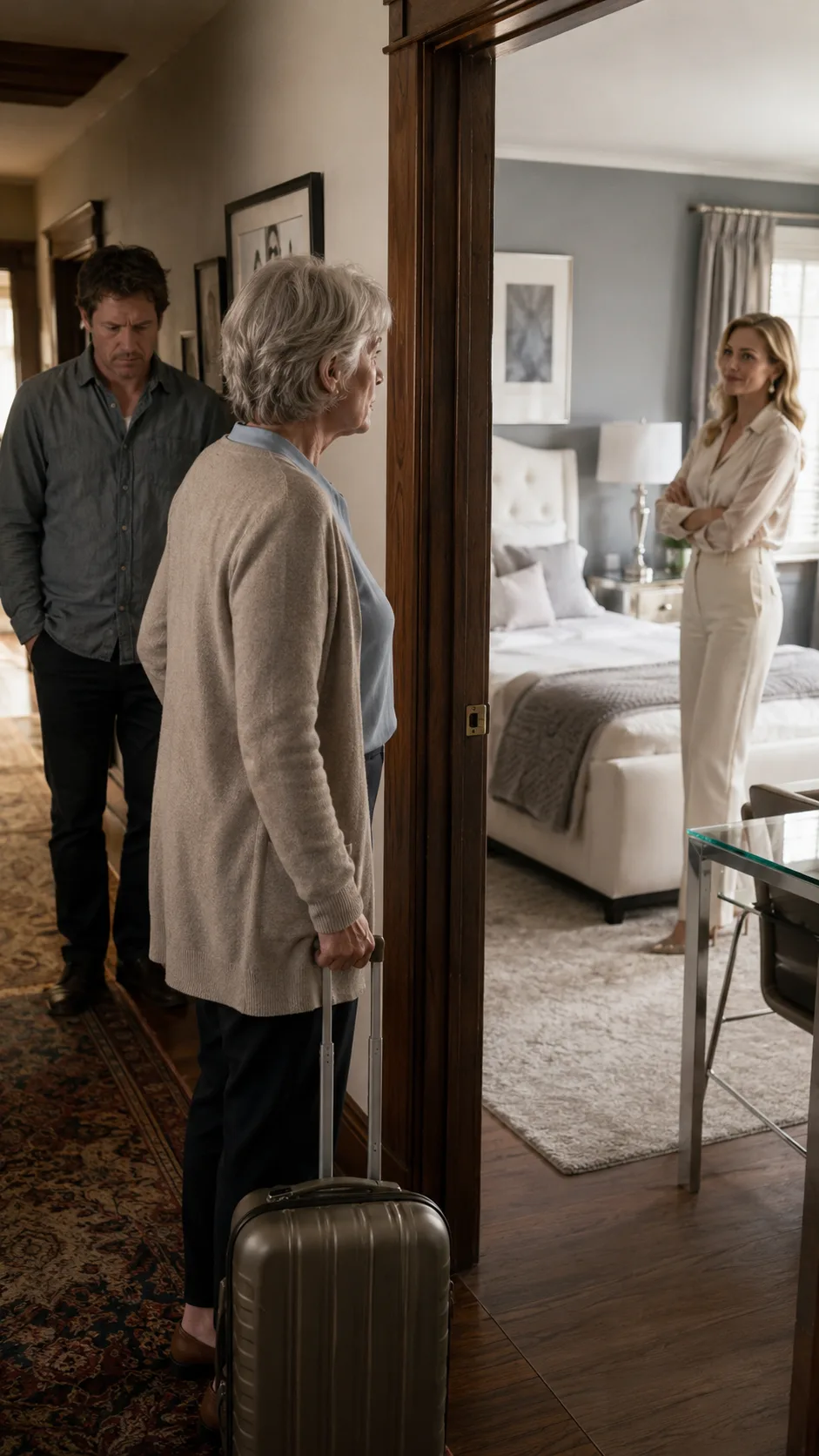
By late Saturday morning, Sabine tried to turn my house into a stage.
Chapter 3
By late Saturday morning, Sabine tried to turn my house into a stage.
That was her mistake.
She had already invited three friends for brunch before she knew Lenora was coming. I heard her near the pantry, speaking softly into the phone.
“No, still come. It’s fine. I need normal people around.”
Normal people.
I nearly laughed.
At 10:45, Sabine walked into the kitchen wearing a fitted cream sweater, dark jeans, gold hoops, and the expression of a woman trying to look like a victim in good lighting.
“Coralie,” she said, “could you put together something simple? Eggs, fruit, maybe that casserole you make. And set the dining room.”
I sat by the window with my coffee.
“No.”
She blinked. “What?”
“No.”
Her smile tightened. “I have guests coming.”
“I know.”
“And you’re just going to sit there?”
“In my chair. In my kitchen. In my house.”
Darien stood near the refrigerator, pale and silent.
Sabine looked at him, waiting for support.
He
gave none.
“This is childish,” she snapped.
“No,” I said. “Moving a widow’s bedroom into a garage while she is away is childish. Asking her to cook brunch for the women you invited to admire the room you stole is something else.”
Darien whispered, “Sabine. Don’t.”
It was the first useful word he had spoken in days.
Too late.
The doorbell rang.
Sabine’s friends came in wrapped in perfume and confidence. One carried flowers. Another brought champagne, although it was barely noon. The third had careful eyes, the kind that noticed tension and enjoyed being close to it.
Sabine recovered quickly.
“Come in,” she said, laughing too loudly. “It has been a morning.”
I said nothing.
Darien looked like a man waiting for a judge.
At 11:28, Lenora came down the stairs in her navy suit, leather folder under one arm.
Sabine froze.
Lenora looked at the champagne bottle on
the counter.
“Good,” she said. “I’d rather handle this while everyone is still sober.”
One friend slowly set down her glass.
Sabine’s face went pale under her makeup. “Lenora, this is not the time.”
“It is exactly the time.”
Lenora placed the folder on the dining table.
“We need to discuss the house, the opened credit accounts in my mother’s name, the unauthorized use of her personal information, and the documents prepared for her signature.”
Nobody moved.
The word unauthorized changed the air.
One friend picked up her purse first.
“I should go,” she murmured.
The others followed fast. Coat sleeves. Purse straps. Soft panic. The silence of women realizing they had walked into evidence.
Sabine watched her audience leave.
When the front door closed behind the last of them, the house changed shape.
It was no longer her stage.
It was my witness box.
Lenora opened the folder with
calm precision.
First, the photographs from Sabine’s desk.
Then the furniture receipts.
Then the contractor invoice.
Then the credit statement in my name.
Then the opened bank envelope.
Then the deed.
She placed every document on the table between Sabine and Darien.
Darien’s breathing grew louder.
Sabine sat very still.
I stood by the window because from there I could see the hydrangeas where Sabine had made the phone call that ended my confusion.
Lenora pressed play.
Sabine’s own voice filled the room.
“She’s sitting on value we could actually use.”
Darien shut his eyes.
Sabine said, “Turn that off.”
Lenora did not.
“Darien is dragging his feet.”
“Turn it off.”
“He knows we already used her information for the cards.”
Sabine stood so fast the chair scraped across the floor.
“You had no right to record me.”
Lenora paused the audio.
“I’m not debating rights with you at my mother’s dining table.”
Sabine pointed at me. “She was spying on me.”
I laughed once.
It surprised all of us.
“You were standing in my yard discussing how to steal my house.”
Darien covered his face with both hands.
“Mom,” he said, and his voice cracked.
There was that word again.
This time, it almost sounded human.
Lenora slid a statement toward him.
“Did you provide Sabine with my mother’s personal information?”
He did not answer.
“Darien.”
He looked at me.
For one second, I saw the little boy who split grilled cheese with me when we were poor. I saw the teenager trying not to cry at his father’s funeral. I saw the young man standing in my driveway saying my house was the safest place in the world.
Then I saw the man who stood behind his wife while my wedding photo lay cracked in a garage bin.
“Yes,” he whispered.
Sabine turned on him. “Are you serious?”
Lenora kept her eyes on him.
“Did you open, or allow accounts to be opened, using her information?”
Darien shook his head, then nodded, then seemed to fold in the middle.
“I didn’t mean for it to get this far.”
“That is not an answer.”
His voice barely cleared his mouth.
“Yes.”
Something inside me locked.
Not broke.
Locked.
Then he started talking too fast. Debt. Interest. Missed payments. Sabine’s expectations. The remodel was supposed to increase value. The paperwork was supposed to buy time.
He kept saying temporary, as if temporary fraud was smaller than permanent betrayal.
“I was going to fix it,” he said.
Lenora’s face did not move.
“When? After she signed the papers?”
He had no answer.
Sabine sat back down slowly. Without friends watching, without Darien protecting her, without control of the room, she looked like a woman doing math and hating the answer.
Lenora placed the final documents on the table.
“You have forty-eight hours to leave this house. Both of you. You will sign that you have no ownership claim and no permission to use my mother’s identifying information. You will return every document, card, statement, and piece of mail belonging to her. If you refuse, I proceed with bank fraud reports, police reports, credit disputes, and every civil remedy available.”
Sabine’s mouth tightened.
“You can’t just throw us out.”
Lenora looked at her for a long moment.
“Try me.”
Darien picked up the pen first.
His hand shook.
Sabine stared at him as if he had betrayed her, which might have been funny in another life.
He signed.
She signed after him, pressing so hard the pen nearly tore the page.
When it was done, I stepped closer.
Darien looked up at me with wet eyes.
“I’m sorry,” he said.
I wanted those words to matter more.
“I survived being poor,” I told him. “I survived losing your father. I survived raising two children alone. What I will not survive quietly is being turned into a line of credit by my own son.”
His face crumpled.
I did not comfort him.
Some grief does not deserve a lap.
The next forty-eight hours moved through my house like bad weather. Boxes scraped floors. Suitcases thumped down stairs. Packing tape tore again and again.
Sabine packed with angry efficiency.
Once, I found her standing in my bedroom doorway, staring at the gray walls as if she could still own them by looking.
“You’ll regret this,” she said.
“I already regret enough.”
For the first time, I think she understood I was not afraid of being alone.
That had been her mistake.
Women like Sabine think loneliness is the worst threat.
Widows know better.
Darien tried to speak to me twice.
The first time, he said, “Mom, I know I messed up.”
I turned off the kitchen faucet.
“Messed up is forgetting a birthday. This needs a better verb.”
The second time, he said, “I didn’t want to hurt you.”
“But hurting me was acceptable if it helped you.”
He had no answer.
That was the answer.
Monday afternoon, they loaded the last box into Sabine’s SUV and Darien’s old sedan.
Sabine drove away without looking back.
Darien lingered on the porch.
“I don’t know where we’re going after tonight,” he said.
For a moment, the mother in me rose by habit.
Then I remembered the yellow legal pad.
Next step: get her signature.
“No,” I said quietly. “I imagine you don’t.”
He nodded as if I had said something kinder.
Then he left.
Lenora stayed.
She took off her suit jacket, rolled up her sleeves, and said, “Let’s get your room back.”
We opened the windows first.
Then we carried out Sabine’s curtains. The stiff bedding. The silver lamps. The gray things that had made my room feel like a stranger.
Two neighborhood boys helped carry my walnut bed upstairs. My mother’s vanity returned to its corner. The silver-backed brush went back where it belonged. Louis’s photo went to a frame shop for new glass.
We painted the walls cream again.
Not the exact old shade.
Close enough.
When afternoon light spread across the wall, I felt my lungs remember how to open.
The blue quilt returned to the foot of the bed.
Once, it had meant comfort.
Then it had meant proof.
Now it meant I came back.
Months later, Darien asked to meet me for coffee.
I chose a public place. Lenora knew where I was. My credit was frozen. My deed was safer than either of my children knew.
Darien looked older when he walked in.
Not wiser.
Just worn enough for shame to sit beside him.
“I don’t expect you to forgive me,” he said.
“That’s good.”
He admitted Sabine had pushed, but he had crossed the line himself. He had given the information. He had ignored the wrongness because stopping would have meant admitting who he had become.
“I kept thinking I’d fix it before you knew,” he said.
“That is what people say when the only person they planned to spare was themselves.”
He cried quietly into a paper napkin.
Part of me wanted to reach across the table.
Part of me remembered the crack across Louis’s smile.
I kept my hands around my cup.
“An apology is a beginning,” I said. “It is not a repair.”
Now my house is quiet again.
Lenora calls every Sunday. Darien calls sometimes. I answer sometimes. Sabine’s name no longer enters my house unless someone else carries it in, and even then, it does not stay long.
My walnut bed sits where it belongs.
Louis’s photo has new glass.
The blue quilt rests folded at the foot of the bed.
Some people say a house is just walls, wood, and a roof.
Those people have never built one out of widowhood, diner tips, double shifts, and every year they refused to disappear.
My house was not just a house.
It was the receipt for my survival.
And no one will ever move me into the garage of my own life again.
Not politely.
Not with paperwork.
Not in fifteen days.
Never again.
THE END.
Chapter complete
You have reached the end of this chapter.
Continue reading
A few more worlds to get lost in after this chapter.




