THE BILLIONAIRE FIRED HER AFTER ELEVEN MINUTES...SHE CAME BACK THE NEXT MORNING
The first time Ethan Kingsley fired me, I had worked for him for eleven minutes.
Chapter 1
The first time Ethan Kingsley fired me, I had worked for him for eleven minutes.
The first time he kissed me, he apologized before I could slap him.
And the first time he cried in front of me, he threatened to destroy anyone who found out.
Unfortunately for him, I had already become the one person he couldn’t intimidate.
“Get out,” he said.
I stood in front of his desk, holding the coffee he had not asked for and the resignation letters of the three assistants who had come before me.
Ethan Kingsley was exactly as advertised.
Forty-seven years old.
Billionaire CEO.
Divorced.
Brilliant.
Impossible.
He sat behind a slab of black marble large enough to host a diplomatic summit, wearing a charcoal suit that looked severe enough to have its own legal department.
His dark hair was immaculate. His face belonged on the cover of a magazine titled MEN WHO HAVE NEVER BEEN TOLD NO.
His eyes, however, ruined the illusion.
They were
exhausted.
Not ordinary exhaustion.
The kind that lived beneath the skin.
The kind no amount of sleep could fix because sleep was not the problem.
“You’ve been here eleven minutes,” he continued. “You’ve moved my nine o’clock, canceled lunch with the Norwegian delegation, and removed whisky from my office.”
“Yes.”
“Why?”
“Your nine o’clock was lying to you, the Norwegian delegation requested the change yesterday, and drinking before noon makes you meaner without making you smarter.”
Silence dropped into the room.
His chief of staff, standing near the door, looked as though he had just witnessed a public execution.
Ethan rose slowly.
He was tall enough to make the movement feel threatening.
I did not step back.
That seemed to irritate him more.
“What is your name?” he asked.
“Clara Bennett.”
“I know what the file says.”
“Then why ask?”
“I want to hear you say it before security escorts
you out.”
“Clara Bennett.”
His jaw tightened.
“Pack your things.”
“I haven’t unpacked.”
“Excellent. Then this will be efficient.”
I placed the coffee on his desk.
“Oat milk. No sugar. Two shots.”
He looked at it.
Then at me.
“You don’t drink breakfast,” I said. “You train at five, take calls during your commute, skip food until midafternoon, and mistake irritability for productivity.”
“You have no idea what I mistake for productivity.”
“I read the incident reports.”
His expression went still.
Behind me, the chief of staff quietly left the room.
Coward.
Ethan rounded the desk.
“You accessed confidential files?”
“I reviewed the transition materials Seraph provided.”
“Those reports were private.”
“They describe a smashed laptop, two verbal complaints, and an assistant who locked herself in a bathroom for forty minutes.”
“She was incompetent.”
“She was twenty-six and you shouted at her for booking a car you had already booked
yourself.”
“She should have checked.”
“You should have remembered.”
Something dangerous flashed across his face.
I saw it.
Anger.
Shame.
And beneath both, fear.
Most people would have focused on the anger.
That was why most people failed with men like Ethan.
Anger was rarely the foundation.
It was the drawbridge.
“You think you understand me?” he asked.
“No.”
“Good.”
“I think you’re predictable.”
That was worse.
His gaze sharpened.
“You arrive early because lateness feels like weakness. You exercise until pain drowns out thought. You drink when the pain wins. You sleep with women you don’t like because intimacy is easier when it has no consequences.”
His face became unreadable.
I should have stopped.
I did not.
“You overwork because silence terrifies you. You control everyone around you because somewhere in your life, something happened that taught you control was the only reliable form of safety.”
He stepped close enough that I had to tilt my head back.
“Finished?”
“For now.”
His voice dropped.
“You’re not afraid of me.”
“No.”
“You should be.”
“People who need others to fear them are usually frightened themselves.”
The silence that followed felt volcanic.
Then Ethan reached for the phone on his desk.
I assumed he was calling security.
Instead, he pressed a button.
“Margaret.”
A woman answered.
“Yes, Mr. Kingsley?”
“Restore Ms. Bennett’s access.”
I raised an eyebrow.
“You just fired me.”
“I changed my mind.”
“That quickly?”
He picked up the coffee.
Took one sip.
His expression remained severe, but something in his eyes shifted.
“You said I was predictable,” he replied. “Consider this your first correction.”
I smiled.
It was a mistake.
Ethan stared at my mouth as though happiness was an act of insubordination.
Then he looked away.
“Your probation ends Friday.”
“It’s Monday.”
“Exactly.”
That was how I became the fourth assistant Ethan Kingsley hired that year.
And the first one who refused to leave.
Seraph had rules.
We did not apologize for our fees.
We did not tolerate abuse.
We did not confuse access with consent.
And we were never “just assistants.”
The agency recruited women who could survive rooms built to exclude them.
Former lawyers.
Crisis strategists.
Diplomatic aides.
Financial analysts.
Women who could manage mergers, affairs, breakdowns, and breakfast without smudging their lipstick.
Our clients paid extraordinary sums because they did not need someone to answer phones.
They needed someone to manage the machinery of their lives.
Sometimes that included travel.
Sometimes reputation.
Sometimes loneliness.
Every arrangement was negotiated.
Every boundary explicit.
Mine were simple.
No shouting in my face.
No threats.
No humiliation.
No emotional dependency disguised as romance.
The last one existed for a reason.
My mother had spent twenty-three years orbiting a difficult man because she believed understanding his pain made her responsible for healing it.
It did not.
It only made her tired.
I had no intention of repeating her life.
Then Seraph assigned me to Ethan Kingsley.
His file was four hundred pages long.
The executive summary required only one sentence:
Highly functional in public; catastrophic in private.
He was the third-generation chairman of Kingsley Global, a logistics and infrastructure empire founded by his grandfather and weaponized by his father.
Ethan had inherited the company at thirty-one.
He had also inherited its culture.
Win.
Dominate.
Never explain.
Never need.
His marriage ended after sixteen years.
His former wife, Caroline, lived in Surrey.
Their son, Noah, was seventeen and had recently stopped answering Ethan’s calls.
The file described their relationship as “strained.”
Corporate language was impressive.
It could make heartbreak sound like a scheduling conflict.
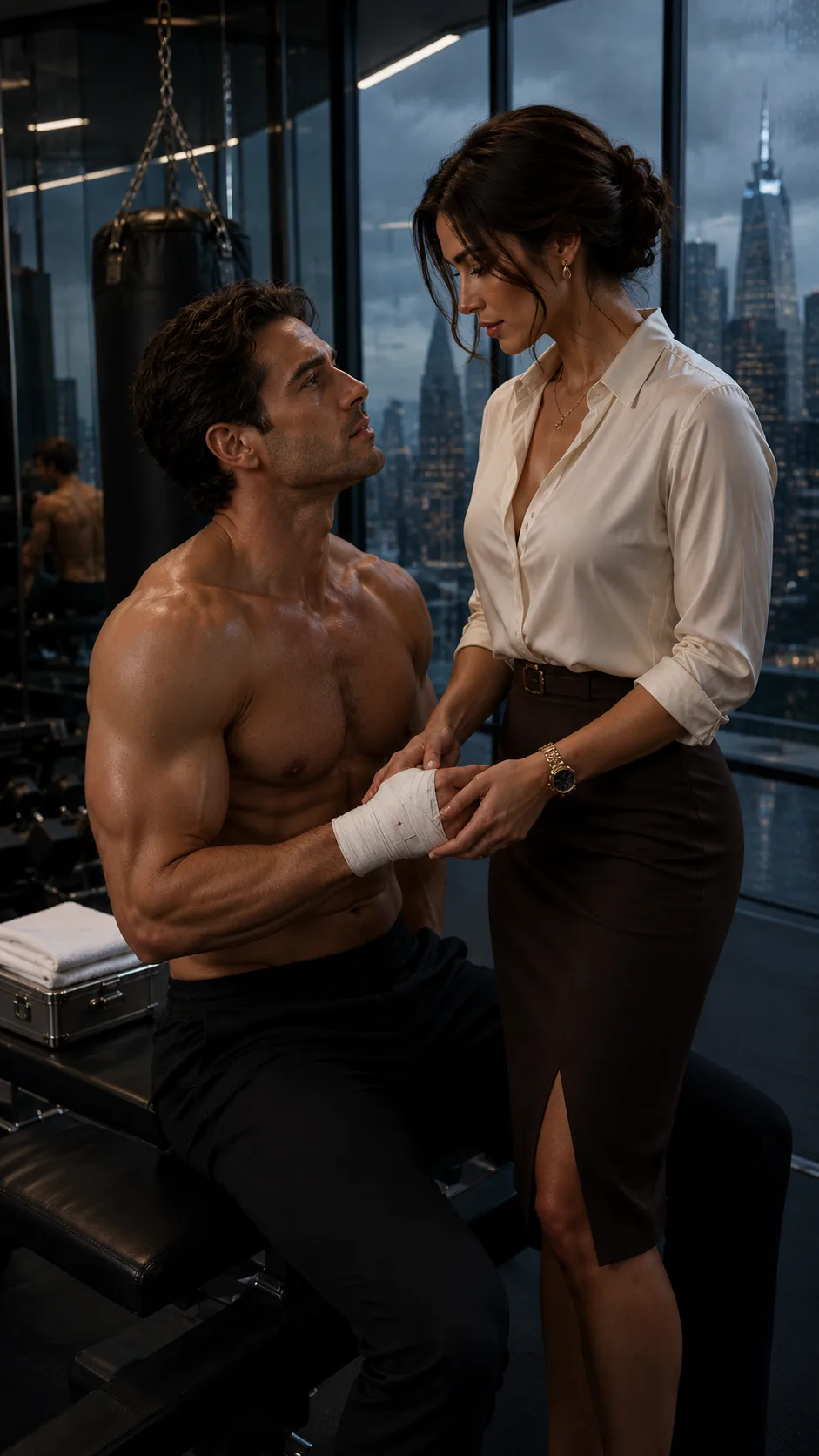
On my second day, I found Ethan standing in the executive gym at six in the morning, punching a heavy bag without gloves.
His knuckles were bleeding.
I walked in and switched off the music.
He turned.
“Leave.”
“No.”
“I am not in the mood.”
“You’re never in the mood. It saves time.”
His chest rose and fell.
He wore black training trousers and nothing else.
It was inconvenient.
I had prepared for the temper.
I had not prepared for the body.
Years of obsessive training had carved every line with brutal precision. He looked less like a businessman than a weapon pretending to be one.
My gaze lingered half a second too long.
Ethan noticed.
Of course he did.
“See something relevant to my schedule?” he asked.
“Yes.”
“What?”
“A self-destructive coping mechanism.”
His mouth twisted.
“Disappointed?”
“Relieved.”
“That’s an unusual response.”
“You’re easier to manage when the symptoms are obvious.”
He looked down at his hands.
Blood streaked his fingers.
“It’s nothing.”
“That sentence has caused more damage than most wars.”
I took the first-aid kit from the wall.
“Sit.”
“No.”
“Fine. Bleed on the floor. Facilities already dislikes you.”
He stared at me.
Then sat.
I cleaned his knuckles.
He did not flinch.
That told me nothing.
Some men were skilled at pain because they had never learned what to do with tenderness.
“You enjoy this,” he said.
“Bandaging emotionally constipated billionaires before sunrise?”
“Giving orders.”
“Only when people deserve them.”
His gaze lifted to my face.
“And do I?”
“Frequently.”
My thumb brushed the inside of his wrist as I secured the bandage.
His pulse jumped.
So did mine.
Neither of us acknowledged it.
“You shouldn’t touch me,” he said.
I looked at him.
“You’re bleeding.”
“That’s not what I meant.”
The air changed.
I removed my hand.
“Then say what you mean.”
His eyes darkened.
For one second, the controlled CEO vanished.
There was only a man sitting shirtless beneath white fluorescent lights, looking at me as though I had walked too close to something starved.
Then the armor returned.
“Move my eight o’clock,” he said.
I closed the kit.
“Already done.”
Noah Kingsley appeared in the office on a Thursday afternoon wearing a school blazer and an expression of calculated hostility.
He looked like Ethan.
That was the first problem.
Same dark eyes.
Same sharp jaw.
Same habit of using silence as a weapon.
The second problem was that he had come to return his father’s birthday gift.
A watch.
Vintage.
Rare.
Unopened.
“I need to see him,” Noah told reception.
“He’s in a board meeting,” I said.
“I know.”
“Then you know he can’t be interrupted.”
Noah looked me over.
“You’re the new one.”
“Clara.”
“How long have you lasted?”
“Three weeks.”
His eyebrows rose.
“That’s impressive.”
“I’m resilient.”
“He’s awful.”
“I’ve noticed.”
That surprised a laugh out of him.
It disappeared quickly.
He held out the box.
“Give him this.”
“No.”
His expression hardened.
“I’m not asking permission.”
“And I’m not a courier.”
“I thought that was exactly what assistants were.”
I smiled.
“You inherited his charm.”
Noah’s face closed.
Instantly.
I had touched something tender.
He set the box on my desk.
“Tell him I don’t want it.”
“Tell him yourself.”
“He won’t hear me.”
The words were quiet.
That changed everything.
I looked through the glass wall.
Ethan sat at the head of the boardroom table while twelve people waited for him to speak.
Power radiated from him.
So did distance.
I turned back to Noah.
“What do you want him to hear?”
“That he missed my concert.”
I glanced at the calendar.
“There was no concert scheduled.”
“There was. Mum emailed him twice.”
I opened the shared family folder.
Nothing.
Then I checked Ethan’s filtered messages.
The emails were there.
Flagged low priority by an automated system his previous assistant had set up.
I swore under my breath.
Noah gave a bitter laugh.
“Exactly.”
“He didn’t see them.”
“He never sees anything that isn’t worth money.”
“That’s not fair.”
“You’ve known him three weeks.”
“And you’re angry enough to make unfairness feel honest.”
His eyes flashed.
“Don’t analyze me.”
“I’m not. I’m recognizing a family resemblance.”
The boardroom doors opened.
Ethan emerged.
He saw Noah.
Stopped.
The entire executive floor went quiet.
“What are you doing here?” Ethan asked.
Wrong question.
I saw Noah’s expression harden.
“I came to return this.”
He placed the watch on the desk.
Ethan looked at it.
“I bought that for your birthday.”
“I know.”
“You said you wanted one.”
“Two years ago.”
Ethan’s jaw tightened.
“You could have called.”
“I did.”
“I didn’t receive anything.”
“I left messages.”
“I’ve been busy.”
Noah laughed.
It was a brutal sound from someone so young.
“You’re always busy.”
Ethan’s face became cold.
“This is not the place.”
“Right. Because God forbid anyone at work discovers you have a son.”
“Enough.”
“No. You don’t get to say that.”
Noah’s voice cracked.
That crack should have stopped Ethan.
Instead, it triggered him.
Maybe because pain in other people looked too much like failure.
“You came here to make a scene,” he said. “You’ve made it.”
Noah went pale.
I stepped between them.
“Ethan.”
His eyes snapped to mine.
“Not now.”
“Exactly now.”
“This is a family matter.”
“Then behave like family.”
The office seemed to stop breathing.
Ethan’s face changed.
No one spoke to him that way.
No one except me, apparently.
Noah looked at us both.
Then grabbed the watch.
“Forget it.”
He walked toward the lifts.
Ethan did not follow.
So I did.
I caught Noah before the doors closed.
“Wait.”
He looked at me.
His eyes were bright with furious tears.
“Don’t defend him.”
“I’m not.”
“Good.”
“But he didn’t know about the concert.”
“He could have asked.”
“Yes.”
That answer disarmed him.
I continued.
“He should have asked. He should know what matters to you without making you file a formal request.”
Noah looked down.
“But he didn’t miss it because he doesn’t care.”
“You can’t know that.”
“No.”
I glanced toward Ethan’s office.
“But I know men who don’t care don’t keep every school report in a locked drawer.”
Noah’s expression shifted.
“He has them?”
“All of them.”
“Why?”
“Because your father is profoundly bad at loving people where they can see it.”
Noah looked toward the office.
“Sounds like his problem.”
“It is.”
The lift arrived.
Before stepping inside, he looked at me.
“Why are you helping him?”
I thought of Ethan’s bleeding knuckles.
His empty office.
The way he stared at his son as though love had become a language he could no longer speak.
“I haven’t decided yet,” I said.
The doors closed.
When I returned, Ethan was waiting.
“You undermined me.”
“You humiliated him.”
“He came into my office during business hours.”
“He came because you missed something important.”
“I didn’t know.”
“You built a system so airtight that your own son can’t reach you.”
His face tightened.
“You think I wanted to miss it?”
“I think wanting is useless when your behavior says the opposite.”
“Be careful.”
“No.”
I stepped closer.
“You don’t get to hide behind anger because shame is uncomfortable.”
His control cracked.
He slammed one hand against the desk.
“I said enough.”
I did not flinch.
That made him angrier.
Or more frightened.
“Fire me,” I said.
He stared.
“Go on. You’ve done it before.”
Silence.
“You won’t,” I continued. “Because I’m the only person in this building who tells you the truth before you turn it into another disaster.”
His chest rose sharply.
“You know nothing about my son.”
“I know he wanted his father at a concert.”
“You know nothing about me.”
“I know you love him.”
His expression broke.
Barely.
But I saw it.
That terrified him.
“Get out,” he said.
This time, his voice was quiet.
I left.
Ten minutes later, my phone buzzed.
A message from Ethan.
Find the next concert.
I smiled.
Then replied.
Ask him yourself.
Three dots appeared.
Disappeared.
Appeared again.
Finally:
You are intolerable.
I typed:
And still employed.
Ethan’s father suffered a stroke in November.
Sir Alistair Kingsley had built Kingsley Global into a global institution and his son into a man who believed affection was weakness.
He was seventy-eight.
Still chairman emeritus.
Still capable of frightening an entire board from a hospital bed.
Ethan flew to Geneva that night.
I went with him.
At the hospital, Sir Alistair refused to allow Noah into the room.
“He has exams,” he said.
Noah stood in the corridor.
“He’s my grandfather.”
“You have obligations.”
“I came to see you.”
“You came because your father indulges emotional impulsiveness.”
Ethan’s face went cold.
Noah looked at him.
Waiting.
This was the moment.
The choice.
Ethan could defend his son.
Or obey his father.
For several terrible seconds, old conditioning won.
Then Sir Alistair said, “Send the boy home.”
Ethan’s shoulders went rigid.
“The boy has a name.”
His father blinked.
Noah did too.
Sir Alistair’s voice sharpened.
“Do not become sentimental.”
Ethan stepped closer to the bed.
“My son crossed three countries to see you.”
“He should learn priorities.”
“He is my priority.”
The words seemed to surprise everyone.
Especially Ethan.
Sir Alistair’s face hardened.
“That attitude will destroy everything I built.”
Ethan’s jaw tightened.
“You mean everything I’ve spent sixteen years holding together?”
“I gave you an empire.”
“You gave me a test I was never allowed to pass.”
The room fell silent.
Noah stared at his father.
I stood near the door, afraid to breathe.
Sir Alistair looked at Ethan with old, cold disappointment.
“You’re weak.”
Ethan flinched.
He hid it quickly.
But Noah saw.
So did I.
Then something extraordinary happened.
Noah stepped beside him.
“No,” he said.
Sir Alistair turned.
Noah’s voice shook, but he continued.
“He came.”
Two words.
Small.
Devastating.
He came.
Not perfectly.
Not early enough.
Not without damage.
But he came.
Ethan looked at his son.
The expression on his face made my chest ache.
He placed one hand on Noah’s shoulder.
Awkwardly.
As though tenderness were a tool he had never been shown how to hold.
“We’re leaving,” Ethan said.
Sir Alistair laughed bitterly.
“You walk out now, don’t bother returning.”
Ethan looked at his father.
For most of his life, that threat had controlled him.
Family.
Legacy.
Inheritance.
Approval always promised and never delivered.
Ethan glanced at Noah.
Then at me.
And made his choice.
“All right,” he said.
We left.
In the lift, no one spoke.
When the doors opened, Noah turned to his father.
“I’m staying with Mum tonight.”
Ethan nodded.
“I understand.”
Noah hesitated.
“My next concert is December fifth.”
Ethan’s face changed.
“I know.”
“Seven thirty.”
“I’ll be there.”
Noah looked as though he wanted to believe him and hated himself for it.
“Don’t promise.”
Ethan swallowed.
“I’ll be there.”
Noah left.
Ethan watched him disappear through the hospital doors.
Then he said, “Get me a drink.”
“No.”
He turned.
“I am not asking as your boss.”
“Then I’m refusing as the woman who knows what you’re doing.”
His expression hardened.
“You think tonight qualifies as a wellness opportunity?”
“I think tonight qualifies as the worst possible moment to numb yourself.”
“You are not my therapist.”
“No.”
“Not my wife.”
“Definitely not.”
“Then stop acting as though you have authority over me.”
I stepped closer.
“I don’t have authority.”
“Then what do you have?”
The answer arrived before I could protect myself.
“Concern.”
His face went still.
The hospital corridor hummed around us.
I wished I could take the word back.
Not because it was untrue.
Because it was not billable.
Not professional.
Not safe.
Ethan looked away first.
“You shouldn’t.”
“I know.”
“I ruin people.”
“That is self-pity wearing expensive shoes.”
His eyes flashed.
“You think everything can be reduced to a diagnosis.”
“No. I think you use damage as an alibi.”
“For what?”
“For never changing.”
That hit him.
He stepped toward me.
“So fix me.”
The words were cruel.
Designed to push.
I didn’t move.
“I can’t.”
“Then what good are you?”
His face changed the second he said it.
Regret.
Immediate and sharp.
But the words had landed.
I nodded slowly.
“There he is.”
“Clara.”
“The man who hurts people before they can discover he needs them.”
“I didn’t mean—”
“You did.”
I picked up my bag.
“Where are you going?”
“To my room.”
“You can’t leave.”
“I can.”
“I need—”
He stopped.
The unfinished sentence hung between us.
I looked at him.
“Say it.”
His jaw tightened.
“No.”
“Then call someone else.”
I turned.
His hand closed around my wrist.
Not hard.
Desperate.
I looked down at it.
He released me instantly.
“I need you,” he said.
The words nearly broke him.
Not dramatically.
Quietly.
Like something inside him had split under pressure.
His voice dropped.
“I need you not to leave me alone tonight.”
Every boundary I had built rose inside me.
No emotional dependency.
No rescue fantasies.
No becoming responsible for a damaged man’s healing.
I could hear my mother’s voice.
Understanding someone does not obligate you to stay.
She was right.
But leaving was not always strength.
Sometimes staying was a choice.
“I’ll stay,” I said. “But I won’t help you disappear.”
Ethan nodded.
In his hotel suite, he did not drink.
He sat on the floor beside the sofa.
I sat across from him.
For nearly an hour, he said nothing.
Then he began talking.
About his father.
About being eight years old and forced to stand outside in winter because he had cried after losing a tennis match.
About being twelve and learning that praise was always conditional.
About marrying Caroline because she made life feel warm, then punishing her when warmth began to feel like dependence.
About Noah.
Every missed birthday.
Every call postponed.
Every apology replaced with money.
“I became him,” Ethan said.
“No.”
He looked at me.
“You made the same choices.”
“That’s what becoming someone means.”
“No. Becoming him would mean refusing to see it.”
He laughed bitterly.
“You always have an answer.”
“Not tonight.”
The exhaustion in his face softened.
“What happens now?”
“You apologize.”
“To Noah?”
“To everyone.”
“That could take years.”
“Yes.”
“And if they don’t forgive me?”
“Then you become better anyway.”
His eyes filled.
He looked furious about it.
“I don’t know how.”
“Start small.”
“How small?”
“Cry without threatening anyone.”
He almost laughed.
Then the laugh broke.
So did he.
Ethan covered his face with both hands.
His shoulders shook.
I moved beside him.
Slowly.
Giving him time to refuse.
He did not.
When I put my arms around him, he collapsed against me with the helplessness of someone who had not been held in decades.
“This never happened,” he said against my shoulder.
“Of course not.”
“I mean it.”
“I’ll have the security footage altered.”
“There are no cameras.”
“Then your reputation is safe.”
His laugh came out wet and broken.
He lifted his head.
We were too close.
His eyes dropped to my mouth.
I felt the shift immediately.
Grief becoming heat.
Need searching for another exit.
I placed my hand against his chest.
“No.”
He froze.
Shame flooded his face.
“I’m sorry.”
“You don’t need to apologize for wanting.”
“I nearly—”
“But I won’t let you turn pain into sex because sex feels easier.”
His breathing slowed.
“You see through everything.”
“Occupational hazard.”
He looked at me for a long moment.
Then he whispered, “That’s what scares me.”
Ethan attended Noah’s concert.
He arrived forty minutes early.
He sat in the second row.
He turned off his phone.
When Noah walked onto the stage with his guitar, he saw his father.
He nearly missed the first chord.
Ethan did not look away once.
Afterward, Noah approached us in the lobby.
“You came.”
“I said I would.”
“You say many things.”
Ethan absorbed the blow.
“I know.”
Noah looked at me.
“Did she force you?”
“No.”
“Yes,” I said at the same time.
Noah laughed.
Ethan looked offended.
“She reminded me.”
“Repeatedly.”
“That is not forcing.”
“You tried to schedule a call during the interval.”
“It was urgent.”
“I threatened your phone.”
Noah grinned.
It was the first time I saw them laugh together.
The moment was small.
That made it precious.
Change rarely announced itself with fireworks.
Sometimes it looked like a father standing awkwardly in a school lobby while his son pretended not to be pleased.
On the drive back to London, Ethan sat beside me in the car.
“You were good with him,” he said.
“He likes honesty.”
“He likes you.”
“Most people do.”
His mouth curved.
“Modest.”
“Accurate.”
The car moved through rain-slick streets.
Neither of us spoke for several minutes.
Then Ethan said, “Thank you.”
I looked at him.
“For what?”
“Not giving up on me.”
The words were too intimate.
I turned toward the window.
“That’s not part of my job.”
“No.”
“Don’t confuse my support with permanence.”
His expression shuttered.
“I’m aware of the contract.”
“That isn’t what I mean.”
“Then what do you mean?”
I looked at him.
His body went still.
I had spent weeks managing his schedule, his family, his damage.
But the hardest thing to manage was the way he watched me now.
Not like an employee.
Not like an accessory.
Like safety.
That was dangerous for both of us.
“You need more than one person,” I said.
“I have a board.”
“You need people who know you.”
He gave a humorless smile.
“That list is short.”
“Make it longer.”
“And if I don’t want to?”
“Then you’re not building a relationship. You’re building a dependency.”
His jaw tightened.
“You always find a clinical word for emotion.”
“And you always use emotion to avoid responsibility.”
The car stopped outside my building.
I reached for the door.
Ethan caught my hand.
I looked down.
He immediately loosened his grip.
“Stay,” he said.
“In the car?”
“With me.”
The words carried no command.
That was what made them powerful.
“I can’t.”
“Because of Seraph?”
“Because I don’t know whether you want me or the version of yourself you become when I’m near.”
His eyes held mine.
“Is there a difference?”
“Yes.”
He leaned closer.
“Not to me.”
I should have left.
Instead, I whispered, “That’s the problem.”
Ethan kissed me.
Not roughly.
Not like a man demanding entry.
Like a man asking a question he was terrified I would answer.
For one heartbeat, I did nothing.
Then my hand slid into his hair.
The sound he made nearly erased every sensible thought I possessed.
He pulled me closer.
The kiss deepened.
Months of tension collapsed at once.
All that anger.
All that observation.
All that impossible restraint.
Then I remembered the hotel floor.
His grief.
His need.
I pulled away.
Ethan’s forehead rested against mine.
“Tell me that was a mistake,” he said.
“It was.”
“Liar.”
“Yes.”
His breathing was uneven.
“So was it?”
“Yes.”
“Do you regret it?”
“No.”
He closed his eyes.
That answer hurt him more.
I touched his face.
“You are becoming someone different.”
“Because of you.”
“No.”
His eyes opened.
“Do not make me responsible for your transformation.”
“You started it.”
“I challenged you. You chose.”
“What if I choose you?”
The question entered the quiet car and changed it.
I withdrew my hand.
“Then choose me when you don’t need me to save you.”
His expression hardened.
“I don’t need saving.”
“Good.”
I opened the door.
“Prove it.”
Sir Alistair recovered.
Then he returned to London with a plan.
He convened the board and proposed restructuring Kingsley Global.
Publicly, it was about succession.
Privately, it was punishment.
He wanted Ethan removed unless Ethan sent Noah to an elite boarding school in Switzerland and recommitted to the “discipline required of the Kingsley name.”
I read the proposal twice.
Then I went to Ethan’s office.
He stood at the window with a glass of whisky.
Untouched.
Progress.
“My father has enough votes,” he said.
“He has enough fear.”
“Same result.”
“What does Noah want?”
“To stay in London.”
“Then there is your answer.”
Ethan laughed bitterly.
“You think walking away from a thirty-billion-pound company is simple?”
“No.”
“My grandfather built it.”
“And your father used it to control you.”
“Thousands of people work for us.”
“Then protect the company. Not the dynasty.”
He turned.
“How?”
“Take the restructuring public. Expose the governance issues. Force an independent vote.”
“That could destroy confidence.”
“It could save the business.”
“And if I lose?”
“You lose the title.”
His eyes narrowed.
“And the empire.”
“No.”
I stepped closer.
“You lose the throne. There’s a difference.”
He looked at me.
For years, Ethan had mistaken the company for proof that he mattered.
His father had made sure of it.
Without Kingsley Global, who was he?
A father.
A damaged man.
A difficult man.
A man learning.
That terrified him more than any hostile takeover.
“What would you do?” he asked.
“I would choose Noah.”
“You didn’t hesitate.”
“He’s your son.”
“The company is my life.”
“No. The company is where you hide from it.”
The words struck hard.
He looked down at the whisky.
Then poured it into the sink.
The next morning, Ethan called a press conference.
He exposed his father’s coercive proposal, announced an independent governance review, and offered to resign if the board believed his leadership had become inseparable from family control.
Markets panicked for six hours.
Then stabilized.
Employees issued a statement supporting him.
Three independent directors turned against Sir Alistair.
The vote passed.
Ethan remained CEO.
His father lost voting control.
But that was not the real victory.
The real victory came that evening.
Noah arrived at the office.
He walked straight into Ethan’s conference room and shut the door.
I waited outside.
Twenty minutes passed.
Then forty.
At one hour, I heard shouting.
At seventy minutes, silence.
At ninety, the door opened.
Noah’s eyes were red.
So were Ethan’s.
Noah looked at me.
“He apologized.”
I smiled.
“That’s a start.”
“He didn’t explain.”
My gaze shifted to Ethan.
He stood behind his son, looking exhausted and strangely lighter.
“No,” Noah continued. “He just said he was wrong.”
For Ethan, that was revolutionary.
Noah turned back to him.
“I’m still angry.”
“You should be,” Ethan said.
“I don’t trust you yet.”
“I understand.”
“You’ll have to keep showing up.”
“I will.”
Noah nodded.
Then, awkwardly, he hugged his father.
Ethan froze.
For one terrible second, I thought he would fail again.
Then his arms closed around his son.
His eyes met mine over Noah’s shoulder.
The gratitude in them was so naked I had to look away.
This was not my victory.
I reminded myself of that.
Not my family.
Not my healing.
Not my man.
The last thought hurt.
That was how I knew I was in trouble.
I resigned the following Monday.
Ethan read the letter once.
Then again.
His face revealed nothing.
“This is effective immediately?”
“Yes.”
“You’re under contract.”
“Seraph approved the transfer.”
“Who asked for a transfer?”
“I did.”
His jaw tightened.
“Why?”
I had rehearsed the answer.
It sounded convincing when no one was looking at me like that.
“Because our professional boundaries are no longer viable.”
“We kissed once.”
“That was not the boundary I crossed.”
“What was?”
I met his gaze.
“I fell in love with you.”
The truth hit the room like shattered glass.
Ethan went completely still.
I continued before courage failed.
“I fell in love with the ruthless man everyone fears. I fell in love with the frightened man beneath him. And I can no longer tell whether I’m helping because it’s my job or because I need to believe you’ll choose a better life.”
His voice dropped.
“I did choose it.”
“For yourself?”
“Yes.”
“For Noah?”
“Yes.”
“For me?”
Silence.
That silence was why I had to go.
I nodded.
“Exactly.”
Ethan came around the desk.
“You think I haven’t chosen you?”
“I think you haven’t learned who you are without me.”
“And leaving is supposed to teach me?”
“No.”
I picked up my bag.
“It’s supposed to teach me that your survival is not my responsibility.”
His face hardened.
“Your mother.”
I flinched.
He understood immediately.
“You think loving me makes you her.”
“I think staying because you need me might.”
“I don’t need you.”
The words were immediate.
Defensive.
Cruel.
I forced myself to smile.
“Then this should be easy.”
I walked toward the door.
“Clara.”
I stopped.
His voice changed.
“Don’t leave like this.”
I turned.
“Then give me a reason to stay that isn’t your pain.”
He stared at me.
Nothing came.
I left.
For three months, I heard nothing from him.
No flowers.
No demands.
No late-night calls.
It hurt more than I expected.
Then I began hearing other things.
Ethan started therapy.
Not privately hidden through corporate health.
Openly enough that Noah knew.
He stopped drinking.
He delegated operations to a new executive team.
He took Friday evenings off.
He attended every concert.
He apologized to Caroline without asking for forgiveness.
He rehired one of the assistants he had driven out, not as an assistant but as a project director with a raise.
He changed.
Not loudly.
Not for applause.
Not because I stood nearby with instructions.
He changed when I was gone.
That was when I knew it was real.
Ethan appeared at my apartment on a Sunday morning carrying no flowers.
No expensive gift.
No dramatic speech.
Only two coffees and an expression that looked almost uncertain.
I opened the door.
“What are you doing here?”
“Trying something unfamiliar.”
“What?”
“Asking.”
I leaned against the frame.
“Asking what?”
“Whether I may come in.”
I should have made him suffer longer.
Instead, I stepped aside.
He entered.
He looked different.
Not physically.
The suit was still perfect.
The posture still controlled.
But the pressure around him had eased.
He no longer seemed like a man bracing for impact.
I took the coffee.
“You remembered my order.”
“I remember everything about you.”
“That sounds threatening.”
“It probably is.”
We stood in my living room.
Awkwardly.
It was almost funny.
The terrifying Ethan Kingsley, brought to ruin by a sofa and honest conversation.
“How is Noah?” I asked.
“Angry.”
“Good.”
“He speaks to me now.”
“Better.”
“We had dinner last night.”
“How did that go?”
“He told me my personality needs rehabilitation.”
I laughed.
“I like him.”
“He likes you more.”
The warmth faded.
Ethan took a breath.
“I came to tell you that you were right.”
“About which thing? There were many.”
His mouth almost curved.
“I did need you.”
I said nothing.
“But that wasn’t love. Not all of it.”
My chest tightened.
He continued.
“I needed you to regulate me. Translate my son. Interrupt my worst impulses. Stand between me and every consequence I refused to face.”
The honesty in his voice was new.
Painful.
Clean.
“That was unfair,” he said.
“Yes.”
“I confused feeling safe with being rescued.”
“Yes.”
“I also loved you.”
I looked at him.
He held my gaze.
“I loved you badly,” he said. “Possessively. Fearfully. Like a man who thought wanting someone meant finding a way to keep them.”
My throat tightened.
“And now?”
“Now I know love is what remains after control fails.”
He stepped closer.
Not too close.
“I rebuilt my life without you.”
“I heard.”
“I hated every day of it.”
“That sounds healthy.”
“It was miserable.”
I almost smiled.
He continued.
“But I did it because you asked me to prove I could choose a life that wasn’t built around fear.”
“And did you?”
“Yes.”
His voice softened.
“I choose Noah.”
My eyes burned.
“I choose the company only when it deserves me.”
I swallowed.
“And I choose you.”
He paused.
“Not because I need you to hold me together.”
His gaze moved over my face.
“Because when I am together, you are still the person I want beside me.”
That was the reason.
The one I had asked for.
Not pain.
Not crisis.
Choice.
I whispered, “You took three months.”
“I am profoundly complex.”
I laughed before I could stop myself.
His face changed at the sound.
The Ice King vanished.
There was only Ethan.
Hopeful.
Terrified.
Alive.
“You’re mocking me,” he said.
“Deeply.”
“Is that a good sign?”
“It’s not a bad one.”
He lifted his hand.
Stopped before touching me.
“May I?”
The question mattered.
So did the waiting.
I nodded.
His fingers touched my cheek.
Gentle.
Reverent.
Nothing like the desperate kiss in the car.
This time, there was no collapse behind it.
No pain demanding escape.
Only a man standing in the life he had chosen.
“I love you,” he said.
I placed my hand over his.
“I know.”
“That is an infuriating response.”
“You’ve survived worse.”
His eyes narrowed.
“Clara.”
I smiled.
Then kissed him.
Slowly.
Deliberately.
On my terms.
His arms came around me, but he did not pull until I moved closer.
The chemistry between us still burned.
But it no longer felt destructive.
Fire could ruin a house.
It could also make one warm.
A year later, Ethan stood in the kitchen arguing with Noah over pancakes.
“You burned them,” Noah said.
“They are caramelized.”
“They are black.”
“Color is subjective.”
“Fire is not.”
I sat at the table beside Caroline, trying not to laugh.
She and Ethan were not friends.
Not yet.
But they had learned to speak without reopening every wound.
That was enough.
Found family was not neat.
It was not a replacement for what had broken.
It was a collection of people choosing, repeatedly, to remain honest.
Noah placed a ruined pancake on Ethan’s plate.
“Eat your work.”
Ethan looked at me.
“Help.”
“No.”
“You’re enjoying this.”
“Immensely.”
Caroline lifted her coffee.
“She always was too intelligent for you.”
Ethan looked offended.
“You’ve met her six times.”
“It was clear after one.”
Noah grinned.
The room filled with laughter.
For a moment, Ethan simply watched us.
His family.
Not perfect.
Not restored to what it had been.
Something new.
Something earned.
Later, we stood alone in the garden while Noah packed his guitar into Caroline’s car.
Ethan slipped his hand into mine.
“I spent most of my life believing power meant no one could reach me,” he said.
“And now?”
“Now I think that was cowardice.”
I looked at him.
“That is almost emotionally mature.”
“Don’t ruin the moment.”
“I manage expectations.”
He kissed my temple.
At Seraph, I had been hired to manage everything.
His stress.
His schedule.
His appetites.
His damage.
But love began only when I stopped managing him.
When I stepped away and allowed him to become responsible for his own life.
Ethan did not heal because I loved him.
He healed because he finally understood that pain could explain his behavior without excusing it.
He chose his son over inheritance.
Truth over control.
Connection over performance.
And when he came back to me, he did not offer an empire.
He offered something far rarer.
A self he had fought to become.
Noah called from the car.
“You two are being disgusting.”
Ethan looked at me.
“See? He’s emotionally expressive now.”
“He’s insulting us.”
“Progress is not linear.”
I laughed.
Ethan’s gaze softened.
There were still shadows in him.
There always would be.
But he no longer built walls around them and called the darkness strength.
He let people in.
He apologized.
He showed up.
He stayed.
The world still called Ethan Kingsley an Ice King.
They were wrong.
Ice was not his nature.
It was his armor.
And beneath it had always been a man terrified that love would demand his surrender.
In the end, love demanded something harder.
His honesty.
His responsibility.
His willingness to be seen.
He gave it all.
And for the first time in his life, vulnerability did not cost him power.
It gave him a family.
Chapter complete
You have reached the end of this chapter.
Continue reading
A few more worlds to get lost in after this chapter.




