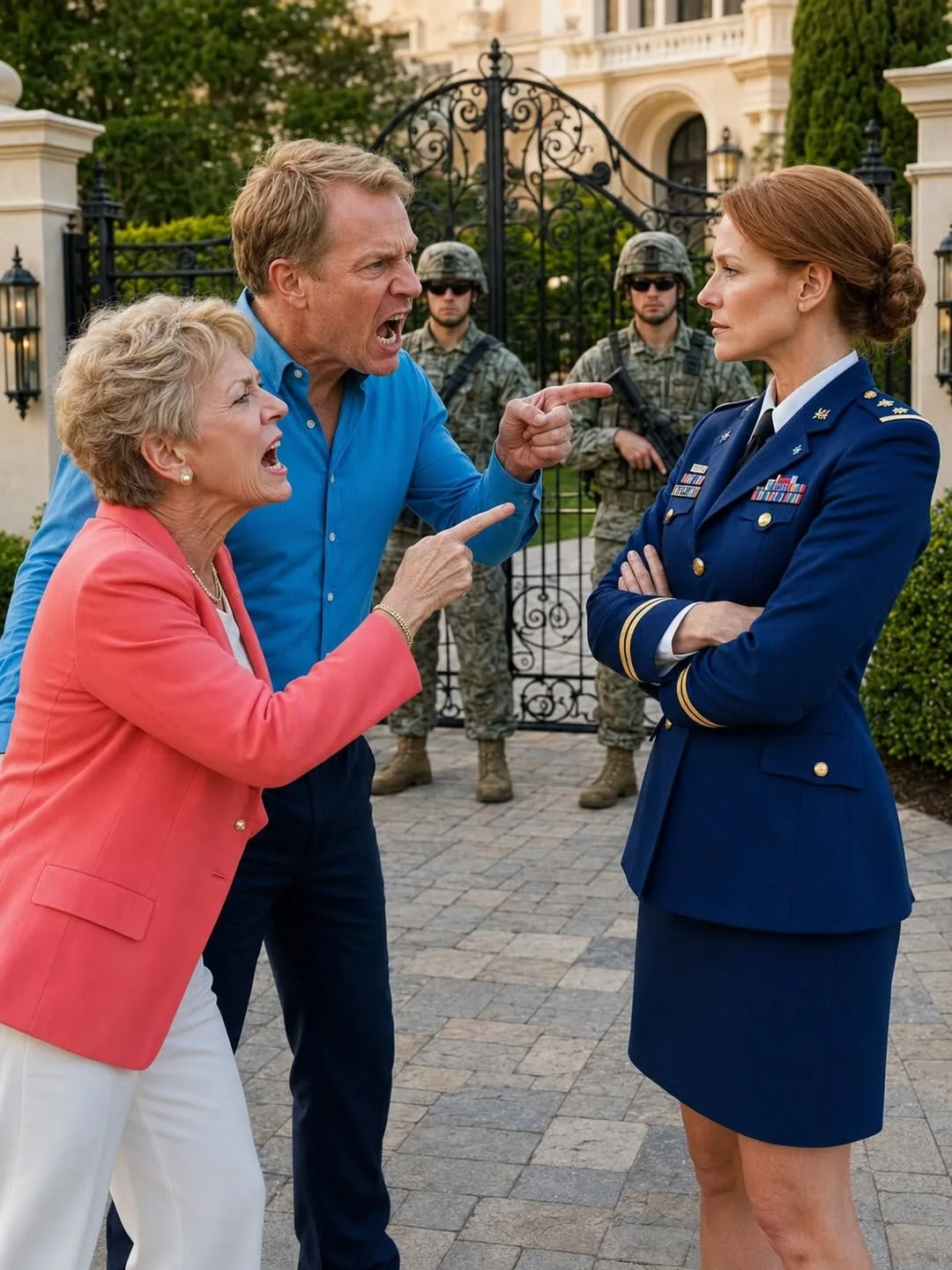
Anthony stared at the screen as if seeing his own words for the first time.
Chapter 4
Anthony stared at the screen as if seeing his own words for the first time.
Eleanor released his arm.
Not slowly.
Immediately.
Like touching him had suddenly become dangerous.
“You wrote that?”
Anthony didn’t answer.
His mother stepped backward.
“You told me this was about protecting the family.”
“I was protecting the family.”
“By destroying your wife?”
“Ex-wife.”
The correction was automatic.
Petty.
Almost absurd.
And somehow, it told me everything.
Even now, with federal investigators standing beside him, Anthony still needed the technicality.
The marriage was over.
Therefore, what he had done to me mattered less.
Ortiz took the phone back.
“Mr. Whitmore.”
Anthony raised both hands.
“I want an attorney.”
“That is your right.”
“And I’m not answering anything else.”
Ortiz nodded.
For the first time that morning, Anthony made a smart decision.
The elevator doors opened.
He stepped inside with the investigators.
Before the doors closed, he looked at me.
I expected anger.
Instead, I saw something worse.
Expectation.
Some part of
him still believed I would save him.
Five years of marriage had trained him to expect that.
I had paid debts he created.
Smoothed over insults he caused.
Explained his mistakes.
Defended him to friends.
Apologized when his mother was offended.
Protected the image of our marriage long after the marriage itself had stopped protecting me.
His lips moved.
“Marissa.”
I said nothing.
The doors closed.
Eleanor and I stood in the hallway.
For once, there was no Anthony between us.
No son for her to defend.
No husband for me to excuse.
Just two women and the wreckage of every lie we had chosen to believe.
She looked smaller without him.
Her coat was still immaculate.
Her handbag still expensive.
Her hair still perfectly arranged.
But the woman inside all of it looked tired.
“I didn’t know about the complaint,” she said.
I believed her.
That did not absolve
her.
“You knew he was moving money.”
Her mouth tightened.
“I knew the business needed help.”
“From my accounts.”
“You were married.”
“That is not permission to forge my signature.”
“I never forged anything.”
“No. You just used my card for years and called me selfish whenever I questioned it.”
Her eyes flashed.
“You gave me that card.”
“Yes.”
“And now you’re acting as if generosity was some terrible burden.”
“No.”
I stepped closer.
“I’m acting as if generosity ended when the marriage did.”
She stared at me.
That sentence seemed more offensive to her than the investigators.
Because Eleanor understood transactions.
She did not understand endings.
In her world, once something entered the family, it belonged to the family forever.
Money.
Property.
People.
Especially people.
“You hated me,” she said.
There was no anger in her voice now.
Only accusation.
I thought about it.
All the dinners.
The small
comments.
The way she corrected my clothes before charity events.
The way she introduced me as “Anthony’s wife” even after learning I held a doctorate.
The Christmas she told me, in my own kitchen, that Anthony could have married someone “more naturally feminine.”
The vacation where she spent $14,000 in three days and told me not to be vulgar enough to discuss money.
“I didn’t hate you,” I said.
She looked surprised.
“That would have been easier.”
“Then what?”
“I kept hoping you would eventually decide I was enough.”
Her face changed.
For the first time, Eleanor had no immediate answer.
“That was my mistake,” I continued. “I thought if I was generous enough, patient enough, quiet enough, you would stop needing me to feel small.”
She looked away.
For one brief second, I saw shame.
Then pride covered it.
“Anthony always felt inferior to you.”
“I know.”
“You could have made it easier for him.”
There it was.
Even now.
His envy was somehow my responsibility.
“No, Eleanor. Anthony could have become a better man.”
She flinched.
“That was his job.”
The elevator returned.
Two building security officers stepped out.
Behind them stood Daniel.
My attorney looked at Eleanor.
Then at me.
“Are you all right?”
“I will be.”
He nodded toward my apartment.
“We need to talk.”
Eleanor moved to follow.
Daniel held up one hand.
“Mrs. Whitmore, this conversation does not involve you.”
She almost laughed.
“Everything involving my son involves me.”
Daniel’s expression remained neutral.
“That belief may be part of the problem.”
I had never liked him more.
Inside the apartment, Daniel placed a second folder beside mine.
Gray.
Thinner.
“Federal investigators will handle whatever falls within their jurisdiction,” he said. “But we also have the civil side.”
“How bad?”
“For Anthony?”
“Yes.”
Daniel took off his glasses.
“Bad.”
He walked me through it.
The fraudulent account.
The forged authorization.
The unauthorized credit line.
Transfers out of marital and personal funds.
False signatures.
Documents created to make the hidden account appear legitimate.
It was not one mistake.
It was a system.
And systems leave patterns.
Anthony had believed complexity would protect him.
Instead, complexity gave investigators more places to look.
“What about Eleanor?”
Daniel opened another section.
“Her card usage itself is complicated because you authorized the account.”
“I know.”
“But there are charges after the separation agreement date.”
“How many?”
“Thirty-seven.”
My eyebrows rose.
“Thirty-seven?”
“She increased spending substantially during the final six weeks.”
Of course she had.
I almost laughed.
Eleanor had sensed the end coming and treated my credit line like a closing sale.
“Can we recover it?”
“Some.”
“How much?”
“That depends on whether you want litigation.”
I looked toward the window.
Manhattan glittered in the morning sun.
For years, I had imagined revenge.
Not consciously.
But in the private, embarrassed way hurt people sometimes do.
I imagined Eleanor losing invitations.
Anthony losing clients.
Both of them discovering that I was more powerful than they thought.
Standing there, with everything finally possible, revenge felt strangely cheap.
“What happens if I sue for everything?”
Daniel considered it.
“You probably win a significant judgment.”
“And then?”
“You spend months, possibly years, staying connected to them.”
That answered the question.
“Recover what is straightforward.”
“And the rest?”
“Let it go.”
Daniel studied me.
“You’re sure?”
“Yes.”
I was done paying them.
I was also done letting them occupy my life for free.
Three weeks later, Anthony was charged.
The initial counts involved wire fraud, identity theft, false financial documents, and conspiracy connected to the account opened in my name.
The national security review continued separately.
Investigators ultimately found no evidence that Anthony had obtained classified material.
That mattered to me.
Not because it saved him.
Because it saved the truth.
He had not been a master spy.
He had been something far more ordinary.
An insecure man who wanted access to importance without doing the work required to earn it.
He had exaggerated his proximity to my career.
Used my name to impress investors.
Hinted at government connections he did not possess.
And when the lies started collapsing, he had prepared a way to blame me.
Bellweather Meridian turned out to be a financial vehicle used by two businessmen attempting to gain introductions into defense contracting networks.
Anthony had promised access.
He had none.
So he sold the appearance of access.
My travel schedule.
My title.
Photographs of harmless documents.
Stories about people he had met at dinners.
Fragments.
Enough to make himself valuable.
Not enough to make himself innocent.
Eleanor was never charged in the national security case.
But the financial investigation exposed something she had spent her entire adult life protecting.
Her reputation.
Several purchases she had described as “family expenses” had been reimbursed through Anthony’s company.
Charitable donations had been routed through accounts he controlled.
A foundation she chaired quietly removed her.
Three boards asked for her resignation.
The Upper East Side did what the Upper East Side always does.
It did not scream.
It stopped inviting.
That hurt Eleanor more than any courtroom could have.
Two months after Anthony’s arrest, she asked to meet me.
I almost refused.
Then I agreed.
Not at my apartment.
Not at hers.
A quiet restaurant near Central Park.
Neutral ground.
She arrived ten minutes early.
For the first time since I had known her, she carried an ordinary leather handbag.
No visible logo.
No platinum card.
She sat across from me.
“You look well,” she said.
“So do you.”
It was a lie.
She looked older.
Not physically.
Socially.
As though the world had stopped reflecting back the version of herself she preferred.
For several minutes, neither of us spoke.
Then she said, “Anthony blames me.”
“Do you blame yourself?”
Her mouth tightened.
“I raised him to believe he deserved better.”
“Better than what?”
She looked down.
“Whatever he had.”
That was perhaps the most honest thing Eleanor had ever said.
“My husband was like that,” she continued. “Anthony’s father. Nothing was enough. The next house. The next promotion. The next table. The next invitation.”
“And you taught Anthony the same thing.”
“I suppose I did.”
I waited.
She touched the edge of her water glass.
“I thought ambition kept men strong.”
“No.”
I thought of Anthony standing outside my apartment, demanding that I open the door.
“Sometimes it just keeps them hungry.”
Her eyes filled.
She looked away immediately.
Eleanor did not cry in public.
Some rules survived everything.
“I called you a gold digger,” she said.
“Yes.”
“You never needed our money.”
“No.”
“You had more than Anthony knew.”
“This was never about how much I had.”
“I know that now.”
I looked at her.
That was the tragedy.
She did know now.
Too late to save the marriage.
Too late to save her relationship with her son.
Too late to reclaim the years she had spent turning every family interaction into a contest.
“I’m sorry,” she said.
The words were quiet.
Not dramatic.
No witnesses.
No benefit.
That made them more credible.
I nodded.
But I did not rescue her from the silence afterward.
Forgiveness does not require pretending nothing happened.
“I hope you build a life that doesn’t require anyone else to feel small,” I said.
She closed her eyes.
When she opened them, she nodded.
We never met again.
Anthony eventually accepted a plea agreement on the financial charges.
I did not attend sentencing.
People were surprised by that.
They expected me to want the moment.
To watch him lose everything.
But I had already watched him lose the only thing that mattered to me.
My trust.
A courtroom could not make that more final.
Six months after the divorce, I stood once again in my kitchen with coffee in my hand.
Same skyline.
Same windows.
Different life.
My apartment looked almost empty.
I had removed Eleanor’s furniture.
Sold the dining table Anthony chose.
Repainted the bedroom.
Changed the art.
Nothing expensive.
Nothing symbolic enough for a magazine.
Just mine.
The black folder sat on the counter.
Federal investigators had returned it after copying what they needed.
I opened it one final time.
Receipts.
Statements.
Emails.
Evidence of five years spent explaining away behavior I should have confronted sooner.
Then I closed it.
Not because the story no longer mattered.
Because it no longer controlled me.
That afternoon, I walked past Bergdorf Goodman.
For a second, I remembered Anthony’s furious phone call.
Half the Upper East Side watched her get treated like a criminal.
At the time, he believed the declined platinum card was the catastrophe.
It wasn’t.
The catastrophe was believing access was ownership.
Believing marriage was permission.
Believing love meant one person could keep taking while the other kept proving they were generous enough to deserve respect.
Eleanor thought she lost a credit card.
Anthony thought he lost a wife.
What they actually lost was access to a woman who had finally learned the difference between loyalty and surrender.
My military rank did not save me.
My clearance did not save me.
The black folder did not save me.
The moment that saved me came much earlier.
It was the moment I stopped asking people who benefited from my silence for permission to speak.
I went home before sunset.
Opened the balcony doors.
Poured one glass of Amarone.
And watched Manhattan light up beneath me.
No pounding at the door.
No accusations.
No demands.
Just quiet.
The black folder eventually went into a locked archive box.
The evidence had done its job.
The silence stayed with me.
And this time, it belonged entirely to me.
THE END.
Chapter complete
You have reached the end of this chapter.
Continue reading
A few more worlds to get lost in after this chapter.




