They Took Everything From Her, Until One Silver Pendant Changed the Entire Mansion
For five long years, everyone around me worked very hard to convince me that I was small.
Chapter 1
They Took Everything From Her, Until One Silver Pendant Changed the Entire Mansion
For five long years, everyone around me worked very hard to convince me that I was small.
My husband said it with a smile. His mother said it with perfume on her wrists and diamonds on her fingers. His mistress said it with the calm cruelty of a woman who believed the world had already chosen her side.
“You came from nothing, Lenora,” Darnell would tell me whenever he wanted to make sure I remembered my place. “You should be grateful I gave you a name people recognize.”
But the truth was, I had a name before him.
I just did not know what it was worth.
My name is Lenora Washington. I was thirty-two years old, a pediatric oncology nurse in Atlanta, and most days I knew exactly who I was. At the hospital, I was the steady voice in frightened rooms. I helped parents breathe when doctors said words no family wanted to hear. I held tiny hands through long nights and smiled for children
who had every reason to be afraid.
At work, I was trusted.
At home, I was erased.
Darnell had not begun our marriage as a monster. That was what made it difficult to explain. In the beginning, he was charming, polished, almost tender. He opened doors, remembered my favorite coffee, told me he admired my strength. He made me believe he saw something rare in me.
Then, slowly, he began taking pieces.
First, it was my time. Then my money. Then my confidence. Then my voice.
If I worked late, he accused me of caring more about strangers than my own husband. If I came home exhausted, he called me cold. If I questioned the strange withdrawals from our joint account, he kissed my forehead and told me I worried too much.
By the second year, he had learned exactly how to wound me without leaving a mark anyone else
could see.
His mother, Beverly, helped.
Beverly Washington had built an entire personality around looking disappointed. She was the kind of woman who could turn a compliment into a knife. She never yelled. She never needed to. A single raised eyebrow from her could make a room feel smaller.
“You are fortunate,” she told me once, while inspecting the silverware before a dinner party. “A man like Darnell could have married into any family in Atlanta. Old money, political money, real money.”
I remember looking down at the forks in my hand.
“And instead,” she added, “he chose kindness.”
By kindness, she meant me.
By me, she meant charity.
I came from a modest family. My grandparents had raised me after my parents died when I was young. We did not have mansions or family lawyers or portraits above fireplaces. We had faith, secondhand furniture, and a little plot of
land in Georgia that my grandmother Ruth always told me never to sell.
“That land remembers us,” she used to say.
As a girl, I thought she meant history.
As a woman, I thought she meant sentiment.
I had no idea she meant ownership.
For years, that land was the one thing Darnell could not fully touch. Everything else became tangled in marriage, bills, promises, signatures, and lies. He was clever about it. He never demanded everything at once. He asked for help. He called it temporary. He said we were building a future.
Then he borrowed against my savings.
Then he opened credit lines.
Then he placed papers in front of me while I was tired from twelve-hour shifts and said, “Just sign here, baby. I already had someone look over it.”
Someone.
Later, I would learn her name had been on more than one document.
Candace Thornton.
Candace was an attorney from one of Atlanta’s oldest and most intimidating families. She was tall, elegant, educated, and cold in a way people mistook for class. Her family name carried weight in rooms where mine carried silence. The Thorntons owned property, influence, charities, and reputations people were afraid to challenge.
Candace also owned Darnell’s attention.
At first, he insisted she was only handling some legal paperwork for his business contacts. Then she began calling at night. Then she began appearing at events. Then she stopped pretending.
The first time I saw her hand rest on Darnell’s arm in public, she did not pull away.
She looked straight at me.
Not guilty.
Not embarrassed.
Amused.
That was the moment I understood that humiliation was not an accident in my marriage. It was part of the design.
Still, I stayed.
I stayed because leaving is not always one brave step. Sometimes leaving is a thousand small battles against fear, exhaustion, money, shame, and the voice someone planted inside you saying, Where would you even go?
Darnell knew that voice. He fed it well.
“You think anyone will believe you over me?” he asked one evening when I confronted him about Candace.
He was standing in our bedroom, fixing his cufflinks for a gala I had not been invited to.
“I don’t need everyone to believe me,” I said quietly. “I just need you to stop lying.”
He laughed then.
Not loudly. Not dramatically.
Just enough to make me feel foolish for expecting honesty.
“You really do not understand the world, Lenora,” he said. “People like Candace are born into power. People like you are lucky when power lets them stand nearby.”
I should have left that night.
Instead, I went to work the next morning and held a little boy’s hand while he cried because he missed his dog.
That was my life. Pain at home. Purpose at work. I survived by keeping them separate.
Then Darnell took even that from me.
The complaints arrived all in one week.
Formal. Detailed. Devastating.
A parent claimed I had mishandled medication. Another report suggested I had spoken cruelly to a patient. A third accused me of violating hospital protocol in a way that could end my career.
None of it was true.
Not exaggerated. Not misunderstood.
False.
My supervisor, Marlene, could barely look at me when she called me into her office. Her hands were folded tightly on her desk, and her voice was gentle in the way people sound when they are about to hurt you because policy demands it.
“Lenora,” she said, “you know I respect you. But the hospital has to investigate.”
“I didn’t do this,” I whispered.
“I know who you are,” she said.
But her eyes told me something else.
Knowing who I was did not protect me from paperwork.
By the end of that meeting, I was suspended pending investigation. My badge was deactivated. My name, which had once meant trust in the pediatric ward, now sat under suspicion in a file.
When I walked out of the hospital, my phone buzzed.
It was Darnell.
Not a call.
A text.
We need to talk about the divorce.
I stood in the parking garage for a long moment, staring at those words while fluorescent lights hummed above me.
By the time I reached home, he was waiting in the living room with Beverly seated beside him like a judge and Candace standing near the window like she already owned the view.
There were papers on the coffee table.
Divorce papers.
Darnell did not look sad. He looked relieved.
“I think we both knew this was coming,” he said.
I looked at Candace. “Did you file the hospital complaints?”
Her smile barely moved.
“Careful, Lenora,” she said. “Accusations can become expensive.”
My hands were shaking, but I kept them at my sides.
Darnell slid the papers toward me.
“I am being generous,” he said. “Given your current employment situation, you should appreciate that.”
“My employment situation?” I repeated.
Beverly sighed. “Do not make this more embarrassing than it already is.”
I picked up the papers and scanned the pages through blurred vision. Legal language. Asset division. Waivers. Claims. Darnell had structured everything carefully, too carefully.
Then I saw it.
The Georgia land.
He wanted it.
That tiny piece of inheritance from my grandparents. The last thing left that had not been poisoned by him.
I looked up slowly. “You want my grandmother’s land?”
Darnell smiled.
“There is no reason for you to keep it. What are you going to do with dirt, Lenora? Build a kingdom?”
Candace looked away, but not before I saw the flicker in her expression.
Interest.
Not amusement.
Interest.
That should have warned me.
Instead, all I felt was rage and grief tangled so tightly I could barely breathe.
“You emptied the joint account,” I said.
Darnell’s face hardened. “I protected marital assets.”
“You redirected notices.”
“I managed household affairs.”
“You helped destroy my career.”
Candace’s voice cut in like glass. “Again, I suggest you choose your words wisely.”
Beverly stood, adjusting the pearls at her throat.
“This is what happens when women without breeding are invited into respectable families,” she said. “They confuse opportunity with entitlement.”
For a moment, no one spoke.
Then Darnell leaned close to me and lowered his voice.
“Sign what needs to be signed, Lenora. Walk away quietly. And maybe I will make sure the investigation at your hospital does not become uglier.”
I looked at the man I had married.
I remembered his hand on mine at the altar.
I remembered believing him.
Then I looked at Candace, calm and shining beside him, and understood that the woman who had helped ruin me was not satisfied with taking my husband.
She wanted the last piece of my grandmother too.
I did not sign.
I left with nothing but my purse, my keys, and the silver pendant I had worn under my collar since I was eighteen.
The pendant had belonged to my grandmother Ruth. It was old, slightly tarnished, and engraved with a crest I had never understood. Darnell used to call it ugly.
“Sentimental junk,” he said once.
But Ruth had clasped it around my neck on my eighteenth birthday with trembling hands.
“Never take this off for anyone who makes you feel ashamed,” she told me.
At the time, I thought she meant dignity.
She meant proof.
That night, I drove to my best friend Clara’s apartment and finally broke apart on her couch.
Clara did not tell me to calm down. She did not say everything happened for a reason. She sat beside me, held my hand, and let me cry until there was nothing elegant left in me.
The next morning, she went to my grandmother’s old house.
“I remembered something,” she told me when she returned that afternoon, carrying a cedar box wrapped in a faded quilt. “Your grandmother gave this to my mother for safekeeping after she got sick. My mom kept it in storage. I should have brought it sooner.”
Inside the box were photographs, brittle documents, a small velvet pouch, and an envelope with my name written across the front in my grandmother’s careful handwriting.
Lenora.
My fingers went numb.
I opened the envelope slowly.
The letter was dated fifteen years earlier.
My dearest Lenora,
If this letter has reached you, then the trust has matured, and it is time you learn the truth about who you are.
I stopped breathing after the first sentence.
Clara sat across from me, silent, as my eyes moved over the page.
Your grandfather and I raised you quietly because powerful families protect their lies with money, lawyers, and time. The land I left you is not merely land. It is the foundation deed tied to the original Thornton Estate.
The room tilted.
Thornton.
Candace Thornton.
I kept reading.
My mother, your great-grandmother, was the lawful heir to the Thornton fortune. She was married in secret to Elias Thornton before his family forced him into a public marriage that served their social ambitions. To protect the true bloodline, Elias placed the core estate, including the Buckhead mansion and its holding accounts, into a generational trust. The public branch of the family was allowed to reside there only under conditional terms.
My hands shook so violently Clara reached across the table to steady the paper.
They live in the house, Lenora. They do not own it.
I covered my mouth.
The letter went on to explain what had been hidden for decades. The Thornton family’s wealth had been split between public control and legal ownership. Candace’s side of the family had influence, reputation, and access. But the heart of the estate—the mansion, the trust holdings, the land rights, and the oldest assets—belonged to the true heir.
Me.
The trust can only be activated by two things: the deed in your legal name and the silver pendant bearing the matriarch’s seal.
I reached under my collar and pulled out the pendant.
For the first time in my life, I looked at it not as a memory, but as a key.
The faded crest suddenly seemed alive beneath my thumb.
The letter ended with one final line.
Do not beg for a seat in a house that is already yours.
I read that sentence again.
Then again.
Something inside me, something Darnell had spent years burying, lifted its head.
Clara whispered, “Lenora… do you understand what this means?”
I looked at the deed folded beneath the letter.
Then I looked at the pendant.
Then I thought of Darnell laughing about building a kingdom.
For the first time in weeks, I smiled.
“Yes,” I said. “It means they made a mistake.”
Two days later, the Thornton Mansion opened its doors for the most anticipated social event of the season.
A masquerade gala.
Five hundred guests.
Judges, donors, executives, politicians, hospital board members, society wives, family friends, and enemies dressed as friends. Champagne moved through the room on silver trays. A string quartet played beneath crystal chandeliers. The marble floors shone like ice.
It was supposed to be Candace’s night.
Not officially, of course. Officially, the event was for charity. Unofficially, everyone knew it was her public arrival beside Darnell. Their debut. Their victory walk through the same mansion her family claimed as proof of their superiority.
I arrived uninvited.
Clara helped me choose the dress.
Crimson.
Floor-length.
Simple enough to be elegant, striking enough to be impossible to ignore.
The silver pendant rested openly at my throat for the first time in my adult life.
When I stepped into the ballroom, conversation shifted around me like wind moving through curtains. People recognized me. Of course they did. The disgraced nurse. The abandoned wife. The woman whose marriage had collapsed into scandal.
Some looked curious.
Some looked pleased.
Some looked away.
I kept walking.
At the top of the grand staircase stood Candace Thornton in diamonds, smiling like a queen welcoming guests into her kingdom. Darnell stood beside her in a black tuxedo, polished and pleased with himself. Beverly hovered nearby, glowing with the satisfaction of a woman who believed her son had finally corrected his mistake.
Then Darnell saw me.
His smile died.
Candace followed his gaze, and for one second, her mask slipped.
Not fear.
Recognition.
Her eyes dropped to the pendant.
Then narrowed.
Darnell came down the stairs fast, his steps controlled but angry. He reached me near the center of the ballroom, where enough people could see but not yet hear.
“What are you doing here?” he hissed.
“Attending the gala,” I said.
“You were not invited.”
“I know.”
His hand closed around my upper arm. Firm. Possessive. Familiar.
“You need to leave before you embarrass yourself further,” he said.
I looked down at his hand, then back at him.
“Take your hand off me.”
Candace arrived beside him, carrying a crystal flute and wearing a smile so sharp it should have cut her lip.
“Oh, let her stay,” she said loudly enough for nearby guests to hear. “It is a charity event, after all. Giving the less fortunate a warm room for the evening seems on theme.”
A few people laughed.
Not many.
Enough.
Beverly approached with disgust written across her face.
“Lenora,” she said, “whatever dramatic display you are planning, spare us. This family has endured enough of your instability.”
“My instability?” I repeated softly.
Darnell leaned closer.
“You lost your job. You lost your marriage. You are about to lose that pathetic land your grandmother left you. Do not make me have security remove you too.”
The words were meant to break me.
Instead, they steadied me.
Candace stepped closer, her diamonds flashing under the chandelier light.
“You do not belong in this house,” she said.
I looked at her then.
Really looked at her.
At the woman who had mistaken access for ownership.
“Are you sure?” I asked.
Something in my voice made her expression tighten.
Darnell noticed. His patience snapped.
“I said get out.”
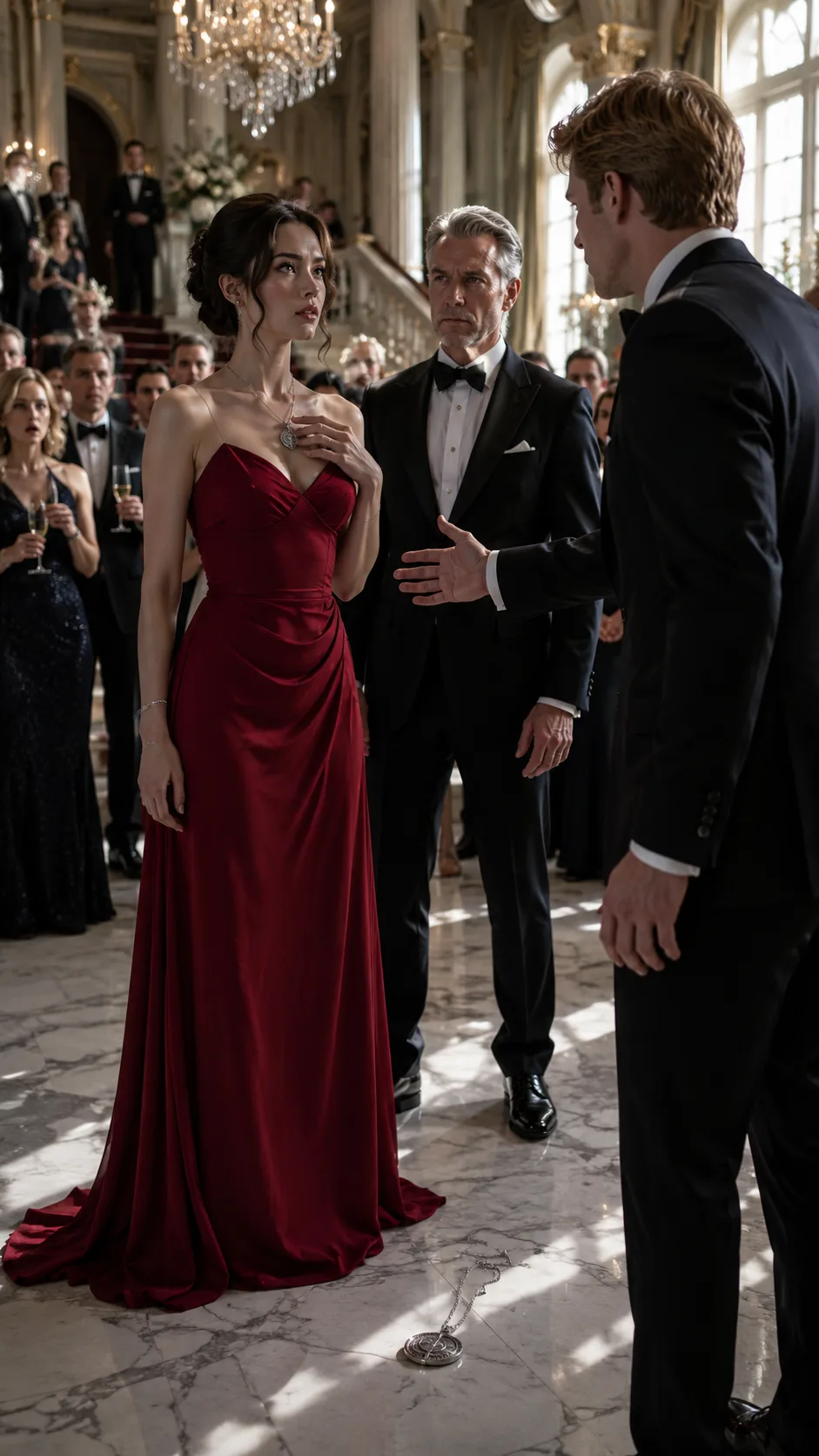
Then he shoved me.
It was not the hardest fall of my life.
But it was the most public.
My heel caught the edge of a rug, and I went down onto the polished marble as a collective gasp swept through the ballroom. Champagne glasses paused halfway to painted mouths. Music faltered. Five hundred people watched the woman they thought had already been ruined land at the feet of the people who had ruined her.
For a heartbeat, I stayed there.
One knee against the marble.
One hand braced on the floor.
Breathing slowly.
Then the pendant slipped free from the neckline of my dress and struck the marble with a clear, ringing sound.
Clink.
The sound traveled farther than it should have.
A man stepped out from the crowd.
Older. Tall. Silver-haired. Wearing a tuxedo and an expression of disbelief.
Arthur Vance.
Even I knew his name. Everyone in Georgia society did. Senior partner at Vance, Bell & Whitaker. Executor of old trusts, silent fortunes, and family secrets that never appeared in newspapers. The sort of man wealthy families treated with careful respect because he knew exactly where the bodies were buried, financially and otherwise.
His eyes were fixed on my pendant.
He moved past Darnell without acknowledging him and knelt beside me.
“May I?” he asked, his voice barely above a whisper.
I lifted the pendant.
His face changed.
Not slightly.
Completely.
“The matriarch’s seal,” he said.
The room went silent.
Candace’s champagne flute trembled in her hand.
Arthur looked up at me.
“You are Ruth’s granddaughter,” he said. “You are Lenora Washington.”
“I am.”
He helped me stand.
Darnell let out a harsh laugh, but there was unease beneath it now.
“Arthur, what is this?” he demanded. “Some kind of stunt? She is trespassing.”
Arthur turned toward him slowly.
The old deference was gone.
“No,” Arthur said. “She is not.”
The ballroom seemed to hold its breath.
Candace spoke first. “Arthur, stop. Whatever you think you are doing—”
“I am doing what your family has delayed for sixty years,” he said.
Her face went pale.
Arthur’s voice rose, clear enough to reach the balcony.
“For six decades, the Thornton family’s public branch has occupied this property under a conditional residence agreement attached to a generational trust. The primary estate, its original deed, its holding accounts, and its protected assets were never transferred into your ownership.”
Murmurs erupted.
Beverly grabbed Darnell’s sleeve.
Darnell looked confused, then irritated, then afraid.
Candace tried to laugh. “That trust is folklore. My grandfather settled that.”
“No,” Arthur said. “Your grandfather concealed it.”
I opened my clutch and removed the folded deed.
Every eye followed the movement.
“This was recorded this morning,” I said, handing it to Arthur. “Along with the activation documents.”
Arthur examined the seal, the notary stamp, the signatures.
Then he looked at Candace.
“The trust is active.”
The words landed like a judge’s gavel.
Candace stared at him, her lips parted.
Darnell turned toward me. “Lenora…”
That was the first time he said my name without contempt in months.
I almost laughed.
He stepped closer, lowering his voice into the warm, pleading tone he used whenever he wanted to crawl back from cruelty without admitting he had been cruel.
“Baby,” he said, “let’s talk. Whatever this is, we can handle it together. We are still married.”
I looked at him for a long moment.
The ballroom disappeared.
For five years, I had waited for that voice to mean love again.
Now it only sounded like hunger.
“We are still legally married for a few more days,” I said. “But you filed expedited divorce papers yesterday.”
His face tightened.
“And in those papers,” I continued, “you waived any claim to assets acquired outside the marriage. You specifically excluded my grandmother’s land because you thought it was worthless.”
A ripple moved through the guests.
Darnell’s eyes widened.
I smiled.
“You did that to keep me poor,” I said. “Instead, you protected my inheritance from yourself.”
Beverly made a small strangled sound and reached for the nearest column.
Candace looked as if the room had lost oxygen.
I turned to Arthur. “As the legal owner of this estate, I would like to make several decisions immediately.”
Arthur inclined his head. “Of course, Ms. Washington.”
That title moved through the room like a storm.
Ms. Washington.
Not Mrs. Darnell Washington.
Not the disgraced nurse.
Not the woman from nowhere.
Ms. Washington.
I looked at Candace.
“First, I want a forensic review of every legal document connected to my marriage, my finances, and the complaints filed against me at Atlanta Children’s Medical Center. If any of those complaints can be traced to fraudulent legal conduct, notify the hospital board and the state bar.”
Candace’s face collapsed.
“You cannot prove anything,” she whispered.
I held her gaze.
“Then you should have nothing to fear.”
Someone in the crowd gasped. Someone else whispered her name.
I turned to Darnell.
“Second, I want Mr. Washington removed from my property.”
His mouth opened.
Closed.
Opened again.
“Lenora, do not do this,” he said.
It was almost funny, hearing panic dressed as love.
“You humiliated me in front of five hundred people,” I said. “You drained my accounts. You tried to take my grandmother’s land. You stood beside the woman who helped attack my career, and you called it winning.”
His jaw clenched.
“You are my wife.”
“No,” I said quietly. “I was your lesson.”
The security guards near the entrance shifted, suddenly uncertain where loyalty belonged.
I lifted my chin.
“Escort him out.”
Darnell’s composure shattered.
“You cannot throw me out!” he shouted, loud enough that the entire ballroom heard. “This is not yours!”
Arthur’s voice cut through the room.
“It is hers.”
That was all it took.
The guards stepped forward.
Darnell tried to pull away when one of them touched his arm. His face flushed dark with humiliation as the same crowd he had wanted to impress watched him lose everything he had tried to steal.
Candace stepped backward, shaking her head.
“No,” she said. “No, this is impossible.”
I turned to her.
“You may leave voluntarily,” I said. “Or you may leave with him.”
Her eyes filled with fury, but fear had already won.
Beverly grabbed Candace’s wrist. “Do something,” she hissed. “You are a Thornton.”
Candace looked around the ballroom, at the guests, the lawyers, the donors, the people who had laughed at me only minutes before.
Then she looked at Arthur.
And understood.
A name was not ownership.
A reputation was not a deed.
A mansion was not yours just because everyone had been too afraid to ask who held the key.
Darnell was escorted toward the front doors, protesting, pleading, threatening. Candace followed, her diamonds trembling at her throat. Beverly stumbled after them, no longer regal, no longer untouchable, just another woman watching the story she believed about herself collapse under public light.
The doors opened.
Cold night air swept into the ballroom.
Then they were gone.
For a moment, no one moved.
The string quartet sat frozen. The guests stared. The chandeliers glowed above the marble floor where I had fallen and risen in the same breath.
Arthur stood beside me.
“What would you like to do now, Ms. Washington?” he asked.
I looked around the Thornton Mansion.
The staircase.
The crystal.
The portraits.
The guests who had come to watch Candace claim a crown that had never belonged to her.
Then I touched the silver pendant at my throat.
For the first time in my life, it did not feel like an heirloom.
It felt like a door opening.
“Continue the gala,” I said.
Arthur’s mouth twitched, almost a smile.
“And the charity?”
I looked toward the hospital board members standing near the fireplace, all of them suddenly very interested in avoiding my eyes.
“The children still need funding,” I said. “Unlike some people in this room, they did nothing wrong.”
A nervous laugh moved through the crowd.
Then applause began.
Soft at first.
Then stronger.
Not from everyone. I did not need everyone.
I only needed the truth to stand where lies had been sitting.
That night, I walked up the grand staircase of the Thornton Mansion while Atlanta’s elite watched in stunned silence. My crimson dress moved behind me like a flame. The pendant rested against my chest. My grandmother’s letter was folded safely in my clutch.
For five years, they told me I came from nowhere.
But nowhere had a deed.
Nowhere had a seal.
Nowhere had a grandmother who had waited patiently for justice to outlive arrogance.
And as I stood at the top of the staircase looking down at the room that had tried to swallow me, I finally understood what Ruth had meant.
I had not come from nowhere.
I had come home.
THE END.
Chapter complete
You have reached the end of this chapter.
Continue reading
A few more worlds to get lost in after this chapter.




