My Family Sold Dad’s Cabin Behind My Back, Then Learned I Was the Secret Buyer
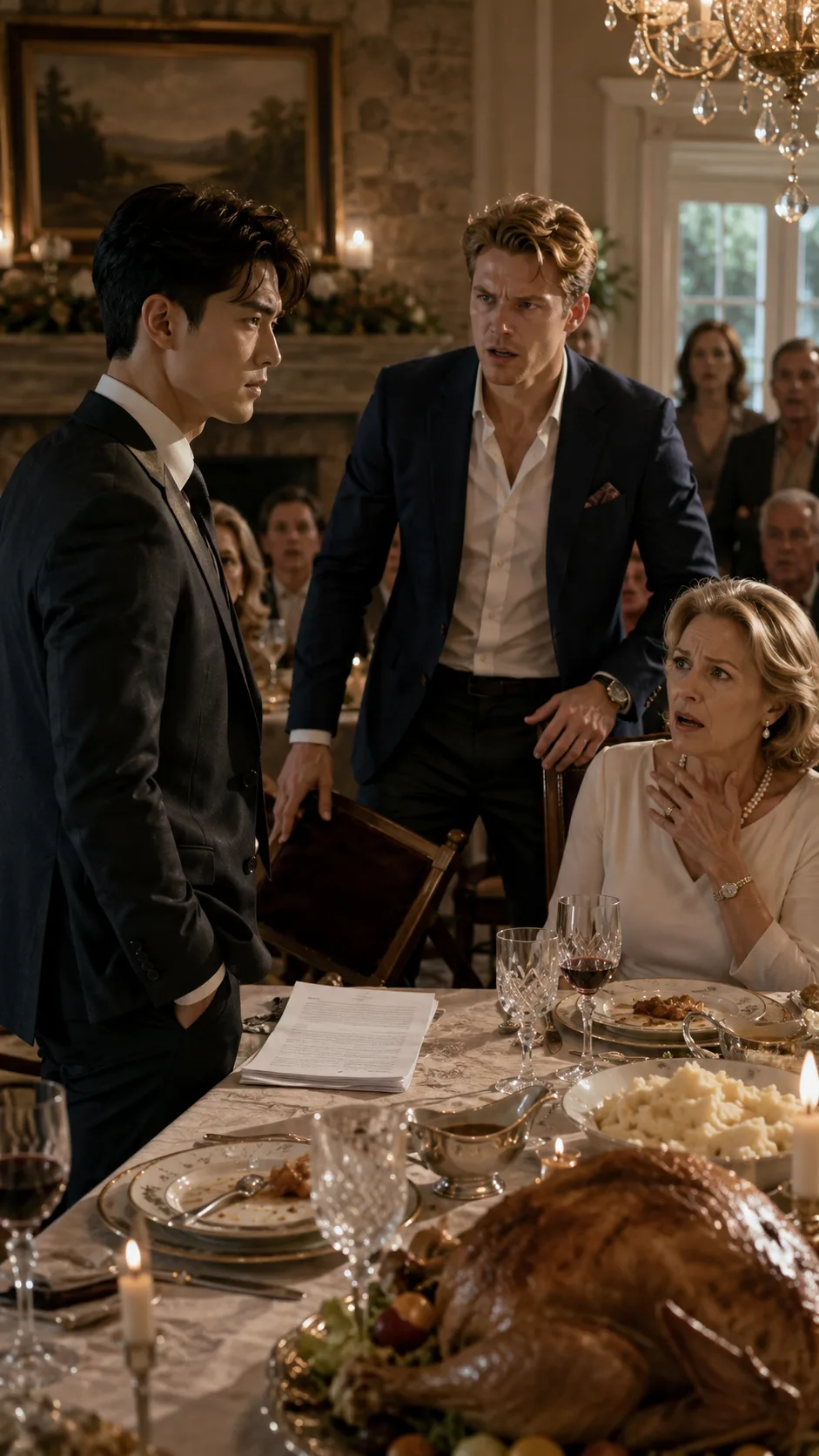
“We sold Dad’s cabin at last,” my mother announced over Thanksgiving dinner, smiling as if she were offering a blessing instead of a blade.
Chapter 1
My Family Sold Dad’s Cabin Behind My Back, Then Learned I Was the Secret Buyer
“We sold Dad’s cabin at last,” my mother announced over Thanksgiving dinner, smiling as if she were offering a blessing instead of a blade.
“And honestly, some people never deserved a piece of it.”
My brother Blake laughed under his breath. “As if Ethan could have bought it anyway.”
Every sound at the table seemed to die at once.
The carving knife stopped moving. My aunt lowered her fork. My cousins suddenly became fascinated with their plates. Sixteen people sat around my mother’s long dining table, pretending not to hear what everyone had clearly heard.
Marianne, my mother, stood at the head of the table with her wineglass raised. She had always been good at cruelty when it wore good manners. She could insult you softly, smile afterward, and make the room feel as if you were the unreasonable one for bleeding.
Blake sat beside her, broad-shouldered, smug, and polished in the way men become when the world has spent too long rewarding them for being loud. He leaned back in his chair, grinning
at me across the candles and crystal.
I did not argue.
I did not defend myself.
I smiled.
That smile made my mother pause.
Six weeks earlier, I would not have had the strength for it. Six weeks earlier, I was still the son they believed could be cornered, mocked, and pushed out of his own inheritance. They thought I was sentimental. They thought I was broke. They thought I would eventually get tired, embarrassed, or intimidated enough to walk away.
But by Thanksgiving night, I knew what they had done.
And I knew what I had already done in return.
My father, Thomas Hale, had been dead for four years.
He was not a rich man. He worked for the county water department, drove the same truck for nearly fifteen years, and kept his tools cleaner than most men kept their kitchens. But he had one thing he loved
more than anything he owned: the cabin by the lake.
He built it himself.
Not all at once. Not with a contractor and a blueprint and a checkbook. He built it slowly, over ten years, with weekends, overtime money, borrowed equipment, and hands that were always split at the knuckles. Every beam, every step, every shelf had his fingerprints in it.
When I was a kid, that cabin was where Dad became lighter.
At home, he was quiet. At the cabin, he whistled while fixing the dock. He woke before sunrise to fish, cooked pancakes in an old iron skillet, and let me sit beside him on the porch while fog lifted off the water.
During the last year of his life, when cancer had started taking pieces of him week by week, the cabin became more than a place. It became his refuge.
I drove him there every weekend
I could. Sometimes he was too weak to walk down to the water, so we sat on the porch under a blanket and listened to the wind move through the trees. Sometimes he talked about repairs he knew he would never make. Sometimes he said nothing at all.
Blake never came.
Not once.
My mother came twice. Both times she complained about the weak phone signal, the old mattress, and the smell of pine smoke in her clothes.
When Dad died, his will was simple. The cabin was to be divided equally between my mother, Blake, and me. One third each.
The savings went mostly to Mom. His truck went to her. His tools were split, though Blake took most of them and later sold half online. I did not fight over any of that.
I only wanted the cabin.
They wanted money.
At first, my mother tried to make it sound practical.
“Ethan, be reasonable,” she told me. “The taxes are going up. The roof needs work. None of us has time to maintain it.”
“I’ll maintain it,” I said.
Blake laughed. “With what money?”
“I’ll pay for the repairs.”
“You?” he asked, as if the idea itself was funny.
I made a formal offer to buy out their shares. I got preapproved for financing. I hired an attorney to draft the paperwork properly. I sent everything in writing.
They ignored it.
Then the pressure became uglier.
My mother said I was clinging to dead things. Blake said Dad would have wanted us to be practical. Mom said I was letting grief make me selfish. Blake said I was embarrassing myself by pretending I could afford anything of value.
Finally, they stopped discussing it with me at all.
That was when I started looking.
Not emotionally. Not desperately. Carefully.
I searched county property records. I checked tax documents. I reviewed title history. I looked for anything connected to the cabin.
Eight months before Thanksgiving, I found the listing.
Dad’s cabin was online.
For sale.
The brokerage handling it was Blake’s firm.
My name was nowhere on the listing.
I remember sitting at my desk, staring at the screen while something cold and clear settled inside me. They had not misunderstood me. They had not forgotten me. They were trying to remove me.
Legally, they could not sell that cabin without my signature, a court order, or a formal partition action. They knew that. Blake especially knew that. He was a licensed real estate broker. He understood title requirements, inherited property, signatures, notarization, and closing documents.
Which meant one thing.
They were counting on me not knowing enough.
Or not fighting hard enough.
They were wrong.
So when my mother humiliated me in front of the family on Thanksgiving, I let her have her moment. I let Blake laugh. I let everyone in that room witness the version of me they had created in their minds: quiet, weak, defeated.
Then I set my glass down.
“Congratulations,” I said calmly. “You did sell the cabin.”
My mother’s eyes brightened with satisfaction.
Blake’s grin widened.
Then I added, “You sold it to me.”
A fork slipped from someone’s hand and struck a plate with a sharp, bright sound.
Blake stopped smiling.
My mother stared at me as if I had spoken in another language.
“What did you just say?” she asked.
“I said congratulations,” I replied. “The sale went through.”
Blake leaned forward, his face tightening. “That’s impossible.”
“Is it?”
“Yes,” he snapped. “An out-of-state development company bought it. Oakhaven LLC. I handled the transaction myself.”
“I know.”
His expression flickered.
“I also know you handled the wire transfer,” I continued. “And because you were so eager to close the sale, collect your commission, and cash out before I could interfere, you never looked closely at who owned the buyer.”
The room had gone completely silent.
My aunt Susan slowly placed her napkin beside her plate. My uncle stared at Blake. One of my cousins whispered, “What?”
Blake’s jaw worked, but no sound came out.
“Oakhaven LLC,” I said, “belongs to me.”
My mother gave a short laugh, but it cracked halfway through. “Ethan, don’t be ridiculous.”
I looked at her.
“You don’t have that kind of money,” she said. “You’re a junior data analyst.”
“I was a junior data analyst five years ago.”
Her face changed slightly.
“Three years ago, I co-founded a logistics software company,” I said. “Last spring, we were acquired. I did not tell you because I knew exactly what would happen the moment you realized I had money. You and Blake would stop calling me useless and start calling me selfish.”
Blake’s face had gone pale.
“I let you believe what you wanted,” I said. “That I was broke. That I was sentimental. That I was too small to stop you.”
Blake swallowed hard, then tried to recover with a sneer. “So you bought a property you already owned part of? You paid full market price for something that was one-third yours? That’s not revenge, Ethan. That’s stupidity.”
“No,” I said. “Buying the cabin was never the point.”
His eyes narrowed.
“The point was letting you finish the crime.”
The words dropped into the room like a stone through glass.
My mother’s fingers tightened around her wineglass.
Blake pushed back from the table. “You need to be very careful what you say next.”
“I have been careful,” I said. “Extremely careful.”
I reached inside my jacket and removed a folded document. I placed it on the table beside the gravy boat.
Nobody touched it.
“That,” I said, “is the closing contract filed with the county clerk on Tuesday.”
Blake stared at the paper.
“To clear title for sale,” I continued, “the county required signatures from all three legal inheritors. Thomas Hale’s widow. His eldest son. And his youngest son.”
My mother’s lips parted.
“I never received that contract,” I said. “I never reviewed it. I never signed it.”
The candles flickered between us.
“And yet,” I said, “on page fourteen, there is a signature that looks very much like mine.”
Blake’s eyes darted to my mother.
That small movement was enough. Everyone saw it.
“A practiced signature,” I said. “Very neat. Very confident. Notarized by someone from Blake’s real estate office.”
My mother pressed one hand against her pearls. “Ethan…”
I turned to her.
“We were trying to spare you,” she said quickly. “You were too emotional. You were making everything harder than it needed to be.”
“You forged my signature.”
Her mouth trembled.
“You were refusing to let go,” she whispered. “Your father would not have wanted this ugly fight.”
“Do not use Dad to excuse stealing from me.”
Blake stood so abruptly his chair crashed backward onto the hardwood floor.
Several people flinched.
“Enough,” he barked. “This is family business.”
“No,” I said. “This is felony forgery.”
His face hardened, but fear was already showing through the anger.
“And for you, Blake, it is worse. You were the broker. You arranged a sale involving inherited property. You submitted fraudulent documents. You accepted funds through a transaction built on a forged signature.”
“Shut up,” he said.
“You helped push a fraudulent deed transfer.”
“Shut up.”
“And because the buyer was registered out of state when the wire was processed,” I said, “your problem may not stay local.”
Blake’s breathing changed.
For the first time that night, my brother looked exactly like what he was: not powerful, not untouchable, not golden.
Trapped.
My mother began to cry, but even her tears seemed confused, as if they were not sure whether they were grief, panic, or performance.
“Ethan, please,” she said. “We can fix this.”
“No, you can’t.”
“We’ll give the money back.”
“You can return money,” I said. “You cannot unforge a legal document.”
Blake gripped the edge of the table with both hands. “You wouldn’t do this to us.”
I looked at him for a long moment.
“You did this to yourselves.”
“We’re your family,” he said, and his voice broke on the word.
That almost made me laugh.
Family.
They remembered that word only when consequence entered the room.
“You stopped being my family when Dad died and you treated the only place he loved like a pile of cash to divide behind my back.”
My mother reached toward me across the table. “I am your mother.”
“Yes,” I said. “That made it worse.”
The room was frozen. No one defended her. No one defended Blake. The people who had looked away during years of little insults now sat in front of the result of their silence.
I stood.
“The six hundred thousand dollars wired into your joint account,” I said, “should not be touched.”
Blake’s knees seemed to weaken.
“Yesterday morning,” I continued, “my attorney delivered copies of the forged closing documents, the LLC ownership records, the wire information, and my sworn affidavit to the State Real Estate Commission.”
Blake closed his eyes.
“And to the district attorney’s white-collar crime division.”
My mother covered her mouth.
Somewhere down the table, Aunt Susan whispered, “Oh my God.”
Blake stared at me with pure hatred, but beneath it was something smaller and uglier.
Fear.
He knew enough about the law to understand what I had done. He knew his license was in danger. He knew the commission would open an investigation. He knew the notary could be questioned. He knew every email, every message, every recorded call, every document connected to that sale could now become evidence.
“You ruined me,” he whispered.
“No,” I said. “I gave you an opportunity to tell the truth. You chose paperwork.”
My mother sobbed harder. “Ethan, please. Please don’t walk out like this.”
I looked at the Thanksgiving table.
The turkey was untouched. The candles were burning low. The silverware shone under the chandelier. It was a perfect family dinner, arranged around a crime.
“I did not come here to argue,” I said. “I came here so you could say it in front of everyone.”
My mother stared at me.
“You wanted witnesses when you humiliated me,” I said. “Now you have witnesses for the truth.”
Then I stepped away from the table.
No one stopped me.
As I walked through the hall, I heard Blake say my name once. It was not a threat this time. It was not a command.
It was panic.
I opened the front door. Cold air moved across my face, clean and sharp after the suffocating warmth of the dining room.
Behind me, my mother was crying. Blake was shouting something at someone. The family was finally speaking, but I no longer cared what any of them had to say.
I walked to my car, started the engine, and pulled out of the driveway without looking back.
The road to the lake was dark and quiet.
By midnight, I reached the cabin.
Dad’s cabin.
My cabin.
The porch light was on because I had replaced the wiring the week before. The old steps creaked under my shoes in the same familiar way. Inside, the air smelled faintly of cedar, dust, and woodsmoke.
I stood in the living room for a long time, listening to the silence.
For four years, they had treated my love for that place like weakness.
But love was not weakness.
It was memory.
It was loyalty.
It was the reason I had fought carefully instead of loudly.
I lit a fire, sat in Dad’s old chair, and watched the first sparks catch.
Outside, the lake was black beneath the November sky.
For the first time since my father died, the cabin felt safe again.
THE END.
Chapter complete
You have reached the end of this chapter.
Continue reading
A few more worlds to get lost in after this chapter.




