The beer hit my shoulder before his insult did.
Chapter 1
The beer hit my shoulder before his insult did.
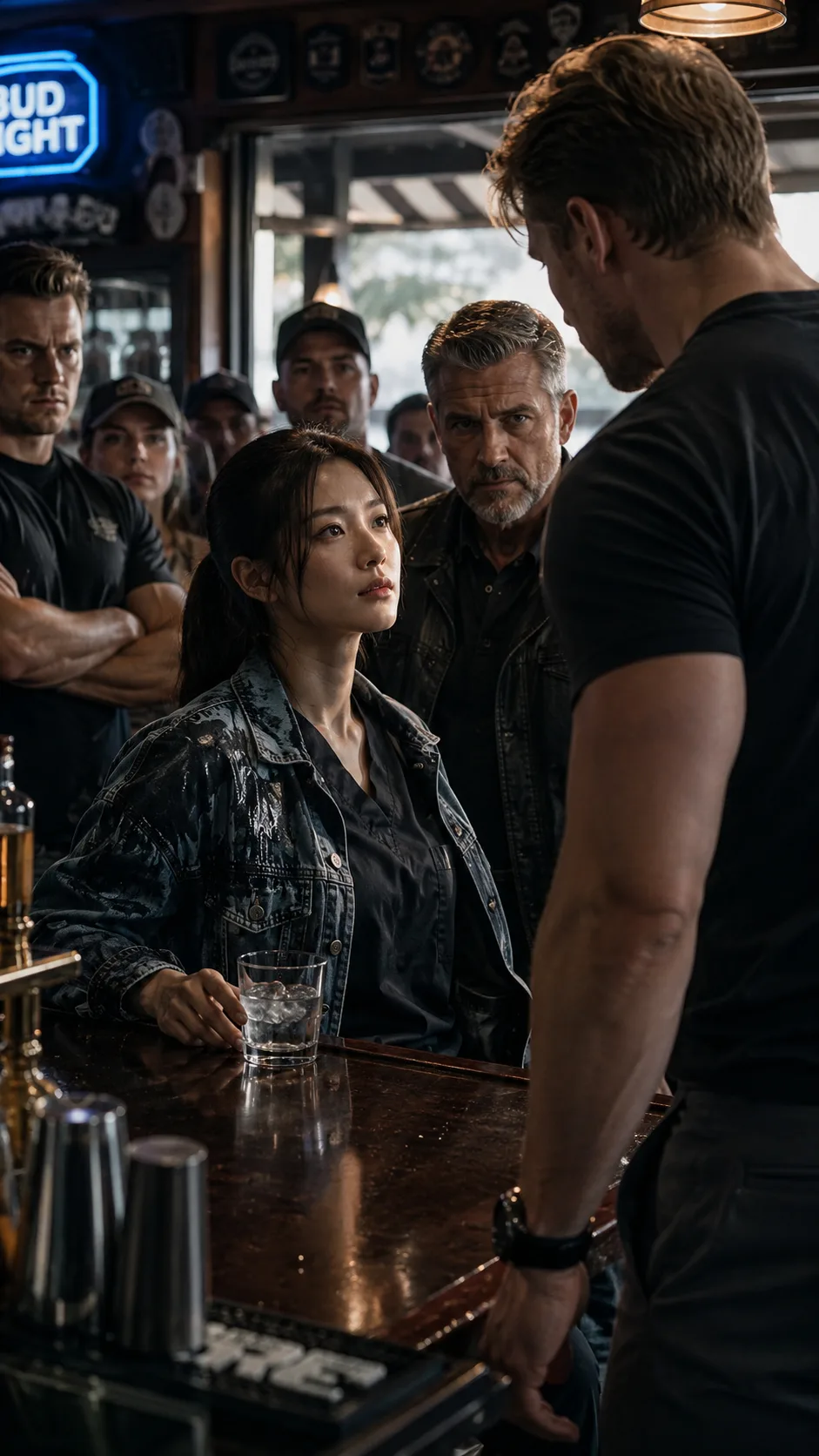
It soaked through the faded denim of my jacket in a cold, sticky stream, sliding down my sleeve and dripping from my elbow onto the floor of Anchor Point, a loud little bar tucked just off Orange Avenue in Coronado. The place smelled like old wood, spilled alcohol, fried food, and ego. A blue beer sign buzzed above the liquor shelves. Military stickers covered half the mirror behind the bottles. Every table seemed to have at least one man leaning back like the room belonged to him.
I had not come there looking for trouble.
I had just finished twelve hours in the emergency room at Coronado Medical Center. My shoulders hurt. My feet felt like they had been filled with gravel. My scrub top was hidden beneath my jacket, my hair was pulled back badly, and my only plan before driving through San Diego traffic was simple: sit alone,
drink something cold, breathe for ten minutes, then go home.
No attention.
No conversation.
No performance.
But some men notice silence and mistake it for weakness.
Lieutenant Rodriguez had been watching me from the moment I sat down at the bar. I noticed him the way tired women learn to notice men in loud rooms — without turning my head, without reacting, without giving them the satisfaction of knowing they have been seen. He was broad-shouldered, flushed from alcohol, surrounded by friends who laughed too quickly at everything he said. He had the loose confidence of a man used to uniforms, titles, and other people moving out of his way.
He looked me over once.
That was all it took for him to decide what I was.
A woman alone.
A civilian.
A nurse.
Tired enough not to fight back.
Then he lifted his beer and tilted it just enough.
Not an accident. Not a stumble. Not bad balance.
A choice.
The liquid ran down my jacket.
His friends burst out laughing before the first drop reached the floor.
Someone near the pool table raised a phone. Another man grinned like he had just been given free entertainment. The bartender, Jake, stopped wiping the counter for half a second, his eyes narrowing.
I pulled a handful of napkins from the metal dispenser and pressed them against my sleeve.
I did not curse.
I did not jump up.
I did not throw the drink back.
That bothered Rodriguez more than anger would have.
He stepped closer, dragging the attention of the room with him.
“Hey, sweetheart,” he said, loud enough for his friends to hear. “I’m talking to you.”
I kept blotting the beer from my jacket.
His smile thinned.
Then his hand closed around my wrist.
The bar seemed to
inhale.
There is always a moment like that in places like Anchor Point. A room full of witnesses suddenly becomes very busy pretending not to understand what it is seeing. The woman is expected to laugh it off. The man is expected to smirk. Somebody will say it was just a joke. Somebody will record it. Somebody will decide it is not worth getting involved.
I looked down at his fingers wrapped around my wrist.
Then I looked up at him.
“Let go,” I said.
My voice was quiet.
Clear.
Rodriguez smiled wider.
He did not think I was warning him.
He thought I was begging.
So I moved.
One twist of my wrist broke his grip. One step shifted my weight. One controlled turn brought his arm down flat against the bar with enough force to empty the laughter out of the room.
It was over before anyone understood it had started.
Rodriguez’s breath caught. His friends froze. A glass somewhere behind me stopped halfway to someone’s mouth.
I held him only long enough for the message to reach him.
Then I released him.
No drama.
No mess.
No shouting.
I sat back down on my stool, folded the damp napkins over my sleeve, and looked at Jake.
“Water,” I said. “With ice.”
Jake did not ask questions. He had old Army tattoos fading beneath the rolled sleeves of his black shirt, and the kind of face that belonged to someone who had watched drunk men become problems many times before. He filled a glass, set it in front of me, and said nothing.
His silence was smarter than everyone else’s noise.
A woman in a Padres cap lowered her phone slightly.
One man at the end of the bar stopped smiling.
Rodriguez rubbed his wrist, his face darkening. He glanced around the room, searching for the audience he had owned a minute earlier.
It was slipping away from him.
A captain from his group stepped forward. She was sharp-eyed, uniform-straight even out of uniform, and her voice carried the clipped authority of someone used to backing the wrong person with confidence.
“You just put your hands on a SEAL,” she said.
I wrapped both hands around the cold glass.
“He grabbed me first,” I replied. “Do you usually leave that part out?”
That landed harder than the hold.
For the first time, the room did not laugh.
Rodriguez’s jaw flexed.
“Lucky move,” he muttered.
I took a slow sip of water. The ice tapped against the glass, small and bright in the silence.
Then someone near the dartboard called out, “She’s a nurse.”
As if that explained me.
As if that made me smaller.
As if a nurse could only mean soft hands, long shifts, polite smiles, and no danger.
I did not correct him.
Not yet.
The front door opened, and Elena from the ER stepped inside. Her hospital badge still hung from a blue lanyard around her neck. She stopped just inside the entrance, scanning the room until her eyes found me.
I gave her the smallest shake of my head.
Do not interfere.
Her face changed immediately. She understood before the rest of them did. She knew the look in my eyes. She knew the kind of stillness that came after too many hours of blood, shouting, and controlled emergencies.
Rodriguez straightened, wounded pride pushing him toward something stupider than the beer.
“Arm wrestling,” he said, planting one hand on the bar. “Right now. Let’s see if you’re still tough when it’s fair.”
“No.”
The captain’s mouth curled.
“Scared?”
I looked at her.
“No,” I said. “Tired. There’s a difference.”
A few people in the room understood the warning.
Most did not.
A contractor from the back of the bar decided he wanted a role in the story. He was huge, thick-necked, and smiling with the confidence of a man who had never had to think very hard before putting his hands on someone smaller. He stepped toward me and reached for my shoulder.
He hit the floor before the chorus of the song playing overhead finished.
I did not fully stand.
My water glass did not tip.
The contractor groaned once against the floorboards.
This time, no one laughed.
The entire bar changed temperature.
Humiliation is easy for a crowd when it is aimed at a woman sitting alone. It becomes confusing when it climbs back up the men who started it.
By the time Colonel Brooks entered with two aides behind him, the room had gone stiff.
He carried himself like a man whose rank arrived before he did. Conversations stopped. Shoulders straightened. Drinks hovered in the air.
His eyes moved from the contractor on the floor to Rodriguez at the bar, then to me.
The soaked denim.
The glass of water.
The men standing too close.
“Who taught you that?” Brooks asked.
I said nothing.
In the corner booth, an older Master Chief lowered his whiskey with deliberate slowness. He had been quiet until then, watching. His face had lost color, but his eyes had sharpened.
He reached for his phone.
Outside, headlights swept across the front windows.
A black SUV pulled into the parking lot fast enough to make someone near the door turn.
Rodriguez noticed it too. His expression shifted, not to fear yet, but to calculation. He could feel the room leaving him, and men like him never surrender the stage quietly.
So he reached for the only weapon he had left.
Rules.
“Everybody real has a call sign,” he said, stepping closer with his teammates until they formed a loose half-circle around my stool.
They did not touch me this time.
They did not have to.
The pressure was the performance.
Rodriguez leaned in, voice low but meant for everyone.
“If you’re what you’re pretending to be, say it.”
The captain crossed her arms, finding just enough courage to be foolish again.
“Because from here,” she said, “you look like a woman who got lucky twice.”
Jake stopped polishing the glass in his hand.
Elena stayed frozen near the door.
The Master Chief was still on the phone, his face unreadable.
I finished my water.
Set the glass down.
The ice clicked once against the side.
Then I looked at Rodriguez.
Not his shoulders.
Not his posture.
Not the imaginary authority he had wrapped around himself.
Just his face.
There is a tiny moment before fear. Smaller. Quieter. More honest.
It is the moment a man realizes the room no longer belongs to him.
“Hemlock,” I said.
I did not raise my voice.
I did not need to.
The word moved through the bar like a match dropped into gasoline.
Rodriguez blinked.
“What the hell is a Hemlock?”
“It is not a what.”
The voice came from the corner booth.
The older Master Chief was on his feet now. He did not move like the younger men. He did not swagger. He walked with the heavy, grounded certainty of a man who had outlived too many battlefields to be impressed by noise.
The captain stepped toward him.
“Chief—”
“Shut your mouth, Captain.”
The words cracked through the bar.
Everyone went still.
The Master Chief’s gaze stayed fixed ahead.
“Stand at attention. Step away from that bar. And pray your commanding officer never watches the security footage from this room.”
The captain’s face drained.
Rodriguez’s friends shifted back.
The Master Chief ignored them all and stopped three feet from me. His eyes moved once to the beer soaking into my sleeve. Then he looked directly at me.
His posture straightened.
Not a salute. Not in a bar. Not out of uniform.
But close enough for everyone to understand.
“Ma’am,” he said. “I heard you had medically retired in Coronado. I thought it was just a rumor.”
“I like the weather,” I said. “And the ER keeps me occupied.”
His mouth tightened.
“Not the way Kandahar did.”
The silence that followed was no longer confused.
It was afraid.
Rodriguez looked from the Master Chief to me, the alcohol finally clearing from his eyes. Something cold and sick settled over his face.
The front door opened again.
This time, it hit the wall with a heavy wooden thud.
Two men entered first, plainclothes but unmistakably trained, their eyes scanning exits, corners, hands, bodies. Behind them came a man whose presence changed every spine in the room.
A two-star General walked into Anchor Point.
He did not hurry.
He did not look around for attention.
Attention found him.
The crowd separated without being asked.
The General stopped beside the Master Chief and glanced down at the contractor still on the floor, who had begun to push himself up.
“Stay down,” the General said.
The contractor froze.
Then the General turned to Rodriguez.
“Lieutenant Rodriguez,” he said, his voice controlled enough to be more dangerous than shouting. “My office was informed that one of my SEALs spent his evening physically harassing a decorated officer in a public bar.”
Rodriguez opened his mouth.
Nothing came out.
The General waited.
Rodriguez finally managed, “Sir… she’s a civilian. She’s a nurse.”
The General’s expression did not change.
“She is a trauma nurse,” he said. “She is also Major Evelyn Vance. Former combat medic and operative attached to JSOC’s Special Applications Team.”
The bar seemed to shrink around Rodriguez.
The General continued, each word clean and merciless.
“The woman you poured beer on has dragged men out of active fire zones while rounds were coming in. She has stabilized operators under conditions most people in this room cannot imagine. She has more confirmed saves in hostile territory than you have decorations worth mentioning.”
Rodriguez’s face went pale.
“They called her Hemlock,” the General said, “because when she entered a room, the enemy usually did not leave it.”
No one moved.
The captain stared at the floor.
The contractor kept very still.
Jake stood behind the bar, the glass forgotten in his hand.
I exhaled slowly.
“Sir,” I said, “with respect, I’m off duty.”
The General looked at me then. For the first time, his expression softened.
“I know, Evelyn.”
I reached for my bag beneath the bar.
“But some habits are hard to ignore,” he added, turning his eyes back to Rodriguez. “And some men need a reminder that rank is not a license.”
I stood.
The men who had boxed me in nearly stumbled over themselves clearing a path.
I stopped in front of Rodriguez.
He was standing rigidly now, eyes forward, jaw tight, color gone from his face. The cocky man who had poured beer on me was nowhere to be found. In his place stood a lieutenant who finally understood that the joke had ended long before he noticed.
I leaned just close enough for him to hear me.
“You asked how my night was going to end,” I said. “Mine ends with sleep. Yours ends with an investigation you will not talk your way out of.”
He did not answer.
There was nothing left for him to say.
I gave the Master Chief a brief nod. Then the General. Then I walked toward the door.
Elena was still standing near the entrance, her eyes wide, a slow smile pulling at the corner of her mouth.
“Rough shift?” she asked.
I pushed the door open.
Cool San Diego air moved over my beer-stained sleeve.
“Just a spill,” I said.
Then I stepped outside.
“Come on,” I added. “Coffee’s on me.”
THE END.
Chapter complete
You have reached the end of this chapter.
Continue reading
A few more worlds to get lost in after this chapter.




