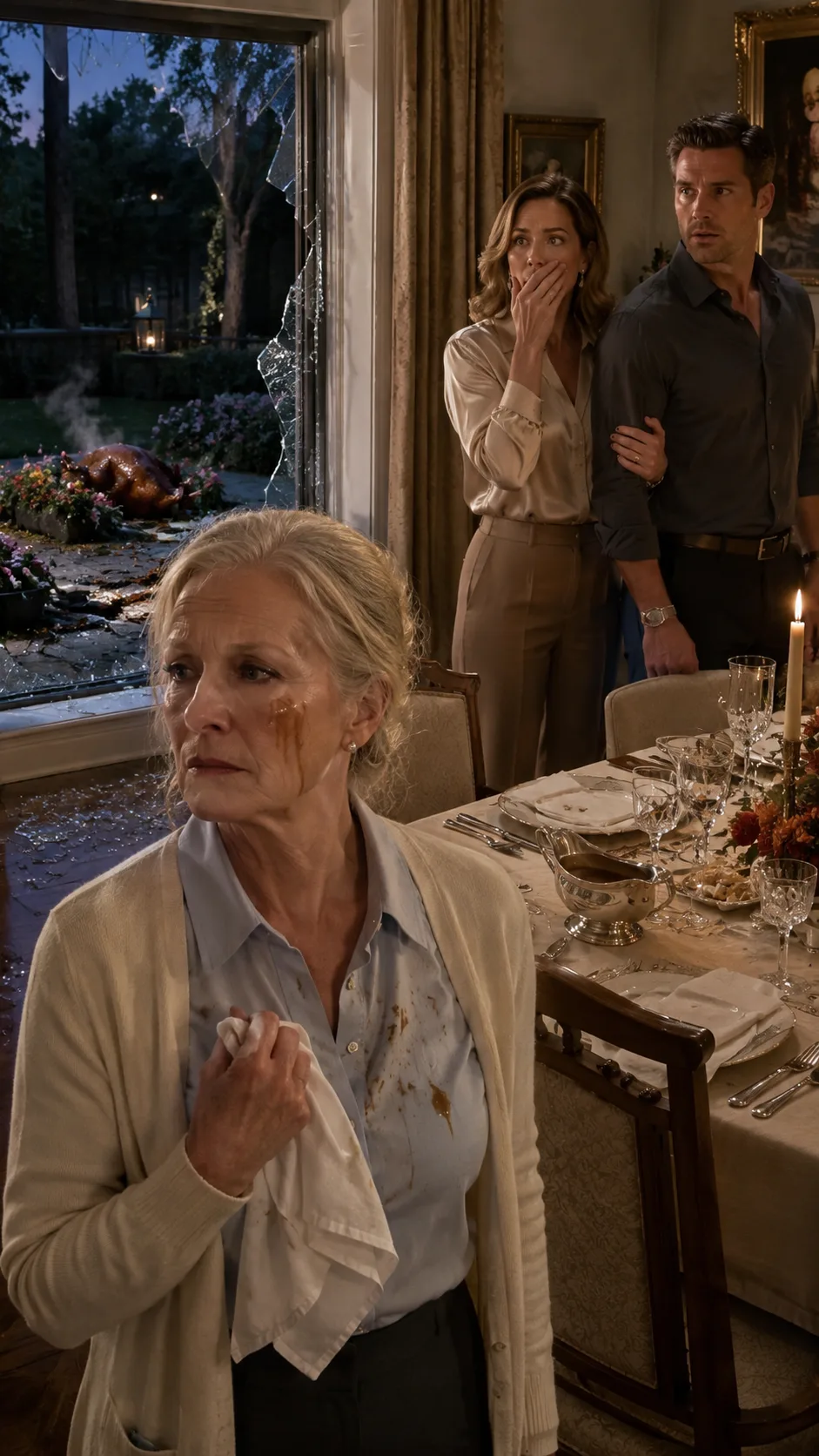
For one terrible second, I thought Vanessa was going to throw the gravy boat at me.
Chapter 3
For one terrible second, I thought Vanessa was going to throw the gravy boat at me.
Her fingers wrapped around the silver handle. Her chest rose and fell. Her perfect hostess mask was gone now, replaced by something younger, uglier, desperate.
Brian saw it too.
“Vanessa,” he warned.
She turned on him with tears bright in her eyes. “You believe her?”
He looked at the gravy stains on my blouse.
Then at the shattered window.
Then at the envelope in my hand.
“I believe what I saw,” he said quietly. “And I saw you spit in my mother’s face.”
The words landed harder than any scream.
Vanessa flinched.
For the first time that night, she looked at me not as furniture, not as an inconvenience, not as the poor older woman she had been forced to tolerate.
She looked at me like I was a person.
It was far too late.
Her grip loosened on the gravy boat.
Diane stepped toward her. “Put that down.”
Vanessa’s
mouth trembled. “Mom, you don’t understand. She’s trying to ruin Dad.”
“No,” Diane said. “Your father seems to have done that without help.”
Martin barked, “Diane, don’t be a fool.”
The room froze.
In all their marriage, I doubt anyone had ever spoken to Diane Holloway like that in front of guests.
Her face went smooth.
Dangerously smooth.
“A fool?” she asked.
Martin realized too late what he had done.
“I didn’t mean—”
“Yes,” Diane said. “You did.”
She turned to me. “Mrs. Bennett, may I see the rest?”
I handed her the envelope.
Martin lunged.
Brian caught his arm.
Not violently. Just enough.
“Don’t,” Brian said.
Martin stared at him, furious. “You have no idea what you’re touching, boy.”
Brian’s voice shook, but he held on. “Then explain it.”
Martin looked around the room as if searching for someone weak enough to believe him.
There was no one left.
So he did what guilty men often do.
He attacked the victim.
“She was unstable,” he said, pointing at me. “Her husband died. She was drowning in debt. She signed what she signed and regretted it when she realized she couldn’t run a company.”
I had expected that lie.
I had heard versions of it for nearly three decades.
Poor Caroline.
Grieving Caroline.
Confused Caroline.
The woman who misunderstood business.
The widow who could not accept reality.
I walked to the dining table, past the crystal glasses and untouched plates, and picked up the old cassette again.
Then I looked at Diane.
“Do you have a cassette player?”
Diane’s eyes narrowed. “Martin keeps one in his study. For old interviews.”
Martin’s face changed.
That was how I knew the universe still had a taste for irony.
Ten minutes later, we were in the study at the front of the house.
It smelled like leather, money, and control.
Framed charity awards lined the shelves. A photograph of Martin shaking hands with a senator sat beside a silver pen set. Vanessa stood near the doorway, arms wrapped around herself. Brian stayed close to me. Diane sat at Martin’s desk, the cassette player between her hands.
Martin did not sit.
Powerful men hate chairs when they are losing.
Diane pressed play.
At first, there was only static.
Then Ellen Marsh’s frightened voice filled the room.
“Martin, this is wrong. Caroline signed temporary control only.”
A younger Martin answered, smooth and impatient.
“Then the second page needs to disappear.”
Vanessa covered her mouth.
The tape crackled.
Ellen said, “Thomas Bennett never agreed to sell.”
Martin laughed softly on the recording.
“Thomas Bennett is dead. His widow is broke. By the time she understands what happened, the company will belong to people who know what to do with it.”
The room seemed to shrink.
Brian’s hand found the back of my chair.
On the tape, Ellen whispered, “You’re stealing from his son.”
Young Martin said, “I’m building something bigger than one grieving boy.”
The tape clicked on.
No one moved.
When it ended, the silence was so deep I could hear Vanessa crying.
Not loud dramatic sobs.
Small, humiliated breaths.
The kind that come when the world you were raised to worship turns around and shows its teeth.
Diane removed the cassette with shaking hands.
Then she stood.
“Get out,” she said.
Martin blinked. “This is my house.”
“No,” Diane said. “It is held in the Holloway Family Trust. A trust I administer. You made sure of that when you thought it protected you from lawsuits.”
For the first time all night, I almost smiled.
Martin looked at Vanessa. “Tell your mother she’s being ridiculous.”
Vanessa looked at him.
And in that moment, I saw a daughter lose a father without him dying.
“You lied about everything,” she whispered.
He stepped toward her. “I gave you everything.”
“No,” she said. “You gave me stolen things and called them standards.”
Diane turned to Brian. “Take your mother home.”
I almost laughed. “This is my home.”
The reminder made everyone pause.
Diane nodded once. “Then forgive me. I forgot who had the right to decide who stays.”
I looked at Martin.
He was still standing in his expensive suit, in my son’s house, in the middle of the wreckage his daughter had helped create. For twenty-eight years, he had been the man people toasted at galas. The man who donated hospital wings. The man who smiled beside oversized checks.
And now he was just a frightened old thief in a hallway full of broken glass.
“Leave,” I said.
His eyes burned. “You’ll regret this.”
Brian stepped forward. “No. She won’t.”
Martin stared at him.
Something passed between them then.
Not history. Not family.
Choice.
My son had made one.
Late, imperfect, but his.
Martin walked out.
Diane did not follow him.
Vanessa stood frozen until her mother touched her shoulder.
“Apologize,” Diane said.
Vanessa looked at me.
Her lips trembled. Her eyes were red. Her diamond bracelet looked suddenly cheap against her shaking wrist.
“I’m sorry,” she whispered.
I said nothing.
She swallowed. “For what I said. For what I did. For treating you like…” Her voice broke. “Like you were beneath us.”
I looked at the gravy stain on my blouse.
Then at my son.
Then at the shattered dining room window.
“An apology does not clean what you spit on someone,” I said.
She cried harder.
Good.
Some lessons should hurt.
Brian turned to me. “Mom, I should have stopped her.”
“Yes,” I said.
He flinched.
I did not soften it.
“You should have stopped her months ago. The comments. The corrections. The way she spoke to me in my own kitchen. Tonight was not the first time you abandoned me, Brian. It was just the first time you had to look at the mess.”
He covered his face with one hand.
“I’m sorry,” he said.
This time, the words mattered a little more.
Not enough to fix everything.
But enough to begin somewhere honest.
Diane gathered the papers into the envelope and handed them back to me.
“The state attorney will want those originals,” she said.
“They already have copies,” I replied. “These are mine.”
She nodded.
Then, quietly, she removed her wedding ring.
Vanessa saw it and began to shake.
“Mom…”
Diane looked at her daughter with tired eyes. “You and I are going to have a very long conversation about what kind of woman you became while I was admiring the table settings.”
Vanessa lowered her head.
Outside, a police siren wailed faintly in the distance.
Martin had not made it far.
Brian looked toward the front window.
I did not.
I had spent twenty-eight years looking backward.
I was done.
The next morning, my son came over alone.
He brought no flowers. No dramatic speech. No excuse wrapped in guilt.
He brought a toolbox.
For three hours, he boarded up the dining room window while I sat at the kitchen table drinking coffee from Thomas’s old mug.
When he finished, he came inside with sawdust on his shirt.
“Mom,” he said, “I don’t know how to fix this.”
I looked at him for a long time.
Then I said, “Start by never asking me to shrink myself again so someone else can feel important.”
He nodded.
“I won’t.”
Months later, Martin Holloway’s name disappeared from charity boards. Then from dealership signs. Then from the society pages Diane used to read every Sunday.
The investigation did not give me back my husband.
It did not give Brian back his father’s company or erase the years I spent choosing between groceries and legal advice.
But it gave the truth a room to stand in.
And sometimes, after a lifetime of being told to stay quiet, that is enough.
As for Vanessa, she sent one handwritten apology.
Then another.
I answered neither.
Forgiveness is not a performance.
It does not arrive because someone wealthy finally learns how shame feels.
On Thanksgiving the next year, I cooked a small turkey for myself.
Brian came by with pie.
He asked if Vanessa could come next time.
I looked at him over my coffee.
“Next time,” I said, “she can start by washing dishes.”
He smiled sadly.
Fair enough.
Outside my new dining room window, roses bloomed where the old turkey had landed.
Every time I looked at them, I remembered the night everything shattered.
The glass.
The lies.
The silence.
And the woman I became when I finally stopped swallowing humiliation to keep peace at a table that had never protected me.
THE END
Chapter complete
You have reached the end of this chapter.
Continue reading
A few more worlds to get lost in after this chapter.




