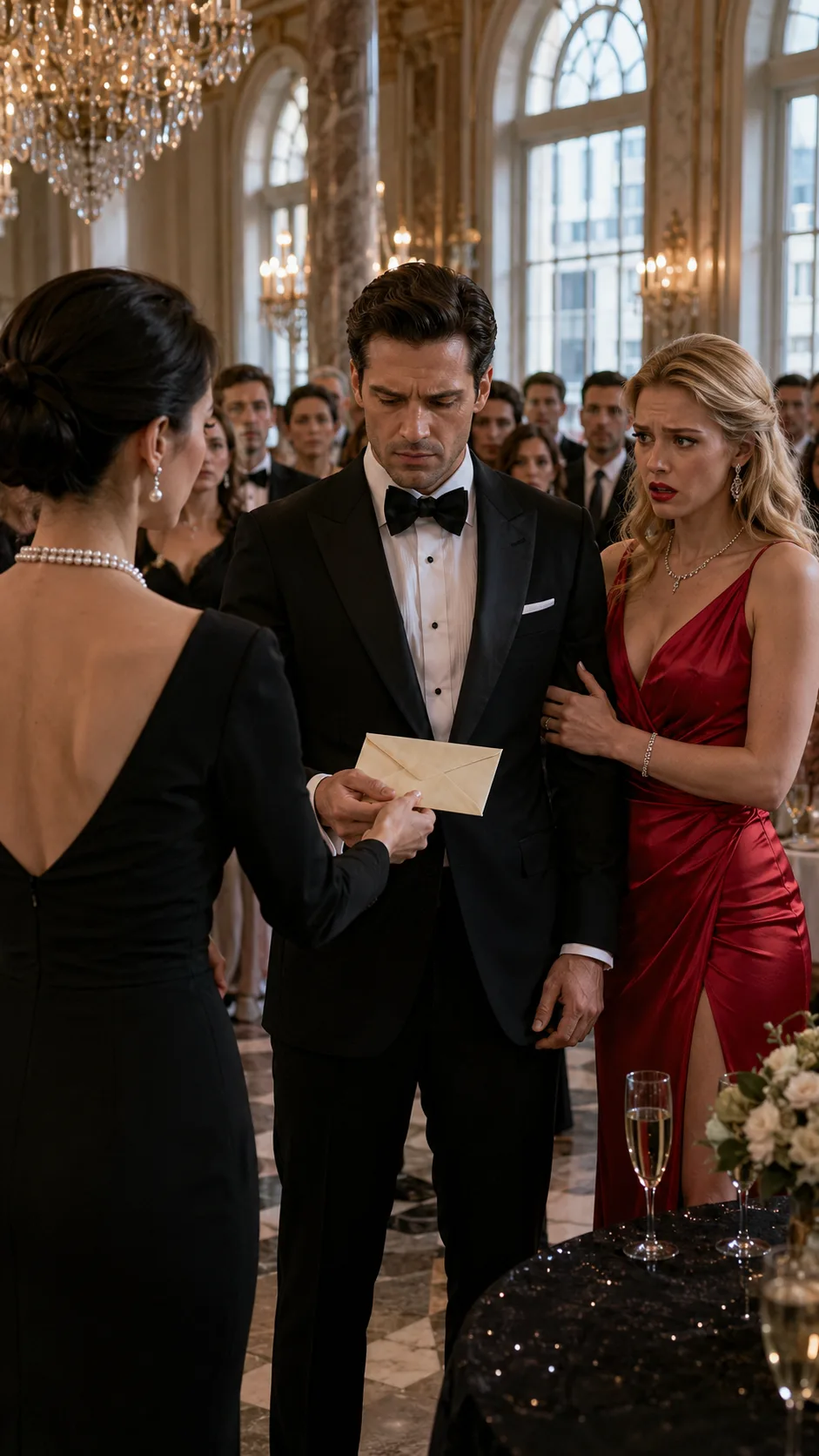
AN UNFORGETTABLE GALA NIGHT: THE MISTRESS THOUGHT SHE HAD WON UNTIL THE WIFE ARRIVED
The September night in Manhattan felt cold enough to cut.
Chapter 1
AN UNFORGETTABLE GALA NIGHT: THE MISTRESS THOUGHT SHE HAD WON UNTIL THE WIFE ARRIVED
The September night in Manhattan felt cold enough to cut.
High above the street, inside the Grand Astor Club, the ballroom glowed beneath hundreds of crystal lights. Gold shimmered across marble floors, champagne flutes, diamond bracelets, tailored tuxedos, and gowns made for women who never had to ask the price of anything.
A violin played somewhere near the grand staircase. Laughter floated gently through the room, polished and careful. But beneath every smile was calculation. This was not only a charity gala. This was where reputations were built, damaged, repaired, or destroyed with one handshake, one photograph, one whisper spoken at the wrong time.
At the center of all that light stood Alexander Sterling.
To most people in the room, he looked like power made flesh.
Thirty-eight years old. Handsome. Wealthy. The founder of Sterling Ventures, a real estate empire known for ambition, risk, and ruthless expansion. His black tuxedo fit him perfectly. His silver cufflinks caught the chandelier light
whenever he raised his glass. His dark hair was styled with the kind of effort that was meant to look effortless.
From a distance, Alexander looked untouchable.
But from close up, anyone could see the truth.
He kept adjusting his cuffs.
Not because they were crooked.
Because he was nervous.
And the reason was standing beside him.
Scarlet Blake held his arm as if it had belonged to her for years. She was twenty-nine, tall, blonde, and wearing a red gown that did not simply enter a room. It announced itself. The dress clung to her figure with theatrical confidence. Her hair fell in glossy waves over one shoulder. Diamonds glittered at her ears. Her lips were painted the same dangerous red as her dress.
Scarlet was not attending the Grand Astor gala like a guest.
She was arriving like a woman coming to claim a throne.
For months, she
had existed in the hidden corners of Alexander’s life. Private dinners. Hotel suites under false names. Weekend trips explained away as business. Text messages deleted the second they were read. Phone calls he never answered in front of his wife.
But tonight was different.
Tonight, Alexander had brought her into the room where everyone important in New York society could see her.
To Scarlet, that meant one thing.
He had chosen her.
Not in words.
In chandeliers. In camera flashes. In whispers. In the eyes of every person who mattered.
“Alexander, darling,” Victoria Albright said as she approached with a smile as cold and flawless as carved ice. She was married to a senator and had survived three decades of New York society by never asking a question unless she already knew the answer. “How unexpected to see you tonight.”
Her eyes moved to Scarlet.
Slowly.
From the hair, to
the dress, to the hand wrapped around Alexander’s arm.
“And who is this?”
Alexander opened his mouth, but Scarlet smiled first.
“Scarlet Blake.”
Her voice was sweet, but there was possession in it.
Alexander quickly added, “Scarlet has been assisting with a few development projects for the company.”
Scarlet gave a soft laugh, too bright and too loud.
“Assisting,” she repeated, looking up at him. “That sounds so modest.”
Her red nails slid lightly along his sleeve.
“We’re much closer than that.”
A thin silence slipped between them.
No one reacted openly. People in this room were trained not to flinch. But eyes gave them away. A few guests exchanged glances. One man paused with his champagne halfway to his mouth. A woman near Victoria curved her lips as if the evening had just become worth attending.
Victoria smiled.
“How modern.”
Then she asked, gently, almost lazily:
“And where is Eleanor this evening?”
The name of his wife fell between them like glass.
Alexander’s throat tightened.
“My wife is busy,” he said.
“What a pity,” Victoria replied. “Eleanor always has a way of making a room look more elegant without trying.”
Victoria moved on.
But the sentence stayed behind.
Scarlet kept her smile in place, though her eyes darkened. She hated Eleanor Sterling, even though she had barely met her. She hated the way people said Eleanor’s name with respect instead of pity. She had expected the absent wife to be a joke. A faded woman hidden away in a mansion. A legal inconvenience. A cold shadow Alexander had outgrown.
But in this ballroom, Eleanor did not sound like a woman who had been discarded.
She sounded like a standard Scarlet had not reached.
Half an hour later, Scarlet had finished her second glass of champagne. She stood among a group of wealthy women, laughing as if she had been born into their world. She let the red dress tell half the story and the diamonds tell the rest.
“That dress is quite something,” Patricia Whitmore said.
“Alexander chose it,” Scarlet replied, glancing at him across the room. “He has excellent taste when it comes to women’s things.”
Several women exchanged looks over the rims of their glasses. One of them nearly laughed, but caught herself.
“How are you finding this world?” another woman asked. “It can take time to get used to.”
Scarlet smiled wider.
“Actually, I feel very comfortable. Maybe even more comfortable than some people who have been here for years.”
She did not say Eleanor’s name.
She did not need to.
Across the ballroom, Alexander was speaking with David Shaw, a junior partner at Sterling Ventures. But he was barely listening. His attention kept sliding back to Scarlet.
At first, he had enjoyed it.
He liked seeing other men look at her. He liked seeing the women from Eleanor’s circle notice her. Scarlet was young, beautiful, bold, and reckless. She made him feel less tired, less trapped, less like a man aging inside a marriage that had grown too quiet for his ego.
But tonight, something in Scarlet’s confidence had changed.
It was no longer admiration.
It was demand.
When Ethan Campbell, heir to an old media fortune, approached Scarlet near the champagne table, Alexander noticed immediately. Ethan was handsome, charming, and dangerous in the way men are when they know every door will open for them. Scarlet laughed at something he said, leaning slightly toward him, her eyes bright as he mentioned a private art collection in London.
“I could show it to you sometime,” Ethan said.
Alexander crossed the room before he had decided to move.
“Scarlet,” he said, his voice sharper than he intended. “We need to speak to the event chair.”
Scarlet turned to Ethan with a playful pout.
“Mr. Sterling is jealous.”
Ethan smiled. “Then I won’t keep you.”
Alexander took Scarlet lightly by the elbow and guided her away.
“You didn’t need to do that,” she said under her breath.
“Do what?”
“Act like someone else could steal me.”
“You were flirting with him.”
Scarlet looked up at him, amused and cold.
“And you were afraid of being embarrassed. Those are not the same thing.”
Alexander released her arm.
“You need to be careful tonight.”
“Careful with what?”
“With what you say.”
Scarlet stopped walking. Her smile sharpened.
“You brought me here, Alexander. Don’t put a crown on my head and then panic when I wear it.”
For the first time that evening, Alexander felt the situation slipping out of his hands.
Near the edge of the ballroom, Julian Hale was watching.
Julian wrote the most feared society column in New York. He did not need a notebook. He did not need a recorder. He had destroyed people with less than a paragraph and resurrected others with a single flattering description. Tonight, he watched Alexander and Scarlet the way a hawk watches movement in grass.
Then he approached.
“Alexander Sterling,” Julian said warmly. “And this must be Mrs. Sterling?”
The silence struck like a dropped silver tray.
Alexander opened his mouth.
But Scarlet was faster.
“Not exactly,” she said. “But life is full of surprises.”
Julian’s eyes lit up.
“Of course it is.”
He kissed Scarlet’s hand.
“I’m sure New York will be very interested to learn more about you, Miss Blake.”
When Julian walked away, cold sweat moved down Alexander’s spine.
Scarlet, however, felt victorious.
She had stepped out of the shadows. She had turned herself from a secret into a presence. Let them whisper. Let them look. Let the papers write. In Scarlet’s world, attention was currency, and tonight she felt richer than anyone.
What Scarlet did not know was that less than a mile away, another woman was fastening the final pearl bracelet around her wrist.
And that woman’s hands were not shaking.
Eleanor Vance Sterling stood before an antique brass-framed mirror and studied her reflection for a long moment.
She was thirty-eight, the same age as Alexander, but time had treated her differently. There was no desperate attempt to look younger. No loud beauty begging to compete with youth. Her dark chestnut hair fell in soft waves against her shoulders. Her features were delicate, composed, and sharp in a quiet way. She looked like a woman who had been wounded deeply and had decided not to let the wound disfigure her.
She wore a black couture gown, severe and elegant, cut with such precision that it needed no ornament. Pearls rested at her collarbone. Small earrings caught the light. There was no red. No shouting. No hunger for attention.
The dress did not beg to be noticed.
It simply belonged.
Maria, the housekeeper who had worked for Eleanor for many years, stood in the doorway holding a shawl.
“You look beautiful, ma’am,” Maria said softly.
Eleanor looked at herself and gave the faintest smile.
“No,” she said. “Tonight I look ready.”
Maria hesitated.
“You still don’t have to go.”
Eleanor let out a quiet breath that was almost a laugh.
“If I wanted peace, Maria, I would have stayed home months ago.”
The truth was, Eleanor had known about Alexander and Scarlet long before Manhattan began whispering.
Alexander had not betrayed her in a single moment of weakness. He had walked into betrayal like a man entering a room he believed had been prepared for him. He left restaurant receipts in jacket pockets. Hotel confirmations appeared on his phone. He answered messages too slowly at dinner and too quickly in the bathroom. Once, Eleanor found lipstick not on his collar, but on the inside of the passenger-side car window, where some woman had laughed too close and turned her head.
A strange perfume.
Missing weekends.
Lazy lies.
The kind of lies that insulted the intelligence of the person expected to believe them.
In the first weeks after she learned the truth, Eleanor had hurt in a way no one could have made beautiful. It was not the dramatic grief of novels. It was standing in the kitchen and forgetting why she had walked in. It was looking at her own dining table, staircase, glassware, and the chair where Alexander usually sat, and feeling as if every familiar object had quietly turned against her.
She had asked herself where she had failed.
Had she been too quiet? Too understanding? Too undemanding? Too willing to stand beside a man who wanted the whole world looking at him?
Then one rainy afternoon, Eleanor opened an old wedding album.
In one photograph taken outside a courthouse in Boston, the younger version of herself was laughing, head tilted, alive and unguarded. That girl had not yet learned to shrink herself so someone else could feel large.
Eleanor stared at the picture for a long time.
And suddenly everything became clear.
She had not been replaced because Scarlet was better.
She had been betrayed because Alexander was smaller than she had believed.
After that, Eleanor stopped collapsing.
She began preparing.
A private investigator named Malcolm Price followed Alexander with cold professionalism. Photos. Hotel records. Financial transactions. Restaurant bills. Gifts hidden as business expenses. Scarlet leaving a Tribeca penthouse at dawn. Alexander entering a private villa in Miami. A recording of Scarlet laughing in a car and telling a friend that Alexander’s wife was “too cold to know how to fight.”
Eleanor saved that recording.
Not because it hurt the most.
Because it showed exactly who Scarlet thought she was dealing with.
Over the next six months, Eleanor met with lawyers, financial advisers, and family office managers. She reviewed trusts, inheritance records, property structures, and every legal protection Alexander had never bothered to understand.
Alexander liked believing Eleanor lived inside the climate of his money.
He had never paid enough attention to learn what she owned.
Eleanor’s grandmother, Beatrice Vance, had come from an old Boston family and had left Eleanor real estate, investments, private holdings, and quietly growing assets that had been managed for years. Eleanor also ran a discreet art advisory firm with clients in New York, Chicago, Palm Beach, London, and Paris.
She had never been trapped.
Alexander had simply mistaken a door he never looked at for a wall.
Then came the Legacy Foundation gala.
It mattered because everyone who mattered would be there: judges, senators, donors, old families, new money, journalists, patrons, collectors, and people who smiled softly but remembered forever. In that world, infidelity was not shocking. People forgave many things if they were handled discreetly.
But publicly humiliating a lawful wife — especially a woman like Eleanor — was not simply betrayal.
It was vulgar.
And vulgarity traveled through that ballroom faster than spilled wine on white silk.
Eleanor had not told Alexander she knew Scarlet would attend.
In truth, she had helped Scarlet want to attend.
At a charity luncheon weeks earlier, Eleanor had allowed a well-known gossip to overhear that the Legacy gala was where New York truly decided who belonged where. She knew the sentence would reach Scarlet. She knew Scarlet’s ambition would do the rest.
Now, as Eleanor placed a small USB drive into her Hermès clutch, she did not think of revenge.
She thought of timing.
Not everything had to be screamed to ruin someone.
Her phone lit up as she stepped into the elevator.
“They have no shame tonight.”
“She wore red.”
“He introduced her as a consultant.”
“Julian Hale is there.”
“Come.”
Eleanor read the messages and smiled faintly.
How kind, she thought, that everyone was helping her take the temperature of the room.
John, her driver, opened the door of the black Mercedes for her.
“You look like trouble tonight, Mrs. Sterling,” he said, his old eyes warm.
Eleanor slid into the car.
“Because for once, John, I am.”
The Mercedes moved through Manhattan’s glittering streets. Eleanor watched the city pass beyond the glass and thought of all the women who had swallowed public humiliation because they were taught that dignity meant silence.
She had once been one of them.
But now she understood.
Dignity was not suffering beautifully.
Dignity was refusing to make yourself small enough to hold someone else’s ugliness.
When the Mercedes stopped outside the Grand Astor Club, the red carpet was still crowded. Cameras were aimed at a newly arrived couple, but they turned when the rear door of Eleanor’s car opened.
Eleanor stepped out.
The noise did not vanish.
It changed shape.
Conversations tilted. Heads turned. Cameras flashed. The attention given to Eleanor was not like the attention Scarlet had been drinking all night. It was not hungry or cheap or curious.
It had memory in it.
It had respect.
People did not look because Eleanor was loud.
They looked because she had returned like an answer to a question no one dared ask.
“Mrs. Sterling!”
“Eleanor, over here!”
“Where have you been?”
She smiled once, lifted a hand, and gave them nothing more.
Robert, the doorman, bowed his head as she passed.
“Welcome back, Mrs. Sterling.”
“Thank you, Robert.”
Before the grand ballroom doors, Eleanor paused for a few seconds.
Inside were music, laughter, and lies wrapped in velvet.
Inside was her husband.
And the woman who believed she had stolen Eleanor’s life as easily as taking a handbag from a display case.
Eleanor inhaled.
Then she walked in.
The first person to see her was not Alexander.
It was not Scarlet.
It was Leonora Hastings, the widow of a federal judge, a woman capable of detecting scandal faster than blood in water. She was speaking beside a marble column when her eyes lifted, stopped, and brightened.
“Good Lord,” Leonora whispered. “She came.”
The whisper spread.
Eleanor moved through the ballroom without rushing. The black gown followed her with quiet authority. Pearls caught the light. Her face was composed, not because she had never suffered, but because she had already done her crying in private and had no intention of wasting tears here.
The room opened wherever she walked.
“Eleanor.”
“You look extraordinary.”
“We’ve missed you.”
She kissed Patricia Whitmore’s cheek, shook Senator Albright’s hand, asked after an engagement, a new appointment, a museum opening. Each greeting returned her to her place. Not as an abandoned wife. Not as a victim.
As a legitimate presence.
Near the bar, Alexander heard her name for the third time and turned.
For one second, he did not recognize his own wife.
Then recognition struck him so hard his face went pale.
He had imagined that if Eleanor appeared at all, she would look wounded. Thin. Tired. Withered from neglect. But the woman walking through the room did not look defeated. She looked like someone who owned the room through memory, lineage, and self-control.
David Shaw leaned close.
“Your wife looks…”
He did not finish.
Alexander knew the missing word.
Dangerous.
Across the ballroom, Scarlet sensed the circle around her changing. A woman who had been speaking to her stopped in the middle of a sentence. A photographer lowered his camera from Scarlet’s direction. A man looked past her shoulder and forgot to smile.
Scarlet turned, irritated.
Then she saw Eleanor.
The first feeling was disbelief.
The second was fear.
This was not the wife Scarlet had built in her imagination. Not a discarded woman with swollen eyes and old sweaters. Eleanor was beautiful in a way Scarlet could not copy because it was not made from clothes. It came from bone, discipline, breeding, restraint, and pain turned into steel.
For the first time that night, Scarlet felt her red dress stop looking powerful.
It looked obvious.
“Who is that?” a young woman whispered, though she clearly knew.
Scarlet answered too quickly.
“Alexander’s wife.”
The word wife tasted bitter.
Alexander remained stiff near the bar as Scarlet gripped his sleeve.
“Let’s go say hello.”
“No,” Alexander said at once.
“No?”
“Not now.”
Scarlet smiled, but the smile had edges.
“I am not hiding.”
“This isn’t the time.”
“I think it is exactly the time.”
She moved before Alexander could stop her.
Pride pushed her forward, but so did panic. If she stepped back now, the room would smell weakness. She had not spent months climbing into this world only to be made invisible by a woman wearing pearls.
Alexander followed her because cowardice often wears manners until the final moment.
The crowd around Eleanor loosened. No one wanted to look too curious, but everyone adjusted position to see better.
Even the music seemed to soften.
“Eleanor,” Alexander said.
His voice was too bright, too careful.
“What a surprise.”
Eleanor turned toward him and allowed a silence to fall before answering.
“Alexander. How interesting. I thought you were in Chicago this week meeting investors.”
A small breath moved through the people nearby.
A lie that might have survived at home looked ugly beneath chandeliers.
Alexander swallowed.
“The meeting was canceled.”
“How fortunate,” Eleanor said. “I would hate for you to miss such an important charity event.”
Scarlet stepped forward with a polished smile.
“You must be Eleanor. I’m Scarlet Blake.”
She extended her hand.
The room held its breath.
Eleanor looked at the hand, then at Scarlet. For one long second, Scarlet had the sensation of being read down to the smallest, most embarrassing part of herself.
Then Eleanor took her hand gently.
“Scarlet,” she said. “Yes. I have heard so much about you.”
The words were polite.
The voice was surgical.
Scarlet did not yet understand the danger.
“Alexander told you I was helping him with a few projects?”
Eleanor’s eyes moved briefly to Alexander, then returned to Scarlet.
“Something like that.”
Scarlet lifted her chin.
“We’re not only colleagues.”
“I gathered.”
No trembling. No anger. No open wound Scarlet could press.
That unsettled Scarlet more than jealousy would have.
“We care about each other,” Scarlet said, deciding to attack. “I think honesty is better than pretending.”
A faint smile touched Eleanor’s mouth.
“I agree. Honesty can be very useful. Especially when it arrives in public.”
Scarlet blinked.
The sentence sounded harmless.
It was not.
Leonora Hastings glided closer like a woman warming herself near a fire.
“Eleanor, your dress is exquisite. Chanel?”
“Yes.”
“Timeless,” Leonora said, loudly enough for several people to hear.
Heat moved up Scarlet’s throat.
“Your dress is lovely too,” Scarlet said to Eleanor. “Very… classic.”
The pause before classic was a mistake.
So was the smile.
Eleanor looked at her with the mild sympathy of an adult watching a child make an unwise move.
“Thank you. Some things are more beautiful when they do not chase fashion.”
A man nearby coughed to hide a laugh. Patricia Whitmore lowered her gaze into her wine.
Scarlet knew she was losing ground. But youth often becomes stubborn exactly where wisdom would retreat.
“The world has changed,” Scarlet said. “People don’t have to live by old rules anymore.”
“That is true,” Eleanor replied. “They only have to live with the consequences of not understanding them.”
Alexander stepped in, desperate.
“Perhaps we should step outside for a little air.”
Eleanor turned to him.
“Why? Are we uncomfortable?”
The question was almost kind.
Alexander clenched his jaw.
“Eleanor.”
But she was no longer only looking at him.
She was looking at the room.
And the room, in a way no one needed to say, belonged to her.
Eleanor touched the pearls at her throat as if merely adjusting them.
“Since everyone seems so committed to honesty tonight,” she said, “perhaps this is the right time to clear up a few misunderstandings.”
Scarlet’s stomach tightened.
Alexander’s face drained of color.
“This is not the place,” he said under his breath.
Eleanor tilted her head.
“You chose the place when you brought her.”
She did not raise her voice.
That made it worse.
Julian Hale was close enough to hear. So was half the room.
Scarlet stood taller.
“I don’t think there is any misunderstanding. Alexander and I are together.”
“Yes,” Eleanor said slowly. “It appears you are.”
For a second, Scarlet believed it was a surrender.
Then Eleanor continued.
“What you may not know, Scarlet, is that Alexander has always been very talented at repeating the same story.”
Scarlet frowned.
“What does that mean?”
Alexander’s jaw tightened.
“Enough.”
But Eleanor had gone too far to be stopped.
“It means you are not the first woman he has convinced that she is the exception.”
The ballroom became completely still.
Scarlet stared at her.
“That is not true.”
Eleanor almost pitied her.
“I’m afraid it is. Usually, they are young. Beautiful. Ambitious. Easy to impress with expensive dinners and promises of a future that was never actually written. A receptionist when he was in his late twenties. A gallery assistant after that. A flight attendant for a few months. A consultant who was not really a consultant. An interior designer. An actress from Connecticut. And now you.”
Each sentence landed softly.
Scarlet felt each one like a slap.
She turned to Alexander.
“Tell her to stop.”
Alexander said nothing.
And his silence let the truth open across Scarlet’s face.
“You told me,” Scarlet said slowly, “that your marriage had been over for years.”
Eleanor nodded.
“Emotionally? Perhaps. Morally? Certainly. Legally? Not until yesterday.”
From her black clutch, Eleanor removed a cream envelope and handed it to Alexander.
He looked at it as if something inside it were alive.
“What is this?”
“The divorce filing,” Eleanor said. “You will be officially served on Monday morning.”
Alexander’s fingers shook when he took it.
“You filed? Without even discussing it with me?”
A few people in the crowd looked away.
The women did not.
Eleanor’s smile was faint.
“For eight months, Alexander, every receipt, every lie, every strange perfume, every missing weekend, every public embarrassment was a discussion. You were simply too busy living your private life in public to hear it.”
Scarlet’s breathing became shallow.
“You are doing this because you are jealous.”
For the first time, Eleanor laughed.
Not loudly.
Not cruelly.
Only in disbelief.
“My dear,” she said, “I did not come here to fight for Alexander.”
She looked at her husband as if he were an item being returned.
“I came to give him back to you.”
The entire room went dead silent.
Even Scarlet’s anger froze.
Alexander finally found his voice, but it was frayed.
“You can’t humiliate me like this.”
Eleanor turned fully toward him.
“Humiliate you? No. You did that when you brought your mistress as your guest.”
A strained laugh escaped near the bar and vanished at once.
Alexander lowered his voice.
“How much do you want?”
And there he was.
The core of him.
Money as language. Money as armor. Money as the only explanation he understood for any wound.
Eleanor’s expression changed. Not with anger.
With disappointment so cold it felt final.
“Still?” she said softly. “After fifteen years, you still think everything comes down to that?”
He stared at her.
“I don’t want your money, Alexander. I have my own.”
Scarlet looked between them, confusion turning into fear.
Alexander gave a dry laugh.
“Your own?”
“Yes. Beatrice Vance’s estate. The Boston properties. The Nantucket holdings. The investment portfolio you never asked about because you assumed anything managed by a woman must be decorative.”
Heads turned.
Eleanor continued calmly, as though discussing the weather.
“My assets, in their current condition, are worth more than Sterling Ventures. Quite a bit more, if we are being precise.”
The shock on Alexander’s face was almost ugly.
For years, he had lived inside the role of provider like a king on a throne. Not because the throne had been real, but because no one had pulled it out from under him.
Tonight, Eleanor did.
In front of everyone who mattered.
“And my art advisory firm,” she added, “is doing very well. European clients. Private collections. Museums. You would be surprised what can grow when it is not starved by contempt.”
Scarlet’s lips parted.
She had spent months imagining Eleanor as dependent, desperate, abandoned. That story had been necessary for Scarlet’s pride. If Eleanor was pathetic, then Scarlet was victorious.
But now that story was breaking apart in front of her.
“So what?” Scarlet said, though her voice had thinned. “You’re leaving him. That means Alexander and I can finally be together.”
Eleanor looked at her with real pity.
“Oh, Scarlet.”
Only two words.
They hurt more than mockery.
“Do you truly believe a man who lied to his wife in order to be with you will suddenly become honest with you? Do you think betrayal only burns one bridge?”
Scarlet turned to Alexander, searching for denial, protection, anything.
But Alexander was looking at the envelope.
Not at her.
And that was when Scarlet understood.
She had not been chosen.
She had been used.
Maybe not with perfect cruelty from the beginning. But used all the same. As a mirror in which Alexander could see himself as younger, more desirable, more powerful. As a rebellion against aging. As proof that he could still make someone break rules for him.
And now, at the moment she needed him to stand beside her, he was shrinking.
Eleanor saw the truth fall across Scarlet’s face.
She did not soften it.
Not because she was cruel.
Because kindness at that moment would have been another lie.
“You made one mistake the others did not,” Eleanor said.
Scarlet looked up, her eyes bright with humiliation.
“What mistake?”
“You thought you had won.”
The sentence landed cleanly, without ornament.
Scarlet felt the whole room looking at her now, truly looking. Not with envy. Not with admiration.
With pity edged in social disgust.
She had entered the gala like the bride of the future.
Now she stood there as one small chapter in a dirty pattern she had not known existed.
Alexander said hoarsely, “Eleanor, enough.”
“Not quite,” Eleanor replied.
She turned slightly toward Julian Hale and the cluster of people listening nearby.
“Julian, you may quote me correctly,” she said. “I am not leaving a marriage. I am leaving a vacancy.”
Julian’s eyes shone with professional delight.
Eleanor looked at Scarlet one last time.
“One more thing. Red suits you. But at charity galas in New York, subtlety is usually wiser. It suggests respect for the cause, not hunger for the room.”
A terrible silence answered her.
The sentence was not loud.
It was simply too accurate to forget.
Scarlet’s chin trembled.
“Go to hell,” she whispered.
Eleanor remained calm.
“I was there for months. That is how I know the exits.”
Then she turned away.
She did not look at Alexander again.
She did not look at Scarlet again.
The crowd parted for her.
That was the real victory.
Not Alexander’s humiliation.
Not Scarlet standing frozen beneath the chandeliers.
But Eleanor walking out of the center of the storm by choice.
While the storm remained behind her.
The next morning, the headlines were not kind.
Julian Hale’s society column described the night Eleanor Sterling returned and all of New York witnessed “what dignity looks like under pressure.” The tabloids repeated every line. Finance blogs discussed Alexander’s poor judgment. Brunches, private clubs, boardrooms, and charity committees all had their own version of the story.
Everyone had a favorite quote.
Everyone claimed they had been standing closer than they really were.
In Manhattan, scandal was theater, and the city loved a perfect ending.
But for Eleanor, the gala was not an ending.
It was only the pause between two lives.
The divorce moved faster than Alexander expected, though slower than he wanted. The evidence in Eleanor’s lawyers’ hands was too complete. Her inherited assets were too well protected. The financial structures Alexander had never cared to understand now stood like walls he could not climb.
He tried apologizing.
First came flowers.
Then long emails.
Then anger.
He sent voice messages after midnight, saying things like, “We can still handle this privately.” That only proved he still understood nothing. He offered settlements Eleanor did not need, explanations she did not want, and finally blame. Scarlet had pressured him. The media had exaggerated. He had made mistakes. He had been stressed. He had not realized how unhappy he was.
Eleanor barely read any of it.
Her lawyers handled the correspondence.
Her therapist handled the grief.
Her spine handled the rest.
Scarlet stayed with Alexander for exactly six weeks after the gala.
She tried to rescue something from the wreckage. For a while, people still saw them together in quieter places: downtown bars, private dinners, locations too far from old society to matter. But the glamour had leaked out of the affair. Once the illusion was punctured, what remained had to survive on character.
And character was what they both lacked.
Alexander became suspicious, irritable, controlling. Scarlet became defensive, bitter, wired with humiliation. She began noticing every unexplained message, every delayed answer, every glance he gave a younger woman in a restaurant.
The habits that had once made him seem powerful now only made him predictable.
When they ended, there was no drama.
Only exhaustion.
A year later, Scarlet moved to Miami and married a cosmetic dentist with perfect hair and the useful talent of not asking too many questions about the past. Eleanor never bothered to find out whether Scarlet was happy. Revenge has an expiration date. Eleanor refused to store it inside herself any longer than necessary.
As for Alexander, the gala did not only wound his pride.
It changed the way people saw him.
In business, that mattered.
Investors cared less about adultery than people might imagine. But they cared deeply about judgment. Bringing a mistress to a major charity gala, publicly lying about his wife, then allowing an entire room to witness his exposure — that was not merely a personal mistake. It was evidence of recklessness. Vanity. A man so drunk on his own legend that he could no longer protect his own interests.
Deals began to wobble.
A board member stepped down.
A waterfront project failed.
A financial dispute surfaced.
Then came a tax investigation.
The reputation Alexander had believed untouchable began tearing in small, visible places.
Eleanor heard pieces of it from other people.
Sterling Ventures downsized.
Sterling was under investigation.
Sterling sold assets.
Sterling no longer received calls back as quickly as before.
But by the time those updates reached her, Eleanor was somewhere else.
First, Boston, in her grandmother’s old house on Beacon Hill, where she spent a winter relearning the sound of quiet when it was no longer made from loneliness.
Then Los Angeles, where a collector introduced her to Daniel DuBois, a French-American gallery owner, at a private dinner in Brentwood.
Daniel was nothing like Alexander.
At first, that difference surprised Eleanor more than it comforted her.
Daniel asked questions and actually listened to the answers.
He admired without trying to possess. He spoke about art, architecture, cities, and family with the same kind of care. He found Eleanor’s intelligence interesting instead of inconvenient. When she disagreed with him, he became curious, not offended.
The first time Daniel visited her office, he brought a catalog from a Paris exhibition and a coffee made exactly the way she liked it, though she had mentioned it only once weeks earlier.
The first time he told her he loved her, there was no performance.
It happened on an afternoon after rain in Santa Barbara. They were folding laundry in the kitchen of a rented house. Daniel’s sleeves were rolled up. The light outside the window was thin and silver. Eleanor laughed at one of his terrible jokes, and Daniel looked at her with such unguarded tenderness that her chest ached.
“I love you,” he said simply. “Not because I want to save you. Not because you deserve compensation for what happened. Just because I love you.”
That was when Eleanor realized she could survive being loved properly.
Three years after the gala, Eleanor lived between Paris and New York, though Paris became the place where her happiness settled deepest. She and Daniel married in a small civil ceremony with only a handful of close friends. Their daughter, Beatrice, named after Eleanor’s grandmother, toddled through their apartment near the Seine with a stuffed rabbit tucked under one arm. Another baby was growing quietly inside Eleanor.
One clear spring morning, Eleanor sat on the terrace beside Daniel’s gallery office, looking down at a quiet stone courtyard. She wore cream, not black. Her hair was loose. A warm cup of coffee rested in her hands. Beatrice was arranging flower petals on the table with the serious concentration of a tiny artist.
Daniel stepped outside with an American business paper under his arm.
“There is news from your old life,” he said gently, handing it to her.
Eleanor looked at the headline.
STERLING VENTURES FILES FOR PROTECTION AS FEDERAL INVESTIGATION EXPANDS.
For a moment, she simply looked at the name Alexander Sterling.
It no longer created fire in her body.
No anger.
No triumph.
Not even satisfaction.
Only distance.
Daniel watched her.
“How do you feel?”
Eleanor folded the paper and set it aside.
“Hungry,” she said. “I haven’t had breakfast.”
Daniel laughed, kissed her temple, and went inside to find croissants.
Beatrice lifted a slightly crushed daisy.
“For Mama.”
Eleanor accepted it as if it were treasure.
And in that small moment, beneath the Paris light, she understood what the gala had truly been.
Not revenge.
Permission.
Permission to stop begging life to preserve something already dead.
Permission to turn humiliation into information.
Permission to leave not as someone exiled, but as someone rebuilding herself.
Years earlier, standing in the ballroom of the Grand Astor, Eleanor had thought the sharpest part of victory was the way she had dismantled Alexander and exposed Scarlet before New York society. But that had only been the visible part. The glittering part. The part people remembered because it was dramatic.
The real victory was much quieter.
This morning.
This child.
This marriage not built from lies.
This work that expanded her instead of shrinking her.
This peace that did not require anyone else’s collapse in order to exist.
That afternoon, Eleanor walked through Daniel’s gallery while he met with a collector from Brussels. She stopped before a large abstract painting layered with gold, deep blue, and stone-gray brushstrokes. The colors struck against one another, broke apart, then found a new shape inside the chaos.
Daniel came to stand beside her and slipped his hand into hers.
“You like this one,” he said.
“I understand this one.”
“Because it survived its own chaos?”
Eleanor leaned lightly against him.
“Because it turned chaos into form.”
That night, after Beatrice fell asleep, they ate dinner by the window while the city glowed outside. Somewhere across the ocean, Alexander Sterling was probably sitting in an office that no longer felt powerful, trying to negotiate with consequences. Somewhere in Florida, Scarlet Blake was perhaps retelling her past with kinder edits than the truth deserved.
Neither image stirred anything violent inside Eleanor.
On the contrary.
They had become irrelevant.
And Eleanor had learned that irrelevance is the most elegant grave for people who once believed they were your destiny.
Before bed, she opened an old drawer and found a copy of the divorce filing. The edges of the paper had begun to yellow slightly. She read the first page, smiled, and placed it back without ceremony.
Daniel, half-awake already, watched her climb into bed.
“What was that?”
“An old map,” she said.
“Where did it lead?”
Eleanor lay down beside him.
“Here.”
He opened his arms, and she settled against him. Outside, Paris hummed in its own language. Inside the room, everything was warm and still.
Eleanor closed her eyes and thought that the cruelest lie betrayed people often tell themselves is that surviving is the same thing as living.
She had survived Alexander.
But afterward came life.
And if, years later, anyone asked her what truly happened on that unforgettable gala night, Eleanor would not say a wife defeated a mistress in front of all of New York society.
She would say something far simpler.
A woman walked into a ballroom.
And finally chose herself.
Everything else was only applause.
Chapter complete
You have reached the end of this chapter.
Continue reading
A few more worlds to get lost in after this chapter.




