She Came To Clean The Mansion, But One Portrait Changed Everything
On the first morning Elena Hart stepped through the servants’ entrance of the Kensington mansion, she told herself one thing again and again.
Chapter 1
She Came To Clean The Mansion, But One Portrait Changed Everything
On the first morning Elena Hart stepped through the servants’ entrance of the Kensington mansion, she told herself one thing again and again.
Do the work. Keep your head down. Get paid.
That was all this job was supposed to be.
The mansion rose above Beacon Hill like it had been carved out of old money and silence. Iron gates guarded the entrance. White stone steps led to double doors polished so perfectly they reflected the gray Boston sky. Inside, everything seemed too expensive to touch: the dark walnut floors, the velvet chairs, the tall mirrors, the chandelier hanging over the foyer like frozen rain.
Elena had cleaned hotel rooms, washed dishes in restaurant kitchens, served coffee to men who never looked at her face, and folded laundry in laundromats until midnight. She knew how to disappear inside other people’s lives.
But the Kensington mansion was different.
It did not simply look rich.
It looked untouchable.
The head housekeeper, Mrs. Weller, gave Elena quick instructions in a clipped voice. Which rooms were used.
Which rooms were never touched unless Catherine Kensington requested it. Which silver polish went on which tray. Which curtains had to be opened by nine and closed before dusk.
Elena nodded at everything.
She needed this job.
Nora needed winter boots. Rent was late again. The preschool had sent home another notice. Miss Dottie downstairs had been kind enough to watch Nora after school, but kindness did not pay bills. Elena had long ago learned that pride was a luxury she could not afford.
So she tied on the white apron, picked up a dust cloth, and entered the grand living room.
The room was quiet in the way churches were quiet before funerals.
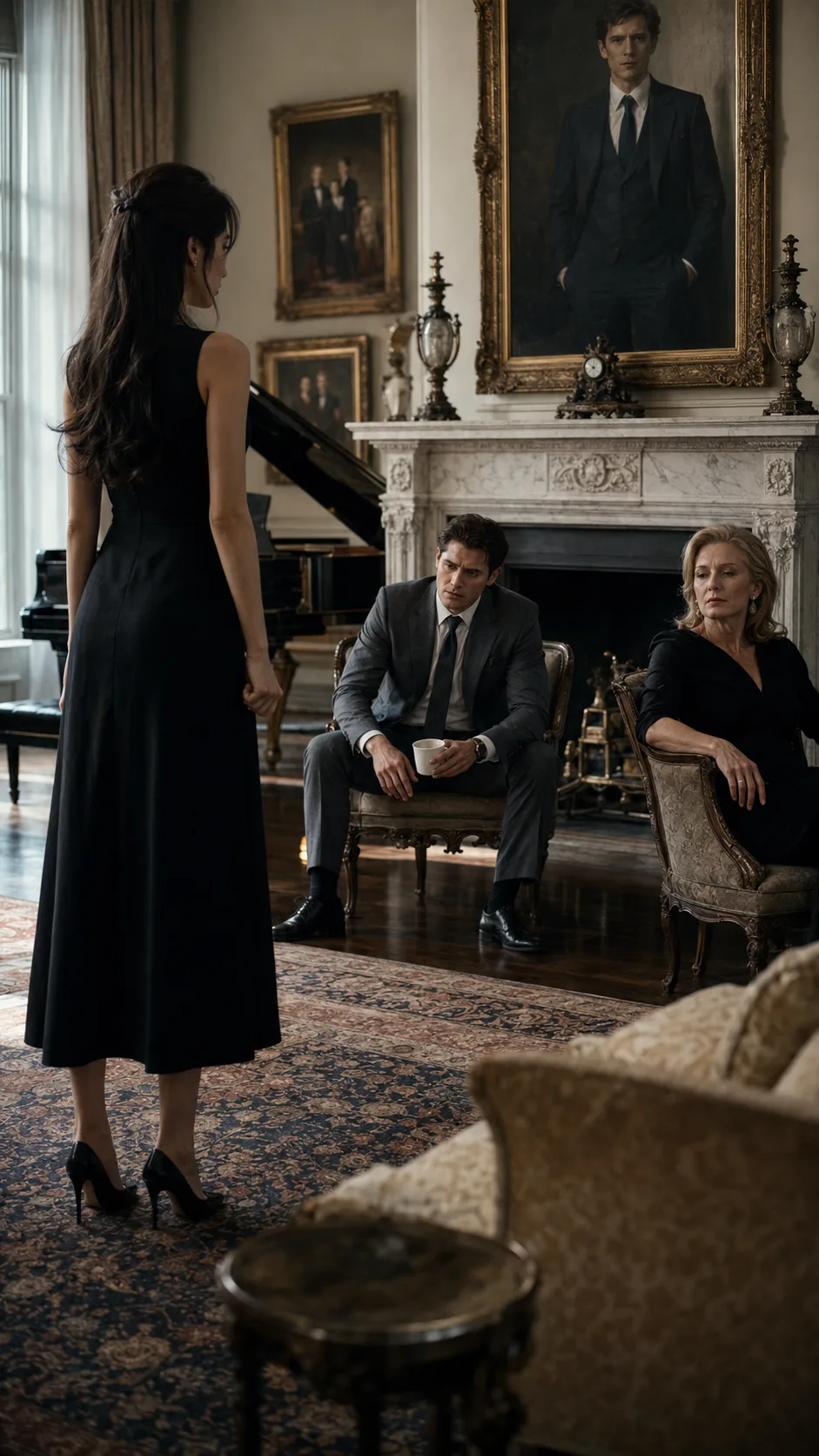
A black piano stood near the tall windows. Heavy cream curtains framed the pale morning light. A marble fireplace glowed softly, though the room was already warm. Gold-framed portraits covered the walls — stern men, elegant
women, children dressed like heirs before they were old enough to understand inheritance.
Elena began dusting the mantel.
Then she looked up.
And the world stopped.
Above the fireplace hung a portrait of a young man in a dark suit. His hair was black, slightly wavy, brushed away from his forehead as if he had run his fingers through it too many times. His eyes were gray-blue, cold in the painting, but unforgettable. His mouth carried the faint curve of a crooked smile.
Elena’s fingers opened.
The cloth slipped from her hand and fell onto the rug.
She knew that smile.
She had seen it at a small café on Tremont Street five years earlier.
She had seen it across a chipped kitchen table while rain tapped against the window.
She had seen it when a man calling himself Jack laughed because he had burned instant noodles and still tried
to pretend dinner was saved.
And every morning for the last four years, she had seen pieces of that same face in her daughter.
Nora’s eyes.
Nora’s dimple.
Nora’s habit of tilting her head when she was trying to understand something.
Elena could not breathe.
Behind her, a woman’s voice said, “Miss Hart?”
Elena turned too quickly.
Catherine Kensington stood in the doorway.
She wore black silk, pearl earrings, and the kind of calm that made ordinary anger seem childish. Her silver-blonde hair was pinned back neatly. Her posture was straight, elegant, almost severe. She looked like a woman who had spent her entire life being obeyed.
Her eyes moved from Elena’s pale face to the cloth on the rug.
“Are you ill?” Catherine asked.
Elena tried to answer.
Nothing came out.
Her eyes returned to the portrait.
Catherine followed her gaze. For one brief second, something sharpened in her expression.
Elena heard her own voice before she decided to speak.
“Ma’am,” she whispered, “why is my daughter’s father in that portrait?”
The silence that followed felt violent.
Catherine did not gasp. She did not clutch her pearls or step backward like a woman in a cheap drama. She simply went still.
Very still.
“What did you say?” she asked.
Elena swallowed. Her throat felt raw.
“The man in that painting,” she said. “I knew him five years ago. He told me his name was Jack. He came into the café where I worked every morning. We were together. Then he disappeared. Six weeks later, I found out I was pregnant.”
Catherine stared at her.
The fire snapped softly behind them.
Elena’s heart was beating so hard she could feel it in her hands.
“I didn’t come here looking for him,” she added quickly. “I didn’t know this was his house. I didn’t know who he really was. I took this job because my daughter needs boots and I need money. But that man is her father.”
Catherine’s eyes traveled over her.
Elena knew what the older woman saw.
Cheap black shoes. A plain dress under a maid’s apron. Hands rough from detergent. A face too tired for twenty-seven. A woman who had learned to eat less so her child could eat enough.
“My son’s name,” Catherine said slowly, “is Jude Kensington.”
Jude.
Elena closed her eyes.
Of course.
Of course even the name had been a lie.
Jack had not simply vanished. He had never fully existed.
“He told me Jack,” Elena said.
“Many people tell convenient stories when they come near this family.”
Elena’s chin lifted.
“I didn’t come near your family. He came near me.”
For the first time, Catherine’s expression changed.
Not much.
Only enough to show that Elena had surprised her.
Then Catherine crossed the room and sat on the blue velvet sofa. She folded her hands in her lap.
“Sit down.”
Elena hesitated.
Catherine’s eyes hardened.
“That was not a request.”
Elena sat in the armchair opposite her, feeling absurdly out of place. The chair was probably worth more than everything inside her apartment.
Catherine leaned back slightly.
“Begin at the beginning. Every detail. If you lie, I will know.”
Elena almost laughed.
She had been accused of many things in life. Lying was rarely one of them. Poor people did not have the luxury of complicated lies. Survival already took too much energy.
So she told the truth.
She told Catherine about Rosie’s Café, where she used to work the early shift. About the man who came in every morning at seven-thirty and ordered black coffee with no sugar. About the way he would sit near the window with a notebook and draw buildings in the margins while pretending not to watch her.
At first, she thought he was just another rich customer with too much confidence.
Then he started making jokes.
Bad ones.
Terrible ones.
The kind that made her roll her eyes and smile despite herself.
His name, he said, was Jack.
He never said much about his family. He claimed he worked in development. He said he liked architecture but had gone into business because life did not always ask permission before choosing your path.
Elena told Catherine how he stayed after closing one night to help her stack chairs. How they walked through Boston Common under orange leaves. How he showed up one evening at her apartment with takeout and a bottle of cheap wine, looking strangely proud of himself for finding food from a place that did not require reservations.
She did not tell Catherine everything.
Some memories were still too soft. Too private.
The way Jack had once kissed her forehead while she slept on the couch.
The way he had traced the scar near her wrist and asked who had hurt her.
The way she had almost told him about foster homes, locked cupboards, and the long years of learning not to need anyone.
But she told enough.
Then she told Catherine how it ended.
“One morning he didn’t come in,” Elena said. “I thought he was busy. Then he didn’t come the next day. Or the next. His phone was disconnected. Three days later, I lost my job. My boss said business was slow, but she wouldn’t look me in the eye. Two weeks after that, I took a pregnancy test in a grocery store bathroom because I couldn’t afford to buy it and wait until I got home.”
Catherine’s face remained controlled, but her fingers tightened.
“I looked for him,” Elena continued. “I had no address. No real name. Nothing but a dead number and four photographs on my phone. So I stopped looking. I had a baby to keep alive.”
Catherine stood.
Without saying a word, she walked to a glass cabinet, unlocked it, and removed an old leather photo album. She placed it on the coffee table.
“Open it.”
Elena did.
The first photograph nearly broke her.
There he was.
Not painted. Not distant.
Alive.
Laughing on a beach, wind pushing his hair back. Standing beside a sailboat. Sitting at a birthday dinner with one arm thrown over a chair. Smiling in that uneven way that had once made Elena feel chosen.
Her hand trembled over the page.
“It’s him,” she said.
Catherine watched her carefully.
Elena turned another page.
“That’s the way he laughs,” she whispered. “He leans back like he forgets the whole room exists.”
Another photograph.
Her eyes blurred.
“My daughter does that,” she said. “When she thinks something is funny, she tilts her head just like that. She holds cups in her left hand. She has his eyes.”
Catherine took the album from her gently and closed it.
For several seconds, the room held only the ticking of an antique clock.
Then Catherine pulled out her phone.
“Brennan,” she said when someone answered. “I need a complete background file on Elena Hart. Age twenty-seven. Employment, residence, medical records if available. Also confirm the birth records of a child named Nora Hart. I want the truth tonight.”
Elena stiffened.
Catherine ended the call and looked at her.
“You will finish your shift,” she said. “You will not discuss this with staff. Not the housekeeper. Not the kitchen. Not anyone.”
Elena stood.
“And if I refuse?”
Catherine’s eyes flickered.
“If you refuse, you walk away without answers. If you stay, perhaps we both get them.”
That was the cruel thing.
Catherine was right.
So Elena stayed.
The rest of the day passed like a dream with sharp edges.
She dusted shelves. Changed linens. Followed Mrs. Weller through hallways full of closed doors and old portraits. She learned that Catherine took tea at four, that the east guest suite was kept ready though no guest used it, and that Jude Kensington’s bedroom was on the second floor at the end of the west corridor.
Late in the afternoon, Mrs. Weller handed her fresh sheets.
“Mr. Jude’s room,” she said. “He’s rarely here, but Mrs. Kensington wants it kept ready.”
Elena’s stomach tightened.
She entered the room alone.
It was not what she expected.
No trophies. No photographs on the wall. No expensive clutter. Just a large bed, a dark desk, a leather chair, and tall windows overlooking the back garden. The room felt less like someone lived there and more like someone had been erased from it.
She stripped the bed.
The scent in the sheets stopped her cold.
Wood. Bergamot. Something clean and dark.
Memory hit so suddenly she had to grip the linen.
Jack standing in her kitchen after the rain. Jack leaning down to kiss her hair. Jack asleep on her couch with one arm beneath his cheek.
Elena shut her eyes.
No.
She had survived him once.
She could survive a smell.
At the desk, she lifted a photo frame to dust beneath it. Something thin slipped from behind the frame and fell to the floor.
A cardboard coaster.
Elena picked it up.
The faded logo made her heart twist.
Rosie’s Café.
She turned it over.
In blue ink, worn at the edges but still readable, was one word.
Elena.
Her handwriting.
She remembered the exact morning. He had asked her name during the breakfast rush. She had been too busy to flirt, so she had grabbed a coaster, written Elena on it, and slid it across the counter with a warning not to waste it.
He had kept it.
For five years.
Elena sat down hard on the edge of the bed.
A cruel man would have thrown it away.
A careless man would have forgotten it.
But Jude Kensington had hidden her name inside his room.
Which meant the worst possibility was no longer the only one.
Maybe he had not left because he stopped loving her.
Maybe someone had taken the choice away.
That evening, Catherine summoned Elena to her private study.
The room smelled like leather and old books. Catherine sat behind a carved desk with a file folder in front of her.
“You told the truth,” she said.
Elena stood very still.
Catherine opened the folder.
“Foster care from childhood. Emancipated young. Café work. Pregnancy confirmed six weeks after Jude left Boston. Nora Hart born at Boston Medical Center. No husband. No contact with this family. No legal claim. No attempt to reach us for money.”
Elena said nothing.
She reached into her apron pocket and placed the coaster on the desk.
“I found this in his room.”
Catherine turned it over.
For the first time, the older woman’s mask cracked.
It was not dramatic. She did not cry. But grief moved across her face like a shadow.
“When Jude left for London five years ago,” Catherine said slowly, “he locked himself in his bedroom for three days. When he came out, he agreed to take over the London branch. He had refused that position for years.”
Elena’s pulse quickened.
“Why did he leave?”
Catherine’s mouth tightened.
“My husband told me Jude had finally accepted responsibility.”
“And you believed him?”
Catherine looked down at the coaster.
“I believed what was convenient. That is not always the same as believing the truth.”
Elena understood then.
Raymond Kensington.
Jude’s father.
The name had floated through the house all day like a warning no one wanted to say aloud.
Catherine looked up.
“Bring your daughter tomorrow.”
Elena stepped back.
“No.”
“If she is my granddaughter, I have the right to see her.”
Elena’s eyes hardened.
“No. You have money. You have staff. You have lawyers. You have gates and men who answer your phone calls at all hours. But you do not have rights to my daughter because your son lied to me.”
Catherine accepted the blow without blinking.
“Then bring her because she deserves the truth.”
That was harder to refuse.
The next morning, Elena dressed Nora in her cleanest floral dress and brushed her curls as best she could.
Nora sat on the edge of the bed, swinging her legs.
“Are the rich people nice?” she asked.
Elena paused.
“Some are polite.”
“That’s not the same.”
“No,” Elena said softly. “It isn’t.”
Nora frowned in the mirror.
“Do they have cookies?”
Despite everything, Elena smiled.
“I think this one probably does.”
That answer satisfied her.
They took the bus across the city. Nora pressed her face to the window and asked questions about every building, every dog, every woman carrying flowers. Elena answered as many as she could, but her mind was already at the mansion.
Catherine had told them to enter through the garden.
The Kensington garden was quiet under pale autumn light. Trimmed hedges lined the stone path. Hydrangeas faded at the edges. A guesthouse stood beyond the main building, grand enough to make Elena’s apartment look like a closet.
Catherine waited on the porch.
Then she saw Nora.
Everything in her changed.
She did not rush forward. She did not make a scene. But her face softened with such sudden pain that Elena almost looked away.
Nora hid behind Elena’s leg.
“She’s staring,” Nora whispered.
Catherine lowered herself slightly, not quite kneeling, but close enough to be less frightening.
“Hello, Nora.”
Nora peered out.
“Do you have cookies?”
Catherine blinked.
Then, for the first time, Elena saw her almost smile.
“Yes,” Catherine said. “I do.”
Inside the guesthouse, a silver tray waited with chocolate chip cookies, apple juice, and napkins folded too neatly for a four-year-old.
Nora forgot to be shy within minutes.
Catherine watched her eat.
When Nora smiled, the little dimple appeared.
Catherine gripped the back of a chair.
“Jude had that same dimple,” she murmured. “He used to steal cookies on Sundays and deny it with crumbs on his shirt.”
Nora considered this carefully, then held out half a cookie.
“You can have some.”
Catherine took it as if the child had handed her a crown.
After juice, Nora pulled out her drawing book. She showed Catherine crooked houses, purple flowers, a cat with too many legs, and a sun wearing eyelashes.
Then she turned to one page and smiled proudly.
“This is my family.”
Elena froze.
Three figures stood together in crayon. A woman. A little girl. A tall man with dark scribbled hair.
Catherine stared at it.
“Who is that?” she asked quietly.
“That’s Daddy,” Nora said.
The room seemed to lose air.
Catherine’s voice was gentle.
“Where is your daddy?”
Nora shrugged.
“Far away. But Mama says he loves me.”
Elena looked down.
She had said that on nights when Nora cried because other children had fathers at school events. She had said it because she could not bring herself to tell a little girl that her father might not have cared. A child could survive many things, but Elena had refused to make rejection one of them.
Catherine looked at Elena then.
No suspicion remained.
Only sorrow.
Her phone rang.
She stepped outside to answer.
Elena heard only pieces through the glass.
“Tomorrow?”
“No. Bring him back now.”
“Yes. He needs to know.”
When Catherine returned, her face was composed again, but her voice had changed.
“Jude lands tomorrow morning.”
Elena’s stomach dropped.
Far away, in a London hotel suite, Jude Kensington sat by a rain-streaked window with the old coaster in his hand.
He had carried it for five years.
Not always in the same place. Sometimes inside a jacket pocket. Sometimes tucked into his desk. Sometimes hidden between pages of a notebook he never let anyone open.
But he had never thrown it away.
Brennan entered without knocking.
“Your mother wants you in Boston,” he said. “She moved the flight.”
Jude did not look up.
“Why?”
“She wouldn’t say.”
Jude rubbed his thumb over the faded blue letters.
Elena.
Brennan sighed.
“You cannot live your whole life around a woman you left five years ago.”
Jude looked at him then.
“I left architecture. I left Boston. I left every version of myself that might have been decent.” His hand closed around the coaster. “This is the one thing I didn’t let them take.”
By dawn, he was on the plane.
Elena did not sleep that night.
She did not wear the maid uniform the next morning. She chose a plain black dress and left her hair down. If she was going to face the man who had broken her life, she would not do it dressed as someone hired to clean his house.
When she entered the mansion, the staff avoided her eyes.
Catherine was waiting in the living room.
Beside the fireplace stood a tall man in a gray suit holding a coffee cup.
His back was turned.
Elena stopped.
He turned.
Five years had changed him.
His jaw was sharper. His eyes looked older. A faint trace of silver touched his hair near one temple. But it was him.
Jack.
Jude.
The man she had loved.
The man she had hated.
The father of her child.
The coffee cup tilted in his hand. A few dark drops hit the marble hearth.
“Elena,” he said.
Her name sounded like it hurt him.
She forced her voice steady.
“Hello, Jack. Or should I call you Jude Kensington?”
His face went pale.
He looked at Catherine.
“Mother, what is this?”
Catherine did not protect him.
“You have a daughter, Jude. She is four years old. Her name is Nora.”
For several seconds, Jude did not move.
Then he reached for the nearest chair and sat down as if his body had forgotten how to stand.
“A daughter,” he repeated.
Elena had imagined screaming. Slapping him. Throwing every bitter year in his face.
Instead her voice came out cold.
“I found out six weeks after you disappeared. I looked for you. Your number was dead. I had no last name. Not even your real first name. I gave birth alone. I raised her alone. And yesterday I found out who you were because your portrait was hanging over that fireplace.”
Jude stared at her.
“I didn’t know.”
The words were rough, almost broken.
“Elena, I swear to God, I didn’t know.”
“Then explain.”
He closed his eyes once.
“My father found out about us.”
Catherine’s face tightened.
Jude continued.
“He had you followed. He knew where you worked. Where you lived. He called me into his office and told me to end it. I refused.”
Elena’s stomach turned cold.
“The next day, you were fired from the café,” Jude said.
She remembered Rosie avoiding her eyes.
Staff cuts.
I’m sorry, honey.
“My father bought the building lease,” Jude said. “He told me that was the gentle version of what he could do. He said if I stayed, he would ruin you quietly enough that no one could prove it.”
Elena stared at him.
“So you vanished.”
“I thought if I left, he would leave you alone.”
A bitter laugh escaped her.
“You thought abandoning me was protection?”
Jude flinched.
“I know what it sounds like.”
“No,” she said. “You don’t. You were not there when I was pregnant and still working double shifts. You were not there when I gave birth with no one holding my hand. You were not there when Nora had a fever and I walked her to the hospital because I didn’t have money for a cab. You were not there when she asked why she didn’t have a daddy.”
His head lowered.
For the first time, Catherine looked away.
Jude’s voice was quiet.
“Can I see her?”
Elena studied him.
The man in front of her was not innocent.
But he was not the monster she had created in her mind either.
That made everything worse.
“Yes,” she said finally. “But if you enter her life and disappear again, I will never forgive you. More importantly, she won’t either.”
Jude nodded.
“Fair.”
The drive to Dorchester was almost silent.
Boston changed around them — polished brick, glass buildings, narrow streets, then older neighborhoods with cracked steps and tired windows.
When Jude stopped outside Elena’s building, he went still.
“This is where she lives?” he asked softly.
Elena opened the car door.
“This is where I kept her safe.”
Miss Dottie opened the apartment door before Elena knocked. Nora ran out, then stopped when she saw Jude.
She looked at his shoes first. Then his face. Then his eyes.
Her own gray-blue eyes narrowed.
“I don’t like strangers,” she whispered.
Jude did not force himself closer.
He stepped back.
“That’s smart,” he said. “You shouldn’t.”
Inside, Nora returned to her drawing table. Jude sat across from her on a chair too small for him and pulled a blank sheet toward himself.
He began to draw.
A house.
Not a child’s square house, but a real one. Windows in the right places. A roof with weight. A porch that looked like someone could actually sit there.
Nora watched from the side of her eye.
“Whose house is that?”
Jude looked up gently.
“I don’t know yet. I just like drawing houses.”
“I like drawing houses too.”
“I noticed.”
Nora slid one of her drawings toward him.
It showed three people: Mama, Nora, and a dark-haired father.
“That’s my daddy,” she said.
Jude stared at the page.
Elena saw his throat move.
“Is he far away?” he asked.
Nora nodded.
“But Mama says he loves me.”
Jude turned his face away for a second.
When he looked back, his smile was careful and sad.
“Your mama sounds very wise.”
Nora studied him.
Then she tore the page out and handed it to him.
“You can keep it. You look sad.”
Jude accepted the drawing like it was worth more than the Kensington estate.
“Thank you,” he said.
He did not become her father in one day.
That was not how children worked.
On the third visit, Nora let him help with a puzzle.
On the sixth, she let him read a bedtime story.
On the tenth, she fell asleep against his arm during a cartoon, and both Jude and Elena sat frozen, afraid to breathe too loudly.
Within a month, she accidentally called him Daddy in a grocery store while pointing at cereal on the top shelf.
Jude froze with the box in his hand.
“Daddy,” Nora repeated impatiently. “That one.”
He put the cereal into the cart.
“That one,” he said, his eyes bright. “Absolutely.”
Catherine changed too.
Every Saturday, Nora visited the mansion. The cold rooms filled with crayons, toy horses, cookie crumbs, and laughter. Catherine bought a child-sized tea set and pretended it had simply appeared. She sat on antique rugs while Nora explained very serious rules about stuffed animals.
The Kensington mansion began, slowly, to feel less like a museum and more like a home.
And Elena began, against her better judgment, to trust Jude’s consistency.
He showed up when he said he would. He asked before making decisions. He brought soup when Nora was sick. He remembered which bedtime story she liked. He listened when Elena said no.
That was what made the black SUV so terrifying.
The first time Elena noticed it, it was parked across from Nora’s preschool.
The second time, it was near the corner store.
By Thursday, a man in a dark suit asked Miss Dottie what time Nora usually came home.
Miss Dottie told him nothing.
That night, Elena called Jude.
He arrived in fifteen minutes.
But the man who stepped into her apartment was not the gentle father who drew houses on the floor.
This Jude was colder.
Sharper.
Dangerous in a quiet way.
He listened to every detail and called Brennan.
“Run the plate,” he said. “Find out who is watching my daughter.”
My daughter.
The words should have comforted Elena.
Instead they made the danger real.
Before midnight, Brennan had an answer.
Vincent Moretti.
A rival from New York. A man who had been negotiating territory and influence with Jude for months. He had discovered Nora existed and realized Elena and the child were unprotected.
Leverage.
Elena felt something inside her snap.
“This is exactly why I was afraid,” she said.
Jude looked at her.
“A man watched my daughter’s school because of your world,” Elena said. “Because of your name. Because powerful men turn everyone they love into targets.”
“I’ll handle it.”
“No,” she said sharply. “That is what men like you always say before women like me end up cleaning blood off the floor.”
Jude went silent.
Elena lowered her voice because Nora was asleep in the next room.
“I will take her and leave Boston if I have to. I know how to run. I have been doing it my whole life.”
Jude did not argue.
He only nodded.
Then he left.
Elena thought he had chosen his world again.
She was wrong.
Jude got into Brennan’s car and called Vincent Moretti himself.
“I’m giving you South Boston,” Jude said. “Every disputed block. Every agreement we fought over. Take it.”
Brennan turned sharply in the front seat.
On the phone, Vincent went quiet.
Jude’s voice stayed calm.
“In exchange, Elena Hart and Nora Hart are never approached again. Not by your men. Not by men pretending they aren’t yours. If anyone comes near my family, negotiations end permanently.”
The agreement came after a long pause.
But Jude was not finished.
His next call was to Daniel Whitmore, a corporate attorney who specialized in turning dirty money into clean exits.
“I need transfer papers tonight,” Jude said. “The offshore accounts, the unofficial holdings, the enforcement contracts, all of it. I’m done.”
Daniel went silent.
“That is fifteen years of operations.”
“I know.”
“You understand what you’re giving up?”
Jude looked out at the city.
“For the first time, yes.”
At two in the morning, after signatures, sealed documents, and decisions that could not be undone, Jude walked out of the law office no longer the man Raymond Kensington had shaped him into.
He still had money. He still had legal businesses. He still had influence.
But the shadow empire was gone.
Brennan stood beneath the streetlight, staring at him.
“You really walked away.”
Jude looked at the folder in his hand.
“Everything in that world put a target on my child. It was never power. It was poison.”
Then he drove to Dorchester.
Elena opened the door before he knocked twice. She looked exhausted, angry, afraid, and ready to fight.
Jude placed the documents on her kitchen table.
“I signed it away,” he said.
She looked down.
“What?”
“The network. The unofficial holdings. Everything dangerous. I’m out.”
Elena stared at him as if she did not trust the shape of the words.
Then Jude unrolled a second set of papers.
Blueprints.
A house appeared beneath the weak kitchen light.
Two stories. Red brick. Wide windows. A studio with north-facing light. A child’s room upstairs. An art room. A backyard with a swing under a young oak tree.
Elena could not speak.
“I wanted to be an architect,” Jude said quietly. “Before my father decided my life belonged to the family business. This is the first house I’ve designed in fifteen years.”
His finger touched the drawing.
“This room is for you. Cool daylight because you sketch better in it. This one is Nora’s. She can draw on the walls if she wants. I put the swing here because last week she asked why apartments don’t come with trees.”
Elena’s eyes burned.
“Don’t,” she whispered.
“I’m not trying to buy you.”
“Then what is this?”
“A promise,” he said. “That I am done choosing fear over love. Done letting my father’s world decide who I become. Done leaving you to survive things you should never have faced alone.”
Elena traced the studio with one trembling finger.
“Do you know what scares me most?” she asked.
Jude waited.
“Not being poor. I know how to be poor. Not being alone. I know that too.” Her voice broke slightly. “What scares me is believing I finally belong somewhere and then losing it.”
Jude stepped closer, slowly.
“You belong with me,” he said. “You and Nora. Not because I say so. Because I will spend the rest of my life proving it.”
Elena looked at him.
The boy who had lied.
The man who had left.
The father who returned.
The son who finally broke free.
She did not give him an easy yes.
Life had not made her easy.
But when he touched her hand, she did not pull away.
“Maybe,” she whispered.
Jude’s smile trembled.
“I can live with maybe.”
The house in Brookline was finished the following autumn.
Nora ran through the front door first with her stuffed rabbit under one arm, shouting that everyone needed to hurry because Bunny had to inspect the rooms.
Her art room nearly made her speechless.
Only for three seconds.
Then she screamed.
Elena stood in the doorway of her studio and gripped the frame. Sunlight spread across the wooden floor. Shelves waited for books. A drafting table stood near the window. The room smelled of cedar and fresh paint.
A place had been built with her in mind.
Not borrowed.
Not temporary.
Built.
Catherine arrived that afternoon with an antique silver frame. Inside was a portrait of Nora sitting in a green velvet chair, chin lifted, dimple visible, looking like a child who had inherited not wealth, but certainty.
Catherine handed it to Elena.
Then she placed one hand on Elena’s shoulder.
It was not an apology.
Not exactly.
But it was acceptance.
Raymond Kensington never came.
He sent no apology. No explanation. No blessing. Only silence.
Catherine stopped waiting for anything better from him.
She came alone and often. She taught Nora card games. She burned cookies twice before learning the recipe. She laughed more in one year with Nora than the mansion had heard in decades.
One winter evening, Jude hung two things on the living room wall.
The first was Nora’s painting from a trip to Walden Pond: three figures by a lake, holding hands beneath the shaky word FAMILY.
The second was a small glass frame.
Inside lay the old coaster from Rosie’s Café.
Elena.
Blue ink. Faded edges. The beginning of everything.
Elena stood at the window later that night, watching snow fall over the backyard swing.
Upstairs, Nora slept peacefully.
Behind her, Jude came close and wrapped his arms around her waist.
For a while, neither of them spoke.
Then Elena said, “We lost five years.”
Jude held her tighter.
“We did.”
She turned in his arms.
The man before her was no longer the portrait above a cold marble fireplace. He was not Jack. Not a ghost. Not a lie she had once loved.
He was Jude.
Flawed. Regretful. Present.
“But we’re here now,” Elena said.
His crooked smile appeared, softer than memory.
“Yes,” he said. “We are.”
And for Elena Hart — orphan, waitress, maid, mother, woman who had spent most of her life standing outside other people’s beautiful homes — the word here felt almost impossible.
Here, where her daughter had a room full of drawings.
Here, where Catherine arrived with cookies and left laughing.
Here, where Jude made black coffee every morning and never left without saying when he would return.
Here, where a child’s painting and an old café coaster shared the same wall.
Outside, snow covered the yard in white silence.
Inside, Elena finally understood that home was not the mansion, not the money, not even the house Jude had built.
Home was the place where love stopped hiding.
And for the first time in her life, she did not feel like a guest.
She felt chosen.
She felt safe.
She felt home.
Chapter complete
You have reached the end of this chapter.
Continue reading
A few more worlds to get lost in after this chapter.




