Robert Morrison had retired from the law firm three years earlier, but nothing about him looked retired when I arrived at his house that afternoon.
Chapter 2
Robert Morrison had retired from the law firm three years earlier, but nothing about him looked retired when I arrived at his house that afternoon.
He still wore a pressed shirt. His white hair was combed neatly back. His eyes still had the same sharp patience I remembered from the years when I worked as an office manager at Morrison and Bradshaw.
His wife Martha opened the door before I knocked twice.
“Patricia,” she said.
Then she saw my face.
“Oh, honey.”
That was when I finally cried.
Not in front of Jessica. Not in front of Derek. Not in the garage while digging for the deed. But in Martha Morrison’s foyer, beside a table full of peppermints and church bulletins, I cried so hard she took my purse and guided me into a chair.
Robert did not rush me.
He waited.
When I could speak, I told him everything.
Not like a broken mother.
Like a woman building a file.
Dates. Utility bills. Groceries. Room changes. The dinner where I was told to eat
alone. The HOA conversation where Jessica had spoken as if she controlled the property. Derek’s business mail arriving at my address. The coffee rings on Carl’s dining table. The sentence in the kitchen.
“You’re lucky we even let you sleep here.”
Robert wrote it all down on a yellow legal pad.
When I finished, he removed his glasses and looked at me for a long moment.
“Do you want them out of the house,” he asked, “or do you want to be done with the house?”
I stared at him.
“I thought those were the same thing.”
“They don’t have to be.”
The words frightened me.
Then they freed me.
I loved that house. I loved the porch Carl painted every spring. I loved the pencil marks behind the pantry door. I loved the fig tree he planted in the backyard because his father had one.
But the house had
already been taken.
Not legally.
Worse.
Emotionally.
Jessica had changed the curtains in the master bedroom. Derek’s watch sat on Carl’s nightstand. Their laundry basket stood where Carl’s oxygen machine had once hummed during his final weeks.
My husband had died in that room while I held his hand.
Now my daughter kept a Pilates mat there.
That night, I sat alone at the kitchen table with Carl’s photograph in front of me.
“I’m sorry,” I whispered.
I did not know whether I was apologizing for selling the house or for waiting so long to save myself.
The house creaked softly around me.
And in that sound, I imagined Carl across from me, hands around his coffee mug, looking at me with the gentle firmness I had loved for forty-six years.
Patty, you know what to do.
The next morning, I called Robert.
“Accept the offer,” I said.
He did
not ask if I was sure.
He already knew.
The buyer was James Chen, a polite developer with a calm voice and a fast-moving team. My corner lot on Palmetto Street had become valuable because of zoning changes. He wanted the property quickly. Cash. No repairs. No parade of strangers walking through the house.
The offer was eight hundred twenty-five thousand dollars.
When Robert told me the number, I had to sit down.
For a moment, I looked around the living room and saw all of it at once: Brandon’s sneaker under the coffee table, Derek’s gym bag on Carl’s chair, Jessica’s vase blocking half of my wedding photo on the mantel.
I was not selling my home.
I was selling the shell they had left behind.
Robert was careful.
“No angry texts,” he warned me. “No threats. No arguments without witnesses. We do this correctly.”
So we did.
I gathered utility statements. Photographs. Receipts. Copies of repair checks Derek had promised to split and never did. Helen signed a statement about the moving trucks, the room changes, the HOA conversation, and the nights she had seen me sitting on the porch because Jessica had guests inside.
“I should have said more sooner,” Helen told me.
“You said enough.”
“No,” she said. “But I’m saying it now.”
Robert discovered Derek had registered his consulting business at my address. That alone was not the worst thing, but it showed how easily he had used my stability to polish his own image.
“They have been careless,” Robert said, tapping one document with his pen, “because they never thought you would push back.”
“Most people are careless when they think the other person is weak,” I said.
He smiled.
“I always liked working with you.”
The notice to vacate was served on March 13.
I chose the living room.
Not because it was practical.
Because it had once been the heart of the house.
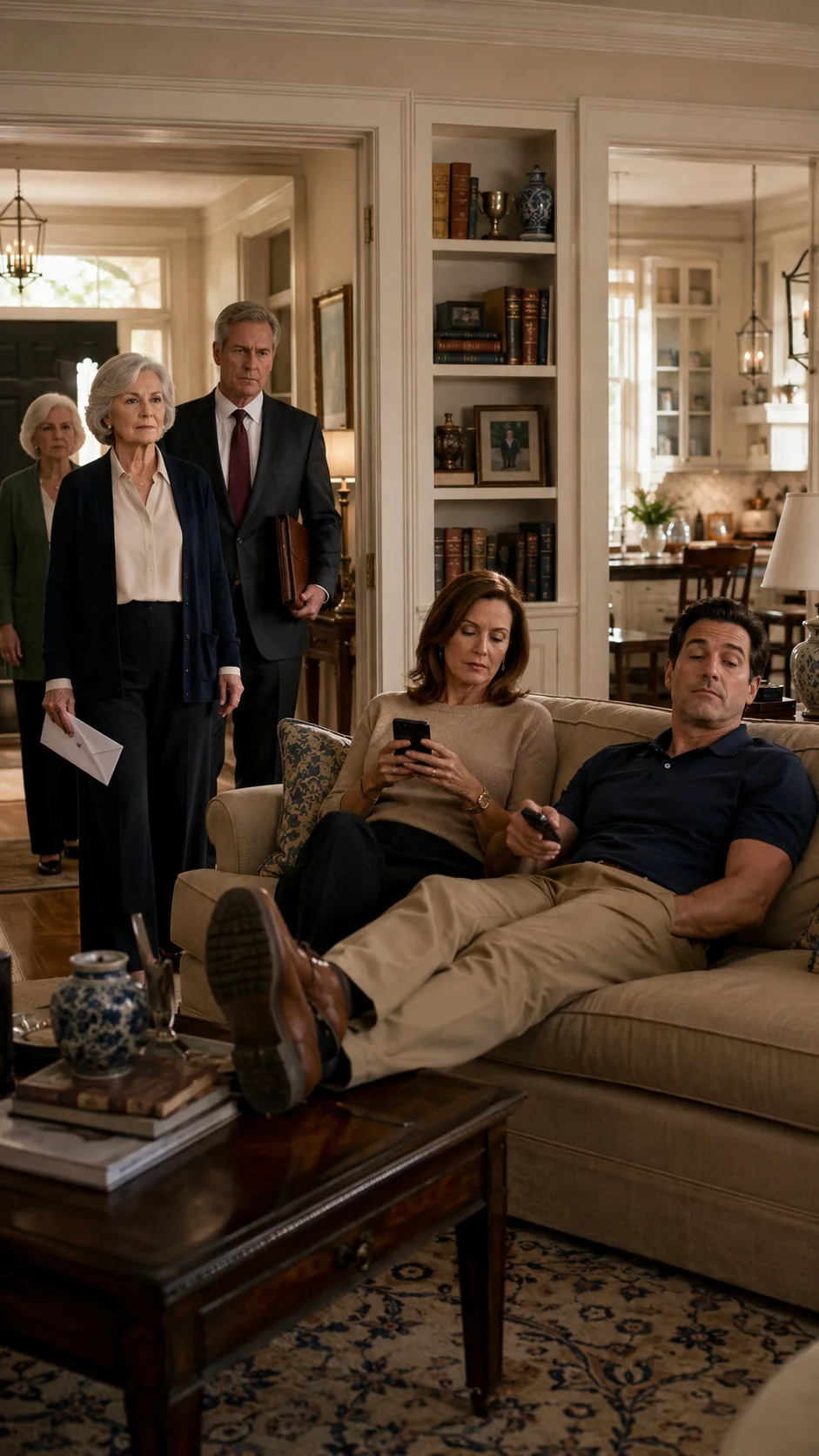
Robert stood by the fireplace. Helen stood near the front door. I held the envelope myself.
Jessica was on the sofa, scrolling through her phone. Derek was watching basketball with his feet on my coffee table. Kylie sat on the floor painting her nails. Brandon had just come home from school and was eating straight from the refrigerator.
“I need you to read this,” I said.
Jessica did not look up.
“What is it?”
“A formal notice to vacate the property.”
That got her eyes off the phone.
Derek muted the television.
“What?” he said.
I handed Jessica the envelope.
“You have thirty days.”
She laughed once, but the sound had no humor in it.
“Mom, stop. This isn’t funny.”
“It isn’t meant to be.”
She pulled out the papers and began reading. Her face changed slowly. Confusion. Anger. Fear. Then anger again.
“You hired a lawyer?”
“I consulted an attorney.”
Derek stood up.
“You can’t just kick us out.”
“I can ask you to leave my home after proper notice.”
“We live here.”
“You were allowed to stay temporarily. That arrangement is over.”
Jessica’s mouth tightened.
“You’re doing this because of one argument?”
I looked at her for a long time.
“No, Jessica. I’m doing this because you thought one argument revealed nothing.”
Kylie stopped painting her nails.
Brandon closed the refrigerator.
Derek pointed at Robert.
“This is ridiculous. We have rights.”
“Yes,” Robert said calmly. “And so does Mrs. Brennan.”
Mrs. Brennan.
Not Mom.
Not Patricia.
Not the old woman in the small downstairs bedroom.
Mrs. Brennan.
The owner.
For the next thirty days, the house became a storm.
Derek tried politeness first.
He cornered me near the mailbox while Helen watered roses close enough to hear every word.
“Patricia, let’s be reasonable.”
I almost laughed.
In my family, reasonableness was always demanded from the person already harmed.
“We can pay rent,” he said. “Maybe not market rate right away, but something. I’ll cover utilities. Jessica can help more.”
“You should have done that when you lived here.”
“We didn’t know you felt this strongly.”
“You did not need to know my feelings to know this was my house.”
His jaw tightened.
“Family doesn’t do this.”
“Family doesn’t take over a widow’s home and call it help.”
Helen’s hose stopped running.
For once, Derek remembered people were watching.
After that came anger.
Doors slammed. Cabinets closed too hard. Jessica spoke loudly on the phone to friends, saying, “My mother isn’t herself,” as if I were too old to recognize a character assassination happening ten feet away.
One afternoon, I heard her say, “I think grief changed her. She’s paranoid.”
I walked into the room.
Jessica froze.
“Be careful,” I said.
“With what?”
“With suggesting I’m incompetent because I stopped being convenient.”
She never made that call in my hearing again.
Then came the grandchildren.
That was hardest.
Kylie brought me tea one evening and hovered in my doorway.
“Grandma,” she asked, “are we going to be homeless?”
The question struck me in the chest.
“No, honey. Your parents have jobs. They have options.”
“Mom says you hate us.”
“I do not hate you.”
“Then why are you doing this?”
I patted the bed beside me.
“Because loving someone does not mean letting them erase you.”
She cried then.
I held her because she was still my granddaughter, and none of this was her fault.
But after she left, I wrote the conversation down.
Not because I enjoyed documenting pain.
Because manipulation often wears a child’s face when adults run out of arguments.
My son Michael called from Denver after Jessica reached him.
“Mom, what’s going on? Jess says you’re throwing them out.”
“I am ending a temporary arrangement that became harmful.”
“That sounds like lawyer language.”
“It is also true.”
So I told him everything.
Michael did not interrupt. He had Carl’s patience.
When I finished, he exhaled slowly.
“I had no idea.”
“They didn’t want you to.”
“Do you need money? Help? Do you want to stay with us?”
The fact that he asked that before asking me to soften made me close my eyes.
“No, honey. I’m all right.”
“Are you sure?”
“For the first time in a long time,” I said, “yes.”
April 12 came.
The deadline.
Nobody moved.
Not one box.
Not one suitcase.
Not even Derek’s gym bag from Carl’s chair.
That morning, Derek came into the kitchen dressed for work, calm in the way arrogant people become when they think they have found leverage.
“We’re not leaving,” he said.
I poured coffee.
“I assumed that might be your choice.”
“We’ll fight it. We’ll drag it out. Jessica talked to someone. We have rights.”
“You should follow your attorney’s advice.”
His face darkened.
“You think you’re clever.”
“No,” I said. “I think I’m done.”
He leaned closer.
“You’re going to end up alone, Patricia.”
There it was.
The real threat.
Not court.
Not money.
Loneliness.
The one thing they believed a widow feared enough to tolerate anything.
I looked at him over my coffee cup.
“I was alone in this house with four other people living in it,” I said. “At least now I’ll have quiet.”
Derek had no answer.
Three days later, I signed the closing papers.
To be continued… Click “PART 3” to read the final part: 👉 PART 3 👈
Chapter complete
You have reached the end of this chapter.
Continue reading
A few more worlds to get lost in after this chapter.




