The Cake Was Expensive, But My Daughter’s Dignity Was Priceless
My little girl only asked for a slice of cake.
Chapter 1
The Cake Was Expensive, But My Daughter’s Dignity Was Priceless
My little girl only asked for a slice of cake.
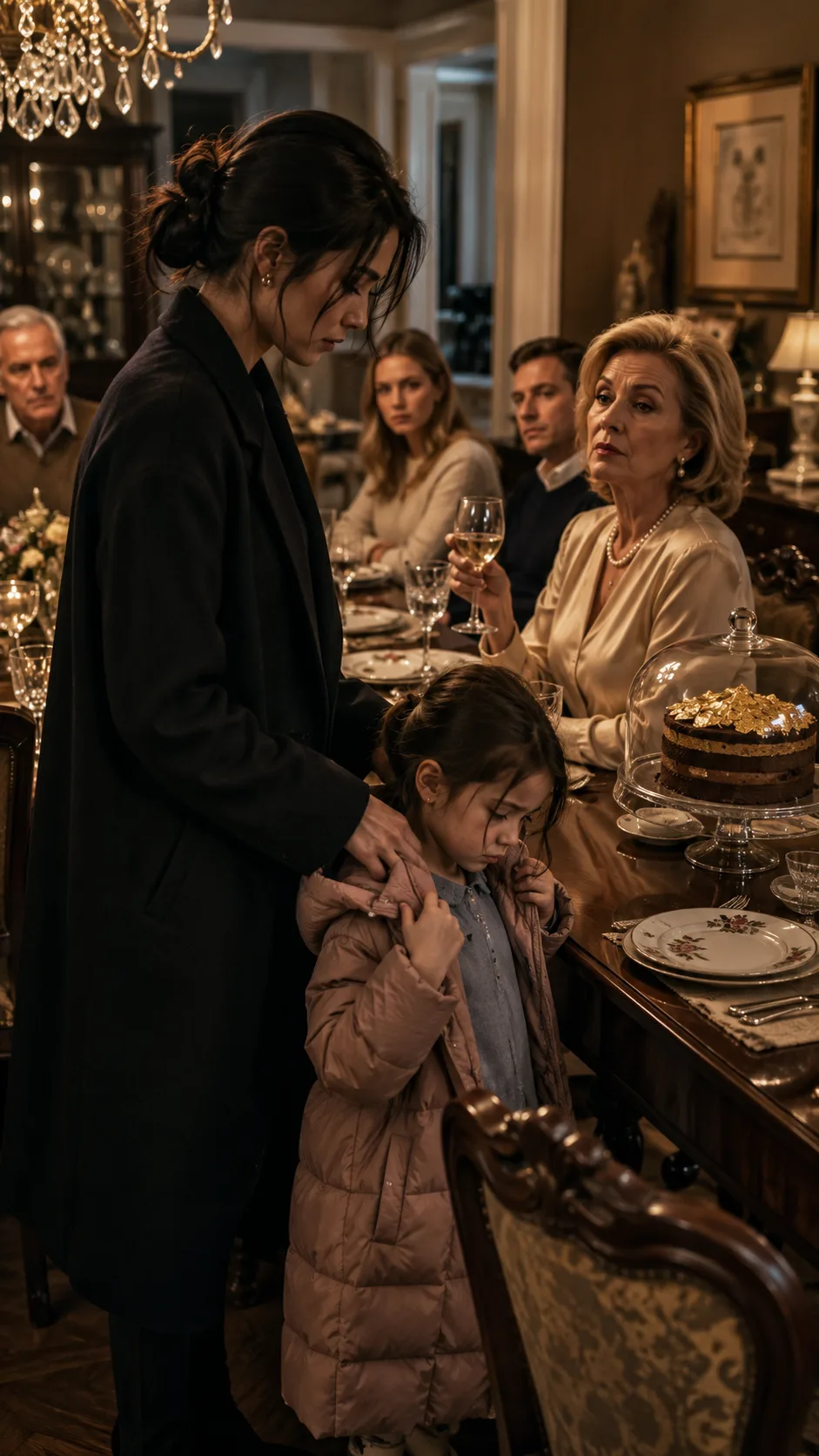
My mother looked at her across the polished dining table and said, “Premium treats are for premium grandkids.”
I stood up, picked up our coats, and walked my daughter out of that house.
By midnight, my mother was texting me about the family estate.
She still had no idea what she had just cost herself.
The first thing that greeted me when I stepped into my mother’s house was not warmth. It was not dinner. It was not the smell of family.
It was money.
The air was thick with expensive candles, lemon polish, old wood, and the kind of cleanliness that never feels welcoming. Everything in that house looked like it had been arranged to impress strangers and intimidate relatives.
Emma held onto the sleeve of my coat as we stood in the entryway. She was six years old, tiny, soft-hearted, and still young enough to believe adults meant
what they said when they called something “family dinner.”
The chandelier above us spilled cold light over her face. She blinked up at it, then looked down at her shoes as if she was afraid to touch anything.
“Shoes off,” my mother said.
No hello.
No hug.
No smile for her granddaughter.
Just an order.
Then came the usual inspection: my worn boots, my thrift-store coat, the tiredness under my eyes, the kind of tiredness that came from late meetings, school drop-offs, grocery budgeting, and building a life no one in that house respected.
My sister Jennifer was already seated in the dining room, laughing too loudly. Her husband, Michael, barely looked up from his phone. My father sat quietly near the end of the table, present in body but absent in every other way.
“Hi, Grandma,” Emma said softly.
She had practiced those two words in the car.
My
mother didn’t answer.
Her attention was on a glass of white wine and the kind of silence she used when she wanted you to remember your place.
Then Emma saw the cake.
It sat beneath a glass dome on the counter, glowing under the cabinet lights like a prize in a luxury bakery. Three dark chocolate layers. Glossy frosting. Thin sheets of gold leaf pressed across the top.
Emma stared at it with the quiet wonder children get when they want something but are trying very hard to be polite.
Dinner began with expensive plates, heavy napkins, crystal glasses, and conversations that made me feel smaller with every passing minute.
Jennifer talked about Pilates.
Michael complained about traffic.
My mother talked about someone’s cruise.
My father nodded like nodding was safer than speaking.
Emma sat on two cushions so she could reach the table. Her little legs swung under the
chair. She ate her carrots slowly, but her eyes kept drifting back to the cake.
I saw the question forming in her.
I wanted to stop her.
Not because she was wrong to ask.
Because I knew my mother.
Emma placed her fork down carefully and lifted her chin.
“Grandma?” she asked.
My mother took a slow sip of wine before looking at her.
“Can I have some cake, please?”
Such a small request.
So innocent.
So easy to answer with kindness.
The room changed.
Jennifer stopped chewing. Michael glanced up. My father froze with his fork halfway to his plate.
My mother smiled.
Not warmly.
Not lovingly.
It was the kind of smile that hides a blade.
“Premium treats are for premium grandkids, sweetheart.”
She said it gently, which somehow made it worse.
Emma blinked.
Once.
Then again.
She did not cry. She did not make a sound. She simply seemed to shrink inside herself, as if those words had folded her inward.
Her eyes found mine.
She did not ask the question out loud.
She didn’t need to.
Am I not good enough?
That was what her face said.
Something inside me went still.
Not angry in the loud, shaking way.
Still.
Clear.
Final.
I reached for my daughter’s hand.
Her palm was warm and small and slightly sticky from dinner.
“We’re leaving,” I said.
My mother set down her glass with a soft, deliberate click.
“Don’t be absurd,” she said. “You just sat down.”
“I think we’re done here.”
Jennifer gave a little laugh and rolled her eyes. “Sarah, seriously? It was a joke. You always do this.”
I ignored her.
I stood up. I helped Emma down from the cushions. I took her jacket from the back of the chair and buttoned it slowly, one button at a time.
My hands did not shake.
My mother watched from the head of the table with that familiar look of disappointment.
The same look she gave me when I chose a state college instead of the school she wanted to brag about.
The same look she wore when I married a mechanic.
The same look she had when I kept going after the divorce instead of collapsing in a way she could pity.
“You’re really leaving because of dessert?” she asked.
I looked at her.
“No,” I said. “I’m leaving because my daughter asked for something sweet, and you gave her shame.”
My father finally moved.
“Sarah,” he said weakly. “Your mother didn’t mean it that way.”
I turned to him.
“She never means it,” I said. “That’s how she gets away with it.”
No one followed us to the door.
No one apologized.
Outside, November rain blurred the streetlights into long gold streaks. Emma sat silently in the back seat, staring out the window while the wipers dragged water across the glass.
I drove to the small ice cream shop near our apartment.
The one with buzzing fluorescent lights, sticky tables, and a teenager behind the counter who did not care that my eyes were red.
Emma chose strawberry with rainbow sprinkles.
I ordered chocolate even though I wasn’t hungry.
We sat in the car with the heater running and the smell of sugar filling the space between us.
Emma took one small bite, then whispered, “Mom?”
“Yes, baby?”
“Am I not premium?”
The words nearly broke me.
I turned toward her and brushed a loose strand of hair from her cheek.
“You are priceless,” I said. “No cake, no house, no money in the world is worth more than you.”
She thought about that with the serious expression only children have when they are trying to understand adult cruelty.
“Then why did Grandma say it?”
“Because Grandma uses the wrong way to measure people.”
That night, after I tucked Emma into bed, she asked me to turn on the star nightlight.
Blue dots scattered across her ceiling.
She fell asleep beneath them, one hand still curled around the sleeve of the stuffed bunny she had carried since she was three.
I stood in the doorway for a long time.
Then I went to my desk.
My apartment was small. My office was smaller. A cheap lamp, a laptop, three neat stacks of folders, and one drawer I kept locked.
I opened my computer and pulled up a file with a name that meant nothing to anyone else.
Oakmont.
Inside was the deed to my parents’ estate.
My mother’s name was there.
My father’s name.
Jennifer’s.
Michael’s.
And mine.
More importantly, so were the words that had changed everything.
Joint tenants.
Equal ownership.
Equal control.
My mother liked to pretend I was the struggling daughter. The one who needed help. The one who had chosen badly and lived smaller because of it.
She had never cared enough to learn what I actually did for a living.
She never asked about the late-night calls, the investment reports, the contracts, the acquisition meetings, the financial structures I built for people who had far more money than manners.
To her, I was still the daughter in cheap boots.
At 11:47 p.m., my phone lit up.
Mom.
I’ve been thinking about the house situation.
I stared at the message and felt nothing.
Then another one came through.
There’s an opportunity to sell Oakmont. It would be best for everyone. We need your signature.
I did not reply.
I turned the phone face down and rejoined the conference call still running through my headset.
Singapore was reviewing projections. A logistics acquisition was entering final negotiations. Seven figures moved through the conversation like ordinary numbers.
When I spoke, my voice was calm.
Precise.
Professional.
The voice my mother had never heard because she had never believed I was worth listening to.
By 12:15 a.m., the call ended.
The apartment was quiet except for the refrigerator humming in the kitchen.
I checked on Emma once more.
She was asleep, hair tangled across her pillow, the little blue stars drifting across her blanket.
Priceless.
I returned to my desk and opened the document my mother had sent.
A buyout agreement.
She wanted to sell Oakmont to a developer.
Luxury condos.
Big payout.
Clean ending.
All she needed was my signature to dissolve my share.
In her mind, she was offering me charity. A generous little payout for the daughter she thought had failed. A way to secure Jennifer and Michael’s future while handing me enough money to make me grateful.
I didn’t call my mother.
I called my attorney.
Two days later, I drove back to Oakmont.
The house smelled exactly the same.
Vanilla candles.
Furniture polish.
Pride.
My mother was waiting in the sunroom with a silver pen, a neat stack of papers, and the pleased expression of someone who believed the ending had already been written.
Jennifer sat beside her, tapping one manicured nail against her phone.
“Sarah,” my mother said brightly. “I’m glad you decided to be reasonable.”
I remained standing.
Jennifer leaned forward. “This is good for everyone. You’ll get money, Mom gets to move on, and you can finally get a decent place in a better district for Emma.”
My mother smiled.
“It’s more money than you’ll probably see in years,” she added. “You should think carefully.”
I looked at the papers.
Then I placed my own folder on the table.
“I’m not signing.”
My mother’s smile stiffened.
“Don’t start this,” she said. “This is not the time for your stubbornness.”
“I agree,” I said. “This is not about stubbornness. It’s about ownership.”
Jennifer frowned. “What is that supposed to mean?”
“It means I’ve used my right of first refusal,” I said. “Since I hold equal interest in Oakmont, I’m buying out the rest of the shares.”
No one spoke.
For once, the room had no clever insult ready.
Jennifer laughed first, but it came out too sharp.
“With what money, Sarah? This property is worth millions.”
“I know exactly what it’s worth.”
My mother stared at me.
I looked straight back.
“I’ve been the lead consultant connected to the firm handling your main investment portfolio for three years,” I said. “I know your numbers. I know the value of this estate. I know what Michael lost last spring in that ridiculous business idea everyone pretended was brilliant.”
Jennifer’s face changed.
Michael’s name had landed like a glass dropped on marble.
My mother went pale.
Not embarrassed.
Exposed.
For the first time in my life, she looked at me as if I had become visible in front of her.
“I’m purchasing Oakmont at fair market value,” I continued. “My attorney has already contacted your estate lawyer. You’ll receive what you’re owed. You’ll have enough to move somewhere more manageable.”
My mother’s lips parted.
“You’re forcing me out of my own home?”
“No,” I said. “I’m removing valuable things from people who never understood value.”
Her eyes narrowed.
I leaned slightly closer.
“You have thirty days.”
I turned to leave, but paused at the dining room.
The cake was still there.
Under its glass dome.
The gold leaf had curled at the edges. The frosting looked dry. Without the shine, it was just chocolate cake pretending to be something rare.
I lifted the dome.
Took a fork from the sideboard.
And cut straight into the center.
No plate.
No permission.
I took one bite.
Too sweet.
Not nearly as impressive as it looked.
I looked back toward the sunroom.
“You were right about one thing,” I said. “This is a special occasion.”
Then I walked out.
This time, the house did not feel powerful.
It felt old.
Small.
Afraid.
I drove home to my daughter, to our small apartment, to the little kitchen where breakfast never came with conditions.
And as the morning light began to rise, I understood something my mother never had.
People are not premium because they are rich.
Children are not valuable because adults approve of them.
And love is not love if it makes a child earn dessert.
Emma would never sit at that table again wondering whether she was enough.
I would build her a different kind of life.
One with warm rooms.
Honest food.
Kind voices.
And a ruler that measured people by love, not price.
THE END.
Chapter complete
You have reached the end of this chapter.
Continue reading
A few more worlds to get lost in after this chapter.




