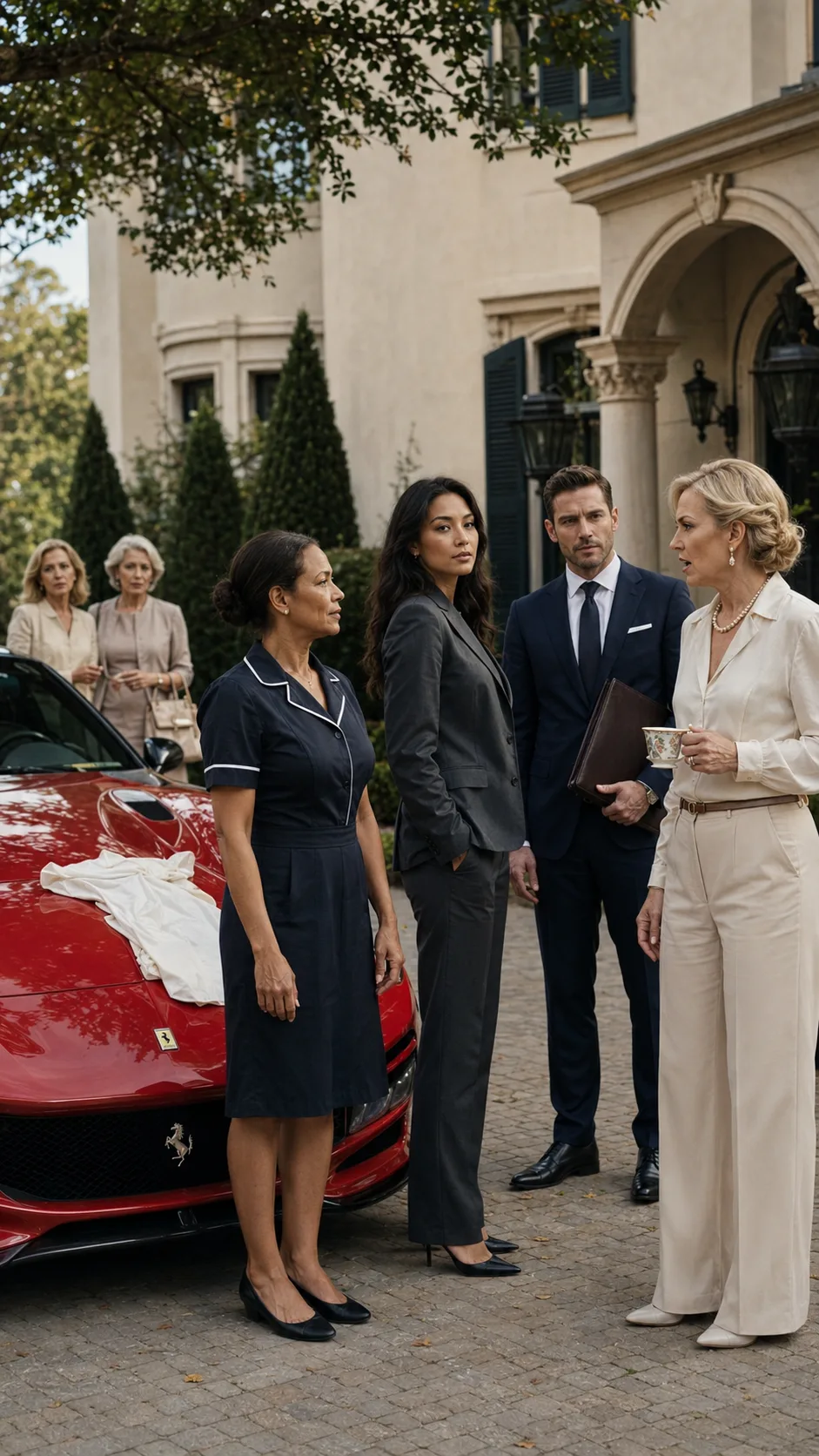
They Sent The Maid Outside Then A Ferrari Came For Her
Celia Warren was sitting on the back porch of the Callaway mansion, eating her lunch beside two golden retrievers, when the red Ferrari rolled into the driveway and changed everything.
Chapter 1
They Sent The Maid Outside Then A Ferrari Came For Her
Celia Warren was sitting on the back porch of the Callaway mansion, eating her lunch beside two golden retrievers, when the red Ferrari rolled into the driveway and changed everything.
Until that moment, it had been an ordinary day of quiet humiliation.
She had arrived before sunrise, the way she always did. At 6:15 in the morning, while the neighborhood was still asleep behind iron gates and manicured hedges, Celia had already let herself into the Callaway estate through the side entrance.
She prepared breakfast.
She wiped down marble counters.
She folded towels so perfectly they looked like they belonged in a hotel.
She polished silver, watered flowers, swept invisible dust from polished floors, and pressed Diane Callaway’s silk blouse for the luncheon Diane had been bragging about all week.
Celia did all of it silently.
At fifty-two, she had learned how to move through wealthy people’s houses without making sound. She had learned how to lower her eyes without surrendering her pride. She had learned how to accept insults without letting them reach the deepest part of her.
People
like Diane mistook silence for weakness.
That was their first mistake.
Late that morning, Diane entered the kitchen carrying a porcelain coffee cup between manicured fingers. She looked around the spotless room as if cleanliness were not the result of Celia’s labor, but simply something her house deserved.
“My friends will be here soon,” Diane said, her tone bright and cruel in that effortless way rich women often mastered. “You shouldn’t eat in the kitchen today. Take your plate outside. And keep Beau and Belle with you.”
Celia paused for only a second.
Her lunch sat on a plain plate beside the stove. The meal she had cooked for herself after serving everyone else.
She looked at Diane.
Diane looked back with the small, satisfied smile of a woman who believed money gave her permission to reduce another human being to an inconvenience.
Celia did not argue.
She picked up
her plate and walked out the back door.
The two golden retrievers followed her as if they understood more than their owner ever had.
On the porch step, Celia sat down beside them. The air was warm. The grass beyond the patio looked impossibly green. Somewhere inside the mansion, Diane’s expensive shoes clicked across floors Celia had polished on her knees.
Celia placed the plate in her lap and bowed her head.
Not in defeat.
Not in shame.
In restraint.
Because there are moments when a woman does not speak because she is powerless.
And there are moments when she does not speak because the ending has already been written.
Four minutes later, the Ferrari arrived.
The sound came first.
A low, powerful growl rolling through the quiet estate like thunder held inside an engine.
Diane heard it too.
Celia watched from the porch as Diane rushed toward the front
of the house, suddenly full of charm, suddenly smiling, suddenly eager to receive whoever had arrived in such a car.
A red Ferrari turned into the driveway and stopped in front of the mansion.
The driver’s door opened.
A young woman stepped out.
She was tall, elegant, and composed, wearing a charcoal blazer that looked tailored to her exact frame. Her dark hair moved lightly in the breeze. Her expression was calm, but there was steel beneath it.
Then a man stepped out from the passenger side.
He was older, sharply dressed in a navy suit, carrying a leather folder under one arm.
Diane hurried down the front steps with her best society smile.
“Good morning,” she called, her voice suddenly warm. “May I help you?”
The man looked past her toward the house.
“We’re looking for Celia Warren.”
Diane blinked.
For a moment, the name seemed to mean nothing to her.
Then her smile twitched.
“The maid?”
The young woman’s face changed.
Not loudly.
Not dramatically.
But something cold passed through her eyes.
“My mother,” she said.
The words struck the driveway like glass breaking.
From the back porch, Celia heard the voice.
She stood.
For three years, Diane Callaway had called Celia many things without saying them directly. Help. Staff. The woman. The maid.
But Natalie Warren had driven three hours to say the only title that mattered.
Mother.
Celia walked around the side of the house toward the front drive, Beau and Belle trotting beside her.
When Natalie saw her, her expression softened for one brief second. Then she straightened, as if remembering why she had come.
The man beside her was Marcus Ellery, a venture strategist from Charlotte. Years ago, when nearly everyone else in Celia’s professional world had erased her name, Marcus had not.
He had believed the truth would surface.
He had believed Celia was not finished.
And he had been right.
Before Diane Callaway ever knew Celia as a housekeeper, Celia Warren had been a chief financial officer in Atlanta. Brilliant. Precise. Respected. The kind of woman who could look at a broken company and see exactly where the money was bleeding.
Then her husband, Russell, destroyed her.
Charming in public and rotten in private, Russell moved stolen funds through accounts connected to Celia’s name. By the time the truth began to emerge, the damage was already done.
Celia lost her job.
Then her home.
Then her reputation.
Then six months of her freedom.
When the truth finally crawled into daylight, it came too late to repair what the world had already decided about her.
So Celia disappeared.
She took work where no one asked about her past. She cleaned houses. She served women who would never have been allowed inside her old boardrooms. She swallowed their condescension and their orders and their tiny cruelties.
And at night, when the Callaway mansion slept, Celia rebuilt herself in silence.
She advised a young company from the shadows.
She studied markets at the kitchen table.
She reviewed financial models after scrubbing floors.
She helped shape Ardora Systems into something powerful.
And that morning, the world finally remembered her name.
Marcus opened the leather folder.
“The acquisition closed today,” he said. “Your equity has been finalized. Twenty-nine million, one hundred forty thousand dollars will transfer within seventy-two hours.”
Diane stared at him.
Her mouth opened slightly.
No sound came out at first.
Celia stood beside the Ferrari, still wearing the maid uniform Diane had expected her to disappear in.
For one beautiful, silent second, the entire estate seemed to stop breathing.
Diane looked from Marcus to Natalie, then to Celia.
“Celia,” she said weakly, “what is this?”
Celia did not answer immediately.
Instead, she reached behind her back and untied the white apron.
Slowly.
Carefully.
With the same precision she had once used to fold Diane’s linens.
Then she folded the apron once and placed it on the shining red hood of the Ferrari.
The white fabric against the red paint looked like a flag of surrender.
But Celia was not surrendering.
She was returning what never belonged to her.
Diane stared at the apron as though it had insulted her.
“My luncheon starts soon,” Diane said, her voice rising. “You can’t simply leave. The dining room isn’t finished. The table hasn’t been properly set. My guests are arriving.”
Natalie stepped closer to her mother.
“The table is your responsibility now, Mrs. Callaway.”
Diane looked offended, as if no one had ever spoken to her without asking permission first.
Natalie’s voice remained smooth, controlled, and merciless.
“My mother has spent three years cleaning your house while helping build one of the most important logistics companies on the East Coast. She didn’t stay because she needed your respect. She stayed because people like you never look closely at the people you think are beneath you.”
Diane’s grip tightened around her coffee cup.
Marcus closed the folder with a soft snap.
“And as of this morning,” he added, “the court has cleared Ms. Warren’s record. Her former husband’s offshore accounts have been seized. The case is closed. Her name is restored.”
The words landed harder than the Ferrari’s engine ever could.
Cleared.
Restored.
Twenty-nine million dollars.
Diane’s face drained pale.
The woman she had sent outside to eat with dogs was standing in her driveway richer, freer, and more powerful than she could comprehend.
“Celia,” Diane said, and now the arrogance had begun to leak out of her voice. “Please. You know I didn’t mean anything by it. It’s just that my friends are particular. Appearances matter. You understand how these things are.”
Celia looked at her for a long moment.
Yes, she understood appearances.
She understood the spotless kitchen Diane never cleaned.
The pressed blouse Diane never touched.
The perfect luncheon Diane expected someone else to create while pretending the labor was invisible.
A black Mercedes turned into the driveway.
Diane saw it and panicked.
Her guests had arrived.
Two women stepped out, dressed in soft beige and pearls, the kind of women who noticed everything and forgave nothing. Their eyes went immediately to the Ferrari, then to the apron on the hood, then to Celia standing beside two executives while Diane stood trembling with a coffee cup in her hand.
“Celia,” Diane whispered urgently, stepping closer. “Don’t do this now. I’ll double your pay. Triple it. You can have the guest suite if you need time. Just stay through the luncheon.”
The offer hung there.
Pathetic.
Late.
Small.
Celia did not smile.
She did not gloat.
That would have made the moment smaller than it deserved to be.
“Diane,” she said softly, “I just made twenty-nine million dollars.”
Diane froze.
Celia glanced at the mansion behind her.
“I could buy this house, knock it down, and turn the land into a park for Beau and Belle.”
The two golden retrievers wagged their tails, oblivious to the collapse of their owner’s pride.
Celia looked back at Diane.
“I don’t want your guest suite.”
One of the women near the Mercedes covered her mouth.
The other whispered something that made Diane’s shoulders stiffen.
Celia turned toward the Ferrari, then paused.
“Your blouse is pressed,” she said. “It’s hanging in the laundry room.”
Diane’s eyes widened, as if she had expected cruelty and had instead received proof that Celia had finished her work with more dignity than Diane had ever shown her.
“The dogs have eaten,” Celia continued. “But you’ll have to serve your own quiche.”
Natalie opened the passenger door.
For the first time in years, Celia walked toward a car without feeling like she was leaving something behind.
She sat in the leather seat.
Natalie slid behind the wheel.
Marcus stepped back, still holding the folder that carried the truth of Celia’s resurrection.
The Ferrari’s engine roared alive.
The sound rolled across the estate, shaking the air, the windows, and whatever remained of Diane Callaway’s certainty.
As they pulled away, Celia looked once into the side mirror.
Diane stood frozen on the manicured lawn. Her guests hovered behind her, confused and fascinated. Her coffee cup hung uselessly in her hand.
For years, Diane had believed Celia was the help.
Now she looked like the one who had lost everything.
By Friday, Celia Warren’s name was everywhere.
The Atlanta business journals called her the hidden architect behind Ardora Systems’ stunning acquisition. Headlines spoke of the former CFO whose reputation had been restored, the strategist who had returned from scandal, the woman who had helped engineer one of the year’s most profitable tech deals while working quietly out of sight.
Diane read the article at her kitchen island.
The same island where she had told Celia not to eat.
Her luncheon had become a social disaster before the first course was served. Without Celia, the wine was late, the food was uneven, and Diane sweated through her perfect blouse trying to manage a house she did not actually know how to run.
But the failed luncheon was nothing compared to the story.
By evening, everyone at the country club knew.
By the next morning, they had repeated it with embellishments.
By the end of the week, Diane was no longer simply the woman whose maid quit.
She was the woman who had sent a multimillionaire financial genius to eat outside with the dogs.
Her reputation did not fall apart loudly.
It dissolved in whispers.
Celia did not buy a mansion.
She had spent too many years cleaning rooms designed to impress people who were empty inside.
Instead, she bought a sun-filled penthouse high above Atlanta, with glass walls, wide terraces, and a view that made the city look like it belonged to her.
She hired a private chef.
Not because she had forgotten how to cook.
But because no one would ever again tell her where she was allowed to eat.
On her first Sunday there, Celia sat outside on the terrace with Natalie. Lunch was served on beautiful porcelain plates. The skyline stretched around them in gold and blue.
Beside the table, Beau and Belle lay happily in the sun, chewing premium steak trimmings.
Celia had bought them from Diane for ten thousand dollars.
Diane had agreed.
Humiliation made negotiation very simple.
Natalie lifted her glass.
“To new beginnings,” she said.
Celia looked out over Atlanta.
For years, she had seen the world from back porches, service doors, and polished floors beneath other people’s feet.
Now the city glittered below her.
She took a slow sip of champagne.
Then she smiled.
The view from the top was far better than the view from the porch.
THE END.
Chapter complete
You have reached the end of this chapter.
Continue reading
A few more worlds to get lost in after this chapter.




