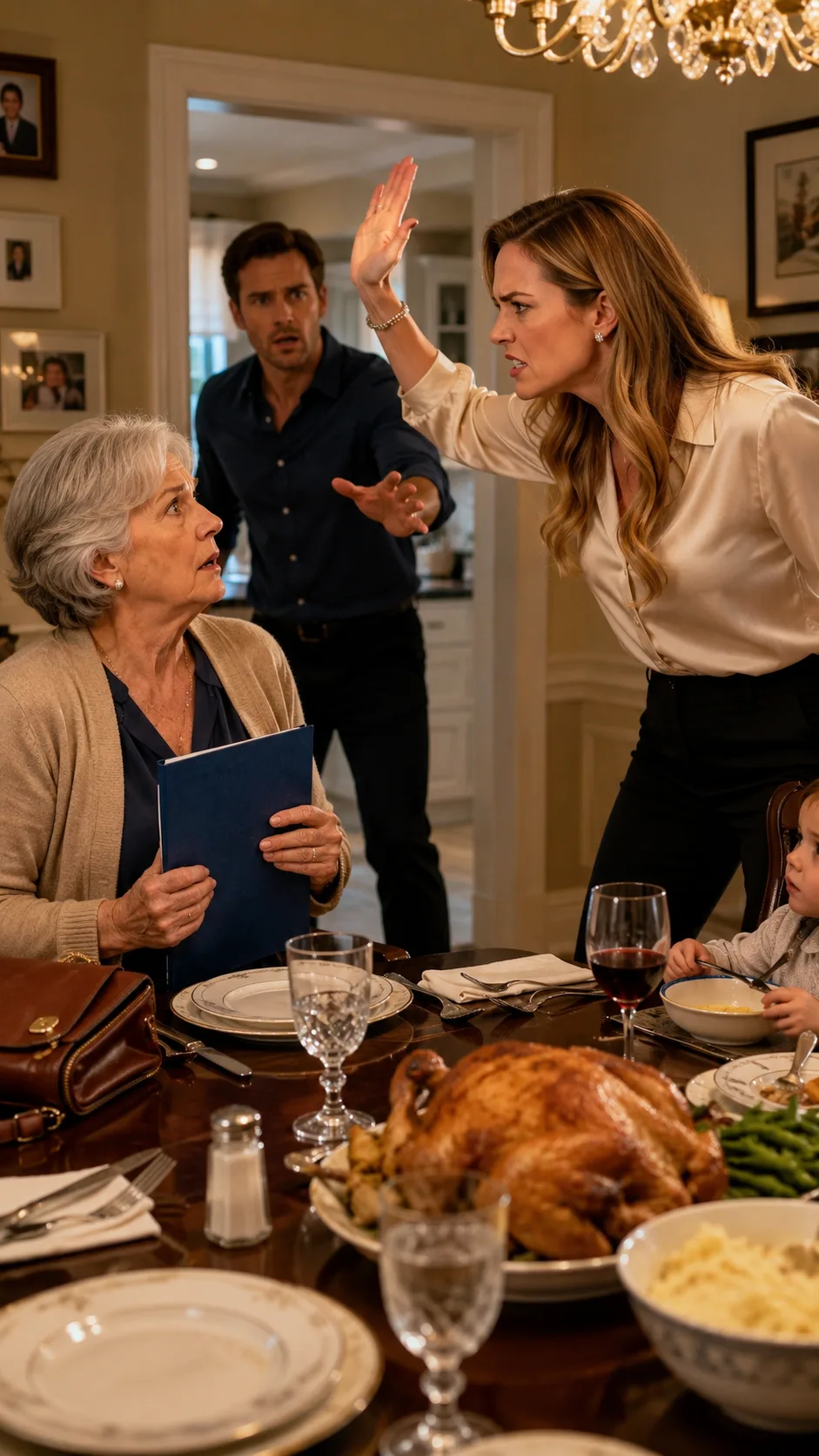
Daniel did not move at first.
Chapter 3
Daniel did not move at first.
He stood beside Lily’s booster seat with one hand on the back of her chair, his other hand half-raised, as if he had forgotten what he meant to do with it. Madison was in the kitchen doorway with my blue folder tucked under her arm, breathing fast, her cheek still flushed from the slap.
I looked at my son and watched the last of his excuses leave his face.
“Before Friday?” he asked.
Madison swallowed.
For once, she did not have a polished answer ready.
The chandelier hummed softly above us. Somewhere in the kitchen, the refrigerator motor clicked on. Lily sniffled in her seat, too young to understand the words, old enough to feel the danger in the room.
Daniel stepped toward Madison.
“What happens Friday?”
Madison looked at me first.
That told me everything.
I reached for the tax statement that had fallen onto the table. My hands
were steadier now. I picked it up, folded it once, and slipped it into my cardigan pocket.
“Friday was moving day,” I said.
Daniel turned to me.
I kept my voice even. “The estimate was for three men, one truck, and a storage unit outside town. My bedroom furniture, my boxes from the basement, your father’s framed military photo, and my sewing cabinet were all listed.”
Daniel’s face twisted. “Dad’s photo?”
Madison snapped, “It was just storage.”
“Where was my mother supposed to go?”
Madison’s eyes flashed. “I found a place.”
“A place,” Daniel repeated.
I reached into my purse again and pulled out the second paper I had folded behind my checkbook. It was not glossy like the senior living brochure. It was plain white paper printed from a website. A pre-admission checklist. My name was handwritten across the top in Madison’s neat, narrow script.
Helen Whitmore.
Required documents.
Medication list.
Power of attorney.
Daniel took the paper from me.
His fingers tightened as he read.
“You signed this?” he asked Madison.
“I started the process.”
“You signed as family representative.”
“I am family.”
“You are not her legal representative.”
Madison’s mouth opened, but no sound came.
That was when I finally understood the shape of her plan. It had not been one angry dinner, one cruel sentence, one hidden brochure. It had been a set of small steps. Change the mailbox. Move my documents. Make me look forgetful. Tell Daniel I was declining. Put my room on a moving estimate. Place a brochure in my purse so later she could say I had been considering it myself.
She had not planned to throw me out in anger.
She had planned to make it look like kindness.
Daniel turned away from her and pressed both hands against the table.
I saw his shoulders shake once.
“Mom,” he said without looking at me, “why did you come alone?”
“Because I wanted to know which son would be sitting at this table tonight,” I said.
He looked up.
His eyes were wet.
I did not soften the sentence for him. A mother can love her child and still stop protecting him from the truth.
Madison moved again, slowly edging toward the kitchen counter where her phone lay beside a stack of mail.
Daniel saw it.
“Don’t,” he said.
“I need to call someone.”
“No. You need to give my mother her folder.”
Madison laughed, but fear had ruined the sound. “Listen to yourself. You slapped your wife, and now you’re taking her side? Do you know how this looks?”
Daniel’s face changed with shame.
I stepped between them before he answered.
“No one in this room should have raised a hand tonight,” I said. “Not her. Not you.”
Daniel lowered his gaze.
Madison seized the opening.
“Exactly,” she said. “He hit me. That is what matters.”
I looked at her.
“No,” I said. “What matters is that you tried to hit an old woman in a house that belongs to that old woman, while hiding papers to remove her from it.”
Madison’s eyes went cold.
“You always do that,” she whispered. “You make yourself sound helpless.”
“I am not helpless.”
I reached into my purse one last time and removed my phone.
Madison’s face shifted.
Daniel noticed. “Mom?”
“I called Martin Hale before dinner,” I said.
The name landed hard.
Martin had been my late husband’s attorney. He had handled the deed. He had handled the estate. He had known Daniel since he was ten years old and still wore sneakers with untied laces to church.
Daniel stared at the phone.
“I told him if I did not call him back by eight-thirty, he should come over with the documents we discussed.”
Madison looked toward the front hall.
As if summoned by her fear, the doorbell rang.
Lily started crying again.
Nobody moved.
The second ring echoed through the house.
Daniel walked to the front door like a man heading toward a verdict. When he opened it, Martin Hale stood on the porch in a gray overcoat, holding a black leather document case.
Behind him stood a uniformed police officer.
Madison made a small sound in her throat.
Martin stepped inside and looked at me first.
“Helen,” he said gently. “Are you safe?”
I nodded once.
Daniel looked from Martin to the officer, then back to me. “Mom, what is happening?”
Martin’s expression was calm, but his voice carried the weight of paperwork already prepared.
“Your mother asked me to file notice terminating the occupancy agreement,” he said. “Given what she found in the house, and given tonight’s circumstances, I advised her not to remain here without witnesses.”
Madison’s face went pale.
“You can’t terminate anything,” she said. “We live here.”
Martin opened his case.
“You live here by written permission,” he said. “Permission can be revoked.”
Daniel closed his eyes.
The sentence hit him harder than the slap had hit Madison.
I looked at my son and saw the boy again, but only for a second. Then I saw the man who had allowed silence to become a language in his marriage.
“Daniel,” I said, “I am not putting Lily out tonight. She is innocent.”
Madison clutched the folder tighter.
“But you,” I said, looking at my daughter-in-law, “will hand me my documents now.”
The officer stepped forward, not aggressively, just enough.
Madison looked at Daniel, waiting for him to rescue her.
He did not.
Slowly, with trembling fingers, she pulled the blue folder from under her arm and placed it on the table.
Not in my hands.
On the table.
Even then, she could not bear the humility of giving something back directly.
I picked it up myself.
Martin handed Daniel a second folder.
“These are copies of the occupancy agreement, the deed, and the proposed notice,” he said. “You should read every page.”
Daniel took them like they were heavier than paper.
Madison whispered, “Daniel, you’re not going to let her do this.”
Daniel looked at his wife for a long time.
Then he said, “I let you do too much already.”
Her face crumpled, but I did not trust the tears. Not yet.
I walked to Lily’s chair and kissed the top of her head. She smelled like baby shampoo and mashed potatoes. Her little hand caught my sleeve.
“Grandma?” she whispered.
“I’m right here, sweetheart,” I said.
Then I looked around the dining room—the chandelier, the white plates, the untouched roast chicken, the family photos Madison had arranged so carefully on the wall. For years, I had mistaken being quiet for keeping peace.
But peace built on fear is not peace.
It is permission.
I turned to Daniel.
“You can stay tonight for Lily,” I said. “Tomorrow morning, you and Madison will leave. After that, we can talk about what kind of son you want to be.”
Daniel nodded, tears slipping down his face.
Madison said nothing.
For the first time since she had moved into my house, she had no command left to give.
I picked up my purse, tucked the blue folder beneath my arm, and walked past the dining table toward the front hall.
Behind me, Daniel finally spoke.
“Mom?”
I stopped but did not turn around.
“I’m sorry,” he said.
I held the doorknob for a moment, feeling the cool brass under my palm.
Then I said, “Be sorry tomorrow too.”
And I stepped out onto my own porch, carrying the deed to my own house, while the door remained open behind me.
THE END.
Chapter complete
You have reached the end of this chapter.
Continue reading
A few more worlds to get lost in after this chapter.




