PART 2
The bartender returned with my drink in a ceramic mug, steam curling from the surface.
Chapter 2
PART 2
The bartender returned with my drink in a ceramic mug, steam curling from the surface.
I wrapped both hands around it, letting the heat seep into my skin. Through the window, I watched the storm continue its assault on the city. People rushed past with newspapers held over their heads, car horns blaring at the flooded intersections.
I was halfway through my drink when the atmosphere shifted. It was not dramatic. Not at first. Just a subtle change in the energy of the room, like the barometric pressure dropping before a tornado. The conversations at the nearby tables grew quieter. The bartender straightened. His casual demeanor was replaced with something sharper, more alert.
Then the door opened.
Three men entered, but only 1 commanded attention. He was tall, easily 6’3”, with black hair swept back from a face that could have been carved from stone. He had dark eyes, a strong jaw, and olive skin that still held summer’s tan despite the winter chill. His
charcoal suit fit him with the precision that came from custom tailoring. Every line accentuated broad shoulders and a lean, powerful frame.
But it was not his appearance that made my breath catch. It was the way everyone else reacted. The bartender moved immediately to pour something without being asked. The couple at the nearest booth fell silent mid-conversation. Even the jazz seemed to quiet, though I knew that was impossible.
The man moved through the space with absolute confidence, flanked by his companions. One was tall and heavily built, his nose clearly broken more than once. The other was leaner, with cold eyes that swept the room in constant assessment. They were heading toward the private area at the back when the lean one spoke so quietly I almost missed it, but the effect was immediate.
The man in the charcoal suit stopped walking and turned, his gaze following
the direction his companion indicated.
Toward me.
I froze, the mug halfway to my lips. His eyes locked onto mine with an intensity that felt physical, like being pinned by a spotlight. For 3 seconds, maybe 4, we stared at each other across the dim interior of the bar.
Then his gaze dropped, traveling down to where I had pushed up the sleeves of my dark gray sweater. To my left forearm.
To the scar.
His expression changed so completely it was like watching a mask shatter. The casual confidence vanished, replaced by something sharp and dangerous. He was moving before I could process what was happening, crossing the distance between us with startling speed.
“Let me see your arm,” he said.
His voice was deep and smooth, with the barest trace of an Italian accent.
“Excuse me?” I managed, setting down my mug with shaking hands.
He did not
repeat himself. Instead, his hand shot out and gripped my wrist, not painfully, but with unmistakable authority. He pulled my arm toward him, turning it so the inside of my forearm was exposed beneath the bar’s lighting.
The scar was old, faded to a pale pink line against my skin. Two letters intertwined in a shape that could have been abstract art if you did not know what you were looking at. An A and a V inside another V. The lines crossed at specific points that had been carefully planned by 2 little girls with a piece of broken glass.
“Who are you?” The man’s grip tightened slightly, his eyes never leaving the scar. “Where did you get this?”
My heart hammered against my ribs.
“I don’t know what you’re talking about. Let go of me.”
“Not until you answer my question.”
He looked up then, and I saw something in his face that made my stomach drop. It was pain. Deep, aching pain hiding behind the anger.
“Who are you?”
The bigger man had materialized behind me, blocking any escape route. The lean one stood to my right, his hand resting inside his jacket in a way that suggested a weapon. The other patrons had suddenly found reasons to look anywhere else. Their drinks became fascinating.
“My name is Emma Collins,” I said, forcing the words out. “I’m a veterinarian. I work at Eastside Animal Emergency. I’ve never seen you before in my life, and I have no idea why you care about an old scar.”
“When did you get it?” he asked.
His thumb pressed against the scar, tracing one of the lines.
“How long ago?”
“15 years,” I whispered. “When I was 12. Now, please let go.”
His jaw tightened.
“Come with me.”
“What? No. I’m not going anywhere with you people.”
“It wasn’t a request.” He released my wrist, but only to gesture sharply toward the back of the bar. “You can walk, or Marco can carry you. Your choice.”
The bigger man, Marco apparently, took a step closer.
I looked at the bartender, hoping for some help. He was studiously polishing a glass, his eyes fixed on his work. No one was going to help me. I was alone with these men, who clearly operated outside normal rules. Refusing would only make things worse.
“Fine,” I said, sliding off the stool.
My legs felt unsteady.
“But if you hurt me, I’m screaming.”
“No one is going to hurt you, Miss Collins.” The man’s voice had softened fractionally, though his expression remained like granite. “I just want to talk.”
He led the way toward a door I had not noticed before, tucked beside the bar. It opened onto a narrow hallway that smelled of aged wood and expensive cologne. Another door waited at the end, this one heavy oak with a brass handle.
Inside was an office that spoke of serious money. Dark wood paneling, leather chairs, and a massive desk dominated the space. Floor-to-ceiling bookshelves lined 1 wall, filled with leatherbound volumes that looked antique. A single lamp cast golden light across the desk’s surface.
The man gestured to one of the chairs facing the desk.
“Sit.”
I sat.
Marco took up position by the door while the lean man disappeared back into the bar. The man in the charcoal suit moved behind the desk, opening a drawer.
When he pulled out the photograph, my world tilted.
It was old, faded around the edges, but the image was clear. A young woman, maybe 19 or 20, laughing at something off camera. She had dark hair cascading over one shoulder, warm brown eyes crinkled with joy, and there on her left forearm, clearly visible as she reached toward whoever held the camera, was a scar identical to mine.
“No,” I breathed, my hand flying to my mouth. “No, that’s not possible.”
“You recognize her.”
It was a statement, not a question.
I could not speak. My throat had closed completely, tears burning behind my eyes, because I did recognize her. She was older in this photo, grown up and beautiful, but I would know that face anywhere. I had memorized it during 4 years of sharing a cramped room in an underfunded orphanage, studying it in the dark when nightmares woke me, finding safety in her presence.
“Val,” I finally managed.
The nickname tore from my chest.
“That’s Valentina.”
The man lowered himself slowly into his chair, his eyes never leaving my face.
“How do you know that name?”
“She was my friend.” The words tumbled out now, unstoppable. “My best friend. We were at Santa Agnes together, the orphanage in Chicago. From the time I was 8 until I got adopted at 12, we shared everything. We were like sisters.”
“Tell me about the scar.”
I looked down at my arm, at the mark I had carried for half my life.
“We made them the night before I left. We knew I was being adopted the next morning. And Val, she didn’t want us to forget each other. She said we needed something permanent, something that would always connect us.”
The memory crashed over me with painful clarity. Val’s face in the dim light of the dormitory bathroom. Tears streaming as she held the piece of broken glass from a shattered mirror. Her hands shook as she made the first cut on her own arm, then on mine. We both bit down on rolled washcloths to muffle our cries.
“We mixed our blood,” I continued, my own tears falling now. “She said it meant we’d always be part of each other, no matter how far apart we were. The V stood for Valentina, but also for forever. We promised we’d find each other again when we grew up.”
The man’s face had gone pale beneath his tan. He leaned forward, bracing his forearms on the desk.
“What else do you remember?”
“Everything,” I said simply. “The way the dormitory smelled like old radiators and pine cleaner. How we’d sneak food from the kitchen after lights out and share it under our blankets. The director, Mr. Pellegrini, with his cold eyes and colder hands. The way kids would disappear sometimes. They said they were adopted out, but we never saw them again. Val used to tell me stories at night about the lives we’d have when we escaped. She wanted to be a teacher. I wanted to work with animals.”
I wiped my face with the back of my hand.
“After I was adopted, I tried to find her. For years, I tried. But the orphanage had burned down, and all the records were gone. It was like she’d never existed. Like those 4 years were just a dream.”
“She existed.”
The man’s voice was rough now, scraped raw.
“She was my wife.”
The word hit me like a fist.
Wife.
“Valentina married me 6 years ago.”
He pulled another photo from the drawer. This one was more recent. The same woman, older now, standing beside the man currently sitting across from me. She wore a white dress. He wore a tuxedo. They were clearly at a wedding.
“She never mentioned you,” he said. “Never said anything about Santa Agnes, about having a friend with a matching scar, about any of it.”
My heart cracked.
“She forgot about me.”
“Or she had her reasons for staying silent.”
His fingers traced the edge of the wedding photo.
“Valentina was murdered 3 years ago. Officially, it was a random mugging. Unofficially, I’ve spent every day since trying to find out who really killed her and why.”
The room spun.
Murdered.
“She was investigating something when she died. Something dangerous. I never knew what. I never understood why she was so secretive in the months before.”
He looked up at me, and I saw grief etched into every line of his face.
“But now you walk into my bar with that scar, and suddenly I’m wondering if the answer was in her past all along.”
“I don’t know anything,” I protested. “I haven’t seen her since I was 12 years old. I didn’t even know she was alive, let alone that she had married someone, that she had died.”
“Maybe not consciously.”
He stood, moving around the desk until he was standing directly in front of me.
“But you’re the first real lead I’ve had in 3 years, Miss Collins, which means you’re not leaving my sight until I know everything there is to know about Santa Agnes, about Valentina, and about why she kept you a secret.”
“You can’t just keep me here.”
“I own this bar. I own the building it’s in. I own half of this neighborhood.” His voice was soft, almost gentle, but utterly inflexible. “My name is Lucas Ravalini, and in this city, that name means something. So, yes, Miss Collins. I absolutely can keep you here until I get the answers I need. The question is whether you’re going to cooperate or make this difficult.”
I stood to face him, anger cutting through my fear and grief.
“Val was my friend. If someone killed her, I want to know who and why just as much as you do. So don’t threaten me like I’m your enemy.”
For a long moment, we stood there, locked in a silent battle of wills. Then something shifted in his expression, a fractional softening around his eyes.
“You’re right,” he said finally. “I apologize. This has been unexpected for both of us.”
I touched the necklace at my throat again, drawing strength from it.
“What do you need from me?”
“Everything you remember. Every detail about the orphanage, about Valentina, about what happened there.”
He returned to his chair, pulling out a legal pad and pen.
“And then we’re going to figure out why my wife died and make sure whoever’s responsible pays for it.”
I sat back down, my wet clothes leaving damp patches on the leather. Outside, the storm continued to rage. But inside this office, a different kind of storm was beginning. One that had been brewing for 15 years, waiting for 2 old friends’ paths to cross again, even if one of them was already dead.
The apartment Lucas Ravalini provided was not a prison cell, but it might as well have been.
It was located on the 14th floor of a building I had never noticed despite working blocks away. It had floor-to-ceiling windows overlooking the East River, hardwood floors that gleamed under recessed lighting, and furniture that screamed money in quiet, understated tones. A king-sized bed dominated the bedroom, its white linens so crisp they looked almost hostile. The kitchen was stocked with food I had not chosen. The bathroom was filled with toiletries still in their packaging.
What it did not have was freedom.
I had been there for 3 days, and Marco, the bodyguard, stood outside my door like a statue made of muscle and silence. When I tried to leave that first morning, he simply stepped in front of me. His expression was apologetic but immovable.
“Mr. Ravalini’s orders, Miss Collins. You stay here until he’s verified your story.”
So I stayed.
What choice did I have? Call the police and tell them what exactly? That a powerful man was keeping me in a luxury apartment while investigating his wife’s murder? They would laugh me out of the station, assuming they believed me at all. Lucas Ravalini clearly had reach in the city, connections that went deeper than I wanted to contemplate.
My phone was my only link to the outside world, and I used it constantly those first 2 days. I called my supervisor at the clinic and fabricated a story about a family emergency in Boston. She was understanding and told me to take the time I needed. The relief in her voice suggested she thought I needed mental health days after losing the golden retriever, and I did not correct her assumption.
I also scrolled through every search result I could find about Valentina Ravalini. The articles from 3 years ago were sparse but consistent. Wife of prominent businessman Lucas Ravalini found dead in apparent mugging. Tragedy strikes Manhattan power couple. Police seek witnesses in fatal robbery.
The photos showed her at charity events, always elegant in designer clothes, her dark hair styled perfectly, her smile warm but somehow distant. I studied each image obsessively, trying to reconcile this polished woman with the scared little girl who had shared my narrow bed during thunderstorms, who had stolen extra bread from the kitchen to make sure I ate.
She had lived an entire life I knew nothing about. She had married a man who clearly adored her, if the grief carved into his features was any indication. She had moved through a world of wealth and privilege so far removed from Santa Agnes it might as well have been another planet.
And apparently, she had never mentioned me once.
That hurt worse than I wanted to admit.
On the afternoon of the third day, Lucas arrived with 2 other men I did not recognize. They wore dark suits and carried leather briefcases, their expressions professionally neutral. I guessed they were lawyers or investigators. They set up in the apartment’s dining area, spreading documents across the glass table. Lucas gestured me over without greeting.
“I need you to verify some information.”
I sat, my jaw tight.
“Good afternoon to you, too.”
His eyes flicked to mine briefly.
“I apologize. Good afternoon, Miss Collins. Now, please verify this information.”
The first document was my adoption record, somehow obtained despite privacy laws. I scanned it, recognizing my younger self’s signature at the bottom, the careful loops I had practiced for weeks before signing. Thomas and Patricia Collins approved adoptive parents. Date of adoption: March 15, the year I turned 12.
“That’s accurate,” I said.
“Tell me about them. The Collins family.”
I leaned back in the chair, crossing my arms.
“They seemed nice at first. Patricia baked cookies. Thomas coached Little League. They had a house in Brooklyn with a backyard and a dog named Chester. They wanted a daughter to complete their perfect family picture.”
“What went wrong?”
The question landed like a punch. I had spent years in therapy dissecting exactly what went wrong, understanding that it was not my fault, that I had been a traumatized kid with behavioral issues. But understanding did not make it hurt less.
“I had nightmares,” I said quietly. “Screaming nightmares that woke the whole house. I hoarded food in my room because I was terrified there wouldn’t be enough. I couldn’t stand being touched without warning, which made Patricia cry because she wanted to be an affectionate mother. I got into fights at school when kids made fun of my secondhand clothes.”
Lucas’s expression had not changed, but something in his posture softened fractionally.
“After 2 years, they sat me down and explained very calmly that they had made a mistake. That they weren’t equipped to handle a child with my level of need. That it would be better for everyone if I returned to state care.”
I picked at a loose thread on my sleeve.
“They were probably right. I was miserable there, trying to be someone I wasn’t. But it still felt like being thrown away twice.”
One of the investigators made a note. Lucas did not move.
“Where did you go after that?”
“Back into the system. Foster homes mostly. Some were okay, some were terrible. All were temporary. I learned to keep my head down and not get attached. On my 18th birthday, I aged out with exactly $300, a garbage bag of belongings, and a social worker who helped me apply for college scholarships.”
“You chose veterinary medicine.”
“Animals don’t lie,” I said simply. “They don’t pretend to want you when they don’t. They’re honest about their needs and their pain. It made sense to me.”
Lucas nodded slowly.
“And your recent move to Manhattan from Boston?”
My shoulders tensed.
“That’s not relevant to Valentina.”
“Everything about you is relevant until I determine otherwise.”
The arrogance in his tone sparked my anger back to life.
“I left because my ex-boyfriend was suffocating me. He wanted to know where I was every minute, who I talked to, what I spent money on. He never hit me, if that’s what you’re asking. But he didn’t have to. The control was violence enough.”
Something dark crossed Lucas’s face.
“His name?”
“Why? Are you planning to break his kneecaps?”
I tried to make it sound sarcastic, but given what I had learned about Lucas Ravalini in my internet deep dives, I was not entirely joking.
“Just curious.”
His tone suggested otherwise.
We spent the next 2 hours going through everything I remembered about Santa Agnes. The investigators took meticulous notes as I described the building’s layout, a converted Victorian house that always smelled of boiled cabbage and industrial cleaner. The shared bedrooms with bunk beds lined up military-style. Thin mattresses and thinner blankets. The dining hall where we ate in shifts, with the oldest kids serving the younger ones under the watchful eyes of staff who seemed perpetually exhausted.
I described Mr. Pellegrini, the director. His tall frame was always dressed in cheap suits that hung slightly wrong. His office smelled of coffee and something chemical I could never identify. The way he would call certain children in for interviews, and they would leave looking pale and shaken, but no one ever explained why.
“Some kids just disappeared,” I told them, touching the necklace at my throat without thinking. “We’d go to bed with them in the next bunk, and by morning they’d be gone. The staff said they had been adopted, that families had come for them, but it always happened so fast. No goodbyes, no warning.”
“Did this happen to children you were close to?” one of the investigators asked.
“A few. Sarah, who was 7 and had a lisp. Marcus, who was 14 and taught me how to pick locks on the supply closet. Both just vanished overnight.”
Lucas’s pen had stopped moving.
“Did Valentina ever mention having siblings or family members she had been separated from?”
I shook my head.
“She said she didn’t remember anything before the orphanage. She was placed there at 3 years old, she thought, but wasn’t sure. The memories were too fuzzy.”
“Did she ever seem like she was looking for someone? Trying to find out about her past?”
“Not that I knew of. She was more focused on the future. She wanted to be a teacher, to work with little kids. She was good at it, too. Always helping the younger children with their homework, reading to them before bed.”
My throat tightened.
“She would have been amazing at it.”
The room fell silent except for the scratch of pens on paper. Through the windows, Manhattan’s evening lights were beginning to bloom, the city transforming into something magical despite all its grit and darkness.
Finally, Lucas stood.
“Thank you for your cooperation, Miss Collins. The information you’ve provided has been helpful.”
“So I can leave now?”
“You can return to your apartment and your job, but you’ll have protection.”
“Protection or surveillance?”
“It’s both.”
He gestured to one of the investigators.
“This is Joseph. He’ll be your primary escort along with a rotating team. They’ll accompany you to work, to the grocery store, anywhere you go.”
“I don’t need a babysitter.”
“You do if you want to stay alive.”
Lucas’s voice had gone cold again.
“Valentina died investigating something connected to that orphanage. Now you show up with evidence linking you to her past, to a place she never mentioned existed. Whoever killed her might decide you’re a loose end.”
The implication settled over me like ice water. I had been so focused on the mystery, on the shock of finding Val again only to learn she was dead, that I had not considered I might be in actual danger.
“I don’t know anything,” I protested. “I haven’t seen her in 15 years. How could I possibly be a threat?”
“You know about Santa Agnes. You remember Pellegrini. You can identify the building, the staff, the other children.”
Lucas moved to stand directly in front of me.
“You’re a witness to whatever was happening there, even if you don’t realize it yet.”
My hands started shaking. I clasped them together in my lap, refusing to show more weakness than I already had.
“Then help me remember. Tell me what you know about Valentina’s investigation.”
“That’s exactly what I intend to do.”
He pulled out his phone, typing something quickly.
“Tomorrow, I’ll show you what she was working on before she died. Tonight, Joseph will take you home to collect whatever you need. Then he’ll bring you back here. This apartment is secure. Your building isn’t.”
“You want me to move in here.”
“Temporarily. Until we know more about the threat level.”
I looked around the pristine space that felt nothing like home. Then I thought about my tiny studio in Hell’s Kitchen, the sketchy neighborhood I had chosen because it was what I could afford, the building with locks that barely worked and neighbors I did not know.
“Fine,” I said finally. “But I need to go to work tomorrow. I have patients depending on me. Animals in recovery that need consistent care.”
Lucas nodded.
“Joseph will coordinate with your schedule. But, Miss Collins, I want to be clear about something. Until we find out who killed Valentina and why, your life isn’t entirely your own. You’re connected to this investigation whether you like it or not. The only question is whether you fight me every step of the way or whether we work together to get answers.”
“I want answers,” I said quietly. “Val was the closest thing to family I had for 4 years. If someone murdered her, I want them to pay for it.”
Something shifted in his expression, the hardness cracking just slightly.
“She would have liked that you’re still loyal to her, even after all this time.”
“Did she really never mention me?”
The question escaped before I could stop it.
“Not once in 6 years.”
Lucas was quiet for a long moment.
“She had nightmares sometimes. She’d wake up calling a name I didn’t recognize. Em or Emmy. I always assumed it was someone from her past, but she would never tell me who. She’d just say it was nothing and go back to sleep.”
My vision blurred with sudden tears.
Emmy.
That was what she had called me. My full name had been too formal for a little girl’s tongue. The nickname had died when I left the orphanage. No one else had ever used it.
She had remembered.
Through everything. Through building a new life and marrying a man who clearly loved her. Through becoming someone I would not have recognized on the street, she had remembered.
“Why wouldn’t she tell you about me?” I whispered.
“I don’t know.”
Lucas’s voice had gentled.
“But I intend to find out.”
Joseph stepped forward, his expression professional but not unkind.
“Miss Collins, whenever you’re ready, we can go collect your things.”
I nodded, not trusting myself to speak.
As I gathered the few items I had brought to this gilded cage, my mind spun with questions that had no answers. Valentina had kept me secret, locked away in whatever box she had built around her past. But she had also dreamed about me, called my name in her sleep.
Whatever had happened to her, whatever she had been investigating, it was connected to the 4 years we had spent as sisters in everything but blood.
And now I was stepping into the shadow she left behind, following a trail 3 years cold with a grieving husband as my only guide.
The only question was whether I would find justice at the end of it, or just another way to lose someone I had loved.
Part 2
Lucas picked me up from the clinic 4 days after our initial interrogation session. I had just finished stitching up a tabby cat who had gotten into a fight with something much larger. My hands were still steady despite the exhaustion creeping through my bones. Joseph had been my shadow the entire shift, positioned near the waiting room with his back to the wall and his eyes on every entrance.
I had gotten used to his presence over the past week, the way shadows had become part of my daily existence.
When Lucas walked through the clinic doors, several of my coworkers stopped what they were doing. He had that effect on people, commanding attention without saying a word. Today, he wore dark jeans and a black sweater under a leather jacket. It was less formal than the suits, but somehow more dangerous.
“We need to talk,” he said without preamble. “There’s something I want to show you.”
I peeled off my latex gloves and tossed them in the biohazard bin.
“Can it wait until after my shift?”
“No.”
Dr. Martinez, my supervisor, appeared from the back office.
“Emma, if you need to go, it’s fine. We’re covered for the rest of the day.”
The way she looked at Lucas, with a mixture of weariness and respect, told me she had figured out he was not just some boyfriend picking me up from work. Small mercies that she did not ask questions.
The car waiting outside was different from the sleek sedan that usually transported me. This was a black SUV with tinted windows, dark enough to be illegal. Marco was behind the wheel. Lucas opened the back door and waited while I climbed in, then slid in beside me.
We drove in silence through Manhattan traffic, heading south toward the industrial areas near the waterfront. The neighborhoods grew rougher, luxury high-rises giving way to converted warehouses and aging brick buildings. Finally, Marco pulled into an alley beside a structure that looked abandoned. Its windows were covered with sheets of plywood, and graffiti tagged every available surface.
“Where are we?” I asked as Lucas helped me out of the SUV.
“Somewhere private.”
He led me to a side entrance, punching a code into a keypad that looked far too new for the building’s exterior. The door clicked open, revealing a stairwell that had been recently renovated. Fluorescent lights hummed overhead. We climbed 2 flights to a heavy steel door. Lucas unlocked it with a key from his pocket, then gestured me inside.
I was not prepared for what I saw.
The space was massive, probably spanning the entire floor of the warehouse. But it was the walls that made me stop breathing. Every available surface was covered with papers, photographs, maps, and documents. They were connected by colored string in patterns that would have looked insane to anyone who did not understand investigation boards.
In the center of it all was Valentina’s face. Dozens of photos of her, maybe hundreds. At charity events, leaving restaurants, shopping, laughing with friends. Candid shots that suggested surveillance rather than social media. And crime scene photos, too. Lucas had positioned those further back, less prominent, but still present.
My stomach turned seeing her like that, the life gone from eyes that had once sparkled with mischief.
“This is what I’ve been doing for 3 years,” Lucas said quietly, standing beside me. “Every waking moment when I’m not handling business obligations, I’m here trying to understand what happened to her.”
I moved closer to the nearest wall section. It was organized by timeline, starting from 6 months before Valentina’s death. There were bank statements, credit card receipts, phone records. Every detail of her life had been documented with obsessive precision.
“You tracked everything she did,” I whispered.
“After she died. Yes. When the police closed the case as a random mugging, I knew they were wrong. Valentina was careful, aware of her surroundings. She wouldn’t have walked into a dangerous situation unprepared.”
His voice carried the weight of endless sleepless nights.
“So I started digging. I found things she had been researching in secret, places she visited without telling me, people she contacted.”
He pointed to a section focused on financial records.
“This is what led me to the truth. Valentina had been tracking money movements through a charitable organization called Hope Foundation. It was legitimate on the surface. Donations going to children’s services, foster care support, adoption assistance. But the numbers didn’t add up.”
I studied the documents, seeing highlighted sections and handwritten notes in the margins.
“How so?”
“Money coming in matched reported donations, but money going out to actual services was only about 30%. The rest disappeared into shell companies and offshore accounts.”
Lucas pulled out a folder from a filing cabinet and handed it to me.
“It took months to trace, but I finally found where most of it was going. To facilitate private adoptions, international placements, and payments to officials in multiple countries to expedite paperwork.”
My hands shook as I opened the folder. Inside were lists and spreadsheets with names, dates, ages, and amounts. Children. Dozens of them. Maybe more.
“Child trafficking,” I said, my voice hollow.
“On a massive scale. Operating for at least 15 years before Valentina started investigating.”
Lucas moved to another section of the wall.
“The organization running Hope Foundation also operated several orphanages and group homes, including this one.”
He tapped a document, and I saw the name that made my blood run cold.
Santa Agnes Home for Children. Chicago, Illinois. Operated 1995 to 2008.
“They closed it down a year after you left,” Lucas said. “They claimed financial difficulties, sold the property, and scattered the remaining children to other facilities. They were very thorough in destroying records. There was a fire in the administrative office that wiped out most documentation.”
“That’s convenient.”
“Too convenient. Which is why Valentina became convinced the fire was deliberately set to cover evidence.”
He handed me another folder, this one thicker.
“These are the documents she managed to recover. Copies of adoption papers, payment records, staff schedules, and this.”
The photograph showed a group of adults standing in front of Santa Agnes. I recognized the building immediately, the Victorian architecture that had seemed grand to a child but looked shabby in the photo. There were maybe 10 people in the picture, dressed formally like it was some kind of official event.
And there, third from the left, was the man from my nightmares.
Mr. Pellegrini looked younger in the photo. His hair was darker, his frame not quite as heavy, but those eyes were the same. Cold, calculating, assessing everything like merchandise to be evaluated.
“That’s him,” I breathed. “That’s the director.”
“Anthony Pellegrini. Currently a successful businessman in New Jersey. He runs several commercial real estate ventures and sits on the board of 3 charities, including one that, surprise, facilitates international adoptions.”
Lucas’s voice had gone hard.
“He has made millions in legitimate businesses, but I believe those businesses were built on money from selling children.”
I could not look away from the photograph.
“Val figured this out.”
“She was getting close. I found emails she exchanged with a journalist discussing an exposé, meeting notes with a lawyer about how to approach authorities with the evidence. She was preparing to blow the whole operation apart.”
He pulled out another file, a death certificate.
“Two weeks before she was supposed to meet with the FBI, she was killed.”
The certificate listed cause of death as blunt force trauma and multiple stab wounds. Time of death: 11:47 p.m. The location was an alley behind a restaurant. The police said witnesses reported seeing a man in dark clothing running from the scene, but no one got a good look at his face. Security cameras in the area had mysteriously malfunctioned that night.
“A very professional hit made to look like a robbery gone wrong.”
Lucas’s jaw tightened.
“Someone knew what she was planning. Someone with resources enough to orchestrate her death and cover the tracks.”
I set down the folder, my legs suddenly unsteady. Lucas guided me to a chair positioned in front of a desk covered with more files.
“Why are you showing me this?” I asked.
“Because you’re connected to it whether you want to be or not. You lived in that orphanage. You can identify Pellegrini. You can confirm he was there and testify to the conditions and the children who disappeared.”
Lucas crouched in front of me, his dark eyes intense.
“You’re a witness to his crimes, Emma. Even if you don’t remember anything specific, your existence threatens him.”
“But he doesn’t know I exist. I haven’t seen him in 15 years.”
“Not yet. But I want to change that.”
I stared at him, comprehension dawning slowly.
“You want to use me as bait?”
“I want to use you as leverage. There’s a charity gala in 3 days. One of those overpriced fundraisers where rich people feel good about themselves. Pellegrini always attends. He makes a show of his philanthropic nature. I’ve already secured us invitations.”
Lucas stood, pulling out his phone and showing me the event details.
“You’ll come with me. Wear something that shows your arm. Let him see the scar.”
“And then what?”
“Then we watch how he reacts. If he recognizes the symbol from Santa Agnes, if he shows any sign of concern or recognition, we’ll know he remembers. We’ll know he’s vulnerable.”
Lucas pocketed his phone.
“Valentina was working alone, trying to protect everyone around her by keeping them in the dark. I’m not making that mistake. We work together on this or we don’t work at all.”
I thought about Val, how she had kept this investigation secret, even from the man she married. How she had carried this burden alone until it killed her. The anger that had been simmering since I learned of her death flared hotter.
“I’ll do it,” I said. “But I want to be clear about something. I’m not doing this just for you or for justice in the abstract. I’m doing it for Val, for the little girl who gave me half her heart and made me promise never to forget her, and for every kid who disappeared from that place while we were too scared to ask questions.”
Something like respect flickered across Lucas’s face.
“Fair enough.”
The next 3 days passed in a blur of preparation. Lucas had a dress delivered to the apartment. It was emerald green silk that draped elegantly and left my arms completely bare. When I tried it on, the scar stood out clearly against my skin, impossible to miss under proper lighting.
The night of the gala, Marco drove us to a hotel ballroom in Midtown. Crystal chandeliers cast golden light across tables draped in white linen. Flower arrangements that probably cost more than my monthly rent were positioned as centerpieces. Women wore designer gowns. Men wore tuxedos. Everyone carried themselves with the casual confidence of people who had never worried about money.
Lucas looked devastating in a black tuxedo. His dark hair was perfectly styled, his hand warm at the small of my back as he guided me through the crowd. We drew attention. People’s eyes followed us with curiosity. I heard whispers and caught fragments of conversation.
“Is that Ravalini?”
“I thought he stopped coming to these things after his wife died.”
“Who’s the woman?”
“I’ve never seen her before.”
“Gorgeous dress. Valentino, you think?”
I kept my head high, focusing on the role Lucas had coached me to play. Confident, elegant, comfortable in this world, even though I felt like an impostor. My fingers found the small necklace at my throat. Val’s pendant was hidden beneath the dress, a talisman for courage.
It took 20 minutes before I spotted Pellegrini.
He stood near the bar talking to a group of men in expensive suits. He had aged considerably since the photograph. His hair was completely gray now, and his frame carried more weight, but the eyes were the same. When I saw them, my childhood fear came rushing back so strongly I almost stumbled.
Lucas steadied me immediately.
“That’s him?”
“Yes,” I managed.
“Then let’s get his attention.”
We circulated through the room, with Lucas introducing me to various people whose names I immediately forgot. He positioned us strategically, moving gradually closer to where Pellegrini held court. Finally, we were close enough that I could hear the man’s voice, smooth and cultured, discussing something about commercial development.
Then Lucas maneuvered us directly into Pellegrini’s line of sight.
I raised my champagne glass to my lips, the movement deliberate, my left arm fully extended with the scar exposed.
I saw the exact moment Pellegrini’s gaze landed on it.
His face went completely still. The champagne in his own glass sloshed slightly as his hand trembled. He said something to his companions, excusing himself mid-conversation, and started walking toward us.
My heart hammered against my ribs.
Lucas’s hand found the small of my back again, grounding me.
“Excuse me,” Pellegrini said.
His voice carried that false warmth I remembered too well.
“I’m sorry to interrupt, but have we met before? You look extraordinarily familiar.”
I turned to face him fully, letting him see my face clearly under the chandelier light.
“I don’t believe so. I’m Emma Collins.”
“Emma Collins,” he repeated slowly, his eyes never leaving my scar. “That name doesn’t ring a bell, but I could swear I know you from somewhere. Have you done any work in children’s services or charity organizations, perhaps?”
“Not professionally, no. Though I did spend time in the foster system as a child.” I kept my voice light and casual. “The Chicago area mostly. A place called Santa Agnes. Maybe you’ve heard of it.”
The effect was instantaneous. What little color remained in his face drained completely. His champagne glass nearly slipped from his fingers before he recovered. That professional mask slid back into place.
“Santa Agnes. Yes, I believe that was a group home that closed some years back. An unfortunate situation.”
He forced a smile that looked more like a grimace.
“Well, it was lovely meeting you, Miss Collins. If you’ll excuse me, I just remembered I have an urgent call to make.”
He turned and walked away with controlled speed. Not quite running, but close.
Lucas watched him go with predatory interest.
“That was more than recognition,” he murmured in my ear. “That was fear.”
Within minutes, Pellegrini had left the gala entirely. Lucas made a subtle gesture, and I saw Joseph slip out after him along with another man I recognized from Lucas’s security team.
“They’ll follow him,” Lucas said quietly. “See where he goes, who he contacts. Fear makes people sloppy.”
We stayed at the gala another hour, maintaining appearances, but my mind was racing, replaying Pellegrini’s reaction over and over. The way his hands had shaken. The panic barely concealed behind his eyes.
He remembered. He knew exactly what that scar represented.
And now he knew I was alive, asking questions, and connected to Lucas Ravalini of all people.
Later that night, back at the secure apartment, Joseph delivered his report. Pellegrini had driven directly to a warehouse facility in Newark. He had stayed inside for approximately 45 minutes, during which time he made numerous phone calls. When he emerged, his body language suggested extreme agitation.
“We couldn’t get close enough to hear the calls without risking exposure,” Joseph said. “But we photographed everyone who entered and exited the warehouse during that time. Three men, all with known connections to trafficking operations in Eastern Europe.”
Lucas studied the photographs with grim satisfaction.
“He’s calling in reinforcements, warning his associates that someone’s asking questions about the old operation.”
“Which means I’m in danger now,” I said, stating the obvious.
“Which means we accelerate the timeline,” Lucas corrected. “Pellegrini just confirmed his guilt by panicking. Now we push harder, force him to make mistakes. And when he does, we’ll be ready.”
I looked at the photographs spread across the table, at the warehouse where Pellegrini had run like a scared animal seeking its den. Somewhere in that building, or in buildings like it, were the records and evidence that could prove what happened to dozens of children, including what happened to Val and why she died.
“What’s the next move?” I asked.
Lucas’s expression was cold and calculating.
“We make him more afraid. And we see what crawls out of the woodwork when a man like Anthony Pellegrini starts to panic.”
I touched Val’s necklace through my dress, drawing strength from the small piece of silver that connected me to her. She had started this investigation alone, driven by the need to find her lost sister and protect other children from the same fate. Now I would continue it, not alone this time, but with Lucas and his resources, his determination, his own need for justice.
The game had begun in earnest, and there was no turning back now.
The night shift at Eastside Animal Emergency was usually quiet. Just me and Dr. Patel handling the occasional emergency that could not wait until morning. Joseph stood at his usual post near the reception desk, pretending to read a magazine while actually scanning every person who walked through the door.
I had gotten used to his presence over the past week.
I was finishing paperwork on a cat with kidney failure when the bell above the door chimed. A man entered carrying a medium-sized dog wrapped in a blanket, his face twisted with apparent concern.
“Please, you have to help him,” the man said, his accent thick, Eastern European maybe. “He was hit by a car. He’s bleeding.”
Dr. Patel was in surgery with another case. I moved around the counter immediately, my training overriding everything else.
“Bring him to examination room 2. Let me see.”
Joseph shifted position, his hand moving inside his jacket, but the man seemed genuinely distraught. The dog whimpered convincingly as we entered the exam room. I gestured to the table.
“Set him down gently. What’s his name?”
“Bruno.”
The man laid the dog on the examination table. The blanket fell away to reveal a German Shepherd mix with what looked like road rash along his side. I pulled on latex gloves, approaching carefully. The dog’s eyes were alert, watching me, and something about the situation felt wrong.
Dogs in genuine distress did not track movement that clearly. But my hands were already reaching for him, checking his gums, feeling for broken bones.
That was when the door burst open behind me.
Two more men rushed in, and I saw the guns before my brain could process what was happening. The first man grabbed my arm, yanking me backward, his grip bruising. I opened my mouth to scream, and he clamped his other hand over it.
“Quiet,” he hissed. “Come with us. No trouble.”
The door to the exam room exploded inward. Joseph came through it like a force of nature, his own weapon drawn. He fired twice, the sound deafening in the small space. I felt rather than saw the first man drop, his grip on me releasing as he fell.
More gunfire erupted from the lobby. Glass shattered. Someone was screaming. Maybe me. Maybe the receptionist who had been at the front desk.
I dropped to the floor, crawling behind the examination table, my hands slick with blood that was not mine. The dog, I realized distantly, had jumped off the table and disappeared. He was not injured at all, just bait.
They had used a dog as bait to get to me.
More men poured through the clinic’s entrance. I heard Marco’s voice shouting orders, then the distinctive sound of automatic weapons. The examination room window exploded, raining glass across my back. I curled into a ball, making myself as small as possible, pressed against the base of the cabinets where I kept surgical supplies.
Someone stepped into the room. I saw expensive leather boots moving through the debris. My heart stopped.
Then I heard Lucas’s voice, cold and lethal.
“Emma. Where is she?”
“Behind the table,” Joseph called back, his voice strained. “She’s clear.”
Strong hands pulled me up. Lucas’s face swam into focus, his expression harder than I had ever seen it. Blood spattered his white shirt, though I could not tell if it was his.
“Are you hurt?”
His hands ran over my arms and shoulders, checking for injuries with clinical efficiency.
“No. I don’t think so. The dog wasn’t really hurt. They used him to get me close.”
“I know.”
He pulled me against his chest, 1 arm wrapped around me protectively while his other hand held his weapon.
“We’re leaving now.”
The clinic was destroyed. Bullet holes pocked the walls. The waiting room chairs were overturned, and blood stained the linoleum in spreading pools. Two bodies lay near the entrance. Neither of them were Marco or Joseph, thank God.
The receptionist huddled behind the desk crying but apparently unharmed.
“Police are coming,” Marco said, appearing at Lucas’s shoulder. “We need to be gone before they arrive.”
Lucas did not argue. He half carried me through the side entrance where an SUV waited, engine running. Marco drove while Lucas kept me pinned against him in the back seat, his body a shield between me and the windows.
We drove north, leaving the city’s lights behind. My ears still rang from the gunfire. My hands shook violently now that the adrenaline was fading. I could not stop seeing that moment when the man grabbed me. I could not stop feeling his hand over my mouth.
“They knew where I worked,” I said finally, my voice hollow. “You said I’d be protected. You said I’d be safe.”
“I was wrong.”
Lucas’s jaw was tight, a muscle jumping beneath his skin.
“They moved faster than I anticipated. I’m sorry.”
“Sorry?”
The word came out sharp, anger cutting through the fear.
“You used me as bait. You dangled me in front of Pellegrini like I was nothing. And now people are dead. That clinic, those animals. Dr. Patel was in surgery when this happened.”
“He’s fine,” Marco confirmed. “We confirmed it before we left.”
“That’s not the point.”
I shoved away from Lucas, pressing myself against the opposite door.
“The point is, you knew this would happen. You knew showing me to Pellegrini would put a target on my back. And you did it anyway.”
“Yes.”
He did not try to deny it. He did not offer excuses.
“I gambled with your safety because I needed to confirm he recognized you, that he saw you as a threat. I was right. But I underestimated how quickly he’d move to eliminate that threat.”
“So what now? How many more times do I almost die before you get your revenge?”
“This isn’t about revenge.”
For the first time since I met him, Lucas’s control cracked.
“This is about justice for a woman who died trying to protect children from monsters. This is about making sure the people who killed her can’t hurt anyone else. And yes, I used you. I won’t apologize for that. But I won’t let them take you the way they took her.”
The vehemence in his voice startled me into silence.
We drove for another hour, the city giving way to suburbs, then to rural darkness punctuated by occasional farmhouses. Finally, Marco turned down a private road, marked only by a small stone pillar. The house appeared gradually through the trees, a sprawling structure of wood and stone that looked more like a lodge than a residence. Security lights illuminated the driveway, and I saw at least 3 other men positioned around the property perimeter.
Lucas helped me out of the SUV, his hand gentle now where it had been commanding before.
“You’ll be safe here. I own the property through several shell companies. No one outside my inner circle knows it exists.”
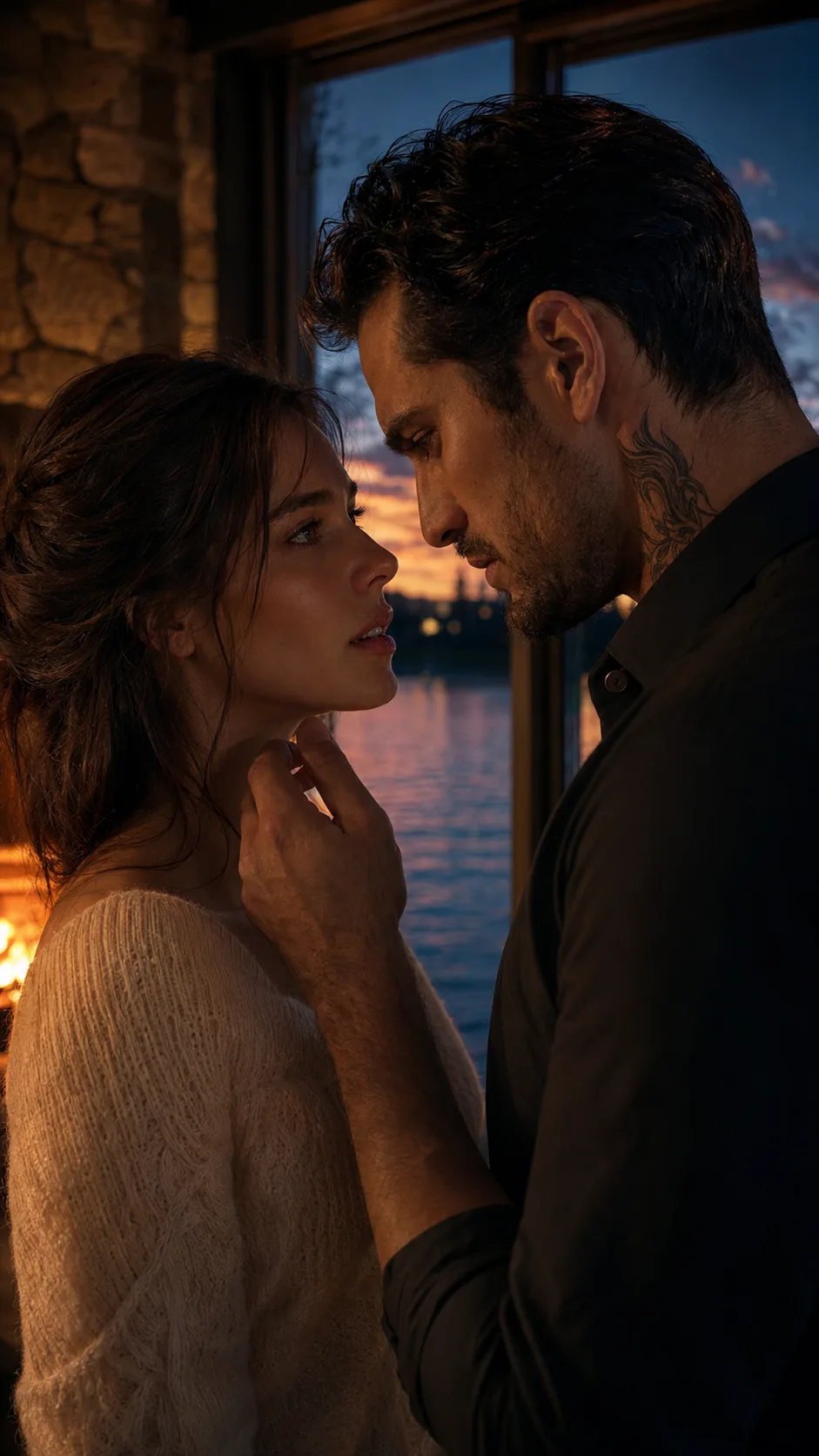
Inside, the house was warm and surprisingly comfortable. Wood-beam ceilings soared overhead. A stone fireplace dominated 1 wall, and leather furniture was arranged to take advantage of the floor-to-ceiling windows overlooking a dark lake. Under different circumstances, it would have been beautiful.
“There are bedrooms upstairs,” Lucas said. “Choose whichever you like. You’ll find clothes in the closets, all sizes. The bathroom is stocked. The kitchen is fully supplied.”
“Another gilded cage.”
I moved to the windows, staring out at my reflection.
Behind me, Lucas stood with his hands in his pockets, blood still staining his shirt.
“I failed her.”
The words came out quietly, almost too soft to hear.
“Valentina. She was investigating something dangerous, and I was too focused on business to notice, too confident that my reputation would protect her. When she died, when I found her in that alley, I swore I’d never fail like that again.”
I turned to face him. His mask had completely dropped, leaving only raw pain visible in his features.
“Every day for 3 years, I’ve lived with the knowledge that I could have saved her if I’d just paid attention. If I’d asked the right questions, noticed her withdrawing, pushed past her deflections. She died alone. She died protecting me from whatever she had discovered, and I let it happen.”
My anger drained away, replaced by something more complicated.
“You couldn’t have known.”
“I should have.”
He moved to the fireplace, bracing his hands against the mantel.
“I knew Pellegrini would see you as a threat. I knew he would act. I thought I had more time. Thought I could control the situation better. I gambled with your life because I’m obsessed with not failing again. And I almost got you killed anyway.”
I crossed the room slowly, standing a few feet away from him.
“You saved my life tonight. Your people were there. If Joseph hadn’t come through that door when he did—”
“If I hadn’t put you in that position at all, you wouldn’t have needed saving.”
“Val was investigating Pellegrini before she ever met you. This started long before you were in the picture. You didn’t fail her, Lucas. The system failed her. The people who should have protected those children failed them. Pellegrini and everyone who enabled him failed. You’re just the one who loved her enough to keep fighting after she was gone.”
He looked at me then, really looked, and I saw the depth of his grief laid bare.
“I don’t know how to do this any other way. I don’t know how to stop.”
“Then don’t stop. But stop blaming yourself for things you couldn’t control.”
We stood there in the silence of the lodge, 2 people bound together by a dead woman’s memory and a shared need for justice. Outside, the lake reflected starlight, peaceful and oblivious to the violence we had left behind in the city.
Over the following days, a strange domesticity developed. Lucas worked from the lodge, taking calls in the study, coordinating his various business interests remotely. I discovered horses in the stable behind the house. Three of them, clearly well cared for. No one stopped me when I started visiting them, spending hours brushing their coats, cleaning their stalls, and finding solace in the simple, honest work.
Lucas watched me. Sometimes I would look up from grooming one of the horses and see him standing at the window of his study, his expression unreadable. When I came back inside, he would be on a phone call or reviewing documents, but the coffee waiting for me was always exactly how I liked it.
Conversations happened in fragments.
Over breakfast, I told him about veterinary school, how I worked 3 jobs to afford it even with scholarships, how the first time I successfully performed surgery on a dog hit by a car, I cried for an hour afterward, overwhelmed by the responsibility of holding a life in my hands.
He told me about meeting Valentina at a business dinner, how she had been seated beside him by her father, an associate looking to strengthen ties, how she spent the entire meal asking him questions about the legitimate aspects of his businesses, pointedly ignoring the unspoken understanding of what else he controlled.
“She wasn’t impressed by power,” Lucas said, his fingers tracing patterns on his coffee cup. “She wanted to know what I actually did with it. Whether I used it to help people or just to acquire more power. I’d never been asked that before. Most people either fear me or want something from me. She just wanted to understand me.”
“When did you know you loved her?”
“Three months later. She had started working as a teacher’s aide at an elementary school in the Bronx. It was a rough neighborhood with kids who had difficult lives. She invited me to come see the classroom she had set up with her own money. She had bought books and supplies because the school couldn’t afford them. I watched her with those kids, how gentle she was, how patient. And I knew I’d never let her go.”
“But it was arranged initially?”
“Her father suggested we meet. We both knew what that meant. But what we built was real, Emma. Every day of those 6 years was real.”
The investigation continued around us. Lucas received constant updates from his people. Pellegrini had gone to ground after the failed attack on the clinic. His usual haunts were abandoned. His phones were disconnected, but he could not disappear completely. Not with his business interests and public profile.
On the fourth night, Lucas called me into his study. Documents covered every surface. His laptop showed what looked like banking records.
“My people found something. Valentina’s lawyer, the one she consulted about bringing evidence to the FBI, kept copies of everything she gave him, including this.”
He turned the laptop toward me. I saw scanned documents, official-looking forms with government seals, birth certificates, adoption papers, medical records, all from Santa Agnes Home for Children.
“This is from a safe deposit box,” Lucas explained. “Valentina rented it under a false name 2 months before she died. The lawyer had a key held in escrow to be delivered to law enforcement if anything happened to her, but he never came forward after her death.”
“Why not?”
“He died. A car accident 6 weeks after Valentina. It was officially ruled an accident, but the timing is suspicious.”
Lucas pulled up another file.
“His firm kept the box rental information in their files. It took my people this long to find it and get access to the bank records.”
“What’s in the box?”
“I don’t know yet. But according to the rental agreement, Valentina designated 1 person besides herself who could access it.”
He pulled up a document, and I saw my name.
Emma Collins. Pre-authorized accessor. Biometric data on file as of March 2020.
“That’s a year before she died,” I whispered.
“She registered you a year before, which means she knew she might die. She was planning for that possibility, and she wanted you to be able to access whatever she’d hidden.”
Lucas closed the laptop carefully.
“The bank is in Connecticut, about 2 hours from here. We can go tomorrow if you’re ready.”
I thought about Val, my scared little friend who had grown into a woman brave enough to investigate a human trafficking ring, who kept me secret to protect me but also made sure I could access her evidence if the worst happened. She had never forgotten me. Not really. She had loved me enough to keep me away from the danger she was walking into.
“I’m ready,” I said.
That night, I could not sleep. I stood at the window of the bedroom I had claimed, watching the lake shimmer under moonlight. Tomorrow, I would learn what Val had been hiding, what she deemed important enough to die protecting, and somehow I would have to find the strength to continue what she started.
To be continued… Click “PART 3” to read the final part : PART 3
Chapter complete
You have reached the end of this chapter.
Continue reading
A few more worlds to get lost in after this chapter.




