PART 2 — FIFTEEN DAYS OF BETRAYAL
When the house was finally finished, nearly fifteen years after Louis died, Darien stood in the driveway with me and wrapped both arms around my shoulders.
Chapter 2
PART 2 — FIFTEEN DAYS OF BETRAYAL
When the house was finally finished, nearly fifteen years after Louis died, Darien stood in the driveway with me and wrapped both arms around my shoulders.
He was grown then, tall like his father, smelling faintly of motor oil and peppermint gum.
“This is the safest place in the world, Mom,” he said.
I believed him.
Lenora, already halfway to becoming the kind of attorney who could cut a lie open with one sentence, had believed something else.
“Safe doesn’t mean unprotected,” she told me two weeks after I moved in. “Put everything in order. Deed. insurance. estate documents. Credit. Lock down what you can.”
I laughed then. “Honey, who’s going to come after me? I don’t have anything worth stealing.”
Lenora looked around my new kitchen, the one with the pale tile backsplash I had chosen after saving pictures from magazines for years.
“You have a house,” she said. “And you have a generous heart. That combination attracts people.”
I listened because my daughter had always seen storms before clouds formed.
The house stayed in
my name alone. The deed stayed in a lockbox. My important papers went into a cabinet that only I used. I checked my bank statements. I paid my bills with the kind of attention that comes from having once counted coins for milk.
I did everything right.
And still, fifteen days was enough.
—
Sabine was not the sort of woman who entered a family all at once.
She arrived polished.
That was how I thought of her at first. Polished nails, polished manners, polished smile. She worked front desk at a private dental office in Biltmore Village when Darien met her, wore gold hoops and soft sweaters, knew how to say “How thoughtful” in a way that made you want to be more thoughtful next time.
Darien had always liked beautiful things he could not afford.
Cars. Watches. New phones. Weekend trips paid for with credit cards he called
“points” as if the balance were not real money. I had warned him gently for years, then sharply, then not at all because mothers eventually learn that warnings spoken too often become wallpaper.
When he married Sabine, he looked proud in a way that made me tender toward him. She looked at my house during their first Sunday dinner with wide eyes and said, “Coralie, this place has such potential.”
I should have asked what she meant.
Instead, I said thank you.
Three years later, when Darien told me their apartment lease was ending and they needed “a few months” to get back on their feet, I said yes before he finished asking.
Lenora, on speakerphone from Charlotte, went quiet.
“Mom,” she said later, after Darien left. “A few months needs to mean a few months.”
“It’s my son.”
“I know who he is.”
“He’s struggling.”
“I know what he’s
doing.”
There was a difference, she meant.
I did not want to hear it.
Darien and Sabine moved into the guest room upstairs with too many boxes and not enough humility. At first, they were grateful in the way people are grateful when they still feel watched. Sabine brought flowers. Darien fixed the loose porch rail. They paid a little toward groceries when they remembered. Then months passed, and gratitude thinned into assumption.
Sabine began leaving her skin-care bottles in my bathroom because “the light is better in there.”
Darien parked in the driveway spot closest to the porch because “it just makes sense.”
They hosted friends on my deck without asking, ordered takeout and left the containers near the sink, turned the thermostat down like they had never seen a power bill with their own name on it.
Small things.
That is how people test a door.
They push softly first.
I told myself not to be petty. I told myself the house was big enough. I told myself widows get particular, and mothers should not keep score.
Then Martha called from Hendersonville and asked me to come stay with her after minor surgery. She had no children nearby, no husband left, and more pride than was good for her. I packed a small bag, gave Darien the emergency numbers, reminded him where the breaker box was, and told Sabine the downstairs freezer had soup if they needed it.
Sabine hugged me at the door.
“Don’t worry about a thing,” she said. “We’ll take good care of the house.”
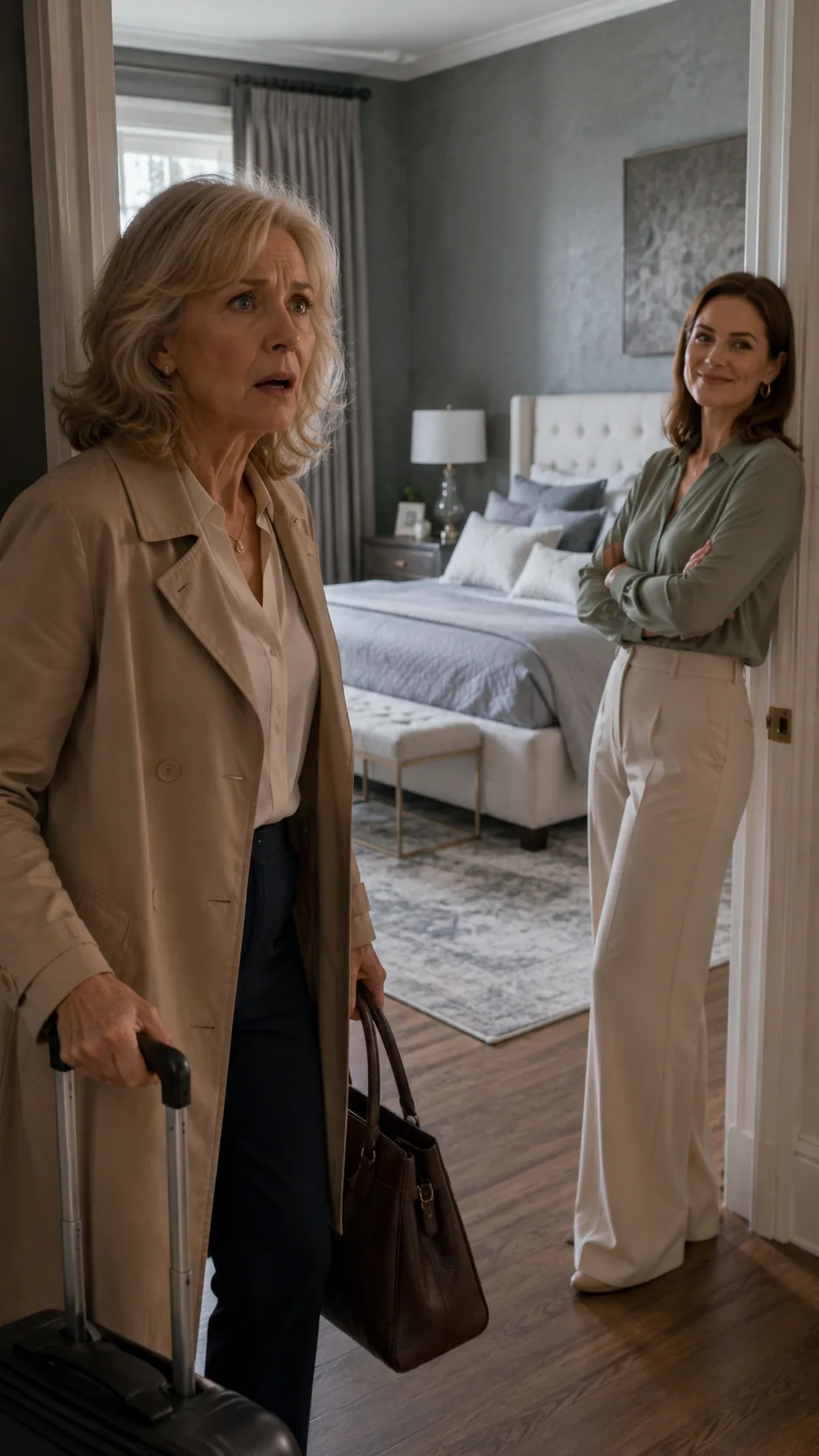
Fifteen days later, I came home to gray walls.
—
“Coralie,” Sabine said after my words landed, “let’s not be dramatic.”
I turned my head toward her slowly.
That was another thing I had learned: when someone does something outrageous, they will often call your response dramatic so they can pretend the crime is your tone.
“You moved my bedroom into the garage,” I said.
“We didn’t move your bedroom,” she replied. “We reorganized. The smaller room downstairs will be easier for you anyway. Less stairs.”
“My knees work fine.”
“For now,” she said.
Darien flinched.
I saw it. So did she.
Her mouth tightened because she had shown too much.
“For now,” I repeated.
She lifted her chin. “I only meant—”
“I know what you meant.”
“Mom,” Darien said again, softer this time. “We wanted to surprise you.”
“Surprise me?”
He rubbed the back of his neck. “Fresh paint. New layout. You always said the downstairs room was cozy.”
“I said it was cozy for guests.”
Sabine let out a small laugh. “It’s still your house. No one said it wasn’t.”
“No,” I said. “You only tried to teach my walls to say it for you.”
For a second, neither of them answered.
The room smelled of paint, new fabric, and Sabine’s perfume, something sharp and sugary that sat in the air like a lie refusing to dissolve. My walnut bed was gone, but I could still see where it had been. Furniture leaves ghosts. So do marriages. So does motherhood.
“Where are my things?” I asked.
Darien looked at Sabine.
That tiny movement told me more than an argument would have.
“In the garage,” she said. “Everything is safe.”
Safe.
I walked past them.
Neither followed at first.
Down the stairs, through the kitchen, across the mudroom. The door to the garage stuck the way it always did when the weather got damp. I shoved it open with my shoulder and stopped just inside.
My life was stacked like an estate sale nobody had bothered pricing.
The walnut headboard leaned against the concrete wall, one corner wrapped in a towel that had slipped halfway off. The side rails lay on the floor beside a box of Christmas ornaments. My mother’s vanity sat under a dusty sheet near the lawn mower. Plastic bins were lined against the shelves, black marker scrawled across the sides.
LINENS.
PHOTOS.
MOM’S OLD STUFF.
Mom’s old stuff.
Not Coralie’s.
Not fragile.
Not keep safe.
Old stuff.
I opened the bin marked PHOTOS.
My wedding frame lay on top, glass cracked across Louis’s face.
That was the moment I nearly broke.
Not when I saw the bed gone. Not when Sabine smiled. Not even when Darien stood behind her like a weak shadow.
It was that crack through Louis’s smile.
I lifted the frame with both hands. Under it lay loose photographs, my winter shawl, my mother’s silver-backed brush, Lenora’s old graduation program, and the blue quilt folded wrong, pressed under the weight of things that should never have touched it.
Sabine’s heels clicked behind me.
“We didn’t throw anything away,” she said.
I stared at the cracked glass.
Darien came in after her, slower. “Mom, it’s just a room. We can make the downstairs one nice for you.”
I looked at him then.
He had his father’s mouth. That used to comfort me.
“This is not about a room,” I said.
He swallowed.
“It’s about respect. It’s about permission. It’s about whether you still understand I am a person before I am your mother.”
Sabine folded her arms again. “Nobody is disrespecting you.”
“You moved my dead husband’s photograph into a garage.”
Her face flickered, not with guilt.
I think it was annoyance.
“In two days,” I said, “everything goes back exactly where it was.”
Sabine’s eyes cooled.
She did not shout. She did not deny me. She only tilted her head with the patience of someone waiting for weather to pass.
That frightened me more than anger.
Because anger means a person still thinks they might lose.
Sabine looked like she had already won.
—
That night, I slept in the downstairs guest room because I was too tired to drag my bed out of the garage by myself and too proud to ask the people who had put it there.
Sleep is the wrong word.
I lay under a thin blanket in a bed meant for company, staring at the ceiling while Sabine’s footsteps moved above me in the room that had held my married life, my widowhood, my private tears, my Sunday naps, my mornings with the curtains open and the Blue Ridge light touching the floor.
Every step she took seemed deliberate.
A drawer opened. Closed.
Water ran in my bathroom.
Something heavy moved across the floor.
Darien murmured once, too low for words. Sabine laughed.
I turned my face toward the wall.
The first wave was anger. Hot, clean, almost useful.
The second was humiliation.
Not because of the room. Because I had let it become possible.
I had mistaken access for closeness. I had mistaken my son’s need for my duty. I had mistaken Sabine’s politeness for character.
Sometime after midnight, when the house finally quieted, my mind began doing what it had done all my life when feelings became too large to hold.
It counted.
The bed upstairs. At least sixteen hundred dollars, maybe more.
The curtains. Custom or pretending to be.
The lamps. The rug. The paint. The glass desk. The contractor’s work because Darien could not paint a straight line without getting it on the ceiling.
Thousands.
And Darien did not have thousands.
That number sat up in the dark beside me.
Fifteen days was enough time to repaint a room.
It was not enough time to suddenly become responsible.
By dawn, I no longer thought I was looking at a stolen bedroom.
I was looking at evidence.
—
At breakfast, I came into the kitchen wearing the same clothes I had worn the day before.
Sabine stood at the counter stirring almond milk into her coffee. She had already dressed in cream slacks and a soft green blouse, her hair blown smooth, her nails pale pink around the mug she liked to use but had never bought.
Darien sat at the table scrolling his phone, though his thumb was not moving.
“Morning,” Sabine said brightly.
I poured coffee.
No one mentioned the room.
That told me they had been awake discussing me.
Darien’s phone rang at 8:12. He looked at the screen and stepped onto the back porch. Through the kitchen window, I watched his shoulders hunch while he listened. He said almost nothing. When he came back in, his face looked thinner.
At 8:36, it rang again.
This time Sabine’s eyes snapped to him before he even stood.
“Take it outside,” she said.
Not asked.
Said.
I sipped my coffee and watched my son obey his wife in my kitchen.
After he left for work, Sabine moved around the house as if she had decided cheerfulness could bulldoze the truth. She opened blinds. She wiped counters. She hummed softly while pretending not to watch me.
I brought in the mail around ten.
Most of it was ordinary: grocery flyer, church newsletter, a water bill, two envelopes for Darien. Then I saw a delivery slip folded under the fruit bowl. The name of a furniture company was printed across the top in tasteful navy letters.
I slid it free.
Sabine turned sharply.
“Oh, that’s mine.”
“It was under my fruit bowl.”
“I must have set it there.”
The total was not visible, but the delivery date was.
Four days earlier.
During the fifteen days.
There it was again.
The same number wearing a different coat.
When she reached for the slip, I let her take it. I had already seen enough to sharpen my suspicion, not enough to prove it.
Later, near the microwave, I noticed a second paper turned facedown. Sabine had left the room to answer a text. I lifted one corner.
Contractor estimate.
Paint, lighting, fixture installation.
Balance due.
Before I could read the amount, Sabine’s voice came from behind me.
“Looking for something?”
I put the paper down.
“Yes.”
She smiled. “And did you find it?”
“Not yet.”
Her smile held, but only because she forced it to.
That afternoon, I found the bank envelope.
It was tucked beside a stack of coupons on the little desk in the mudroom, the place where I kept stamps, return labels, and grocery receipts. My name was printed clearly on the front.
Coralie M. Whitaker.
The flap had already been opened.
Not torn by accident. Opened.
Cleanly.
My fingers went cold before the rest of me understood why.
Darien came in through the back door just as I picked it up.
His face changed.
Not much.
Enough.
“Why is this opened?” I asked.
He set his keys on the counter too carefully. “Probably by mistake.”
“By whose mistake?”
“Mail’s been getting mixed up.”
“My mail has been coming to this house for twenty years.”
Sabine appeared behind him like she had been summoned by guilt itself.
“What’s wrong?” she asked.
I held up the envelope.
She barely glanced at it. Too fast.
“People open mail by accident, Coralie.”
“People also apologize by accident sometimes. I haven’t heard one.”
Darien exhaled. “Mom, can we not make everything into a fight?”
“Where did the money come from?”
Silence.
Sabine blinked once. Darien looked at the floor.
“What money?” he said.
“The furniture. The paint. The contractor. The room you stole and dressed up with things neither of you could afford last month.”
“Our savings,” Darien said.
It was a child’s lie in a man’s mouth.
I knew his lies. I had heard them when he was ten and said the broken lamp “fell by itself.” I had heard them when he was seventeen and claimed the dent in my old Honda had “always been there.” I had heard them when he was thirty-two and told me the credit card bill on my counter was “handled.”
This one sounded the same.
Sabine gave a small shrug. “Investing in a house is normal. People improve property all the time.”
“People improve property they own.”
Her eyes hardened.
There she was.
Not polished. Not pleasant.
Bare.
I set the opened envelope on the counter.
“Two days,” I said again. “My room goes back.”
Darien opened his mouth.
I raised one hand.
“And until then, I suggest both of you remember whose name is on the deed.”
Sabine’s face did not move, but Darien’s did.
He looked afraid.
That should have satisfied me.
Instead, it told me I was late.
Click the blue “PART 3” below to read the next part:
Chapter complete
You have reached the end of this chapter.
Continue reading
A few more worlds to get lost in after this chapter.




