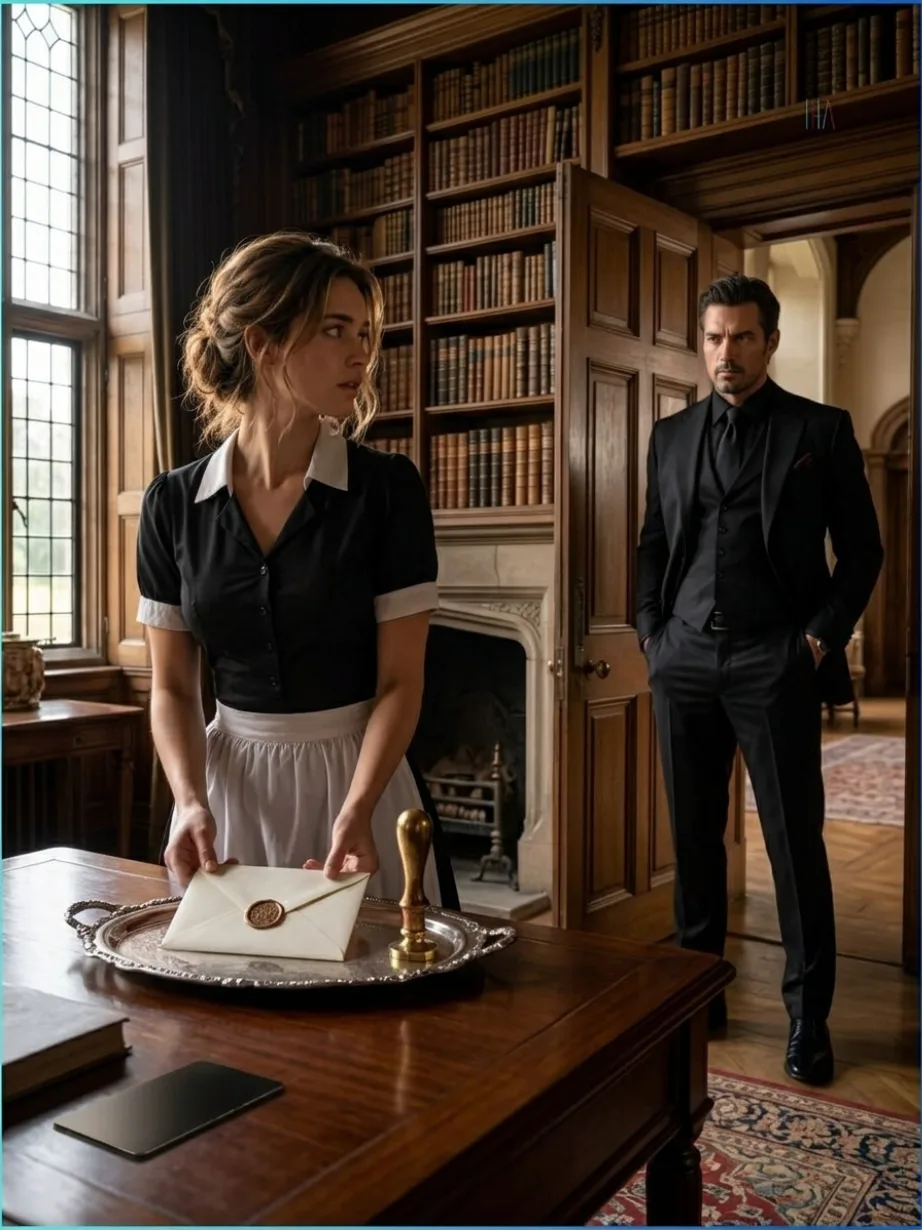
She asked a mafia boss for one day off, and by sunrise his black card was sitting on her kitchen counter
Gabriel’s gaze did not move.
Chapter 1
Gabriel’s gaze did not move.
“No,” he said. “About her.”
The next morning, Khloe woke to someone knocking on her apartment door.
Not the angry pounding of her landlord.
Not the frantic tapping of her neighbor Mrs. Alvarez, who always needed help carrying groceries.
Three measured knocks.
Khloe opened one eye and stared at the cracked ceiling. Her alarm clock said 6:07 a.m. Her whole body hurt. She had gotten home at 2:18, eaten peanut butter from the jar, and fallen asleep with one foot still in a shoe.
The knocks came again.
She dragged herself out of bed, wrapped a fleece robe around her body, and shuffled to the door.
A man in a black suit stood in the hallway.
That was never good in Brooklyn before sunrise.
“Khloe Higgins?” he asked.
“Depends who’s asking.”
He held out a matte black box. “Delivery.”
“I didn’t order anything.”
“I was instructed to place this directly
in your hands.”
Khloe stared at him. “By who?”
The man’s expression did not change. “Please sign.”
She almost shut the door.
Then she saw the small embossed initials on the corner of the box.
G.R.
Against every instinct she had, Khloe signed.
The man walked away without another word.
Khloe carried the box to her tiny kitchen table, the one with one short leg and a stack of unpaid bills under the saltshaker. Her heart started beating too hard.
Inside the box was an envelope and a card.
The card was black, heavy, and cold.
Her name was embossed across the bottom.
Khloe Higgins.
For ten full seconds, she could not breathe.
She had seen cards like this before at The Obsidian Room. She had seen billionaires place them on trays as if dropping keys to a kingdom. She knew what it meant even before she read the note.
The envelope contained one sheet of thick cream stationery.
Take the day off.
Eviction is no longer on the menu.
G.R.
Khloe dropped the note.
“No,” she whispered. “Absolutely not.”
The card sat on her table like a loaded gun.
Part 2
Khloe told herself she would not use it.
She made coffee. She stared at the card.
She showered. She stared at the card.
She put on her waitress uniform, then stood in the mirror looking at the blouse Clare said made her look “boxy,” and felt something inside her finally split open.
She was so tired of surviving.
Her mother’s hospital bill was on the table. Fourteen thousand six hundred eighty dollars and thirty-two cents. A number that had followed Khloe through grief, through double shifts, through birthdays she couldn’t afford to celebrate, through Christmas mornings when she pretended she didn’t want anything.
She opened her laptop.
“Just
to see if it works,” she said to the empty apartment. “That’s all.”
Her hands shook as she typed the numbers into the payment portal.
Name on card.
Khloe Higgins.
Payment amount.
14,680.32.
She closed her eyes and clicked submit.
The page loaded.
Then refreshed.
Payment approved.
Balance zero.
Khloe made a sound she had never heard come out of her own body. Half sob, half laugh, half something breaking loose from her chest after years of being chained there.
She covered her mouth.
Her mother’s debt was gone.
Not reduced.
Not postponed.
Gone.
For one wild second, Khloe wanted to run into the hallway and tell Mrs. Alvarez, tell the mailman, tell every creditor who had ever called during dinner that they had lost.
Then fear rushed back in.
Gabriel Rossi had paid her mother’s bill.
Gabriel Rossi had her address.
Gabriel Rossi had put her name on a card that could open every door in the city and probably bury her behind one.
But fear had to compete with something new.
Relief.
Khloe called The Obsidian Room.
Clare answered on the second ring. “You’re late.”
“I’m not coming in.”
Silence.
“What did you say?”
“I said I’m taking a day off.”
“You are scheduled for lunch and dinner.”
“Then the restaurant will discover the miracle of cross-training.”
Clare’s voice went thin. “Khloe, if you do not come in today, do not come in tomorrow.”
Khloe looked at the black card on her kitchen table.
For the first time in her adult life, losing a job did not feel like falling off a cliff.
“Okay,” she said.
Clare sputtered. “Okay?”
“Okay.”
Khloe hung up.
Then she did something reckless.
She put on her best burgundy wrap dress, the one that hugged her waist and made her feel like a woman instead of a tired machine. She brushed her hair until it fell in loose waves over her shoulders. She wore red lipstick. Not restaurant red. Not respectable red.
Survival red.
She took a cab to Fifth Avenue.
At the first boutique, two saleswomen looked at her like she had wandered in to ask directions to a bus stop.
“Can I help you?” one asked with a smile sharpened at the edges.
“I need shoes,” Khloe said.
The woman’s gaze dropped to Khloe’s body, then to her worn flats. “Our wider sizes are limited.”
Khloe felt the old shame rise automatically, familiar as a bruise.
Then she heard Gabriel’s voice from the night before.
You aren’t shaking.
She lifted her chin. “I didn’t ask what was limited. I asked for shoes.”
The other saleswoman stiffened.
Khloe pointed toward a display of handmade leather loafers. “Those. Custom fitted. Black and chestnut. And I want something supportive I can wear today.”
The first woman laughed politely. “Those start at three thousand a pair.”
Khloe opened her purse and placed the black card on the glass counter.
The sound it made was small.
The reaction was not.
Both women stared.
Then the manager appeared so quickly Khloe wondered if there was an alarm button under the register for women who turned out to be rich.
“Ms. Higgins,” he said warmly, though she had not given him her name. “Please, sit. Champagne? Coffee? Sparkling water?”
Khloe smiled.
“Coffee,” she said. “And bring the shoes.”
For two hours, people who would have ignored her the day before knelt at her feet.
They measured her arches. They brought soft leather. They complimented her dress. They used her name like it was made of gold.
Khloe hated how good it felt.
She hated how quickly respect arrived when wealth walked in first.
When she stepped back onto the sidewalk, her feet were wrapped in temporary custom inserts, her old shoes in a bag, and her body buzzing with a dangerous mixture of joy and guilt.
The rain had stopped. Sunlight flashed off wet pavement. New York looked freshly washed and completely unforgiving.
Khloe was reaching for a cab when a black Mercedes G-Wagon slid to the curb.
The doors opened.
Two men got out.
Not Gabriel’s men. These men were rougher, heavier, dressed in dark leather instead of tailored wool. One grabbed her arm hard enough to bruise.
“Hey!” Khloe shouted. “Get your hands off me!”
The second man took her shopping bags.
A third man stepped out of the back seat.
He was older, silver-haired, with pale eyes and a scar cutting through one eyebrow. He smiled at her as if he had just found a prize inside a cereal box.
“Miss Higgins,” he said with a thick Russian accent. “Victor Orlov sends his regards.”
“I don’t know a Victor Orlov.”
“No,” he said. “But you know Gabriel Rossi.”
Khloe’s blood went cold.
The man leaned closer. “And now he knows you.”
She fought. She kicked. She bit one of them hard enough to taste blood.
It didn’t matter.
They shoved her into the SUV between two bodies built like brick walls. Plastic ties cut into her wrists. The city blurred past the tinted windows. Khloe forced herself to breathe through her nose, to notice turns, to count bridges, to stay alive.
She had grown up in Brooklyn. She knew the shape of danger. But this was not a drunk man in a bar or a landlord threatening court.
This was organized.
This was planned.
This was because of the card.
The SUV stopped near the Navy Yard, in a warehouse district where old brick buildings squatted under the gray sky and the air smelled like salt, rust, and diesel.
They dragged her inside a meat-packing warehouse so cold her breath smoked.
A single chair waited beneath a harsh work light.
Victor Orlov stood beside it, peeling an apple with a knife.
Khloe looked at the chair. “That’s a little dramatic.”
Victor smiled. “Sit.”
“I’ve been on my feet for nine years. Honestly, I was going to.”
One of his men shoved her down and tied her ankles to the chair legs.
Victor studied her, amused. “You are not what I expected.”
“Tall? Blonde? Quiet?”
“Worth a war.”
Khloe swallowed.
Victor took a bite of apple. “Gabriel Rossi has no wife. No children. No visible weaknesses. He moves money through ghosts and lawyers. Then this morning, a private account connected to his personal holdings pays a hospital bill for a waitress in Brooklyn.”
Khloe closed her eyes for one second.
Of course.
One swipe of the card and she had lit up like a flare.
Victor stepped closer. “Who are you to him?”
“Nobody.”
He tilted his head. “Try again.”
“I’m the woman who told him club soda wouldn’t save his pants.”
One of the men laughed.
Victor did not.
“You expect me to believe Gabriel Rossi gave you a black card because you insulted him?”
“Yes,” Khloe said. “Which says a lot about his social life.”
The slap came fast.
Her head snapped sideways. Pain burst through her cheek. For a moment, the warehouse blurred white.
Khloe tasted blood.
Victor sighed. “You will learn not to make jokes.”
Khloe slowly turned back to him.
“No,” she said, voice shaking but clear. “You kidnapped a civilian over a dry-cleaning dispute. I’m going to make jokes because otherwise I’ll have to admit you’re even stupider than you look.”
Victor’s smile vanished.
He pulled out a phone, dialed, and set it on speaker.
It rang twice.
Then Gabriel Rossi’s voice filled the warehouse.
“Orlov.”
No greeting. No surprise.
Just ice.
Victor’s eyes glittered. “You track your property quickly.”
Gabriel was silent for one beat. “The card or the woman?”
Victor laughed. “So she is not nobody.”
Khloe felt her stomach drop.
Gabriel’s voice lowered. “Is she hurt?”
Victor glanced at her bruised cheek. “She talks too much.”
“Is she hurt?”
There was something in the second question that made even Victor’s men shift.
Victor smiled into the phone. “A little. For emphasis.”
Khloe heard nothing on the line.
No shouting.
No threats.
Only silence.
Then Gabriel said, “Put her on.”
Victor held the phone near Khloe’s face. “Speak.”
Khloe stared at it. Her heart was hammering hard enough to hurt.
“Mr. Rossi,” she said.
“Khloe.”
Her name in his voice did something strange to the room. It made the cold sharper. It made her fear both worse and easier to bear.
“Are you bleeding?” he asked.
“A little,” she said. “Mostly I’m annoyed. You really should include a warning brochure with illegal gifts.”
A pause.
Then a low sound that might have been a laugh if it belonged to anyone else.
“You used the card,” he said.
“I paid my mother’s hospital bill.”
“I know.”
The softness in those two words nearly undid her.
Victor’s expression hardened. “Enough. I want Newark. The routes, the warehouses, the names. Sign them over or I will send your waitress back in pieces.”
Khloe’s skin went cold.
Gabriel spoke, still calm. “Khloe.”
“Yes?”
“Close your eyes.”
Victor frowned. “What does that mean?”
Gabriel said, “It means you touched what was under my protection.”
The line went dead.
Victor grabbed the phone. “Rossi?”
The warehouse lights cut out.
The world exploded.
Khloe squeezed her eyes shut.
Metal screamed. Men shouted in Russian. Glass shattered. Boots thundered across concrete. There were sharp cracks, the roar of men colliding, the hiss of commands in voices too controlled to be afraid.
Khloe kept her eyes closed.
She thought of her mother.
She thought of Toby’s shaking hands.
She thought, absurdly, of the three-thousand-dollar shoes now scuffed with warehouse dirt.
Then a hand touched her shoulder.
Khloe flinched so hard the chair scraped the floor.
“Easy,” Gabriel said.
Her eyes flew open.
He was crouched in front of her, wearing a black coat over a white shirt, his hair slightly disordered, his face terrifyingly calm. Behind him, the warehouse had transformed into chaos, but none of it seemed to touch him.
He cut the ties at her wrists, then her ankles.
As soon as she was free, her body betrayed her. The strength drained out of her all at once, leaving her shaking so violently her teeth clicked.
Gabriel caught her before she fell.
His arms went around her with startling gentleness.
“I’ve got you,” he murmured.
Khloe wanted to shove him away. She wanted to scream that this was his fault. She wanted to demand why he had dropped a black card into her life like a match into gasoline.
Instead, she gripped his shirt and shook.
Gabriel removed his overcoat and wrapped it around her shoulders. It smelled like sandalwood, rain, and smoke.
“I can walk,” she whispered.
“No,” he said. “You can survive. Walking can wait.”
“My shoes were expensive.”
“I’ll buy the company.”
Despite everything, a broken laugh slipped out of her.
He lifted her easily.
Khloe stiffened. “I’m too heavy.”
Gabriel looked down at her with an expression so fierce she forgot how to breathe.
“Never say that to me again.”
Her throat tightened.
“I mean it,” he said. “You are not too much. Not for a chair. Not for a room. Not for me.”
Khloe turned her face into his coat before he could see what those words did to her.
Outside, rain began again.
Gabriel carried her into a waiting black SUV, and this time, no one touched her without permission.
Part 3
Gabriel Rossi’s penthouse looked like a museum designed by a man who did not sleep.
It sat high above Manhattan behind walls of glass, all black marble, steel, and silence. The city glittered below like a field of diamonds spilled across velvet. Khloe sat on a low cream sofa with Gabriel’s coat still around her shoulders and a glass of water untouched in her hands.
Dante stood near the elevator, face unreadable.
Gabriel stood by the window, speaking quietly into a phone.
“No hospitals,” Khloe said.
He turned.
“I’m not going to a hospital unless something is broken,” she continued. “And before you argue, remember I’m already angry at you.”
Gabriel ended the call without saying goodbye.
“Your cheek needs ice,” he said.
“My cheek needs an explanation.”
He walked to the bar, wrapped ice in a towel, and came back. When he reached for her face, she caught his wrist.
His eyes dropped to her fingers around him.
“You sent me a card with my name on it,” Khloe said. “You paid my debts. You put me on the radar of men who think kidnapping is a business strategy. So before you touch me like you’re allowed, explain.”
For the first time since she had met him, Gabriel Rossi looked almost uncertain.
Then he sat across from her.
“You’re right,” he said.
Khloe blinked. “That was faster than expected.”
“I wanted to give you relief,” Gabriel said. “Not danger.”
“You don’t get to separate those when you’re you.”
His jaw tightened because he knew she was right.
Khloe leaned forward. “Why me?”
Gabriel studied his hands for a moment. They were strong, beautiful, and probably responsible for decisions she didn’t want to imagine.
“Because last night,” he said slowly, “you were the only honest person in the room.”
Khloe laughed once. “That’s it?”
“No.” His gaze lifted. “You stood in front of a frightened boy even though you had every reason to keep walking. You looked at me like I was a problem, not a prize. Everyone performs around me, Khloe. Fear is a performance. Flattery is a performance. Loyalty is often the most expensive performance of all.”
His voice softened.
“But you were tired. Angry. Real. You took up space in a room that wanted you small.”
Khloe looked away.
Gabriel continued, “I wanted to see what would happen if, for one day, the world was forced to treat you the way it treats people with power.”
“And?”
“And you paid your mother’s bill before buying anything for yourself.”
Khloe’s eyes burned. “Don’t make that sound noble. I was desperate.”
“Desperation reveals people.”
“So does money,” she said. “And violence.”
Gabriel accepted that without defense.
The room settled into a heavy silence.
Finally, Khloe pressed the ice to her cheek herself. “I can’t be bought.”
“I know.”
“I’m not your property.”
“I know.”
“I don’t belong in your world.”
Gabriel leaned forward, elbows on his knees, eyes dark and steady.
“Then change it.”
Khloe stared at him. “Excuse me?”
“You heard me.”
“Mr. Rossi, I am a waitress with a bruised face, no job, and a black card that apparently comes with kidnappers.”
“You are also the first person in years who has told me the truth without asking what it was worth.”
Khloe shook her head. “That sounds romantic until someone gets killed over appetizers.”
A shadow crossed his face.
“I didn’t build the world I was born into,” Gabriel said. “But I have maintained it. Expanded it. Benefited from it. That is on me.”
Khloe had expected arrogance. Excuses. A speech about enemies and honor and all the things dangerous men said to make blood sound like business.
She did not expect accountability.
“What do you want from me?” she asked.
Gabriel’s answer came quietly.
“A reason to become something else.”
Khloe’s breath caught.
He reached into his jacket and pulled out the black card. She hadn’t realized Dante had recovered it. Gabriel placed it on the coffee table between them.
“This is yours,” he said. “Use it or don’t. Cut it in half. Throw it in the Hudson. But no more surprises. No more decisions made over your head.”
Khloe stared at the card.
Then she picked it up.
Gabriel watched her carefully.
Khloe turned it between her fingers, feeling its weight.
“You said anything I want?”
“Yes.”
“Fine,” she said. “I want Toby protected. The busboy. Clare will blame him for the wine, and he can’t afford to lose that job.”
“Done.”
“I want my landlord paid, but only what I owe. No threats. No mysterious men in hallways.”
“Done.”
“I want my mother’s hospital bill treated as a loan until I figure out whether I can live with it.”
Gabriel’s mouth curved faintly. “You negotiate like a union lawyer.”
“I waitress in Manhattan. Same skill set.”
His smile almost became real.
Khloe stood, still wrapped in his coat. Her knees trembled, but she stayed upright.
“And I want one actual day off,” she said. “No kidnappings. No black SUVs. No crime-family conference calls. Just one day where nobody needs me to carry anything.”
Gabriel rose.
“You’ll have it.”
Khloe looked out at the city, then back at him. “And after that?”
“After that,” he said, “you decide.”
The next morning, Khloe woke in Gabriel Rossi’s guest room under sheets softer than anything she had ever touched.
For a few seconds, she forgot where she was.
Then the previous day returned.
The card.
The shoes.
The warehouse.
Gabriel’s arms around her.
She sat up fast.
On the nightstand was a glass of water, two pain relievers, and a handwritten note.
No one will disturb you.
Breakfast is available whenever you want it.
Your phone is charging.
Toby is safe.
G.R.
Khloe read the note three times.
Then she slept until noon.
When she finally emerged, wearing borrowed sweatpants and one of Gabriel’s oversized sweaters, she found him in the kitchen making coffee.
Not ordering it.
Making it.
The sight was so absurd she stopped walking.
Gabriel glanced up. “What?”
“You look like a Bond villain trying to understand a Keurig.”
“It’s a very aggressive machine.”
Khloe laughed, and this time it didn’t break halfway through.
They spent the day doing nothing dramatic.
Gabriel ordered breakfast from a diner in Queens because Khloe said she didn’t trust eggs that came with foam. She ate pancakes barefoot at his marble counter. He asked about her mother. She told him about Denise Higgins, who had worked as a school secretary, kept emergency snacks in her purse, and believed every person deserved a second plate if they were still hungry.
Gabriel listened like her mother’s life mattered.
In the afternoon, Khloe called Toby.
He cried when he answered.
“Miss Higgins, I’m so sorry. Clare said you were fired because of me.”
“Clare says a lot of things,” Khloe said. “Listen to me. Are you okay?”
“Some man named Dante came to my house.”
Khloe looked across the room. Dante stood by the window, pretending not to listen.
Toby continued, “He told my mom my job was secure and gave her an envelope for my college applications. Is he, like, your uncle?”
Khloe stared at Dante.
Dante shrugged.
“Yes,” Khloe said slowly. “Very emotionally distant uncle.”
Gabriel’s mouth twitched.
By sunset, Khloe felt almost human.
Then Clare called.
Khloe almost didn’t answer.
Gabriel watched from across the room. “You don’t have to.”
Khloe looked at the screen, at the name of the woman who had spent years making her feel lucky to be tolerated.
“No,” Khloe said. “I do.”
She answered. “Clare.”
There was a pause.
“Khloe,” Clare said, her voice strangely tight. “We need you to come in tonight.”
Khloe blinked. “I thought I was fired.”
“We’re short.”
“You’re always short. You treat people like napkins and act surprised when they stop folding.”
Clare inhaled sharply. “Do you know who called the owner this morning?”
Khloe looked at Gabriel.
He lifted both hands, innocent in a way no jury would believe.
“No,” Khloe said.
“Mr. Rossi’s office,” Clare whispered. “The owner is coming in. There are questions about staff conditions.”
Khloe slowly smiled. “Are there?”
“Khloe, please. Let’s not make this ugly.”
“It already was ugly,” Khloe said. “You just didn’t care until someone important noticed.”
Clare said nothing.
Khloe’s voice softened, but only slightly. “Toby keeps his job. Every server gets proper meal breaks. No more comments about bodies, accents, ages, or shoes. And you apologize to the staff in writing.”
“You can’t demand that.”
Khloe looked at the black card lying on the counter.
Then she looked at Gabriel, who was watching her like she had hung the moon over Manhattan with both hands.
“I’m not demanding,” Khloe said. “I’m informing.”
She hung up.
That night, Khloe returned to The Obsidian Room.
Not in uniform.
She wore a navy dress Gabriel’s assistant had arranged but Khloe had chosen herself. It fit her like confidence. Her hair fell loose over her shoulders. Her cheek was covered with makeup, but if someone looked closely, they could still see the bruise.
Let them look.
The restaurant stopped when she entered.
Toby nearly dropped a tray again.
“Don’t you dare,” Khloe warned.
He grinned through tears.
Clare stood near the host stand, pale and rigid. The owner, Richard Bellamy, hovered behind her with the frantic energy of a man who had just discovered labor laws.
Gabriel walked in behind Khloe.
Every whisper died.
He did not touch her. He did not claim her. He simply stood at her side, close enough that the entire room understood she was not alone and far enough that Khloe understood he remembered her rules.
Richard rushed forward. “Miss Higgins, Mr. Rossi, we are prepared to discuss—”
Khloe raised a hand.
The gesture stopped him.
That almost made her laugh.
For years she had raised her hand in this restaurant to ask permission for a break. Now the owner stopped breathing because she lifted her fingers.
“I’m not here for revenge,” Khloe said.
Clare flinched like she had expected exactly that.
Khloe looked around the dining room, at the staff lined up in nervous clusters. People she had worked beside for years. People who had cried in bathrooms, skipped meals, taped their ankles, smiled at men who touched them, and apologized for existing in the wrong shape, color, age, or class.
“I’m here because this place teaches people that dignity is a luxury,” Khloe said. “It isn’t.”
No one moved.
“Toby stays. Everyone gets breaks. Everyone gets safe shoes or a footwear stipend. Harassment from guests gets them removed, not rewarded. And no one here ever gets told to take up less space again.”
Her voice cracked slightly on the last sentence.
Gabriel’s eyes shifted to her, but he stayed silent.
Richard nodded too quickly. “Of course. Absolutely.”
Clare’s mouth tightened.
Khloe turned to her. “Say it.”
Clare’s eyes flashed with hatred.
Khloe waited.
The dining room waited.
Finally, Clare swallowed. “I apologize for my comments and management choices. They were inappropriate.”
Khloe tilted her head. “And?”
Clare’s face reddened. “And cruel.”
Khloe nodded once.
“Good.”
She turned to leave.
Gabriel followed.
Outside, the night was cold and clean. The city roared around them, alive and indifferent.
Khloe stopped under the awning.
“That felt good,” she admitted.
“It looked good.”
She glanced at him. “You didn’t say anything.”
“You told me to let you carry it.”
Khloe studied him.
He was still Gabriel Rossi. Still dangerous. Still wrapped in shadows and power. One decent day did not erase what he was.
But she had seen something else in him.
Not softness.
Possibility.
“What happens now?” she asked.
Gabriel looked toward the street where his car waited.
“Orlov’s people are finished in New York,” he said. “The mole who flagged your transaction has been handled legally. Fired, arrested, and very eager to cooperate.”
“Legally?” Khloe asked.
“I’m trying something new.”
She smiled despite herself.
He continued, “My legitimate companies are being separated from everything else. It will take time. It will make enemies. But I have lived long enough as a man people fear.”
Khloe’s heart beat carefully.
“And what do you want to be now?”
Gabriel looked at her.
“A man you don’t have to be afraid of.”
The answer landed between them, heavier than the card, heavier than the city.
Khloe looked away first, because this time she was shaking.
Not from fear.
From the terrifying realization that she believed he meant it.
Six months later, The Obsidian Room closed for renovations and reopened under a new name.
Denise.
Khloe did not own it because Gabriel gave it to her.
She owned half because she demanded a contract, hired a lawyer, reviewed every line, and made Gabriel sit through a three-hour meeting where he learned that romance did not replace paperwork.
The restaurant became famous for three things.
The food, which was excellent.
The staff, who were paid well enough to smile honestly.
And the sign in the service hallway that read: You are allowed to take up space.
Toby became assistant floor manager before his nineteenth birthday. Clare left hospitality entirely and, according to rumor, took a job where no one let her supervise humans. Mrs. Alvarez got a new elevator in her building after Khloe discovered Gabriel owned the property through four companies and one very embarrassed cousin.
As for the black card, Khloe kept it.
Not in her wallet.
Framed behind the bar at Denise, next to a photo of her mother laughing in a yellow sweater.
Under it was a small engraved plaque.
The most expensive day off in New York history.
People asked about it constantly.
Khloe never told the whole story.
She would just smile and say, “A man once asked me what I wanted most. I gave him a joke. He gave me a problem. So I turned it into a restaurant.”
Gabriel came every Friday night.
He always sat at the corner table.
He always ordered coffee after dinner, no foam, because Khloe still did not trust it.
And he always watched her move through the room the same way he had watched her the first night, except now the room belonged to her.
One Friday near closing, Khloe found him standing by the framed black card.
“You regret it?” she asked.
Gabriel turned. “Sending it?”
“Yes.”
He looked at the card, then at the restaurant, then at Toby laughing with a line cook near the kitchen, then at Khloe.
“No,” he said. “It was the first good investment I ever made.”
Khloe rolled her eyes. “Careful. That sounded sentimental.”
“I’ve been accused of worse.”
She stepped closer. “You know, I only asked for one day off.”
Gabriel’s expression softened in that rare way that still made her chest ache.
“I know.”
“You gave me chaos.”
“I gave you a card.”
“You gave me kidnappers, a labor negotiation, and half a restaurant.”
He nodded solemnly. “My courtship needed work.”
Khloe laughed.
Then she reached for his hand.
In the beginning, Gabriel Rossi had terrified entire rooms into silence.
But Khloe Higgins had done something far more dangerous.
She had taught him to listen.
And in a city where everyone wanted to be thinner, richer, harder, colder, and less human, she had built a place where tired people could sit down, eat well, and be treated like they mattered.
All because one exhausted waitress had looked a mafia boss in the eye and asked for the smallest impossible thing.
A day off.
THE END
Chapter complete
You have reached the end of this chapter.
Continue reading
A few more worlds to get lost in after this chapter.




