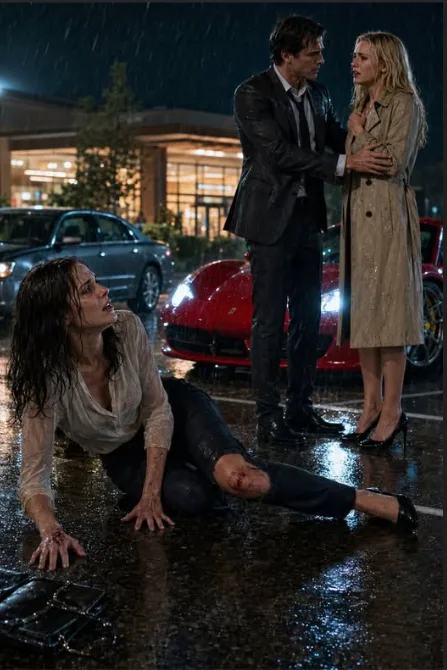
His Ex Ran Me Over—And He Still Chose Her Side
The rain was not just falling.
Chapter 1
His Ex Ran Me Over—And He Still Chose Her Side
The rain was not just falling.
It was attacking, a relentless, icy barrage that turned the world into a gray, shimmering smear. Each drop hit my windshield like a tiny bullet, and the wipers, set to their highest frantic speed, could offer only fleeting moments of clarity.
I gripped the steering wheel, my knuckles white, my focus narrowed to the taillights of the car in front of me. Two blurry red eyes guiding me home.
Home.
The word felt hollow, a shell I was returning to out of habit, not desire.
The argument that morning with Julian had been a quiet, vicious thing. No raised voices, only carefully chosen words designed to wound. He had forgotten our anniversary dinner. Again. But this time, when I brought it up, his sigh had carried profound irritation, as if my need for even a modicum of romance was a childish whim.
“Alera, be reasonable. The Kensington account is a
beast. I’m buried. You know how important this is.”
I did know. I always knew. The Kensington account. The Pembroke merger. The quarterly reviews. They were the mistresses who always came first, their demands more urgent, their presence more captivating than mine. I had become an accessory in my own life, the quiet, supportive wife who kept the home fires burning while he conquered the corporate world.
My knee ached with a dull throb, a phantom pain from an old college skiing injury that always flared up in cold, damp weather. It was a constant, low-level reminder of a time when I was more daring, more myself, before I had folded into the neat, acceptable shape of Julian’s wife.
I was almost at the turnoff for our neighborhood when my phone buzzed on the passenger seat.
A text from Julian lit up the screen.
Running late. Don’t wait up.
The
simplicity of it, the sheer lack of apology or affection, was a final heavy stone added to the scales that had been tipping for months, maybe years. I felt something inside me, a last fragile thread of hope, snap.
Tears blurred my vision, mixing with the rain on the other side of the glass. I blinked them back furiously. I would not cry over him. Not anymore.
That was when I decided to stop for wine. A big, bold, ridiculously expensive cabernet that I would drink by myself in a bubble bath while listening to music he hated. It was a small rebellion, but it was mine.
I signaled and turned into the slick, shiny parking lot of the upscale market, the 1 with the artisanal bread and the cheese counter that smelled like a Parisian cellar. I found a spot not too far from the entrance, killed the engine,
and took a deep, shuddering breath.
The rain hammered a frantic rhythm on the roof. I waited for a break in the downpour, but it showed no sign of relenting. Resigned, I grabbed my purse, opened the door, and stepped out into the deluge. Cold water instantly soaked through my blouse.
I hunched my shoulders, locked the car, and turned toward the glowing lights of the market.
That was when I saw it.
A low-slung, fire-engine-red sports car, a Ferrari, parked a few spaces down.
I knew that car. Everyone in our social circle knew that car.
It belonged to Sloane.
Sloane. The name was a bitter taste in my mouth. Sloane, his new junior partner, the 20-something wunderkind with the laugh that was a little too loud and the hands that lingered on Julian’s arm a little too long at company functions.
She was everything I used to be: ambitious, sharp, unapologetically hungry. And everything I was not anymore: young, unencumbered, new.
I pushed the thought away and focused on the dash to the awning. I was halfway there, my shoes splashing in the growing puddles, when I heard the guttural roar of an engine turning over.
I glanced back.
The Ferrari’s headlights flared to life, 2 blinding white orbs in the gray gloom. It was not just turning on. It was revving, the sound aggressive and out of place in a grocery store parking lot.
A prickle of unease ran down my spine. I picked up my pace, my stupid, traitorous knee protesting with a sharp twinge.
Then the world exploded.
There was no warning, just a sudden, brutal impact from behind. A force like a giant’s fist slammed into my legs, sending a shockwave of pure, undiluted agony up my spine. I was thrown forward, my body a rag doll in the storm.
Time fractured, slowing to a nightmarish crawl. I saw the wet asphalt rushing up to meet me. I felt the scrape of gravel against my palms as I instinctively tried to break my fall. And I heard a sickening, wet crunch that I knew with terrifying certainty came from my own body.
The pain was a living thing, a white-hot fire centered in my right knee, so intense it stole my breath. I lay there, sprawled on the cold, wet ground, gasping like a fish out of water. Rain pelted my face, mixing with the tears of shock and pain that now flowed freely.
The roar of the Ferrari’s engine died abruptly. A car door opened and closed. High heels clicked rapidly on the asphalt, a sound both frantic and precise.
“Oh my God. Oh my God, I am so sorry.”
Sloane’s voice was high, panicked, but underneath it, I detected a thread of something else. Annoyance. Inconvenience.
She appeared above me, her silhouette blocking the rain for a moment. She was perfectly put together even now, in a sleek trench coat, her blond hair barely mussed.
“I didn’t see you. This rain is just insane. Are you okay?”
I tried to speak, but only a pained whimper escaped. My entire universe had shrunk to the agony in my knee. I tried to move my leg, and a fresh wave of nausea washed over me. The world swam in and out of focus.
Then another sound.
A familiar engine.
Julian’s sensible, dark-gray sedan pulled into the parking lot, slowing as it approached us.
Of course.
He was running late.
He was meeting her.
He parked haphazardly and was out of the car in an instant, his face a mask of confusion that quickly morphed into alarm as he took in the scene. Me, crumpled and weeping on the ground. Sloane hovering over me, her hands fluttering uselessly.
“What happened?”
Julian’s voice was sharp, authoritative, the voice he used in boardrooms.
Sloane turned to him, her eyes wide and instantly brimming with manufactured tears.
“Julian, thank God. It was an accident, a terrible, terrible accident. I was backing out, the visibility is zero, and Alera just—she came out of nowhere. I barely tapped her.”
Barely tapped her.
The words echoed in my pain-fogged brain. I had been walking. She had hit me with a car. A tap did not feel like being hit by a freight train.
Julian’s eyes flicked from Sloane’s perfectly distressed face to mine, pale and contorted with pain.
He did not rush to my side. He did not kneel down to check on me. He stood there, a statue of indecision, his gaze lingering on Sloane.
“She’s okay, right?” Sloane pressed, her voice carrying a little-girl tremble. “It was just a scare. I’m so, so sorry, Julian. I feel awful.”
He moved then, but not toward me.
He went to Sloane.
He put a comforting hand on her arm.
“It’s okay, Sloane. Calm down. These things happen.”
These things happen.
The words cut through the pain more effectively than any morphine ever could. They were so casual, so dismissive. His wife was lying in a puddle of cold water and her own pain, and he was comforting the woman who had put her there.
I managed to push myself up onto my elbows, the movement sending fresh jolts of fire through my leg. My dress was torn. My knees and hands were scraped raw and bleeding, already beginning to bruise. But it was my right knee that was the epicenter of the disaster. It was already swelling, an angry, misshapen lump beneath the fabric of my trousers.
“Julian,” I gasped, my voice ragged. “My knee. I think it’s broken. It’s the same one.”
He finally looked at me. Really looked at me.
For a fleeting second, I saw a flicker of concern. Of memory. He knew what that knee meant. He had helped me through physiotherapy. He had listened to my fears of never being able to run again.
He knew.
But then Sloane let out a delicate, shuddering sob, and his attention snapped back to her.
“She’s fine, Alera. You’re just shaken up. It was an accident. Sloane didn’t see you.”
The rain continued to fall, washing my blood into the gutter. But it could not wash away the coldness seeping into my soul, a coldness far deeper and more permanent than the chill of the water.
I stared at him, at my husband of 7 years, as he stood protectively beside the woman who had just run me over, prioritizing her hysterics over my very real, very acute suffering.
I looked down at my knee, at the visible, physical proof of the damage. The old injury, a vulnerability he had once sworn to protect, now shattered by his protégée, and he was taking her side.
In that moment, something inside me broke cleanly and irrevocably. The pain, the betrayal, the years of quiet neglect, it all crystallized into a single, diamond-sharp point of clarity.
I looked up from my injured knee and met his eyes.
My tears had stopped. My face was a mask of rainwater and calm fury. My voice, when it came, was low, flat, and colder than the pavement beneath me.
“We are done here.”
He blinked, confused.
“What? Alera, don’t be dramatic. Let’s get you up, and—”
“You are not worth being my husband.”
The words hung in the air, absolute and final.
For a second, there was silence, broken only by the rain and Sloane’s sharp intake of breath.
Then Julian’s face changed.
The placating mask shattered. His eyes widened, then narrowed, his jaw tightening into a hard line. The carefully controlled, respectable corporate lawyer vanished, and what remained was something raw and feral.
“What did you just say to me?” he snarled, his voice dropping to a dangerous whisper.
He took a step toward me, his composure utterly gone. The man was unraveling before my eyes.
“You ungrateful bitch,” he spat, the words lashing me like a whip. “After everything I’ve given you, this house, this life, and you have the audacity to speak to me like that? To threaten me? Over an accident?”
He was screaming now, his face purpling, spit flying from his lips. Sloane took a step back, her distress now looking genuinely alarmed.
“You are nothing without me,” he roared, jabbing a finger at me. “Nothing. You think you can walk away? You have nowhere to go. You have nothing.”
I did not flinch. I did not look away. I just stared at him, at the crazed, pathetic spectacle he was making of himself in a grocery store parking lot.
The rain soaked him, plastering his expensive haircut to his forehead, but he did not seem to notice. His entire world had become the perceived insult I had dealt him.
His tirade continued, vile and venomous, each word a confirmation that I was right. This man, this stranger screaming at his injured wife, was not the man I had married. He was a hollow shell, and I had just seen the last of whatever good had been inside him evaporate into the stormy air.
He was still screaming, his words becoming less coherent and more unhinged, when the distant wail of a siren cut through the noise.
A store employee must have called an ambulance.
Help was coming.
But as I lay there in the cold rain, listening to the man I had vowed to love forever completely lose his mind, I knew the real help had already arrived. It had arrived in the form of a brutal impact, a betrayal of trust, and the cold, clear voice of my own worth finally speaking up.
The ambulance was coming for my body.
My soul had already begun its rescue.
The world narrowed to a series of disjointed sensations. The frantic, strobing red and blue lights of the ambulance painted the rain-slicked asphalt in garish alternating colors. The paramedics’ voices were low and professional, a calm counterpoint to the frantic, receding echo of Julian’s screams.
He was being held back by a store security guard, his face a contorted mask of fury, his shouts now muffled by the drumming rain and the closing doors of the ambulance.
Sloane was gone. I had seen her slip into her Ferrari and speed away, escaping the consequences just as Julian had allowed her to.
The ambulance interior was a sterile, beige cocoon. The paramedic, a woman with kind eyes and competent hands, worked quickly, cutting away the fabric of my trousers to expose my knee.
I forced myself to look.
It was worse than I had imagined. A grotesque, swollen balloon of mottled purple and angry red, already distorting the familiar shape of my joint. The old, faded scar from my surgery was now the epicenter of a new, violent catastrophe.
“Can you tell me what happened, honey?” the paramedic asked, her voice gentle as she began to immobilize my leg with an air splint.
The cold of it was a shock against my feverish skin.
What happened?
The question seemed absurdly vast. Did she mean the impact of the car, or the impact of my husband’s betrayal? Which one had truly broken me?
“A car,” I managed, my voice hoarse. “I was hit by a car.”
The words sounded so dramatic, so cinematic, but they were the truth. I had been a pedestrian struck by a vehicle. A simple, factual statement that held within it a universe of personal devastation.
The ride to the hospital was a blur of streetlights streaking past the rain-streaked windows, the beep of monitors, and the deep, throbbing agony in my leg that pulsed in time with my heartbeat. Each jolt of the vehicle sent fresh spikes of fire through my nervous system.
I closed my eyes, trying to escape into the darkness behind my eyelids, but all I could see was Julian’s face. Not the crazed, screaming visage from the parking lot, but the way he had looked at Sloane. The gentle hand on her arm. The placating tone.
“It’s okay, Sloane. Calm down.”
The memory was a different kind of pain, a cold internal laceration that no splint could stabilize.
At the hospital, I was wheeled through a labyrinth of brightly lit corridors, a passive participant in the efficient chaos of the emergency room. The transfer from the gurney to a crisp hospital bed was a fresh exercise in torture.
A nurse with a tired smile asked for my emergency contact. I gave her my mother’s number, my fingers fumbling on the keypad.
The automatic response would have been Julian. For 7 years, he had been my first and only call.
Now, the very idea was unthinkable.
The doctor, a young man with a serious demeanor and a 5:00 shadow, examined my knee with careful, probing fingers. I cried out, unable to stop myself.
“I’m sorry, Ms. Thorne,” he said, his voice not unkind. “The mechanism of injury, combined with your history, means we need to get you in for X-rays and an MRI. I’m concerned about your ACL, possibly the meniscus as well. There’s significant swelling and instability.”
The medical jargon washed over me, a clinical confirmation of what I already knew in my soul.
Something was broken.
Something fundamental.
It was in the cold, humming tunnel of the MRI machine, trapped with only the rhythmic, industrial knocking for company, that the full weight of it all finally crashed down.
The enforced stillness was a prison. I could not run from the images, from the feelings.
I was alone. Truly alone, in a way I had not been before I met Julian.
The life I knew was over. The partnership I had cherished was a lie. The future I had envisioned, the vague, assumed path of growing old together, of maybe 1 day filling our quiet, tasteful house with children, was gone. Erased in the space of 1 rainy evening.
Tears leaked from the corners of my eyes, tracking hot paths down my temples and into my hair.
They were silent tears. Not of self-pity, but of profound, gut-wrenching grief. I was mourning my marriage. I was mourning the woman I had been, the trusting, hopeful woman who believed in for better or worse.
That woman was gone, left broken on a wet parking lot.
The MRI finally ended, and I was wheeled back to my curtained-off cubicle. The silence was broken by the sound of hurried footsteps and a voice I had not heard in months, a voice that was home.
“Alera. Oh, my baby girl.”
My mother pushed back the curtain. Her face, usually so composed, was pale and etched with worry. She rushed to my side, her warm, familiar hands immediately finding mine. Her scent of lavender and vanilla was a balm to my shattered nerves.
“Mom,” I whispered, my voice cracking.
The dam broke then. The calm, cold fury that had sustained me through the confrontation with Julian melted away, and I sobbed, great, heaving sobs that shook my entire body and sent fresh waves of pain through my knee.
She did not ask questions. She just held my hand, stroked my hair, and murmured soft, nonsensical comforts as I cried out a lifetime of disappointment, neglect, and betrayal.
When my tears finally subsided into shaky hiccups, she handed me a tissue, and her eyes, the same shade of hazel as mine, hardened.
“Now,” she said, her voice quiet but steely. “Tell me everything.”
And I did.
I told her about the rain, about Sloane’s car, about the impact. Then I told her about Julian. His arrival. His choice. His words.
“It’s okay, Sloane. You’re just shaken up.”
“You are nothing without me.”
As I spoke, I watched the love she had for Julian, the son-in-law she had welcomed into our family, the man she had trusted with her only daughter, evaporate from her eyes and become a cold, maternal fury.
“That bastard,” she whispered, the curse sounding foreign and potent on her lips. “That spineless, pathetic bastard.”
Just then, a noise came from beyond the curtain. A commotion. A raised, familiar voice, slurred and aggressive.
“Where is she? I’m her husband. You have to let me see her.”
Julian.
He had found me.
My mother’s grip on my hand tightened. She stood, her petite frame suddenly seeming formidable. She pulled the curtain back just enough to see out.
Julian stood there, his suit jacket gone, his tie loosened and askew. His hair was a mess, and his eyes were wild, bloodshot. He smelled of rain and unmistakably of whiskey.
He had been drinking.
“Julian,” my mother said, her voice a blade of ice. “You are not welcome here.”
He blinked, focusing on her with difficulty.
“Marilyn. I need to see Alera. I need to explain. She’s overreacting. It was a misunderstanding.”
“A misunderstanding?” My mother’s voice was dangerously low. “She has a potentially shattered knee. She was hit by a car. And you took the side of the woman who was driving it. There is no misunderstanding. There is only a profound failure of character on your part.”
His face twisted.
“You don’t understand. She threatened me. She said we were done. After everything I’ve given her.”
“She doesn’t want what you’ve given her, Julian,” my mother shot back, her voice cutting through his drunken bluster. “She wanted a husband. You have clearly demonstrated you are incapable of being 1. Now leave, before I have security escort you out.”
A nurse and a burly orderly were already approaching, alerted by the raised voices. Julian saw them, and a flicker of his old, controlled self surfaced through the drunken haze. He knew he was losing, and it infuriated him.
His eyes met mine over my mother’s shoulder. The rage in them was pure and undiluted.
“This isn’t over, Alera,” he snarled, his voice low and venomous. “You can’t do this. You’re my wife.”
“Not anymore,” I said, my voice quiet but clear, carrying in the hushed corridor.
It was the only thing I said to him.
The orderly placed a firm hand on Julian’s arm.
“Sir, you need to come with me.”
For a moment, I thought he would resist. I saw the fight in him, the urge to lash out. But then his shoulders slumped, and he allowed himself to be led away, casting 1 last searing look of hatred back at me before he disappeared around a corner.
The silence he left behind was heavy, but it was clean.
The poison was gone.
My mother turned back to me, her face softening.
“We’re going to get through this, my love. I promise you.”
The doctor returned then, holding a tablet with my MRI results. His expression was grave.
“Ms. Thorne,” he began, pulling up the ghostly gray and white images of my knee, “the news isn’t great. You’ve suffered a complete rupture of your anterior cruciate ligament. That’s the ACL. There’s also a significant tear in your medial meniscus, and a hairline fracture of the tibial plateau where the impact occurred.”
He pointed to the screen, to the torn, ragged edges of what should have been smooth, strong ligaments.
I stared at the visual proof of the damage.
It was my marriage mapped onto my anatomy.
A complete rupture.
A significant tear.
A fracture.
“What does this mean?” I asked, my voice numb.
“It means surgery,” he said gently. “And a long, difficult recovery. We’re talking months of physical therapy. You won’t be able to bear weight on this leg for at least 6 weeks. It’s going to be a challenging road.”
Months.
A long, difficult recovery.
A challenging road.
I looked from the MRI, the picture of my broken body, to my mother’s face, which was filled with love and unwavering support. I thought of Julian, of his rage and his betrayal.
The path ahead was terrifying. I was facing 1 of the hardest physical trials of my life, and I would be doing it alone, while simultaneously dismantling the life I had built.
But as I lay there in that sterile hospital bed, the initial shock and grief began to harden into something else.
Resolve.
A cold, sharp, unyielding determination.
Julian thought I was nothing without him. He thought I could not walk away.
He was wrong.
I would walk away.
But first, I had to learn how to walk again.
The revenge would not be dramatic or violent. It would not be a scene in a parking lot. It would be quieter, more profound. It would be in every painful step of physical therapy I took without him. It would be in building a life so full and vibrant that the memory of his betrayal would shrink to an insignificant speck in my rearview mirror.
The doctor was talking about scheduling the surgery, about preoperative procedures. My mother was making a list of things I would need from home.
I closed my eyes, not in defeat, but in focus.
The impact was over.
The aftermath was just beginning.
And I, Alera Thorne, was just getting started.
Part 2
The first week after the surgery was a flat, gray landscape of pain.
It was a different kind of agony than the initial sharp trauma of the impact. This was a deep, pervasive, throbbing ache that lived in the marrow of my bones, a constant, unwelcome companion. My world had shrunk to the confines of my mother’s guest room, the room of my childhood, now a sickroom, and to the intricate geography of my own suffering.
My leg was encased in a monstrous, robotic-looking brace, locked straight to protect the delicate work the surgeons had done: grafting a piece of my own hamstring to create a new ACL, stitching the torn meniscus, and waiting for the fractured bone to begin its slow, stubborn knit.
The physical therapist, a relentlessly cheerful woman named Brenda, came to the house 3 times a week.
Our sessions were a special kind of torture. She would manipulate my leg, forcing a few degrees of bend, and the fire would roar back to life, white-hot and consuming. I would bite down on a towel to keep from screaming, tears of pure physical frustration streaming down my face.
“Good. That’s great, Alera. A little more,” Brenda would chirp, her strength belying her petite frame.
It felt like failure, not greatness.
It felt like breaking all over again.
My mother was my rock, my saint. She managed my medication, helped me to the bathroom, brought me meals on a tray, and never once let her mask of calm competence slip.
But I saw the shadows under her eyes, the way her smile sometimes looked strained.
My disaster had become her full-time job.
It was during 1 of those long, painful afternoons, while I was propped up in bed trying and failing to concentrate on a book, that my phone buzzed.
It was a text from an unknown number.
Hi, Alera. It’s Ben Covington. Julian’s—well, I used to be Julian’s lawyer. I heard what happened. I’m so sorry. I’ve left the firm. If you need anything legal or otherwise, please don’t hesitate. Ben.
I remembered him. He was a few years older than Julian, with a quiet steadiness that had always contrasted with Julian’s sharp ambition. He had a kind smile and eyes that actually seemed to see you when you talked. I had always liked him at company parties, finding his presence a calm harbor in a sea of networking sharks.
He had been 1 of the firm’s top litigators.
Him leaving was big news.
Part of me, the proud, wounded part, wanted to ignore it. It felt like pity. But the practical part, the part that had been lying awake at night wondering how I was going to afford this new life, the part that was terrified of the legal battle I knew was coming, won out.
Hi, Ben. Thank you for reaching out. I could actually use a lawyer. Things are complicated.
His reply was almost immediate.
I’m not surprised. I’m free tomorrow afternoon. I can come to you if that’s easier.
The relief was so profound it felt like physical warmth spreading through my chest.
Yes, please. My mother’s house. 3:00 p.m.
See you then.
The next day, I felt a nervous flutter that had nothing to do with pain. I asked my mother to help me change out of my sweats and into clean, presentable leggings and a soft sweater. I brushed my hair and put on a little moisturizer, trying to scrub the invalid pallor from my face.
It felt absurd, this vanity, but necessary.
I needed to feel like Alera Thorne, a woman capable of hiring a lawyer, not just a patient, not just a victim.
Ben arrived exactly on time, carrying a laptop bag and a small white box from my favorite patisserie.
“I thought you might be sick of hospital food,” he said with a tentative smile, handing me the box.
Inside were 2 perfect, flaky almond croissants.
It was such a simple, thoughtful gesture. It undid me more than any grand statement of support could have. My eyes welled up.
“Thank you,” I managed, my voice thick.
“Hey, no,” he said softly, pulling up a chair beside the bed.
His presence was calm, solid. He did not fill the space with platitudes or empty sympathy. He just sat, allowing the silence to be comfortable.
For the next hour, I talked.
I told him everything, from the slow erosion of my marriage to the cataclysm in the parking lot. I told him about Julian’s subsequent drunken appearance at the hospital, the harassing texts that had since tapered off into a menacing silence, and the single threatening voicemail from his new lawyer, a pit bull named Margaret St. James, demanding that I return to the marital home or face consequences.
Ben listened intently, taking a few notes on his laptop, but mostly just watching me, his expression neutral, his eyes absorbing every word.
When I finished, emotionally drained, he leaned back in his chair.
“First,” he said, his voice firm, “you are not nothing without him. You have a master’s in art history. You ran the gallery department at the auction house for 5 years before you left to support his career, and you’ve managed your own successful art consultancy on the side for the last 3. You are a capable, intelligent woman who has been systematically undermined by a narcissist.”
His words were like a key turning in a rusty lock.
He had not just listened to my story of the accident.
He had seen me.
The me I had forgotten.
“Second,” he continued, “from a legal standpoint, his behavior is a gift.”
“The DUI?”
“Yes. He was charged after the hospital incident. The verbal abuse witnessed by medical staff, his abandonment of you in your time of critical need, and his financial coercion all paint a very clear picture. We have the upper hand.”
“The upper hand for what?” I asked, feeling small and lost again.
“For your freedom,” he said simply. “We’ll file for divorce, obviously, on the grounds of constructive abandonment and cruelty. But more immediately, we need to secure your financial independence. I’ll file a motion for temporary spousal support and for exclusive use of the marital home. He can afford an apartment. You currently cannot. And you need a safe, stable place to recover.”
The idea of going back to that house, with its echoing rooms and ghosts of a failed marriage, made my skin crawl.
“I don’t want it,” I whispered. “I don’t want anything from him.”
“Alera,” Ben said, his voice gentle but unwavering, “this isn’t about want. This is about justice. This is about him taking responsibility for the life he built with you and then shattered. He doesn’t get to throw you away and keep the silverware. The law is the scaffolding you will build your new life upon. Let me help you build it strong.”
Scaffolding.
The word resonated. My body was in a brace, a scaffold holding my broken pieces together while they healed.
Now, I needed the legal equivalent.
“Okay,” I said, taking a deep breath. “What do we do first?”
We spent the next hour going over details. Bank accounts. Investments. The mortgage. The value of the art we had collected together. Ben was methodical, respectful, and fiercely competent. He saw the whole battlefield, not just the single skirmish of the accident.
As he was packing up to leave, he paused at the door.
“There’s 1 more thing. Sloane.”
I flinched at the name.
“The police report lists it as an accident,” Ben said. “But given the circumstances, the relationship, the lack of a proper apology, Julian’s response, we could explore a civil suit against her for negligence, maybe even intentional infliction of emotional distress. It would be a fight, but it’s an option. Something to think about.”
Revenge.
The word hung in the air unspoken. The idea of dragging Sloane through court was momentarily, darkly satisfying. But it also felt draining. It would tie me to them, to that moment, for years.
“I don’t know,” I said honestly. “Right now, I just want to be free of them.”
Ben nodded as if he had expected that answer.
“Then that’s what we’ll focus on. Freedom first.”
After he left, the room felt different. The air was clearer. The path ahead was still steep and fraught with pain, but for the first time, I could see a path. Ben had handed me a map and a sword.
My mother came in to collect the teacups.
“He seems like a good man,” she said quietly.
“He is,” I agreed, looking out the window at the late afternoon sun. “He’s a very good lawyer.”
“That’s not what I meant, honey,” she said, and left the room.
I looked down at the brace on my leg, at the stark white evidence of my brokenness.
But for the first time since the impact, I did not feel broken.
I felt under construction.
The demolition was complete. The messy, painful work of clearing the rubble was underway.
And now, thanks to Ben, the first strong pieces of scaffolding were being hammered into place.
I was going to build something new.
And it was going to be unshakable.
The first step was not a step at all.
It was a shattering, humiliating, sweat-drenched transfer from the edge of the bed to the wheelchair. My mother and Brenda, the therapist, hovered, their hands a supportive but suffocating cage around me as I used my arms, trembling with effort, to shift my dead weight, brace-locked leg, and the rest of my body the few inches into the chair.
The simple act left me panting, a fresh sheen of cold sweat on my forehead. The phantom fires in my knee stoked back to a dull, roaring blaze.
“Excellent, Alera,” Brenda beamed, as if I had just scaled a mountain.
It felt like falling into a crevasse.
That was my life now. A life measured not in miles or milestones, but in inches and agonizing transfers.
Ben’s legal scaffolding was being erected with startling efficiency. The motion for temporary spousal support had been filed. Julian’s response, via his pit bull lawyer Margaret St. James, had been a predictable torrent of venom: denials, counteraccusations of emotional instability on my part, and a vicious fight against me getting the house.
They were trying to reframe the narrative, painting me as a hysterical woman who had overreacted to a simple fender-bender and was now trying to financially gut her poor, hard-working husband.
It was gaslighting on a legal pad, and it made me want to scream.
But Ben was unflappable.
“It’s posturing,” he said during 1 of our now-daily phone calls, his voice a calm anchor in my storm of frustration. “They’re trying to rattle you. They know the facts aren’t on their side. The DUI charge alone undermines his credibility significantly.”
He was also handling the insurance nightmare stemming from the accident. Sloane’s company was dragging its feet, questioning the extent of my injuries, implying I was milking a minor incident. Ben’s responses were terse, legally airtight, and, he assured me, would eventually force them to pay.
It was another battle in a war I had never wanted to fight.
The only front where there was silence was Sloane herself. She had vanished from the scene, a ghost who had delivered a crushing blow and then disappeared into the mist. I both craved and dreaded a confrontation with her. What would I even say? The words felt too small for the canyon of hurt she had helped create.
A week after Ben’s visit, I was parked by the living room window, watching the world go on without me. Children rode bikes. Neighbors walked dogs. Life was happening in a universe of movement from which I was exiled. The self-pity was a thick, cloying syrup, and I was drowning in it.
My phone buzzed.
It was Ben.
How’s the PT going?
I looked down at my monstrous brace, at the muscles in my thigh that were already starting to atrophy, becoming soft and unfamiliar.
A slow, special kind of hell, I typed back.
His reply came a moment later.
I’m sorry. I know it’s tough, but you’re tougher. Remember, the goal isn’t to be pain-free right now. The goal is just to be 1 degree better than yesterday. 1 degree.
I clung to that.
It was a smaller, more manageable metric. I did not have to run a marathon. I just had to survive Brenda’s next session without crying. I just had to make it to the bathroom on my crutches without falling.
One degree.
Later that afternoon, my mother helped me into the car for a follow-up appointment with the orthopedic surgeon. It was my first time leaving the house since coming home from the hospital. The world outside the window was too bright, too loud, too fast. I felt fragile, like a convalescent ghost observing the land of the living.
The surgeon was pleased with the mechanical stability of the knee. The grafts were taking. The bone was healing. It was all very clinical, very positive.
Then he said the words I had been simultaneously dreading and longing for.
“Alera, next week we’ll start unlocking the brace. Five degrees of flexion to start. And we’re going to try you weight-bearing.”
My heart hammered against my ribs.
Weight-bearing.
It sounded like a myth, a thing that happened to other people in stories. The idea of trusting that shattered joint, that collection of ruined ligaments and bruised bone, to hold me up felt like the purest form of madness.
The following week, the day of the great unlocking, arrived with the solemnity of an execution. Brenda was there, her cheerfulness dialed to an almost manic level. My mother hovered in the doorway, trying to look casual and failing miserably.
“All right, Alera. Deep breath,” Brenda said, her hands on the dials of my brace. “This might feel strange.”
Strange was a euphemism.
The click of the lock disengaging was the loudest sound I had ever heard. Then, as she gently encouraged my leg to bend, the sensation was a violent, alien wrenching. It was not the sharp pain of the initial injury, but a deep structural protest, a screaming of tendons and muscles that had been held in a rigid, terrified straitjacket for weeks.
It felt like my knee was being torn apart from the inside.
I gasped, seeing stars.
“Good. Good. That’s 5 degrees. Look at that,” Brenda crowed.
Five degrees.
It was nothing.
It was everything.
It was the first terrifying acknowledgement that my leg could move again, that it was not a permanently frozen monument to that night.
Then came the real test.
The crutches were positioned. Brenda and my mother stood on either side of me. I pushed myself up, my arms shaking violently with the strain. I stood, my good leg bearing all my weight, the toes of my injured leg just brushing the floor.
“Okay,” Brenda said, her voice calm and steady. “Now I want you to try and shift just a little, a tiny, tiny amount of your weight onto the right leg. Just enough to feel the floor.”
I shook my head, panic rising in my throat.
“I can’t.”
“You can,” my mother said, her voice firm. “I’ve seen you do harder things.”
I looked at her, saw the absolute faith in her eyes. I looked at Brenda’s expectant face. I thought of Ben’s text.
One degree better.
I closed my eyes. I took a shuddering breath.
And I leaned.
It was infinitesimal, a shift of balance so slight it was barely perceptible, but I felt it. The pressure through the sole of my foot. A dull, deep ache flaring to life in my knee. A tremor of weakness so profound it threatened to buckle the entire structure.
But it held.
It was not a step. It was a negotiation, a tense, terrifying standoff between my will and my broken body. I held the position for maybe 3 seconds before the fear and the pain became too much, and I shifted my weight back to the safety of my left leg, gasping.
Brenda and my mother erupted in applause as if I had just won an Olympic gold medal.
Tears, this time not of pain but of staggering, overwhelming relief, streamed down my face.
I had done it.
I had borne weight.
It was the smallest victory imaginable, but in that moment, it felt more significant than my college graduation, my wedding day, any achievement of my former life.
That night, exhausted and sore but humming with fragile new energy, I called Ben.
“I did it,” I said, my voice cracking. “I put weight on my leg.”
There was a pause on the other end of the line.
“Alera, that’s incredible. Really, I’m so proud of you.”
And he sounded it. The warmth in his voice was a tangible thing, a blanket wrapped around my weary soul.
We talked for an hour. Not about lawsuits or motions, but about stupid, normal things. He told me about a disastrous attempt at making lasagna. I told him about the squirrel that taunted me from the oak tree outside my window.
It was the most normal I had felt in a month.
When we hung up, I lay in the dark, the memory of that small seismic shift in balance replaying in my mind.
The first step in my physical recovery was complete.
And I realized with a jolt that another first step had been taken, too. Somewhere in the midst of the legal strategizing and the shared quiet moments, my relationship with Ben had imperceptibly shifted. It was no longer just a lawyer-client dynamic. A foundation of something else, friendship, trust, a flicker of something more, had been laid.
It was terrifying.
It was exhilarating.
It was 1 degree better.
For now, that was enough.
The world began to expand, inch by painful inch. My universe was no longer just the bed, the wheelchair, and the path to the bathroom. With the brace unlocked to a daring 15 degrees, I could navigate the main floor of my mother’s house on crutches, a clumsy, clattering explorer in a familiar land.
The independence was intoxicating, even if it was punctuated by exhaustion and the constant low-level thrum of pain.
Ben’s visits became the highlights of my week. They were no longer strictly business. He would arrive with coffee, or a new book he thought I might like, or takeout from the Thai place I had mentioned craving.
We talked about the case for a while. He was preparing the formal divorce petition now, a document that felt both terrifying and liberating. But then the conversation would inevitably drift. We talked about art, about our favorite terrible movies, about his dream of sailing the Greek Islands, a dream he had put on hold for the relentless grind of corporate law.
“Why did you leave the firm?” I asked him 1 afternoon as we sat in the sun-drenched living room.
I was on the couch, my leg propped up, and he was in the armchair opposite, looking more like a relaxed friend than a high-powered attorney.
He was silent for a moment, swirling the coffee in his mug.
“A lot of reasons,” he said finally. “But the tipping point was Julian. I watched him change, become harder, more ruthless. The Sloane situation—it wasn’t a secret in the office. The favoritism was blatant, unprofessional. I’d built a reputation on ethics, on fighting for what was right. I realized I couldn’t do that in a place that tolerated, even rewarded, what he was doing.”
He paused.
“The day I heard about your accident was the day I handed in my resignation. I couldn’t be associated with him anymore.”
His words settled over me, a warm, weighted blanket of validation. He had not just left a job. He had taken a stand. For his principles, and in a way I did not dare examine too closely, for me.
The legal war, however, was escalating. Margaret St. James filed a motion to reduce the spousal support, claiming my art consultancy was a hidden asset I was deliberately undervaluing to appear more destitute.
It was a vile, transparent tactic, but it meant Ben had to depose me formally and under oath about every aspect of my freelance work. It felt like an invasion, having to justify the small business I had nurtured, the 1 thing that had still felt like mine during the lonely years of my marriage.
The day of the deposition arrived. It was to be held at Ben’s new, smaller office. My mother drove me, her knuckles white on the steering wheel.
“You’re going to be brilliant,” she said, a fierce tremor in her voice. “Just remember, you have nothing to hide.”
Ben met us in the lobby. He was in full lawyer mode that day, wearing a sharp, dark suit, his expression focused and calm.
“Ready?” he asked, his eyes searching mine.
“No,” I said honestly.
“Good. Stay sharp.”
He gave my shoulder a brief, reassuring squeeze.
“Remember, just answer the questions truthfully. Don’t volunteer anything. She’s going to try to bait you. Don’t take it.”
The conference room was cold and sterile. Margaret St. James was exactly as I had imagined: a woman in her 50s with a severe blond bob and eyes that missed nothing. She looked at me not as a person, but as a problem to be solved, an obstacle to her client’s financial comfort.
Julian was not there.
Of course he was not.
He had sent his attack dog to do his dirty work.
The court reporter swore me in. The video camera’s red light blinked, a malevolent eye.
For the first hour, it was tedious. Ben walked me through my professional history, establishing my credentials and the modest, intermittent nature of my consultancy work.
Then Margaret took over.
Her tone was deceptively pleasant at first. Then it began to needle, to insinuate.
“Ms. Thorne, isn’t it true that you resented your husband’s success?”
“No.”
“Isn’t it true that you saw this unfortunate incident as an opportunity to secure a financial windfall?”
Ben objected.
“Argumentative.”
She switched tactics, drilling down into the minutiae of my business finances, trying to find a discrepancy, a hidden PayPal account, anything. I answered as clearly as I could, my knee aching from sitting in 1 position for so long.
Then she landed the blow I should have seen coming.
“Ms. Thorne, let’s talk about the day of the accident. You were upset with your husband, correct? You’d had an argument that morning.”
“We’d had a discussion,” I corrected, my voice tight.
“A discussion that left you in tears, according to your own statement. You were emotionally distraught. Is it possible you weren’t paying attention to your surroundings? That you stepped out without looking?”
I felt the blood drain from my face.
She was trying to make it my fault.
Ben objected again, more forcefully, but the poison was in the air.
“I’m simply establishing the state of mind of the plaintiff,” Margaret said smoothly, a faint smile on her lips.
She picked up a remote.
“I’d like to enter into evidence exhibit 12, security footage from the market.”
My heart stopped.
Ben had warned me they might have it, but seeing it was a different kind of horror.
The flat-screen TV on the wall flickered to life. It was a grainy, color-drained view of the parking lot from a high angle.
I saw my car. I saw myself get out, hunched against the rain. I saw myself walk, my head down, toward the store.
Then the red Ferrari.
It did not just roll back.
It jerked back with speed.
It was not a slow, cautious reversal. It was a lurch. The impact was obscured by the rain and the angle, but my body crumpling was unmistakable.
Then the footage continued. It showed Julian’s arrival. It showed him going to Sloane.
But the camera’s microphone, or lack of 1, rendered it a silent movie. Without the audio, his body language was open to interpretation. He could have been a concerned husband calming a distraught driver.
It did not capture his words.
It did not capture his choice.
But it captured what happened next.
It captured me pushing myself up on my elbows, my face a pale mask of pain and something else. A cold, clear fury.
It captured me speaking to him.
And it captured, in perfect, damning silence, Julian’s explosion. The way his body contorted with rage, the wild gesticulations, the sheer, unhinged loss of control.
He looked monstrous.
The video ended.
The room was utterly silent.
Margaret St. James looked slightly less confident. She had meant to show a distracted, emotionally volatile woman. She had instead shown the calm before the storm, and the storm itself.
The storm was her client.
“No further questions,” she said, her voice clipped.
Ben did not even bother to re-examine me.
“The video speaks for itself,” he said quietly.
The deposition was over.
I was shaking, a combination of rage and residual shock. My mother rushed to my side as I fumbled with my crutches.
Back in the car, I was silent, staring out the window. The ghost of that day was no longer just in my head. It was on a hard drive, entered into a legal record. It was real in a new, horrifying way.
That evening, my phone rang.
It was Ben.
“You were amazing today,” he said, his voice soft.
“I didn’t do anything,” I whispered. “The video—”
“The video showed the truth,” he interrupted. “It showed his character. Or lack thereof. Margaret overplayed her hand. She thought she could intimidate you. She failed.”
We talked for a while longer, his voice a steady presence calming the chaos in my mind.
When I hung up, I felt drained, but clean.
The ghost had been exorcised in a way. It was no longer my private horror. It was a matter of public record.
And the record showed a man who lost his mind, and a woman who, despite her pain, kept her dignity.
Later, as I was getting ready for bed, maneuvering myself through the slow, careful ballet of brushing my teeth on crutches, I caught my reflection in the mirror.
My hair was longer, starting to curl at the ends. There were new lines around my eyes, etched by pain and stress. But my gaze was different.
It was no longer the wounded, pleading look from the parking lot.
It was steady.
Resolute.
The ghost of the woman I had been was finally, truly gone.
The woman in the mirror was a survivor.
And she was just beginning to fight.
Part 3
The first time I left the house alone, it felt like a moon landing.
It was not a grand outing, just a slow, clattering pilgrimage on my crutches to the end of my mother’s driveway to collect the mail. But the sun on my face, the breeze that was not filtered through a window screen, the simple act of choosing to go outside, all of it was a revolution.
My world, once shrunk to the size of a sickroom, was slowly, painfully reinflating.
My physical therapy was graduating from torture to mere agony. The brace was unlocked to 30 degrees. I could now sit in a chair like a semi-normal person, and Brenda had me doing leg lifts and ankle pumps that felt Herculean.
“We’re building the quads back up, Alera,” she would chirp as my muscles trembled and burned.
The goal was to eventually transition to a cane.
The cane felt like a promise of a future, a life where I would not be a clattering bipedal insect.
Ben was a constant, steady presence. His visits were the scaffolding around my heart, just as his legal work was the scaffolding around my new life. We had settled into an easy rhythm. He would update me on the case. The divorce petition was filed, and Julian was now fighting the temporary support order with the desperation of a cornered animal.
Then we would just talk.
He told me about the struggles of starting his own practice, the freedom and terror of it. I found myself telling him things I had not told anyone. My dreams of maybe 1 day opening a small gallery of my own, my fear that I had forgotten how to be just Alera without the prefix of Julian’s wife.
One afternoon, he brought over a large, flat cardboard package.
“I saw this and thought of you,” he said, a hint of shyness in his voice that I had not heard before.
I opened it carefully.
Inside was not a get-well card or a book, but a beautiful heavy-grade artist pad and a set of high-quality charcoal pencils.
“I don’t draw,” I said, confused.
“I know,” he replied. “But you see art. You understand it in a way I never will. I thought maybe it was time to stop just looking and start making. Even if it’s just lines on a page. It might be a good way to—I don’t know. Process things.”
It was the most thoughtful gift anyone had ever given me. It was not about fixing me or distracting me. It was about helping me create something new from the wreckage.
That night, after he left, I opened the pad to the first terrifyingly blank page. I picked up a piece of charcoal. It felt foreign and clumsy in my hand. I put it to the paper and let my hand move, not drawing anything, just making marks. Dark, angry slashes. Soft, smudged grays.
It was a mess.
But it was my mess.
And it felt good.
This fragile, newfound peace was shattered a few days later.
I was home alone, practicing my crutch walk from the living room to the kitchen, when the doorbell rang. Assuming it was a delivery, I clumsily maneuvered to the front door and pulled it open.
Sloane stood on the porch.
She looked different than she had in the parking lot. The corporate sharpness was softened. She wore expensive jeans and a simple cashmere sweater, her blond hair falling in loose waves. She looked human.
And deeply uncomfortable.
My grip on the crutches tightened until my knuckles were white. Every instinct screamed at me to slam the door. But I was frozen, trapped by my own immobility and a morbid, furious curiosity.
“Alera,” she said, her voice quiet. “Can I—can we talk for a minute?”
“There’s nothing to talk about,” I said, my voice as cold as I could make it.
“I think there is,” she insisted, her eyes flicking down to my braced leg. A flicker of what looked like genuine distress crossed her features. “Please. Five minutes. I just—I need to say this.”
I did not move. I did not invite her in. But I did not shut the door.
It was as much of an invitation as she was going to get.
She took a shaky breath.
“What happened was an accident. A terrible, stupid accident. But I’m so, so sorry. Truly.”
I said nothing.
The silence stretched, heavy and accusatory.
She shifted her weight, unable to meet my gaze for a moment.
“Things with Julian got out of hand. It was never supposed to be—”
She trailed off, waving a hand vaguely.
“He’s not the man I thought he was. The man you described in the deposition, that’s not who he presented himself to be.”
A bitter laugh escaped my lips.
“Welcome to the club.”
Her eyes snapped back to mine, wide.
“I ended it. After the deposition. Seeing him like that on the video, the way he spoke about you, it was sick. I told him it was over.”
I stared at her, trying to find the manipulation, the angle. Was this a ploy? Had Julian sent her to soften me up? But she looked genuinely shaken. She was there on my mother’s porch trying to absolve her own conscience.
It was not about me.
It was about her.
“And you came here to tell me that?” I asked, my voice dripping with ice. “To clear your name? To make yourself feel better so you can walk away from this with a clean slate? You hit me with your car. You fractured my knee, tore my ligaments. You set in motion a chain of events that destroyed my marriage. And you’re sorry? Your sorry doesn’t put me back together. Your sorry doesn’t give me back the last 7 years of my life.”
The words poured out of me, not shouted, but spoken with quiet, devastating intensity. I was not the hysterical woman from Julian’s narrative. I was a force of cold, hard truth.
She flinched as if I had struck her.
“I know that. I do. I’m not asking for your forgiveness. I just—I needed you to know that I see it now. I see what he is. I’m ashamed of my part in it.”
We stood there, 2 women bound together by the toxicity of the same man. One broken physically and emotionally, the other just beginning to understand the cost of her ambition.
“Are you done?” I asked.
She nodded, her shoulders slumping.
“Yes.”
“Then get off my porch.”
She turned and walked quickly back to her obnoxiously red car parked down the street.
I closed the door, my entire body trembling. I leaned against it, the cool wood solid against my back, and slid slowly, clumsily to the floor, my crutches clattering beside me.
The anger was a live wire inside me.
But underneath it was something else. Not pity, exactly, but a sliver of understanding. Sloane was a victim, too, in her own way. A willing one, certainly, but a victim nonetheless of Julian’s charm and his lies. He had used her as a pawn in his own game of ego. And now that she was no longer useful, she was discarded, left to clean up her own guilt.
When my mother came home, she found me on the floor, silent and pale. I told her what had happened. Her face tightened with anger, but she simply helped me up and made me a cup of tea, her presence a silent fortress around me.
Later, I called Ben.
I told him everything, my voice shaking.
He was silent for a long moment.
“Do you believe her?” he finally asked.
“I believe she’s scared,” I said. “I believe she’s trying to save herself. But it doesn’t change anything.”
“No,” he agreed, his voice firm. “It doesn’t. Her conscience is her problem, not yours. Your focus is your recovery. Your future.”
Your future.
The words were no longer terrifying.
They were becoming a destination.
After we hung up, I looked at the artist pad on the coffee table. I picked up a piece of charcoal. This time, I did not just make angry slashes. I tried to draw the lines of the oak tree outside my window.
They were clumsy, childlike.
But they were a start.
I was no longer just clearing rubble.
I was beginning to build.
Sloane had been the uninvited guest, a ghost from my past come to haunt my present. But as I looked at my crude drawing, I realized she had not set me back.
She had, in her own twisted way, shown me how far I had already come.
I was no longer on the floor of that parking lot.
I was here.
I was drawing.
I was healing.
And I was done with ghosts.
The first time I walked with the cane, I felt 100 years old.
It was a sleek black adjustable model that Ben had surprised me with, a far cry from the hospital-issue clunkers I had been using. But it was still a cane. A symbol of limitation, of damage.
Brenda, however, treated it like a graduation certificate.
“This is freedom, Alera,” she declared, her hands on her hips as I took my first lurching steps across her physical therapy studio.
My right leg, still encased in the brace but now allowed 45 degrees of bend, felt both terrifyingly weak and thrillingly responsive. The motion was a stiff, unnatural hitch, my body leaning heavily on the cane for support.
It was not graceful.
But it was walking.
The cane became my new companion. Its rubber tip made a soft, percussive tap against the floors of my mother’s house, a sound mark of my progress.
Pick. Step. Hitch.
Pick. Step. Hitch.
A slow, determined rhythm of rebuilding.
I could now carry a cup of coffee from the kitchen to the living room without having to crutch-hop or ask for help. The small victory brought a prickle of proud tears to my eyes.
The legal war had reached a stalemate, which Ben assured me was a form of victory. Julian, faced with the damning video evidence and the prospect of a messy public trial, had stopped his most aggressive financial attacks. The temporary support was flowing, allowing me to breathe without the constant, suffocating fear of poverty.
The divorce itself was still a snarled knot of asset division, but the frantic, panicked edge was gone. We were in a cold war, and I was learning to endure the frost.
Ben and I had fallen into a new ritual. On Sundays, he would pick me up and take me for a drive. It started as a way to get me out of the house, but it had become something more. We would drive with no destination, exploring winding country roads I had never seen, listening to music, talking for hours.
It was in the confined moving space of his car, with the world scrolling past the windows, that I felt the most like my old self.
Or perhaps a new, wiser version of her.
One Sunday, he drove us to a quiet bluff overlooking the river. The autumn leaves were a breathtaking tapestry of fire and gold. He helped me out of the car, his hand warm and steady on my elbow, and we sat on a weathered bench, my cane leaning between us.
“The support hearing is next week,” he said, his gaze on the water below. “It’s the last big hurdle before we can push for a final settlement. Julian is going to be there.”
A cold knot tightened in my stomach. I had not seen Julian since the hospital, since his crazed, drunken rage. The memory was a fresh bruise.
“I have to be there, don’t I?” I asked, my voice small.
“It would help,” Ben said gently. “The judge needs to see you. Not as a name on a petition, but as a person. He needs to see the consequence.”
The consequence.
I looked down at the cane.
I was a living, breathing consequence.
“I’m scared,” I whispered, the admission feeling both shameful and true.
Ben turned to me then, his expression serious.
“I know. And you have every right to be. But listen to me, Alera. You are not the woman he left broken on that pavement. You are stronger now. You have survived every single 1 of the worst days of your life. He can’t hurt you anymore unless you let him.”
His words were a shield.
I clung to them.
The night before the hearing, I could not sleep. I sat in the dark with my artist’s pad, the charcoal smudging my fingers. I was not drawing trees or shapes anymore. I was trying to draw the feeling: the cold dread, the simmering anger, the fragile hope.
The page was a storm of dark and light, a chaotic mess that somehow felt more honest than any perfect representational drawing ever could.
The courthouse was a monument to intimidation. Its high ceilings echoed with the sounds of muffled grief and legal jargon. My mother was with me, a silent pillar of strength on 1 side, Ben, my stoic general, on the other.
I walked, my cane tapping firmly on the marble floor.
Each tap a declaration.
I am here.
I am here.
I am here.
We entered the courtroom, and there he was.
Julian.
He sat at the defendant’s table with Margaret St. James. He looked diminished. His expensive suit was perfectly tailored, but it hung on him as if he had lost weight. His face was thinner, harder, the handsome lines now sharp with bitterness.
He looked like a man who had been drinking his own poison for too long.
He turned as we entered. His eyes, those same eyes I had once loved, found mine.
They were flat. Empty.
There was no apology there. No remorse.
Only a cold, calculating assessment.
They flicked down to my cane, and for a fraction of a second, I saw a flicker of something. Not guilt. Annoyance. As if my ongoing injury were a personal inconvenience to him.
That flicker extinguished any last, lingering ember of fear inside me.
Ben was right.
This man could not hurt me.
He was too small.
The hearing began. It was a dry, procedural affair of numbers and affidavits. Ben was calm, precise, laying out the clear need for continued support given my disability and lengthy recovery time. Margaret St. James argued, but her fire was banked. She knew the judge was not sympathetic to their cause.
Then the judge, a weary-looking woman with sharp eyes, looked at me.
“Ms. Thorne, would you like to address the court?”
This was it.
I had not prepared a speech. Ben had told me to speak from the heart if I felt able.
I looked at Julian. He was staring straight ahead, his jaw clenched, refusing to look at me.
I pushed myself up, leaning on my cane. The sound of it hitting the floor was loud in the quiet room.
“Your Honor,” I began, my voice clear and steady, surprising me. “I didn’t want to be here. I never wanted any of this. My life, my health, my sense of safety, they were taken from me in an instant. The financial support isn’t a prize. It’s a necessity. It’s the means for me to learn how to walk again, to rebuild a life that was shattered through no fault of my own. I just want the chance to become independent again. This—”
I gestured to the cane.
“—is not a prop. It is my reality. And I am asking the court to help ensure that my reality includes a roof over my head and food on my table while I fight for that independence.”
I sat down, my heart hammering.
My mother squeezed my hand. Ben gave me a small, proud nod.
The judge did not hesitate. She denied Julian’s motion to reduce support, and in a stunning move, granted me exclusive use of the marital home until the divorce was finalized, citing the need for a stable and familiar environment for my recovery.
It was a rout.
As we stood to leave, Julian finally turned to me. The calm mask was gone. His face was mottled with a suppressed rage so potent it seemed to vibrate the air around him.
He took a step toward me, but Margaret put a restraining hand on his arm.
His eyes locked with mine, and he spoke, his voice a low, venomous hiss meant only for me.
“You’ll regret this, Alera. You think you’ve won? This isn’t over.”
I did not flinch. I did not look away.
I simply looked at him, the man I had once vowed to love forever, and I felt nothing. Not anger. Not hate. Not even pity.
Just a vast, empty silence.
“It is for me,” I said, my voice quiet and final.
I turned, my cane tapping a steady rhythm on the marble as I walked away from him.
I did not look back.
I walked out of the courtroom, out of the shadow of his toxicity, and into the uncertain but wholly mine future.
The cane was no longer a symbol of my limitation.
It was the staff of a traveler on a new road.
And I was finally ready to see where it led.
The key felt alien in my hand. Cold, metallic, heavy with the weight of a thousand memories, both good and rotten.
I stood on the pristine porch of the house I had shared with Julian, the house I had fled months earlier, a broken thing on crutches. Now I stood with a cane, and the brace was gone, replaced by a functional, if still ugly, compression sleeve.
I was a convalescent returning to a battlefield after the war had ended.
Ben stood beside me, a silent, steady presence.
“You don’t have to do this today,” he said, his voice gentle. “We can have a service clear it out. You never have to set foot in here again.”
I shook my head, my jaw set.
“No. I have to.”
This was the final exorcism. The court had granted me the house in the divorce settlement, a hollow victory that felt more like a life sentence of haunting. Julian, in a fit of pettiness, had fought to the bitter end. But the DUI, the deposition video, and his own unraveling credibility had left him with little leverage.
The divorce was final.
I was free.
But freedom, I was learning, was not a single event.
It was a series of choices.
And my first choice was to face this place.
I slid the key into the lock, turned it, and pushed the door open. The air that rushed out was stale, smelling of lemon polish and neglect. It was a museum curated by a ghost, the ghost of the woman I used to be.
Everything was perfectly in place, cold and impersonal. The minimalist art we had chosen together. The expensive, uncomfortable sofa. The glass coffee table that showed every fingerprint. It was a showroom, not a home.
I had always tried to warm it up with throws and books and the scent of baking, but my efforts were like drops of color in an ocean of gray. Julian’s essence had always dominated, sucking the life and warmth from the rooms.
I took a step inside, the tap of my cane echoing in the vast, silent space. Ben followed, giving me room but staying close.
I walked through the living room, my eyes taking inventory of the emptiness. Julian had taken what he wanted. His expensive stereo. His collection of vintage whiskeys. The large-screen TV.
He had left the shell, the structure, and all the things that had been mine. The books. The art supplies now dusty in a closet. The mismatched china from my grandmother that I had never been allowed to use.
I made my way to the bedroom.
The king-sized bed was stripped bare, the mattress stark, empty, plain. I could still see the indentations on the carpet from his side of the bed, from his nightstand. I stood in the doorway, remembering the countless mornings I had woken up alone in that bed, the silence a heavier blanket than any duvet.
Then I turned and went to the 1 room that had ever truly felt like mine.
My small study.
It was there that I had run my consultancy, surrounded by art books and fabric swatches, the walls a cheerful, defiant yellow against the house’s monochrome palette.
It was untouched.
He had not even come in there.
I ran a finger over the dust on my desk.
“I’m selling it,” I said, my voice loud in the silence.
I had not known I was going to say it until the words were out.
Ben leaned against the doorframe.
“The house?”
“All of it,” I said, turning to face him. “The house, the furniture, everything. I don’t want any of it. The money can be the start. For the gallery.”
His eyes softened, a slow smile spreading across his face.
“The gallery? You’ve decided?”
I had.
In the months of recovery, in the long talks with Ben, in the messy, cathartic pages of my sketchbook, the dream had solidified from a vague maybe 1 day into a concrete plan. A small, bright space where I could showcase artists who did not fit the cold, commercial mold Julian adored. A place that was warm and alive and mine.
“It’s time to build something for myself,” I said. “Something real.”
He nodded, his gaze holding mine.
In the months since he had first walked into my mother’s guest room, our relationship had deepened slowly and steadily, like the healing of a deep wound. It was not a frantic, passionate blaze. I had had that with Julian and had seen how quickly it could consume everything in its path.
This was different.
It was a slow, steady burn built on friendship, on mutual respect, on the shared experience of surviving a storm. He had seen me at my most broken, my most vulnerable, and he had never once looked at me with anything other than care and unwavering belief.
He pushed off the doorframe and walked toward me. He did not touch me, just stood close, his presence a warm shield against the cold emptiness of the house.
“I’m proud of you, Alera,” he said, his voice low and full of an emotion that made my throat tighten.
“Thank you,” I whispered. “For everything. For being my lawyer. For being my friend. For seeing me.”
He reached out then, his hand coming up to gently cup my cheek. His thumb stroked my skin, a touch so tender it felt like a blessing.
“How could I not?” he murmured. “You’re the most remarkable woman I’ve ever met.”
He leaned in slowly, giving me every opportunity to pull away.
But I did not.
I met him halfway.
The kiss was not a claiming.
It was a promise.
It was soft and searching, a silent conversation that spoke of past pain and future hope. It tasted of closure and new beginnings.
When we finally broke apart, the ghost of the house felt a little fainter, the silence a little less profound.
I rested my forehead against his, my cane balanced between us.
“Let’s get out of here,” I said.
We left the house, locking the door on the past.
I did not look back.
I knew the realtors would handle it. The shell of my old life would be sold, and the proceeds would become the foundation of my new one.
Six months later, I stood in the center of a sun-drenched open space in a revitalized part of the city. The walls were a warm buttery yellow. The polished concrete floor gleamed. Unpacked crates of art stood against the walls, and the smell of fresh paint and possibility filled the air.
Thorne & Company Gallery, the elegant script on the window read.
The company was for the future, for the community of artists I hoped to build.
My knee ached, a permanent dull reminder of the storm I had weathered. I still had a slight limp, 1 the doctor said might never fully disappear, but I no longer needed the cane.
I was standing on my own 2 feet.
Ben was hanging a large abstract painting, 1 of my own chaotic charcoal pieces that I had finally framed. He looked over his shoulder and smiled at me.
“It’s perfect,” he said.
It was not perfect.
It was messy and a little scary.
And it was all mine.
The revenge I had dreamed of in my darkest moments had not been a dramatic confrontation or a public humiliation of Julian.
It was this.
This quiet, resilient joy.
This life built with my own 2 hands, surrounded by beauty I believed in and loved by a man who saw the strength in my scars.
The front door of the gallery opened, the bell jingling. My mother walked in, her arms full of flowers.
“For the opening,” she announced, her eyes shining with tears of pride.
I looked around the room at the art, at my mother, at Ben, who was now walking toward me, his hand outstretched. I took it, his fingers lacing through mine.
The opening was about to begin.
My new life was about to start.
The woman who had been left broken on the rain-soaked asphalt was gone.
In her place stood a gallery owner, an artist, a survivor.
I had taken my husband’s betrayal and his mistress’s violence, and I had alchemized them into something strong, beautiful, and entirely my own.
The revenge was a life lived well.
And it was only the beginning.
Chapter complete
You have reached the end of this chapter.
Continue reading
A few more worlds to get lost in after this chapter.




