There are moments in a marriage when you stop asking whether someone loves you and start asking how far they were willing to go.
Chapter 2
There are moments in a marriage when you stop asking whether someone loves you and start asking how far they were willing to go.
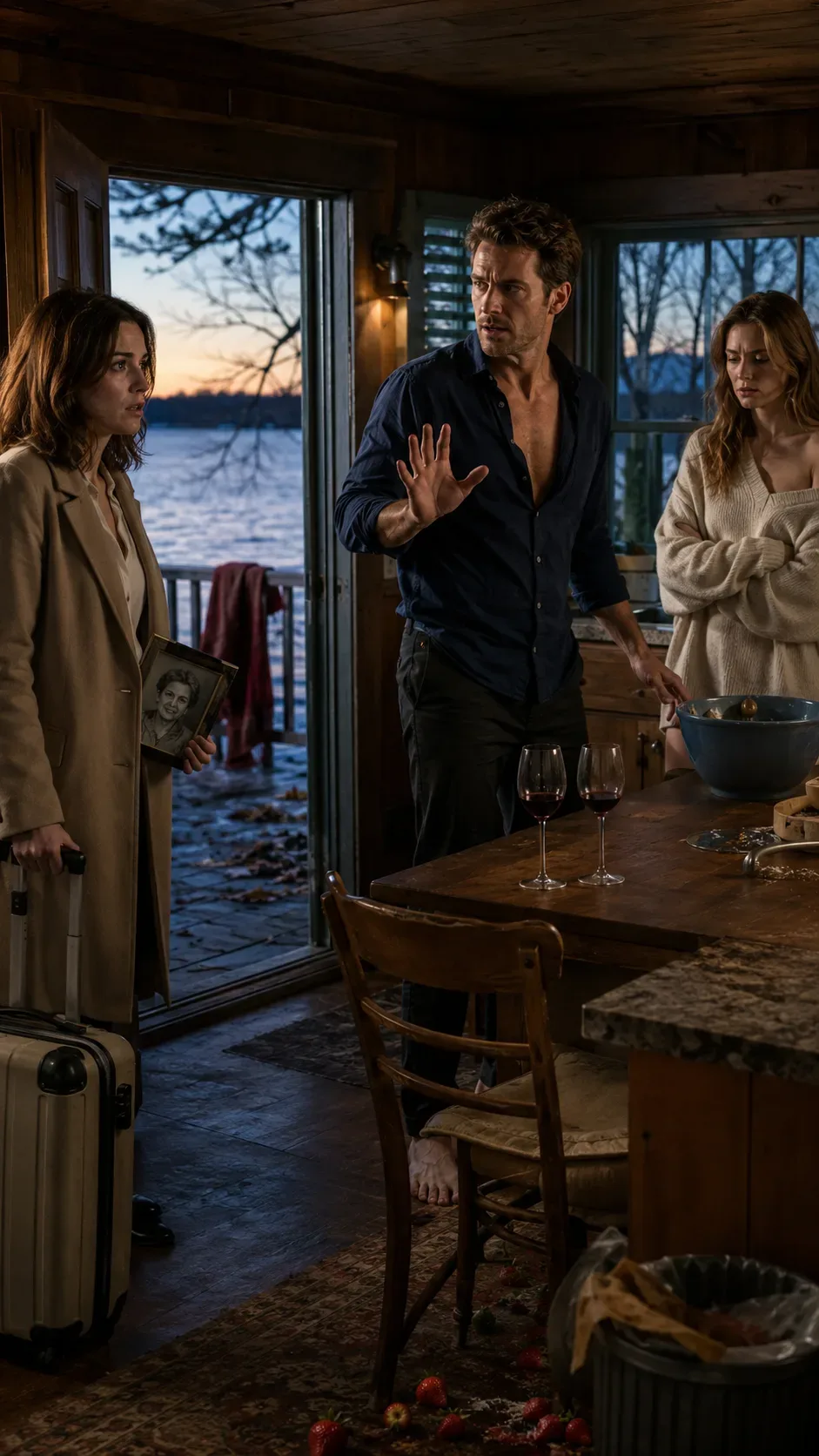
Standing in my grandmother’s kitchen, with torn recipe cards at my feet and my husband’s mistress wearing my sweater, I finally had my answer.
Far enough to lie.
Far enough to cheat.
Far enough to bring another woman into the one place I had left that felt holy.
And now, maybe far enough to steal it.
“My signature is on what?” I asked Howard.
Evan’s face had gone gray.
That was all the confirmation I needed.
Howard’s voice remained calm, but there was steel beneath it. “A quitclaim deed. It appears to transfer partial ownership of the lake house from you to Evan.”
Natalie looked at Evan as if she had never seen him before.
“You said she agreed,” she whispered.
Evan turned on her. “Stay out of this.”
“No,” she said, taking a step back. “You told me she wanted out of the marriage. You said she signed everything.”
I almost felt sorry for her.
Almost.
Then I looked at my sweater on her body and the sympathy stopped at my ribs.
Howard said, “Julia, I need you to listen carefully. Do not sign anything. Do not leave the property unsecured. And do not let him remove documents from the house.”
Evan took one step toward the hallway.
Mrs. Alden moved faster than I thought a woman her age could move.
She stepped in front of him.
“Where are you going, Evan?”
His eyes flashed. “To get my bag.”
“Then Julia will watch you.”
I ended the call and lowered the phone.
The house felt different now.
Not weaker.
Awake.
As if every board, every cabinet, every nail my grandfather had hammered into the dock had been waiting for me to remember what my grandmother had already taught me.
Build a life no one can take from you.
Not
beg for it.
Not explain it.
Protect it.
“Go get your bag,” I said.
Evan looked relieved for half a second.
Then I added, “Mrs. Alden and I will stand in the doorway while you do.”
His relief died.
We followed him upstairs.
I had not been to the upstairs bedroom since my grandmother’s funeral. For years, I avoided it because her quilt was still folded at the end of the bed, her lavender sachets tucked into the dresser, her hairbrush still in the top drawer like she might come back from the porch and need it.
Now Evan had turned it into a staging room.
His leather weekend bag sat on the bed.
Natalie’s dress hung from the closet door.
Two champagne glasses were on my grandmother’s nightstand.
And on the chair beside the window was a folder.
Black leather.
New.
Not mine.
Evan saw me see it.
His
hand moved.
I got there first.
He grabbed my wrist.
It was not hard enough to bruise.
But it was hard enough to answer the last question I had about him.
Mrs. Alden’s voice cut through the room.
“Take your hand off her.”
Evan froze.
I looked down at his fingers around my wrist.
Then I looked at him.
“You don’t get to touch me in this house.”
He released me.
I picked up the folder.
Inside were copies of property tax records, contractor receipts, photographs of the cabin, a rental projection sheet, and a document with my forged signature on the last page.
But that was not what made my breath stop.
Behind the deed was a printed email from Evan to someone named Grant Mercer.
Subject line: Cedar Haven Investor Packet.
I read the first sentence.
Natalie read it over my shoulder.
Then she covered her mouth.
Evan had written:
“My wife is emotionally attached but financially passive. Once I secure the transfer, I can move forward without resistance.”
Financially passive.
That was what seven years of marriage had made me in his head.
Not partner.
Not wife.
Obstacle.
I turned the page.
There was a budget for renovations I had never approved.
A plan to remove “dated personal clutter.”
A note to replace family photographs with “neutral vintage decor.”
And at the bottom, in bold:
Grand opening target: Memorial Day weekend.
My grandmother’s house.
My memories.
My grief.
His business plan.
Natalie stumbled backward. “You brought me here to show me our future.”
Evan said nothing.
“You told me this was going to be ours,” she said.
The room went silent.
Ours.
I looked at her.
Now I understood.
She had not just been his affair.
She had been part of his fantasy.
Not the wife in my sweater.
The replacement owner.
Evan reached for the folder again. “Julia, you’re reading private business documents.”
I almost laughed.
“You forged my name.”
“You can’t prove that.”
That was his mistake.
Not the affair.
Not the flyer.
Not even the folder.
His mistake was forgetting who had raised me.
My grandmother had been sweet, but she had not been soft. She kept receipts for twenty-five years. She labeled keys. She wrote dates on the backs of photographs. She once caught a contractor overcharging her by nine dollars and made him redo the whole invoice because, as she told me, “A man who steals small will steal large when he’s given the chance.”
I walked downstairs without answering him.
Evan followed me, angry now.
“Where are you going?”
“To the pantry.”
He stopped.
Mrs. Alden smiled faintly.
She knew.
Behind the flour bins, beneath a loose shelf, my grandmother kept a small metal lockbox. Most people thought it held cash. It never did.
It held copies.
Insurance papers.
Wills.
Birth certificates.
The original deed.
And the signature card she made me sign in front of Howard Bell the week after she added my name to the lake house trust.
I was twenty-one.
I had thought she was being dramatic.
Now, with Evan breathing hard behind me, I opened the lockbox and pulled out the trust documents.
The cabin was not simply left to me.
It was protected in a family trust.
My grandmother had done more than give me a house.
She had built a wall around it.
Howard arrived twenty minutes later with his old leather briefcase and the calm expression of a man who had spent his career watching greedy people underestimate quiet women.
He read Evan’s documents at the kitchen table.
The same table where Evan had placed wineglasses for his mistress.
Then Howard looked up.
“Evan,” he said, “this is sloppy.”
Evan blinked. “Excuse me?”
Howard removed his glasses. “The property is held in trust. Julia cannot transfer partial ownership through a basic quitclaim deed without trustee approval, notarized authorization, and compliance with the restrictions her grandmother put in place.”
I stared at him.
Howard glanced at me gently. “Your grandmother anticipated marriage.”
The room changed again.
“She anticipated what?” I whispered.
“She loved you,” he said. “And she worried that someday someone might try to make you feel guilty for owning something outright.”
My eyes burned.
Howard tapped the document.
“This is not only invalid. It is evidence.”
Evan sat down slowly.
For the first time all evening, he looked truly afraid.
Natalie removed my sweater.
She stood there in her slip dress, shaking, and folded the sweater over the back of a chair.
“I’m sorry,” she said to me.
I didn’t answer.
Some apologies are real.
Some still arrive too late.
She picked up her boots and walked to the door barefoot, refusing Evan’s eyes as she passed him.
He called her name once.
She did not turn around.
The door closed behind her.
And then there were three of us.
Me.
Howard.
And the man who thought my grief made me weak.
Evan leaned forward. “Julia, we can fix this.”
“No,” I said. “Howard can fix the deed. I’m fixing my life.”
His eyes filled then, too late to be useful.
“I was scared,” he said. “We were drowning. Bills, pressure, my job. The rental idea could have helped us.”
“Us?” I asked.
He swallowed.
I placed the torn recipe card on the table between us.
More butter if Julia is sad.
“My grandmother knew how to love me when I was sad,” I said. “You studied my sadness like it was a loophole.”
His face collapsed.
I thought it would feel good.
It didn’t.
It felt clean.
There is a difference.
Howard called the sheriff. Mrs. Alden made tea because old women understand that even revolutions require something warm in a cup. Evan packed under supervision. He tried once to take the folder. Howard stopped him with one sentence.
“You’ll want to leave that where it is.”
By midnight, Evan was gone.
His shoes were gone from the porch.
His jacket was gone from the chair.
The red scarf was gone from the railing.
But the house still smelled faintly of wine, cologne, and someone else’s perfume.
So I opened every window.
Cold lake air poured in.
I washed the wineglasses and put them in a box for donation. I wiped the table three times. I picked strawberries out of the rug one by one. I taped the torn recipe cards together as best I could, crying only when I reached the note in the margin.
More butter if Julia is sad.
At dawn, I carried my grandmother’s blue mixing bowl to the dock.
The lake was silver.
The sky was pale pink.
For the first time in months, my phone was silent.
No excuses.
No lies.
No man demanding that I make his betrayal easier for him.
Howard filed the fraud report the next morning. The deed transfer collapsed before it ever touched the property record. Evan’s investor walked away. Natalie sent one email to Howard confirming everything Evan had told her. She never asked me for forgiveness. I respected that more than an apology that needed comforting.
The divorce took nine months.
Evan fought for reimbursement, equity, emotional hardship, anything that sounded like ownership.
He got none of it.
Because some gifts are not marital assets.
Some houses are not investments.
Some places belong to the person who survived long enough to come back and unlock the door.
The following October, one year after I found him there, I returned to the lake house alone.
I repainted the porch.
I fixed the dock.
I put my grandmother’s recipe cards in a new tin box and wrote one card of my own.
At the top, I wrote:
Julia’s Apple Pie.
Under it, in the margin, I added:
More butter if she is free.
Then I placed the card behind my grandmother’s.
Not replacing her.
Continuing her.
That evening, I sat at the kitchen table with tea in my hands and watched the lake turn dark.
For years, I thought the house was sacred because my grandmother had left it to me.
I was wrong.
It was sacred because she had taught me what to do when someone tried to take it.
Lock the door.
Keep the proof.
And never mistake a man’s key for his right to enter.
THE END
Continue reading
He Spent Twelve Years Lying — She Opened One Door And Changed Everything
MY HUSBAND TOOK A SECRET TRIP WITH HIS LOVER AND HER FAMILY — WHEN HE CAME BACK, I WAS ALREADY GONE