PART 3 — THE PREDATOR FINALLY FACED JUSTICE
“I understand your hesitation,” Rebecca replied gently.
Chapter 3
PART 3 — THE PREDATOR FINALLY FACED JUSTICE
“I understand your hesitation,” Rebecca replied gently.
“Many victims of domestic abuse have conflicting feelings about criminally prosecuting their abusers. We can initially focus on the divorce and on protecting your assets. Criminal complaints can be a separate decision you make when you’re ready.”
Leaving the office, Andy seemed simultaneously exhausted and relieved.
“It feels like I’m waking up from a nightmare,” he commented as we drove home.
“It’s a process,” I replied. “It’s not going to be solved overnight.”
“I know. But now at least I’m walking in the right direction.”
That night was interrupted by a noise at the front door around ten o’clock. Furious banging, the doorbell ringing repeatedly. Andy and I looked at each other on the sofa where we were watching a movie.
“It’s her,” Andy whispered, fear evident in his voice.
“She can’t get in,” I assured him, grabbing the phone. “And she’s violating the restraining order. I’m calling the police.”
The banging continued, getting louder as I reported the situation to the 911 operator.
“My daughter-in-law is violating a restraining order, trying to force her way into my house. We need a patrol car immediately.”
“Andy!” Carly’s voice cut through the door. “I know you’re in there. Open this door right now!”
Andy shrank on the sofa, trembling. I went to him and held his hands.
“It’s okay,” I said. “She can’t get in. The police are on their way.”
Carly continued yelling, threatening, imploring, alternating between rage and pleading. The noise attracted the neighbors’ attention. I saw lights turning on in nearby houses, faces appearing in the windows.
When the patrol car arrived seven minutes later, Carly was still on the porch, now kicking the door. The police found her in flagrant violation of the restraining order. We watched through the window as they arrested her. She kept looking
at the house, screaming Andy’s name, even as they put her in the patrol car.
“What’s going to happen to her now?” Andy asked, his voice almost inaudible.
“She’ll be arrested for violation of the restraining order,” I replied. “This has serious consequences.”
That night, Andy slept in my room, as he did when he was little and had nightmares. But this time, the nightmare was outside being taken away.
The next morning, I received a call from the detective in charge of the restraining-order violation case. Carly would be kept in custody until the bail hearing scheduled for the following day.
“Due to the recent history of violence and the clear demonstration of instability,” he explained, “it is likely that the judge will set strict conditions for provisional release. This may include an electronic ankle monitor and constant supervision.”
I thanked him for the information and hung up, feeling
a mix of relief and concern.
Andy was still sleeping. The events of the night before had completely exhausted him. I prepared breakfast and left a note explaining where he could find me. I had a scheduled meeting with Rick to discuss new discoveries.
We met at his small office downtown. Rick looked worried when he greeted me.
“Ellie, we discovered more things about Carly. Things you need to see.”
He opened a folder and spread documents on the table. There were police records from two different cities, both involving Carly in cases of domestic violence and financial fraud.
“She’s done this before,” Rick explained. “In Atlanta five years ago and in Dallas three years ago. In both cases, she got involved with people who were financially well off, moved into their houses, started manipulating their finances, and eventually became violent.”
I felt a chill.
“And what happened in those cases?” I asked.
“In the first one, the victim withdrew the complaints after Carly made promises to change. In the second, there was an out-of-court settlement. The victim paid a significant amount of money to get Carly out of his life.”
“She’s a serial predator,” I murmured, glancing through the documents. “And Andy was just her most recent victim.”
“Exactly. And there’s something else,” Rick added, hesitating as if choosing his words carefully. “We found evidence that Carly recently researched life insurance and inheritance—specifically how to guarantee inheritance rights through marriage.”
A shiver ran down my spine. The implications were clear and terrifying.
“Do you think she…” I couldn’t finish the sentence.
“I can’t say for sure that she was planning something specific,” Rick replied. “But the pattern is worrying. She drained Andy’s financial resources. She knew you have a valuable house and other assets. The searches about inheritance, combined with the comments about the ‘old lady biting the dust,’ paint a disturbing picture.”
I left Rick’s office with the folder of documents heavy in my hands and an even greater weight in my chest. What had started as a case of assault at my dining room table had transformed into something much more sinister.
When I got home, Andy was in the kitchen preparing lunch. There was a new energy in him, still fragile but determined.
“Where were you?” he asked, putting water on to boil.
“Meeting with an investigator friend,” I replied, placing the folder on the table. “Andy, we need to talk.”
He looked at the folder, then at me, and turned off the stove.
“More bad news?” he asked.
“Important information,” I said. “Please sit down.”
I showed him the documents, carefully explaining Carly’s patterns of behavior in previous relationships. Andy listened in silence, his face going through a series of emotions—shock, pain, rage, and finally resolve.
“So I wasn’t special,” he finally said. “I was simply convenient.”
“You were a target,” I corrected softly. “But that doesn’t diminish who you are. Predators like Carly are skilled at identifying good, trustworthy people and manipulating them.”
Andy ran his hand over his face, taking a deep breath.
“What do we do now?” he asked.
“We need to talk to the lawyer and the police,” I replied. “These new documents strengthen both the divorce case and the possible criminal proceedings. And her bail hearing is tomorrow.”
“Yes.” He paused. “I don’t have to attend, right? But… I want to. I need to look her in the eyes, knowing the truth.”
The determination in Andy’s voice surprised me. In just a few days, he had gone from a confused victim to a resolved survivor.
That afternoon, Andy and I worked out a detailed plan. First, he filed a petition for a contested divorce citing financial and physical abuse, accompanied by all the documents we had collected. Then, we filed formal complaints for the financial crimes: unauthorized use of the retirement account and fraudulent opening of credit cards. The attorney, Rebecca, accompanied us every step of the way, ensuring all documents were impeccable.
“We want to create a case so solid that there’s no room for escape,” she explained. “The combination of the civil and criminal proceedings will create immense pressure.”
The next morning, we prepared for the bail hearing. Andy chose a sober outfit—black dress pants and a white shirt, the kind of clothing he would wear for an important job interview. I opted for one of the suits I used to wear when I was still a judge—a subtle reminder to the court of who I was.
The courthouse was relatively empty when we arrived with Rebecca. We were directed to the courtroom, where we took discreet seats in the back. Andy held my hand tightly, his fingers cold despite the warmth of the day.
When Carly was brought in, wearing the orange jail uniform and handcuffs, Andy sharply inhaled. It was the first time he had seen her since the night of the trespass. Carly scanned the room and her eyes fixed on us. For a moment, her expression softened when she saw Andy, but then she noticed our intertwined hands and her face contorted with rage. She said something to her lawyer, who looked in our direction and shook his head.
The judge entered and the hearing began. The prosecutor presented the case: flagrant violation of a restraining order, recent history of violence, risk of witness intimidation.
“Furthermore, Your Honor,” he added, “we have information that the defendant has a history of similar behavior in other jurisdictions, having been involved in previous cases of domestic violence and fraud in Atlanta and Dallas.”
This was new information to Carly. She turned sharply toward her lawyer, visibly shocked. She hadn’t expected her past to catch up with her so quickly.
The public defender tried to argue that Carly had ties to the community, posed no real risk, and could await trial out of custody. The judge listened to the arguments with an impassive expression before announcing her decision.
“Considering the seriousness of the violation, the defendant’s history, and the evident risk to the victims,” she said, “I determine that the defendant shall remain in custody until trial, with the possibility of review in thirty days upon presentation of an adequate supervision plan.”
Carly let out a sound of protest, quickly silenced by her lawyer. As the officers approached to take her back to detention, she turned and looked directly at Andy.
“Please,” she cried. “Andy, don’t let this happen. I love you. We can fix this.”
Andy did not look away. He stood firm, looking directly into the eyes of the woman who had betrayed and abused him for months. He said nothing. He just watched as Carly was led out of the courtroom.
In the hallway after the hearing ended, Andy finally released my hand and took a deep breath.
“I thought it would be harder,” he confessed. “Seeing her like that, hearing her beg. But I could only think of everything we discovered. The other people, the lies, the inheritance searches.”
“You are very strong,” I said, feeling immense pride for my son.
“I don’t feel strong,” he replied honestly. “I feel stupid for having fallen for this, for not having seen the signs.”
“You’re not stupid. You were manipulated by someone who turned manipulation into an art form.”
On the way back home, we stopped at a hardware store and bought paint. Andy had decided to repaint his room—a symbolic act of a new beginning. He chose a soft blue, almost sky blue, the color of the sky after the storm passes, as he described it.
The following days brought an almost therapeutic routine. During the day, we dealt with legal matters: meetings with the lawyer, visits to the bank to resolve financial issues, filling out forms for the criminal complaints. At night, we painted Andy’s room, moved furniture, renewed the space that had been his in childhood and adolescence and that would now be his refuge for healing.
Two weeks later, we received the news that the bank had accepted the dispute of the retirement withdrawals. The $400,000 would be returned to Andy’s account, and the bank would cooperate with the criminal investigation against Carly.
“It’s a start,” Andy commented when we received the news. “One step at a time, right?”
“Exactly,” I agreed.
That afternoon, as we applied the last coat of paint to the ceiling of the room, Andy said something he had been holding back.
“Do you know what’s the hardest thing to accept?” he asked. “It’s not the money. It’s not the lies. Not even the violence. It’s realizing that the last two years of my life were based on a farce. That the person I loved never really existed.”
I climbed down from the ladder and sat on the edge of the bed, protected by plastic tarps.
“Grieving for what you thought you had is often much harder than grieving for what you actually lost,” I said.
Andy climbed down from the ladder and sat beside me.
“How do I move forward after this?” he asked. “How do I trust anyone again?”
“Slowly,” I replied carefully. “With the support of people who truly love you. And by remembering that what happened doesn’t define who you are or what you deserve in life.”
He leaned his head on my shoulder, staining my old T-shirt with blue paint. I didn’t mind in the slightest.
“Thank you for not giving up on me,” he murmured. “Even when I was angry at you. Even when I chose the wrong side.”
“That’s what mothers do,” I replied simply. “We wait for the moment when our children are ready to listen. Then we’re there to help them rebuild.”
A month passed. Life took on a new normal. Andy had returned to his job at the veterinary clinic, now full-time. I had returned to my retired routines—reading in the morning, gardening in the afternoon, occasional dinners with friends.
The criminal case against Carly progressed slowly, as is typical in the justice system. She remained in custody, having been denied a second request for provisional release when new evidence of her previous activities came to light.
Andy had started therapy twice a week, working to understand what had made him vulnerable to abuse and how to build healthier relationships in the future. Some nights, I heard him crying in his room, but the episodes were becoming less frequent, less intense.
One Saturday afternoon, as we prepared lunch together—an activity that had become a comforting ritual—the phone rang. It was Rebecca.
“I have news,” she said.
Andy put the phone on speaker so I could also hear.
“What kind of news?” he asked.
“Carly’s lawyer contacted me proposing a plea deal. She pleads guilty to the financial crimes and the violation of the restraining order in exchange for a reduced sentence: two years in prison followed by three years of supervised probation. She also agrees to a no-contest divorce, waiving any claim to your assets or your mother’s future inheritance.”
Andy looked at me, his eyes seeking guidance.
“What do you think?” he asked.
“It’s your decision, Andy,” I said, “but two years in prison plus three on probation is a significant sentence. And most importantly, she would be legally admitting what she did.”
“If we don’t accept?” Andy asked Rebecca. “What happens then?”
“We go to trial. With the evidence we have, I believe we can get a harsher conviction—maybe four or five years in prison—but trials are unpredictable, and you would have to testify, reliving everything publicly.”
Andy took a deep breath.
“Can I think about it?” he asked.
“Of course,” Rebecca replied. “They gave us a three-day deadline to consider the proposal.”
After we hung up, Andy silently returned to chopping vegetables for the salad. I respected his silence, giving him space to process.
“I don’t know if I want to see her in jail for five years,” he finally said. “Not out of revenge. But I also don’t know if two years is enough to feel safe when she gets out.”
“Supervised probation is not a game,” I commented. “She would have to report regularly. She couldn’t approach you. She would have to participate in rehabilitation programs. Any violation would send her straight back to prison.”
Andy nodded, absorbing the information.
“And the divorce would be faster if she doesn’t contest,” he said.
“Much faster—and less emotionally exhausting for you.”
He continued chopping tomatoes in silence for a few more minutes.
“I’m going to think it over,” he said. “I want to make the right decision for the right reasons.”
Two days later, Andy asked me to accompany him to Rebecca’s office. He had made his decision.
“I want to accept the plea deal,” he announced as soon as we sat down. “Not because it’s easier, but because it’s enough. Two years in prison, three on probation, a clean divorce, and the legal recognition of her guilt. It’s justice without being revenge.”
Rebecca smiled.
“I think that’s a wise decision, Andy. I’ll communicate it to the prosecutor and her lawyer immediately.”
The process was surprisingly fast after that. A week later, we appeared in court for the hearing where Carly would formally accept the plea deal. It was the first time Andy would see her since the bail hearing a month ago.
Carly seemed to have aged years in just a few weeks. The prison uniform hung loosely on her thinner body. Her once perfectly dyed hair now showed gray roots. When she saw us entering the courtroom, her eyes fixed on Andy with a disturbing intensity.
The judge reviewed the terms of the agreement in detail before addressing the defendant.
“Mrs. Miller, do you understand that by pleading guilty you’re admitting to committing the crimes of financial fraud, battery, and violation of a court order?”
“Yes, Your Honor,” Carly replied, her voice rougher than I remembered.
“And are you doing so voluntarily, aware of the consequences?”
“Yes.”
“Very well. This court accepts your plea of guilty and sentences you to two years of incarceration followed by three years of supervised probation. The specific terms of the probation include an absolute prohibition of contact with the victims, mandatory participation in anger-management programs and alcohol-dependency treatment, in addition to financial restitution as stipulated in the civil agreement.”
The judge brought the gavel down, finalizing the sentence.
As the officers approached to take her away, Carly turned toward us one last time.
“Andy,” she called out, ignoring the guard’s warnings. “I’m sorry for everything.”
Andy did not respond. He only held her gaze for a few seconds before looking away. It was the closure he needed—not a pardon, not a reconciliation, just the silent acknowledgment that that chapter was ending.
In the hallway after the hearing ended, Andy finally released my hand and took a deep breath.
“I thought it would be harder,” he confessed. “Seeing her like that, hearing her beg. But I could only think of everything we discovered—the other people, the lies, the inheritance searches.”
“You were very strong,” I said, feeling immense pride for my son.
“I don’t feel strong,” he replied honestly. “I feel stupid for having fallen for this, for not having seen the signs.”
“You’re not stupid,” I said. “You were manipulated by someone who turned manipulation into an art form.”
On the way back home, we stopped at a hardware store and bought paint. Andy had decided to repaint his room, a symbolic act of a new beginning. He chose a soft blue, almost sky blue—the color of the sky after the storm passes, as he described it.
The following days brought an almost therapeutic routine. During the day, we dealt with legal matters: meetings with the lawyer, visits to the bank to resolve financial issues, filling out forms for the criminal complaints. At night, we painted Andy’s room, moved furniture, renewed the space that had been his in childhood and adolescence and that would now be his refuge for healing.
Three months after our first meeting with Rebecca, Andy received an invitation to speak at a state conference on domestic violence. He was nervous, questioning whether he was ready to share his story on such a public stage.
“What if I’m not eloquent enough?” he asked as we rehearsed his presentation in the living room. “What if I freeze in the middle and look like an amateur?”
“Then you take a deep breath, take a sip of water, and continue,” I replied. “Remember, you’re not there to impress anyone with perfect public speaking. You’re there to share a truth that can help other people.”
On the day of the conference, I sat in the audience watching my son step onto the stage. He was wearing a simple but elegant blue suit, his hair tied back in a professional bun. He looked confident, centered.
“My name is Andrew Miller,” he began, “and today I’m going to share with you how a broken glass of wine saved my life.”
For forty minutes, he kept the audience completely engaged, alternating between moments of raw vulnerability when describing his own abuse and precise analysis of how the system often fails to recognize and address financial abuse. He concluded with a call for more education, better laws, and greater awareness.
The standing ovation he received when he finished lasted several minutes. As I watched, I felt tears in my eyes—not of sadness, but of deep and overwhelming pride. My son had transformed his pain into purpose, his experience into wisdom.
After the talk, as we prepared to leave, Andy was approached by an older woman, elegantly dressed, with a badge identifying her as a representative of a philanthropic foundation.
“Mr. Miller, your presentation was extraordinary,” the woman said. “I’m impressed with the work you and your organization are doing. I’d like to discuss the possibility of funding to expand Safe New Beginnings.”
Andy looked at me, his eyes wide with surprise and hope. I nodded encouragingly.
“That would be wonderful,” Andy replied. “We have so many ideas to reach more people, especially in rural areas where resources are scarce.”
They exchanged cards and agreed to a meeting for the following week.
As we walked toward the parking lot, Andy seemed to be floating with excitement.
“Can you believe it?” he exclaimed. “Real funding to expand the project? We could create materials in different languages, develop an app for secure financial tracking, maybe even open a small dedicated office.”
“You deserve it, Andy,” I replied. “You worked hard, and you’re making a difference in the lives of so many people.”
He stopped suddenly in the middle of the parking lot and hugged me—a strong hug full of gratitude.
“None of this would have been possible without you, Mom. Without your strength that night, without your persistence afterward, without your support throughout this entire process.”
I returned the hug, feeling the peculiar sensation that only mothers know—pride and nostalgia simultaneously, seeing your child grow beyond what you could ever have imagined.
“You always had that strength inside you, Andy,” I said. “You just needed to rediscover it.”
That night, as I drove back home alone—Andy had gone straight to his new apartment—I reflected on the events of the last year: the assault with the glass, the police report, the discovery of the financial crimes, Carly’s arrest, Andy’s gradual recovery, and now this promising new chapter.
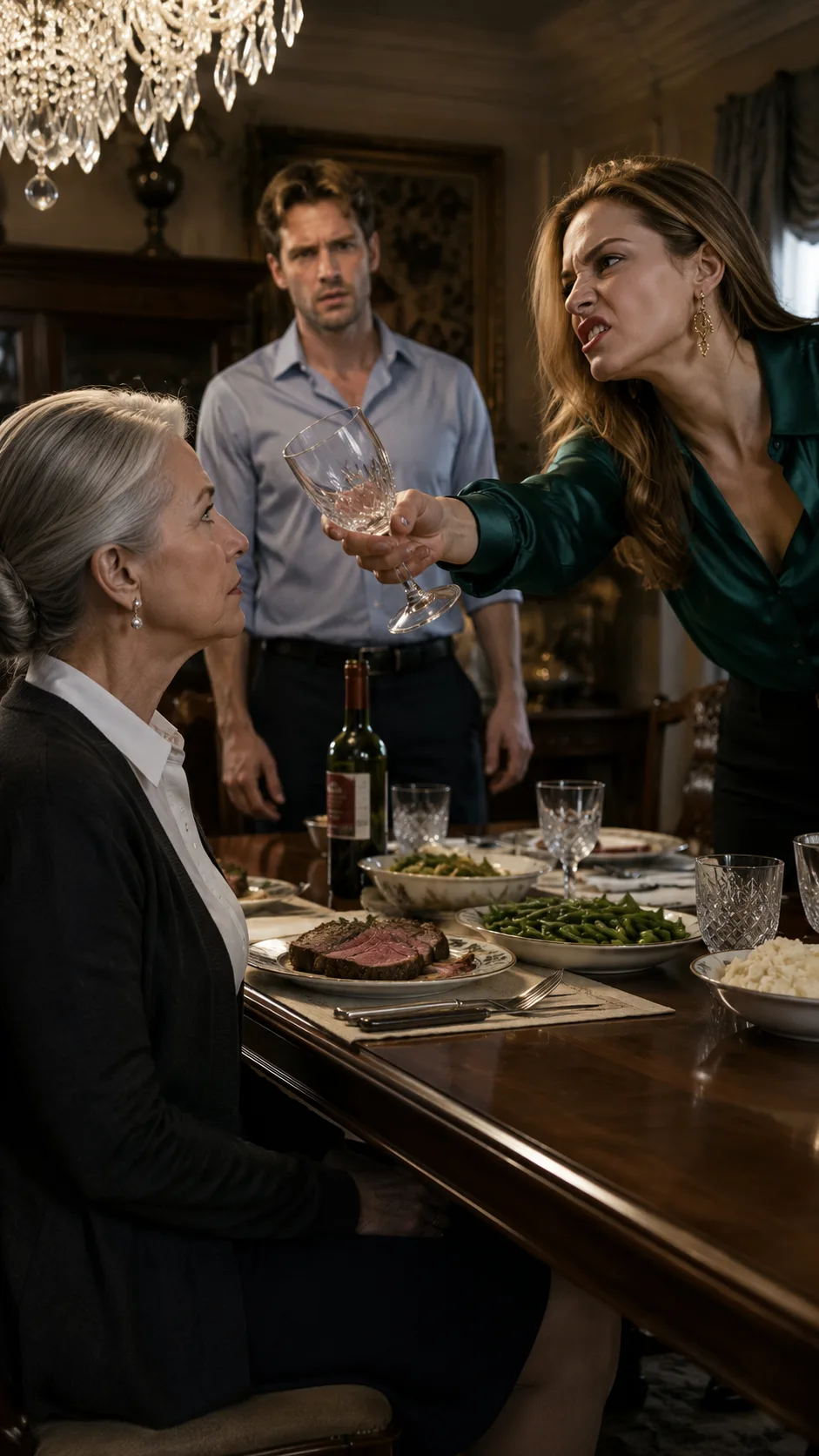
It was impossible not to think about how a moment of violence, terrible as it was, had triggered a series of events that brought not only justice, but also healing and purpose. The broken glass had shattered more than crystal that night. It had broken the power Carly had over Andy, the lies that had built their relationship, and the illusion that abuse only happens to other people.
In its place, we had built something new and stronger—a renewed bond between mother and son, a shared purpose of transforming our own traumatic experience into hope for others.
I parked in the garage, entered the house, and turned on the lights. The silence greeted me—not the oppressive silence of loneliness or the tense silence that had preceded the assault that night, but a peaceful silence of a life that had weathered the storm and found serenity on the other side.
I made a cup of tea and sat on the deck watching the starry sky. I remembered the words of Andy’s therapist during one of the joint sessions we had:
“Sometimes we need to break completely to rebuild ourselves stronger.”
Like that crystal glass, our family had shattered momentarily. But what we built from the fragments was more resilient, more authentic, and infinitely more precious than what we had before.
Now, if you liked this story, click to subscribe and tell me in the comments what part left you speechless. Oh, and don’t forget to become a member for access to exclusive videos that I don’t post here.
THE END.
Chapter complete
You have reached the end of this chapter.
Continue reading
A few more worlds to get lost in after this chapter.




