PART 3 — THE DOOR I FINALLY CHOSE TO TAKE
He stood on the porch holding no flowers, no bag, no visible apology.
Chapter 3
PART 3 — THE DOOR I FINALLY CHOSE TO TAKE
He stood on the porch holding no flowers, no bag, no visible apology.
Just his phone in one hand and that same navy quarter-zip under a rain jacket. He looked exhausted. He also looked prepared to stand there until my sympathy made the next decision for me.
I did not open the door.
He knocked again.
“Mom?”
I stayed where I was.
“Mom, I know you’re home.”
He waited, then said louder, “I’m not leaving until we talk.”
My pulse kicked once, hard. Not because I was afraid of him exactly. Because I recognized the tactic. Make me choose between discomfort and access. Count on my preference for peace.
I took out my phone and texted him through the door.
You were asked to communicate in writing. Leave my property.
His phone buzzed in his hand. He looked at it, then at the door.
“You’re really doing this?” he called.
I typed: Yes.
He stood there for almost two full minutes, jaw tight,
then sent back: Mara handled the paperwork badly but you are making assumptions.
I answered: Did you know my signature was on it?
The dots appeared. Vanished. Reappeared.
No answer came.
That silence was my answer again.
I texted one more line.
Leave before I document trespass.
It sounded harsher on screen than it did in my chest.
He looked at the message a long time.
Then he left.
I watched his taillights disappear down the wet street and understood something with painful clarity:
He had come to manage, not confess.
—
By that afternoon the story had started walking through other people.
Bonnie called around one while I was standing in the laundry room pretending matching socks required full concentration.
“I need you to listen before you react,” she said.
“All right.”
“I ran into Denise Nolan at Market of Choice.”
Of course she did.
Bonnie continued, “She says
Christmas dinner got ‘emotional’ and that you overreacted to some financial planning conversations because you’ve been ‘struggling since Daniel passed.’”
I closed my eyes.
There it was.
Not the legal defense.
The character defense.
Make the older widow sound unstable and the documents become a misunderstanding instead of an act.
Bonnie said, “She didn’t say dementia, but she left a very tidy little outline around the word.”
I leaned my forehead against the laundry room shelf. “Thank you for telling me.”
“I told her I hoped everybody had enough sense to put important things in writing,” Bonnie said. “Then I bought my oranges and left.”
I laughed despite the burn in my throat.
“That was kind.”
“It was restrained.”
After we hung up, I stood there in the laundry room listening to the dryer thump and felt the first real wave of anger since the dinner.
Not at the forgery.
Not even at the public dismissal.
At the speed with which they had moved to discredit me.
That meant the dinner had never been the full event.
It had been one piece of a larger argument they were prepared to make if needed.
Selene is emotional.
Selene gets confused.
Selene doesn’t hear no.
Selene doesn’t understand what she’s seeing.
Once people accept that framework, you can move a surprising amount around them.
I went straight to my desk and started a second list.
September cookout comment re boundaries.
December appliance delivery conflict.
Text request for attorney name.
Downsizing conversation.
Witness Bonnie re Denise statement.
If they wanted a record, I would give the future one.
Only not theirs.
—
On December 26, Leonard’s office reopened.
By ten-thirty I was sitting across from him in a conference room that smelled faintly of leather, printer toner, and the peppermint candies his receptionist kept in a glass dish year-round. Leonard was seventy if he was a day, wore suspenders unironically, and had the unnerving gift of making panic sit down and speak plainly.
He read through my notes, the screenshots, the earlier mortgage records, and the typed summary I had sent that night. He asked precise questions.
“Who physically handled the folder?”
“I did. I opened it.”
“Did anyone explicitly admit the signature was not yours?”
“Mara said I wasn’t supposed to see it yet. She also called it temporary.”
He nodded once. “Not ideal for them.”
“Would a lender accept that application?”
“Not if they do their job properly.”
“Do I call the police?”
He leaned back. “That depends on what outcome you want and what the lender finds in its own internal review. We begin with notice, document preservation, and formal communication. If the application was submitted electronically or through a broker, there will be a trail. Do not threaten. Do not dramatize. Let institutions do what institutions are good at when someone lies on paper.”
I sat with that.
“Do you think they were trying to take the house from me?” I asked.
He folded his hands. “I think they were trying to move money using authority they did not have. Whether they told themselves a kinder story about it is immaterial.”
That sentence did something important inside me.
It separated motive from permission.
Plenty of family crimes survive because everybody keeps discussing intention as if it changes ownership.
Leonard drafted two letters while I sat there.
One to the lender and the broker identified in the folder, stating that any purported signature from me on the refinance application was unauthorized and disputed, that I requested immediate investigation and written confirmation of the application’s status, and that all relevant records be preserved.
Another to Grant and Mara, shorter, colder, and somehow kinder for it. It stated that I had become aware of documents bearing my unauthorized signature, that I was represented by counsel regarding any related matter, and that all future communication concerning the property, loan applications, or my estate should go through Leonard’s office. Personal contact was not invited.
I signed where I needed to.
My real signature.
That felt almost ceremonial.
Before I left, Leonard said, “One more thing. If anyone suggests you are mentally compromised, do not argue emotionally. Produce records. Dates. Function. Consistency. Facts defeat theater.”
I nodded.
He slid my copies across the table. “And do not let guilt push you back into a room where they have already agreed on your role.”
That line stayed with me longer than any legal advice.
—
The lender called two days later.
A woman named Tricia from the fraud review unit, voice polite and brisk. She asked whether it was a good time to discuss a notice I had submitted through counsel. I sat at my kitchen table with my notes and said yes.
She verified basic identity details, then said, “Ms. Harper, I’m not able to discuss every internal step, but I can confirm the application associated with your notice has been flagged and frozen pending review.”
Frozen.
Another steel word.
She asked whether I had personally signed any recent refinance documents related to the property. I said no. She asked whether I had granted power of attorney to Grant or Mara. I said no. She asked whether I recognized a specific email address listed as a point of contact for the file. I did not.
She paused at that.
I asked, “Can you tell me who submitted it?”
“I’m not able to provide that at this stage,” she said. “But I can say the discrepancy you reported is significant.”
Significant.
When the call ended, I wrote down every detail, then sat very still for a moment with the pen in my hand.
This was no longer a family dispute.
It had entered professional language.
That mattered.
By evening, Grant had emailed—not texted, not called, emailed.
Subject line: Please read.
The body began:
Mom,You are escalating this in a way that could seriously damage people over what was meant to be a temporary financial bridge. Mara handled a draft application before all signatures were in place. It should never have been left where you could see it, and I regret how Christmas dinner happened. But your reaction has gone beyond reason.
I read that paragraph twice.
Then the rest.
He wrote about stress. Timing. Miscommunication. Pressure. He wrote that Walter had introduced them to someone who said “preliminary paperwork” sometimes got started before all authorizations were collected. He wrote that they had intended to “loop me in” after the holidays once “options were clearer.” He wrote that Mara felt humiliated by the dinner scene. He wrote that outside reporting could affect his job if the issue became formal.
There was no sentence that said I’m sorry I let someone use your name.
There was no sentence that said I told my wife not to do it.
There was no sentence that said I was wrong when I told you to leave.
The closest thing to truth was hiding inside the phrase before all signatures were in place.
Which meant my name had indeed been used as a step, not an accident.
I forwarded the email to Leonard.
Then I made soup.
That was not metaphorical. I literally chopped onions and carrots and celery and made soup because people underestimate how useful a normal task can be when the rest of your life has gone crooked. Daniel used to say no one should make major decisions hungry or in a house without something simmering. The kitchen steamed. The radio played old folk songs. My body came back to itself.
Halfway through stirring, I realized I had not cried once.
I was past crying.
I was annotating.
—
January brought the social phase.
That is what I call the stretch where people around a situation begin choosing sides without ever naming it that way.
The official review was still moving through the lender and broker. Leonard had advised patience. Grant and Mara had gone quieter on direct contact, which meant the story traveled outward through softer routes.
At church, two women who had never before asked about my winter plans suddenly wanted to know whether I was “doing all right these days.” At the grocery store, Walter Nolan gave me a nod so carefully neutral it might as well have been notarized. One of the cousins unfollowed me on Facebook after years of barely interacting at all. Mara’s friend Kelsey, who sold skincare and overused the word intentional, posted a vague quote about respecting boundaries with family during the new year.
None of it was enough to confront.
That was the point.
Pressure rarely announces itself in communities like mine. It condenses.
Bonnie kept me sane.
“So,” she said one Saturday while we stood in my kitchen shaping scones with too much flour and not enough patience, “the current rumor seems to be that you frightened everybody with legal threats at Christmas because you don’t handle change well.”
I actually laughed this time. “Change.”
“Yes, apparently by change they mean forgery and public expulsion.”
I brushed flour off my hands. “Do you ever get tired of being right about people?”
“Constantly.” She cut the dough into triangles with alarming force. “You know the ugliest part?”
“What?”
“The story they’re selling makes perfect emotional sense to outsiders. Grieving widow. Adult son trying to help. Strong-willed daughter-in-law. Tension. Holiday blowup. People believe whatever version lets them avoid the word crime.”
That landed because it was true.
Most people would rather believe in bad communication than bad character.
Bonnie looked up at me. “You need one calm, simple sentence for anyone who asks.”
I considered that.
Then I said, “There was unauthorized paperwork involving my name. It is being handled properly.”
She nodded. “Good. Again.”
“There was unauthorized paperwork involving my name. It is being handled properly.”
“Again.”
We practiced it three times until the sentence lost heat and gained shape.
That became my line.
It worked because it offered nothing to wrestle with.
No drama. No pleading. No invitation.
Just a fact and an ending.
—
By mid-January, the broker had responded through counsel.
The letter was almost comically careful. It referenced a preliminary application package, noted discrepancies under review, denied final execution, and insisted the office had relied on documents presented by the applicants in good faith. There were phrases like inadvertent inclusion and pending verification. Leonard translated it for me over speakerphone.
“They are saying, in polished language, that they accepted something they should not have accepted and would like to be thought of as victims of your relatives’ sloppiness rather than participants in it.”
“Does that help us?”
“It means they are scared enough to write carefully.”
A week later came the lender’s formal notice.
Application withdrawn. File closed. Signature discrepancy confirmed. No enforceable refinance process completed.
There were other lines too—about internal review, preservation of records, future restrictions—but I only needed the central fact.
Closed.
I sat at my dining table with the letter in my hands and felt something unclench so deeply it almost hurt.
Not triumph.
Security.
No one had taken my name where it could hold.
They had only tried.
That distinction mattered to the law.
It mattered to me too, though in a different way. Because attempt reveals character more cleanly than success. Success can be complicated by outcome and consequences and spin. Attempt is pure intention interrupted.
That evening Grant called from a new number.
I let it ring once, twice, three times, then answered because I wanted to hear whether closure had changed his vocabulary.
“Hello?”
“Mom.”
He sounded tired, older, hollowed out.
“What do you want?”
A long pause. Then: “It’s done, okay? The loan’s dead.”
“I know.”
“You didn’t have to push it this far.”
There it was.
No apology. Just resentment that consequences had survived him.
I said, “You used my name.”
“We were desperate.”
“Then you should have asked.”
“We knew you’d say no.”
I stood very still in my kitchen.
There are moments when a person reveals the truth so nakedly you almost miss it because you were still expecting editing.
I said, “Thank you for finally being honest.”
He exhaled sharply. “That’s not what I meant.”
“It is exactly what you meant.”
Silence.
Then, softer, “I didn’t know she’d already put everything through.”
I closed my eyes.
Not innocence.
Sequencing.
He was carving out a smaller guilt inside a larger one.
“Did you know my signature was on the application when you told me to leave?” I asked.
He did not answer.
I said, “Goodbye, Grant.”
“Mom—”
I hung up.
My hand shook afterward for the first time in weeks.
Not because I regretted it.
Because a final illusion had just died.
—
February was the month I almost caved.
That deserves its own plain sentence because stories like this sound cleaner in retrospect than they feel while you are inside them. People like redemption arcs because they make boundaries look dramatic and easy. In real life, boundaries are repetitive and often lonely.
The rain kept coming. Eugene in February can make a person feel like she lives inside a soaked wool blanket. My house, which had once felt companionable in grief, started feeling too large again. Not unsafe. Just echoing. The soup recipes ran out. The legal process had slowed into follow-up letters and administrative waiting. Bonnie got the flu and stayed home for ten days, which meant my best source of blunt sanity was coughing into tissues across town.
Then Grant sent a photo.
Not a text.
A photo.
It came on a Tuesday afternoon while I was paying the water bill online. The image showed him at around age seven in rain boots and a puffy red coat, missing front tooth, both hands wrapped around a pumpkin bigger than his torso. I had taken that picture at Lone Pine Farms. I remembered because he had insisted on carrying the pumpkin himself all the way to the car and cried when it dropped in the mud.
Beneath the picture he wrote: I found this while cleaning. We had good years too.
I stared at the phone until the screen dimmed.
That was the most dangerous message he had sent yet.
Not because it was cruel.
Because it was true.
We had good years.
That is the thing people do not understand when they ask why family betrayal cuts so deep. It is not because the whole relationship was false. It is because enough of it was real to make the false parts expensive.
I almost answered.
I almost wrote, Yes, we did.
I almost let memory do what it had always done for him—buy back present accountability with old tenderness.
Instead I put the phone down and walked to the hall closet where I had shoved the folding chair three weeks after Christmas.
Yes.
I had one.
Not the one from Grant’s house, obviously, but the old metal folding chair Daniel and I used for extra guests at Thanksgiving when the nieces were young and everybody still squeezed happily around a table too small for us. I had dragged it out in January when I needed extra seating for Bonnie and then could not bear to return it to the garage. So I left it folded in the hall closet, absurdly visible each time I reached for a coat.
That day I opened the closet and looked at it.
Cold metal. Thin cushion. Temporary place.
I said out loud, to no one, “Good years are not permission slips.”
Then I went back to the kitchen and did not answer Grant’s photo.
That sentence saved me more than once.
—
The practical changes began in March.
Some of them were small enough to sound unimportant, which is how life often heals. I changed the emergency contacts on my medical forms. I updated my garage code and the front door keypad. I removed Grant’s name from the spare key envelope at Bonnie’s house and replaced it with Bonnie’s daughter, Elise, who lived fifteen minutes away and had a kind competence I trusted.
I met Leonard again and revised a few estate provisions—not out of spite, but clarity. The early inheritance option for Grant was eliminated. Certain distributions were redirected. The language around discretionary access became stricter. Daniel and I had once believed flexibility was love. I now believed precision was.
I also rented out my spare room for three months to a traveling occupational therapist named Nina who needed short-term housing between assignments at PeaceHealth. She was thirty, organized, and left exactly one mug in the drying rack each morning. Her presence shifted the air in the house. Not because we became deeply close—we didn’t—but because her ordinary coming and going reminded me that space could be shared without being invaded.
One evening she sat across from me at the kitchen table eating takeout pho and said, “I hope this isn’t rude, but this house feels peaceful.”
I nearly laughed at how hard-earned that peace had become.
“Thank you,” I said.
She nodded toward the dining room. “My mother’s house always felt like someone was about to apologize.”
I looked at her.
“That’s a very specific sentence.”
She shrugged. “I work in rehab. I hear a lot of families.”
After she went upstairs, I stood in the dining room for a long moment with the overhead light off and the street glow coming pale through the front window. The room had held Christmases and ordinary Tuesday dinners and Daniel grading claim files in one corner while I folded napkins in the other. It had held casseroles after the funeral. It had held paperwork, flowers, exhaustion, jokes, card games, insurance binders, and too many versions of “it’s fine.”
It deserved better than becoming a shrine to humiliation.
So I did something mildly impulsive.
I bought a new dining table.
Nothing extravagant. Just solid oak, round instead of rectangular, from a local furniture place on West 11th. Four matching chairs. No temporary seat.
When it arrived, I gave my old mismatched set to a young couple furnishing their first apartment. They loaded it into a rented U-Haul and kept thanking me like I had saved them months.
Maybe I had.
Maybe I was really thanking the future for not requiring me to keep looking at scarcity disguised as accommodation.
The old folding chair stayed in the hall closet a while longer.
Not as trash.
As evidence.
—
Three months after Christmas Eve, I moved out of my house.
Not because I was chased.
Because I chose to.
That distinction matters just as much as the one about the loan.
For weeks after the lender closed the file, I kept thinking about what Grant had said—Leave and don’t come back—and how easily other people had accepted my removal from a room I had helped fill. Then I would come home to my own house and feel a strange tenderness toward it, mixed with fatigue. Every corner held history. Good history, some of it. Daniel’s history. My old life. My old reflexes.
I realized I no longer wanted to keep proving I belonged in spaces already weighted with so much explanation.
So I sold while the market was decent.
Not in chaos. Not under pressure. With Leonard reviewing papers, a sensible real estate agent, and my own timeline. The house sold to a divorced elementary school principal from Springfield who loved the garden beds and cried when she saw the breakfast nook. I liked her immediately. On closing day she hugged me in the driveway and said, “I promise I’ll take good care of it.”
“I know,” I said.
That afternoon I signed the final documents with my own hand and then drove to the small rental on the outskirts of Eugene I had already secured—a two-bedroom place with pale siding, a patch of back grass, and just enough room for exactly the life I wanted. No hallway of photographs demanding performance. No oversized yard. No extra square footage to heat out of nostalgia. Just a clean, manageable, mine-by-choice place fifteen minutes from the Saturday market and twenty from the river trails.
When I carried my first box inside, the rooms echoed lightly.
Not lonely.
Unclaimed.
That felt like freedom.
Grant heard about the sale from someone else before I told him.
He called three times that day. I did not answer. Then he emailed.
You sold the house? Without even telling me?
I stared at the screen.
After everything, that was the wound he wanted acknowledged.
Not what he had done.
That I had moved a piece on the board without asking whether it changed his view of me.
I wrote back exactly one sentence.
Adults do not require permission to leave rooms where they were not respected.
He did not respond for six days.
When he finally did, it was only: I don’t know how to fix this.
For the first time in months, I answered honestly.
You may not be able to.
That was not cruelty.
That was inventory.
—
If you are wondering whether Mara ever apologized, the answer is not in any satisfying story shape.
She stopped contacting me directly around mid-February, then sent one final email in April after learning the house had sold.
It began, I think we both know this got out of hand.
People like Mara are skilled at sentences with no owner.
The email went on to say that stress had amplified things, that family systems were complicated, that everyone had said things they regretted, and that she hoped “for Grant’s sake” I would eventually find a way to move toward peace.
Not truth.
Peace.
As if peace were the natural duty of the person who had been used.
I forwarded the email to a folder and never answered.
Months later Bonnie asked if I regretted that.
We were sitting in deck chairs outside my rental, drinking iced tea while the evening cooled around us and somebody a few houses over grilled corn. The air smelled like cut grass and charcoal.
“No,” I said. “Because she did not apologize. She invited me to absorb again.”
Bonnie nodded. “There it is.”
Then she looked toward the back door and asked, “What did you ever do with that folding chair?”
I smiled.
“Come see.”
I took her inside, opened the small hallway closet, and showed her.
The chair now held three banker’s boxes on top of it.
One labeled House Sale.
One labeled Estate.
One labeled December 24.
Bonnie stared, then barked out a laugh so loud it startled us both.
“You made it earn its place.”
“I did.”
That was exactly what I had done.
I had turned the symbol from humiliation into storage.
Temporary seat. Permanent record.
That felt right.
—
The closest thing to a payoff came in June, though it did not look dramatic from the outside.
Leonard called to say the matter had reached what attorneys like to term a functional conclusion. The lender had closed the review. The broker had, in his words, “adjusted internal procedures.” No enforceable loan existed. No claim survived against me. There remained options, technically, regarding further action if I wished to pursue them. Civil pressure. Formal complaint routes. More exposure.
“Do you want to?” Leonard asked.
I stood at my rental’s kitchen counter looking out at the tiny strip of backyard where the previous tenant had planted two tomato cages and then apparently lost interest.
Did I want to keep going?
The question had teeth.
Not because I doubted what they had done.
Because I finally understood the difference between justice and continued attachment.
If I pushed farther, perhaps there would be harsher consequences. Maybe deserved ones. Maybe clean ones. But there would also be more calls, more paper, more hours spent with my son’s worst choices laid across conference tables. More emotional rent paid on a property I no longer inhabited.
I said, “No further unless they re-enter my life through this.”
Leonard was quiet a moment. “That is often the healthier decision.”
After we hung up, I watered the tomatoes.
That was all.
No speech. No music swelling. No courtroom door slamming. Just me, a watering can, and a life that had become quieter than the one I once defended so fiercely.
Later that week Grant showed up one final time.
Not at the house I had sold.
At the craft shop where I worked part-time three afternoons a week.
Yes, I had started working there in spring. Light hours, good people, shelves full of yarn and card stock and little wooden birdhouses waiting to be painted by retirees and anxious children. I liked it because nothing in that store required me to explain my history. Customers wanted ribbon, not absolution.
He came in on a Tuesday just before closing. I saw him through the front window first, hesitating on the sidewalk with his hands in his pockets. Then the bell above the door chimed and there he was, standing between seasonal wreath kits and watercolor pads like an apology that had missed its train.
“Hi,” he said.
I put down the pricing gun. “You should not be here.”
“I didn’t know where else to go.”
“That is no longer my problem.”
He winced, which told me the sentence had found the right place.
He looked thinner. Not ruined. Not transformed. Just worn. There were shadows under his eyes I had not seen before. For one painful second he resembled Daniel after the first round of chemo—same baffled anger at a body and life no longer obeying.
Grant said, “Can I have five minutes?”
There was the number again.
Five minutes to undo a dinner.
Five minutes to panic.
Five minutes to bargain.
I glanced toward the back room where my coworker, Janine, was counting register drawers. Then I looked at my son and said, “You have three.”
His mouth almost smiled at that, then didn’t.
“I was wrong,” he said.
I waited.
He swallowed. “About the loan. About Christmas. About all of it.”
Still I waited.
He shook his head once, frustrated at how much harder truth was when no one helped him toward it. “I told myself it was temporary. That once we got the refinance through we’d fix the paperwork and you’d never really be hurt by it. Mara kept saying we were just bridging a gap. But I knew it was wrong. I knew before dinner. I just…”
He stopped.
“You just what?” I asked.
He looked down at the counter display of washi tape as if decorative adhesive might rescue him. “I kept choosing the version that made my life easier in the moment.”
There it was.
Not desperation.
Convenience.
I nodded once. “Yes.”
Tears did not come to his eyes. This was not that kind of man, not anymore. But something in his face gave way anyway.
“I don’t expect everything back,” he said. “I just need to know if this is it.”
The bell above the door trembled faintly in the air-conditioning draft. Janine laughed at something in the back room. Outside, a teenager on a skateboard clattered past.
Ordinary life moved around the question.
I said, “This is what remains.”
He stared at me.
I continued, “I will not let you near my finances, my paperwork, or my home. I will not participate in any conversation where Mara explains me to myself. I will not celebrate holidays in rooms where my place can be downgraded by consensus. If you want contact, it will be slow, limited, and built on behavior, not emotion. And I may still decide, at any point, that I prefer distance.”
He looked as if he had expected pain but not structure.
Most people do.
“Can I call you sometime?” he asked.
“Not tonight.”
He nodded.
Then, quietly: “I am sorry.”
This time I believed he meant the words.
Belief, however, is not restoration.
I said, “I know.”
That was all I had for him.
He stood there another second, then turned and walked out under the little brass bell that chirped once as the door shut.
Janine emerged from the back room holding the deposit bag. “Friend of yours?”
I looked at the door a moment longer.
“No,” I said. “Family.”
She made the face people make when they understand enough not to ask more.
We locked up together.
—
Three months after that dinner, then six, then nine, my mornings grew simple in a way I no longer mistook for emptiness.
I wake before seven most days. I make coffee. I open the blinds. The rental’s small windows fill with whatever Oregon has decided to be that day—pearl-gray rain, thin winter sun, spring brightness, summer heat already flattening the yard by noon. I walk to the mailbox in slippers some mornings. I read. I work a few shifts at the craft shop. On Saturdays I sometimes drive west toward Florence just to watch the highway unspool and remind myself that movement can be peaceful when no one is chasing you into it.
Grant and I speak occasionally now.
Not often.
Not deeply.
Sometimes he sends a photo of a worksite sunrise or a dog that reminds him of the mutt we had when he was twelve. Sometimes I answer with a sentence. Sometimes I do not. Mara has remained absent, which is its own form of respect, intentional or not. I hear through Bonnie that the Nolans no longer mention Christmas around people who might know both sides. That too is information.
Nothing snapped back into place.
That is the part I would insist on if I were telling this to a room full of women trained, as I was, to mistake endurance for virtue. The end of the story is not reconciliation. It is proportion. People moving to the size they actually earned in your life.
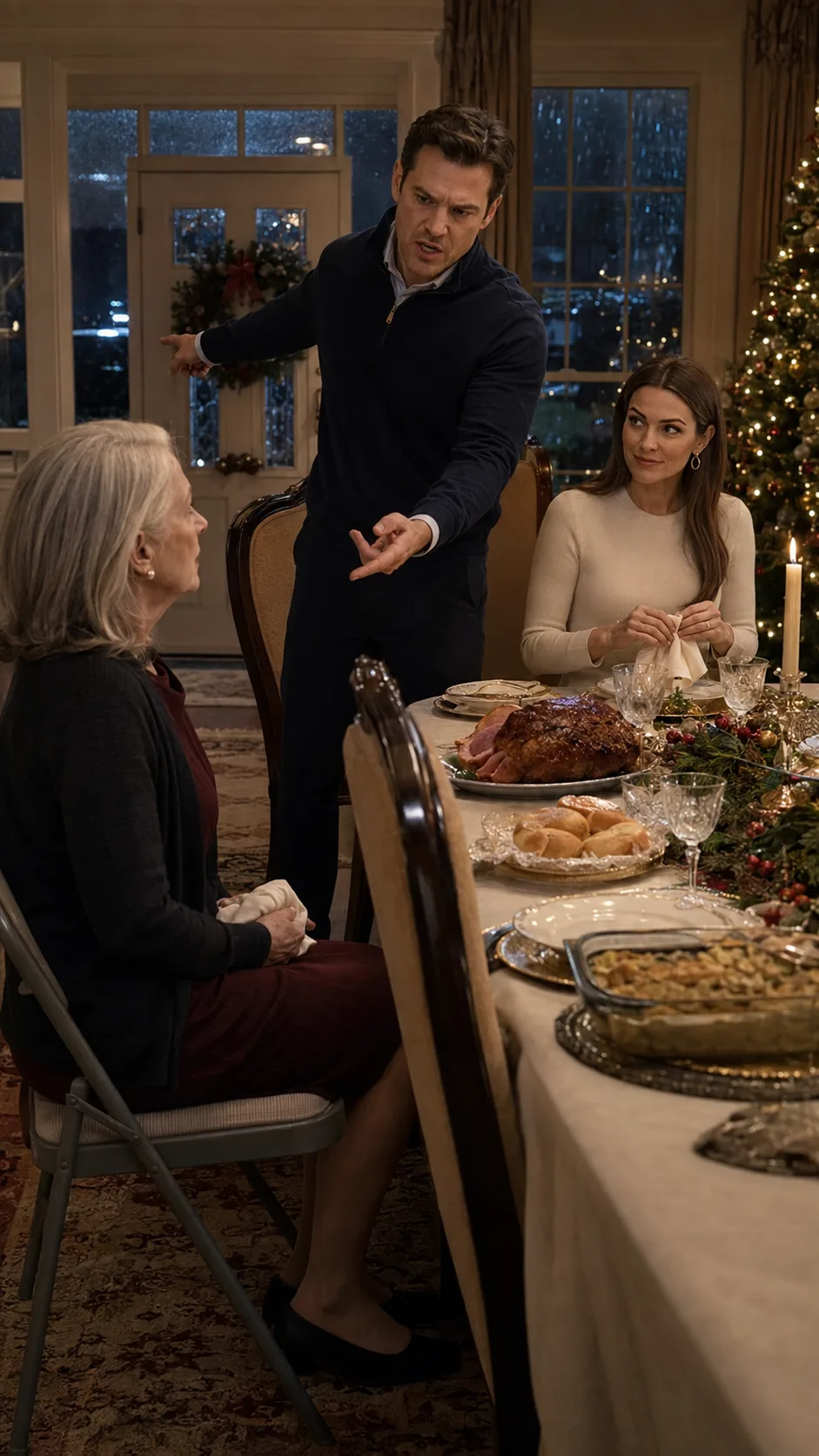
Some nights, when the rental is quiet and the heater kicks on with that familiar metal breath, I think about the dining room at Grant’s house. The polished table. The place cards. The wet dark outside the windows. Mara’s perfect lipstick. Walter’s careful silence. Denise’s hands around the water glass. My son’s finger pointing toward the door as if home were something he had authority to withdraw from me.
And I think about the folding chair.
How easy it would have been to let that be the image that stayed.
My diminished seat. My assigned place. My lesson.
Instead the thing that remains with me now is a different picture.
A small closet in a small rental house.
A metal folding chair standing under three banker’s boxes of records I protected.
My real signature on the documents that mattered.
And the exact calm of knowing that when my son told me to leave and never return, what he really offered—without meaning to, without understanding it, without ever imagining I would accept—was a door.
Not out of my family.
Out of my old role inside it.
I took it.
And if you have ever sat in the only folding chair in a room full of permanent seats, you know exactly why that matters.
THE END.
Chapter complete
You have reached the end of this chapter.
Continue reading
A few more worlds to get lost in after this chapter.




