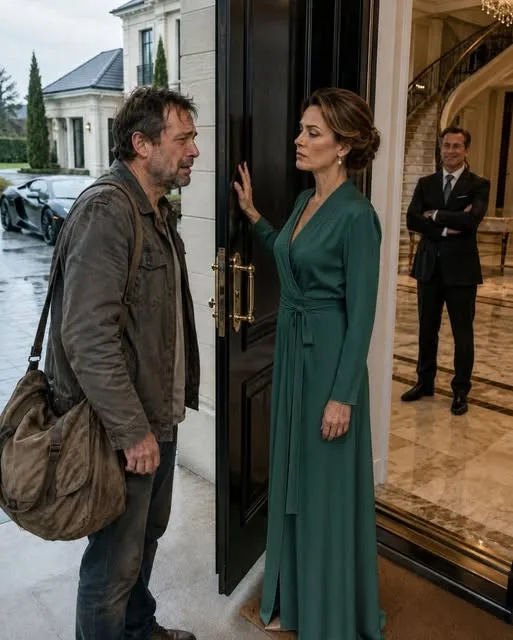
I ran along the railroad tracks until the warehouse disappeared behind a row of abandoned freight cars.
Chapter 3
I ran along the railroad tracks until the warehouse disappeared behind a row of abandoned freight cars.
Rain soaked through my borrowed jacket. My lungs burned. After three years of prison schedules, concrete walls, and guards telling me exactly when to stand, sit, eat, and sleep, freedom had lasted less than a day before I was running from the same people who had stolen it from me once already.
My father stayed on the phone.
“Go two blocks east. There’s a diner called Millie’s. Use the pay phone beside the laundromat across the street.”
“You’re still giving me instructions like I’m twelve.”
“I’m trying to keep you alive.”
That stopped me.
I hung up before I reached the laundromat, then used the pay phone to call the number written inside Rebecca Shaw’s envelope.
She answered on the second ring.
“Michael Sullivan?”
“How did you know?”
“Because your father told me this call would come only if everything had gone wrong.”
“Everything went wrong three years ago.”
There
was silence.
“You’re right,” she said. “Meet me at the county courthouse in forty minutes. Public entrance. Cameras everywhere. Bring the red ledger.”
I almost laughed.
“I just got out of prison. Walking into a courthouse with stolen company records sounds like a bad way to celebrate.”
“They are not stolen. Your father placed them in a trust controlled by my firm.”
That was the first thing anyone had said all day that made me feel the ground beneath my feet again.
Rebecca Shaw was waiting beside the security checkpoint when I arrived.
She was in her early fifties, silver-haired, composed, and carrying two leather folders. She did not offer me a handshake.
She hugged me.
“I’m sorry,” she said.
Those two words nearly broke me more than Grace’s cruelty had.
Rebecca took me into a conference room used by attorneys, closed the blinds, and placed one folder in front
of me.
Inside was my father’s revised will.
Grace had told me the house belonged to her.
It did not.
According to the document, my father had transferred the house, his remaining company shares, and a separate investment account into the Sullivan Family Trust. I was the primary beneficiary. Grace had been granted only a temporary right to live in the home while my father was alive.
If he died—or was declared dead—her right ended after ninety days.
“She has been living there illegally for almost a year,” Rebecca said.
“What about Ian?”
“No inheritance.”
I stared at her.
“My father cut him out?”
“After discovering the theft, yes.”
The second folder contained something more important than money.
A motion to vacate my conviction.
Rebecca had spent eighteen months quietly assembling the original accounting records, sworn statements from two former employees, bank-transfer evidence tied to Ian, and proof that Detective
Mercer had failed to disclose a financial relationship with one of Ian’s shell companies.
“Why wasn’t this filed while I was inside?”
Rebecca’s jaw tightened.
“Your father wanted to. Then he got sick.”
“Poisoned.”
She looked at me carefully.
“So he told you.”
“He also told me he’s alive.”
Rebecca did not react.
That reaction told me everything.
“You knew.”
“I helped him disappear.”
Anger rose so quickly I had to stand.
“You all knew while I sat in a cell.”
“We knew after your second year inside. By then, Ernest was terrified that if we moved too soon, Grace would destroy the remaining evidence or hurt you after your release.”
“I was already being hurt.”
Rebecca accepted that without defending herself.
“Yes.”
The room went quiet.
Then she slid a final document toward me.
It was not legal paperwork.
It was a photograph.
Grace was standing outside a private clinic with Detective Mercer.
The date was three days after my father’s supposed death.
Rebecca said the clinic had treated my father under an alias after toxicology testing showed repeated exposure to a prescription compound capable of causing severe weakness and confusion in high doses.
“Can you prove Grace gave it to him?”
“Not yet.”
“Then what can you prove?”
“That she purchased it.”
My blood went cold.
Rebecca had obtained pharmacy records through a private investigator. The prescriptions had been issued to Grace for a condition she did not have, then refilled four times during the months my father became ill.
“But there’s more,” she said.
She opened her laptop.
A video appeared.
The image was grainy, taken from a camera inside my father’s old home office. Grace entered the room carrying a glass. She set it beside his chair, opened a desk drawer, and searched through papers.
Then Ian walked in.
The audio was faint but clear enough.
“Once he signs the new power of attorney, we don’t need Michael anymore,” Ian said.
Grace answered, “Michael is already gone. Ernest is the problem now.”
I stared at the screen.
Rebecca paused it.
“This is why your father vanished.”
I sat back down.
For three years I had imagined proving my innocence as a clean, beautiful moment. A judge apologizing. A door opening. Everyone finally seeing who I really was.
But the truth was uglier.
It meant my father had doubted me when I needed him most.
It meant the woman he married had used his trust as a weapon.
It meant Ian had watched me go to prison for debts and thefts that belonged to him.
And it meant the detective who escorted me into a courtroom may have known exactly what he was doing.
Rebecca’s phone vibrated.
She looked at the screen, then at me.
“Mercer just entered the courthouse.”
“Why?”
“Probably because someone tracked you here.”
I stood.
“No more running.”
“Michael—”
“No. I ran from the warehouse because my father asked me to. I spent three years obeying people because they controlled every door around me. I’m done.”
I took the red ledger from my backpack.
“If Mercer wants to talk, he can talk where every hallway has a camera.”
We stepped out of the conference room.
Mercer was waiting near the elevators.
Ian stood beside him.
When Ian saw the ledger in my hand, his smile disappeared.
“There it is,” he said loudly. “He stole company property. I want him arrested.”
Mercer reached toward his belt.
Rebecca stepped between us.
“Detective, I suggest you think very carefully before touching my client.”
“He’s on parole.”
“He is also the subject of a pending wrongful-conviction filing that names you personally.”
Mercer’s face changed.
Not much.
But enough.
Ian pointed at me.
“He broke into my mother’s storage unit.”
“No,” Rebecca said. “That unit is owned by the Sullivan Family Trust.”
People in the hallway began watching.
Court officers turned their heads.
Ian lowered his voice.
“You don’t know what you’re doing, Michael.”
For the first time, I smiled.
“I know exactly what I’m doing.”
Then a voice came from behind us.
“So do I.”
Ian went completely still.
Grace, who had just stepped off the elevator, dropped her handbag.
Because standing beside the courthouse doors, thinner than I remembered but very much alive, was my father.
Ernest Sullivan looked directly at his wife.
And said, “Hello, Grace.”
Click the blue “PART 4” below to read the final part: 👉 PART 4 👈
Chapter complete
You have reached the end of this chapter.
Continue reading
A few more worlds to get lost in after this chapter.




