The basement smelled faintly of cedar, dust, and old paint.
Chapter 2
The basement smelled faintly of cedar, dust, and old paint.
Clara turned on the string light and stepped carefully down the stairs, her slippers whispering against the wood.
Her late husband, Martin, had built those shelves himself. Every label was still in his neat handwriting: taxes, insurance, appliance manuals, property records. He had been gone five years, but in that basement, Clara could almost hear him saying, “Keep your papers in order, Clara. People respect paper when they stop respecting promises.”
That morning, she understood him better than ever.
She pulled down the black binder from the second shelf and carried it upstairs to the dining table. The house deed was tucked behind a plastic divider, clean and untouched. Her name was there. Clara Elizabeth Whitmore. Sole owner.
Not Julian.
Not Brenda.
Certainly not Brenda, who had spent the past six months calling the upstairs apartment “our floor,” the backyard “our private space,” and Clara’s laundry schedule “an inconvenience.”
Clara
read the deed slowly. She ran her thumb over the stamped county seal, then over the mortgage satisfaction letter Martin had insisted they frame but never did. Paid in full. Paid by years of sacrifice, skipped vacations, double shifts, and careful budgets.
This house was not a family donation.
It was her life’s work.
By seven o’clock, Clara had made a list. Not an emotional list. A practical one.
Front door lock.
Interior connecting door.
Basement access.
Laundry rules.
Utilities.
Rent.
She began with the thermostat. Julian and Brenda had treated the upstairs like a hotel suite, blasting heat day and night while contributing barely enough to cover one grocery run. Clara opened the utility panel and turned the upstairs heat down to the legal minimum needed to protect the pipes.
“If they need space,” she murmured, “they can stop warming it with my money.”
Next came the borrowed items.
The espresso machine she bought for herself and “loaned” upstairs after Brenda said Clara drank “old lady coffee.” The expensive vacuum cleaner Brenda had used for a year without returning. The holiday serving platters that had migrated to their cabinets. Clara carried every item back downstairs.
She did not touch their personal things.
She did not snoop.
She simply reclaimed what was hers.
By noon, the silence no longer felt lonely. It felt like air returning to a room that had been suffocating for months.
The next day, Clara called Warren Blake, the locksmith her husband had trusted for twenty years. Warren arrived in a gray van shortly after lunch, his hair whiter than Clara remembered, his eyes sharp enough to understand what she did not say.
“Front door?” he asked.
“Front door,” Clara said. “And the interior doors connecting my part of the house to the upstairs apartment. I
want keys that cannot be copied without authorization.”
Warren nodded. “Family trouble?”
Clara looked toward the staircase, where Brenda’s perfume still seemed to linger like a bad mood.
“Boundary trouble,” she said.
Warren smiled faintly. “Those locks are my specialty.”
The drill screamed through the quiet hallway like a tiny machine of justice. Clara stood in the kitchen and listened while each old cylinder came out, each new deadbolt slid into place, each brass plate tightened against the wood.
For the first time in months, the house sounded like it was obeying her again.
On the third day, Clara tackled the basement. Julian and Brenda had taken it over piece by piece: winter tires, broken chairs, unopened boxes, seasonal decorations, Brenda’s unused exercise bike, Julian’s tools scattered near the laundry sink.
Clara put on work gloves and began sorting.
She made no mess. She broke nothing. She labeled everything.
BRENDA — WINTER CLOTHES.
JULIAN — TOOLS.
KITCHEN ITEMS — UPSTAIRS.
OLD FURNITURE — STORAGE UNIT.
Halfway through, she opened a dusty cardboard box and found Julian’s childhood drawings. One showed a small boy standing between a smiling mother and father in front of a crooked blue house. At the bottom, in childish letters, he had written: “My family forever.”
Clara sat back on her heels.
For one dangerous moment, grief softened her anger.
She remembered the boy who used to run into her arms after school. The boy who cried when Martin left for business trips. The boy who once promised, with absolute seriousness, that he would buy her a castle when he grew up.
Then she remembered the man he had become.
The man who looked away when Brenda told Clara not to use her own backyard.
The man who pretended not to hear when Brenda said, “A smaller place would suit you better at your age.”
The man who let his wife send a Christmas Eve text that said, “Don’t call.”
Clara closed the box.
The boy in those drawings was gone, and Clara could not keep sacrificing herself for his ghost.
By the fourth afternoon, every boundary was physical. The basement was locked. The connecting door was locked. The front door had a new deadbolt. Their belongings were boxed and stacked in the storage unit that had always been designated for them, though they had ignored it.
Then Clara sat at the dining table with a blank sheet of paper.
She did not write a speech.
She wrote terms.
Beginning January first, Julian and Brenda would pay fair market rent for the upstairs apartment. Utilities would be split by meter estimate. Laundry hours would be scheduled. Basement access would be restricted. The backyard, garden shed, and downstairs living areas belonged solely to Clara. Overnight guests required written notice. Any attempt to pressure Clara into transferring ownership would result in termination of the living arrangement.
At the bottom, she wrote one final line:
Continued residence depends on respectful conduct toward the homeowner.
She placed the paper on their upstairs kitchen counter.
Beside it, she set one new key.
Only one.
Brenda would hate that most of all.
At 8:07 that night, tires crunched into the driveway.
Clara muted the television.
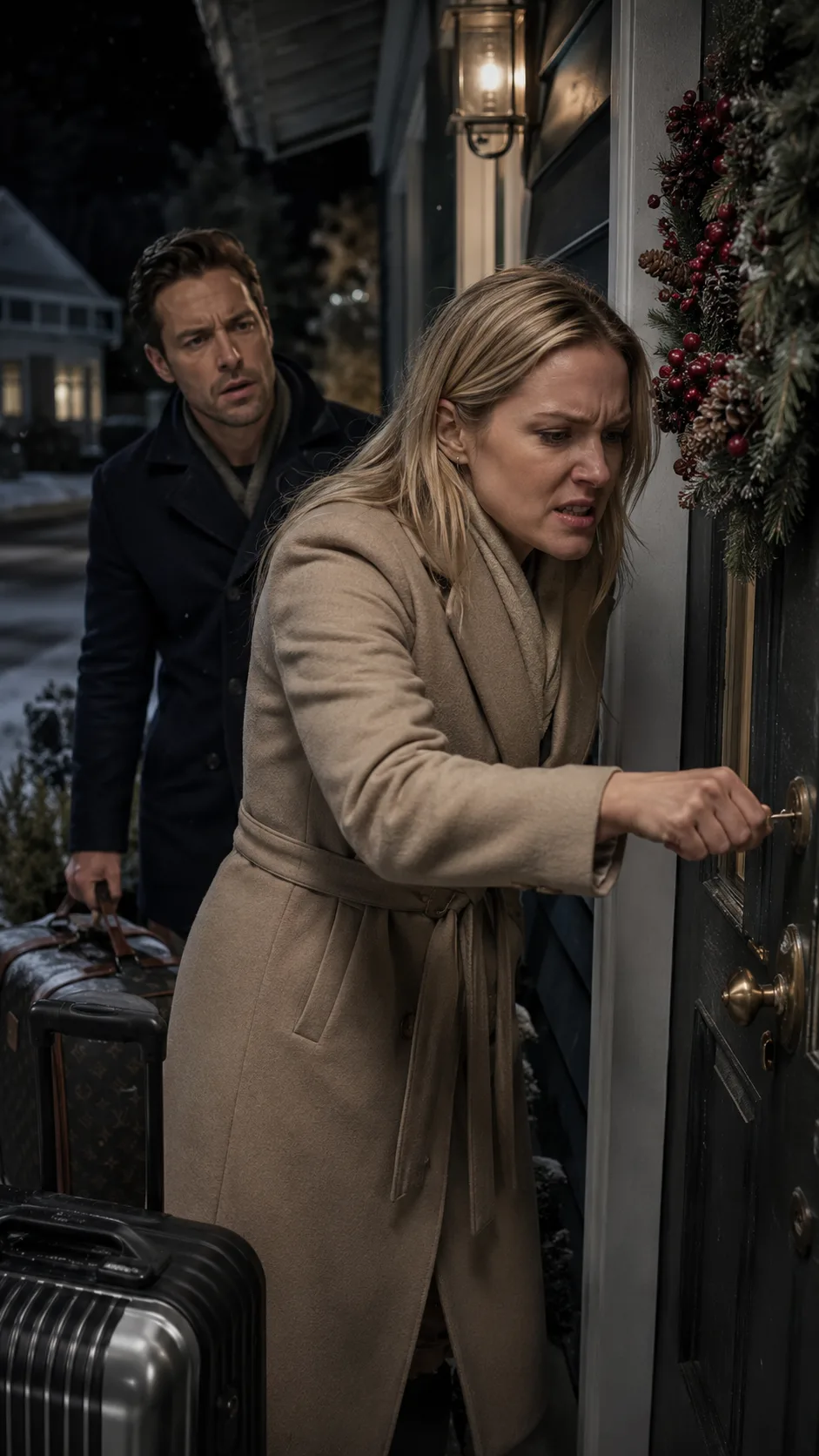
Car doors slammed. Suitcase wheels bumped over the porch. Brenda laughed loudly, the kind of bright, careless laugh she used when she wanted everyone to know she had enjoyed herself.
Then the old key scraped the new lock.
Once.
Twice.
Again.
The laughter stopped.
“What the hell?” Brenda snapped from outside.
Clara remained seated.
The doorbell rang. A long, impatient buzz.
Then came pounding.
“Mom!” Julian called. “Open up!”
Clara waited two full minutes. Then she smoothed her cardigan, walked to the door, and opened it only as far as the new security chain allowed.
Julian stood on the porch, suntanned and startled, one suitcase in each hand. Brenda pushed forward, furious, her beige resort coat open against the freezing night.
“What did you do to the lock?” Brenda demanded. “We just got back from vacation, and you lock us out? Have you lost your mind?”
Clara looked at her calmly.
“You wanted space,” she said. “You told me not to call. I respected your wishes.”
Julian’s face tightened. “Mom, take the chain off.”
“No,” Clara said. “Use the side entrance through the patio. The connecting door to your apartment is unlocked. Everything you need to know is on your kitchen counter.”
Brenda’s mouth fell open.
“You can’t treat us like tenants,” she hissed.
Clara’s eyes did not move.
“In my house,” she said, “that is exactly what you are.”
Then she closed the door.
To be continued… Click “PART 3” to read the final part : 👉 PART 3 👈
Chapter complete
You have reached the end of this chapter.
Continue reading
A few more worlds to get lost in after this chapter.




