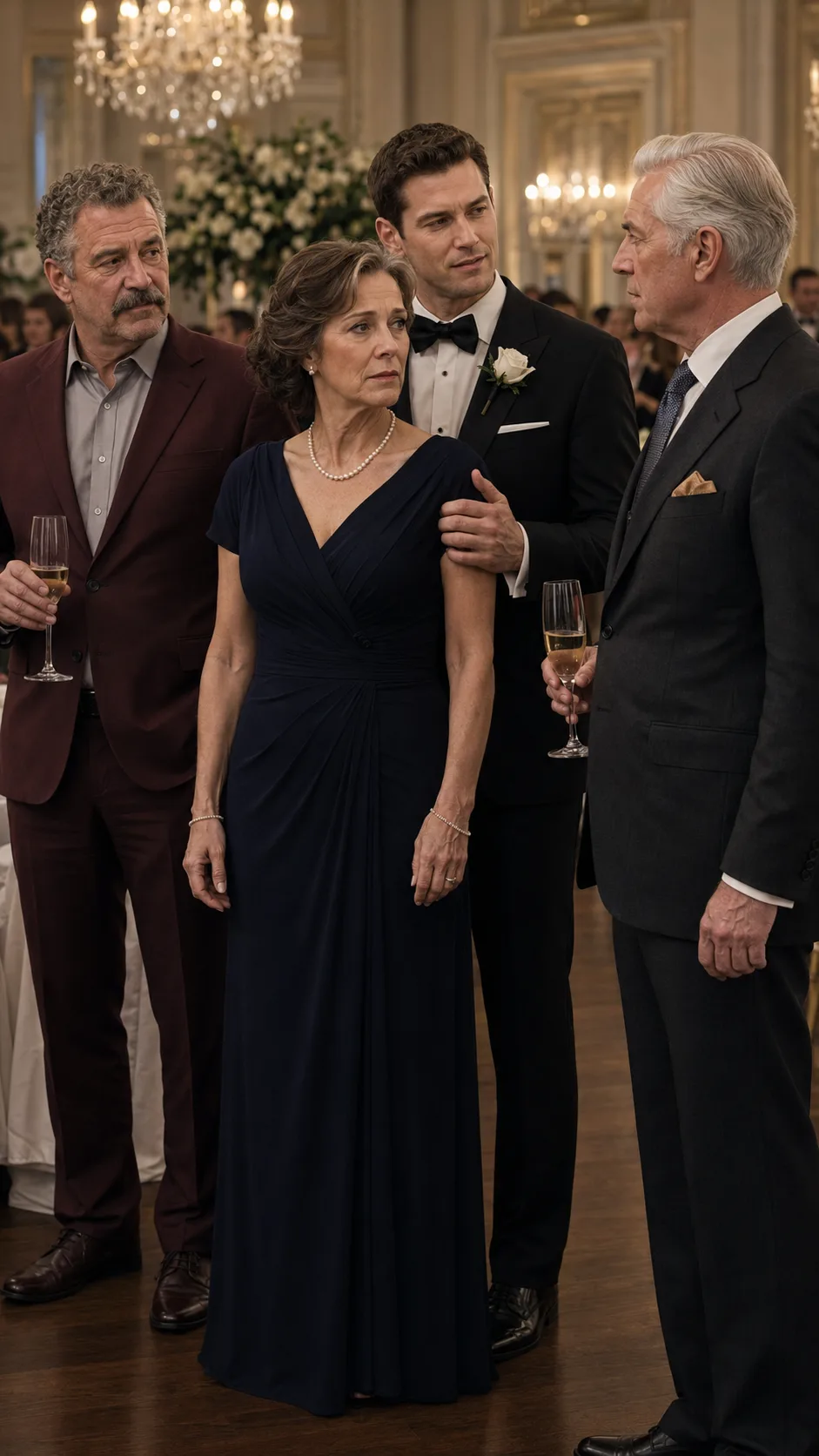
PART 4 — FROM FAMILY FAILURE TO THE FOUNDATION
I absorbed that without showing what it did to me.
Chapter 4
PART 4 — FROM FAMILY FAILURE TO THE FOUNDATION
I absorbed that without showing what it did to me.
Amara knowing before I did.
Reginald’s own daughter carrying this to my door before his office sent the paperwork was not accidental.
Reginald Whitfield did not do anything accidentally.
She apologized then.
Not with preamble. Not with qualifications built around her intentions or her circumstances.
“At the dinner before the wedding,” she said, “you started to answer a question, and I redirected the table. I knew what I was doing. I did it because it was easier than questioning what Deshawn had told me about you.”
A pause.
“That was wrong.”
I looked at her for a moment.
Then I said, “I know you know that. I appreciate you saying it anyway.”
She nodded once and picked up her coat.
I walked her to the door.
We said quiet goodbyes. The genuine kind, not the performed kind.
She stepped onto the porch, and I began to close the door.
She
turned back.
“He married you thinking your name meant nothing,” she said. “My father built a career knowing it meant everything.”
Then she walked to her car.
I stood in the open doorway and watched it until it turned the corner and disappeared.
The street was very still after that.
I stayed in the doorway longer than was necessary.
Silvette called me the following evening and told me everything.
She had been at Amara’s home, a prior arrangement, nothing connected to what was coming.
When Deshawn arrived, she said she offered to leave.
Amara told her to stay.
That detail alone told me everything I needed to know about where Amara had arrived internally.
A woman who asks a witness to remain is a woman who has already made her decision and wants to see whether the other person is willing to tell the truth with someone else in the
room.
Deshawn came in with the energy he always carried when he was managing something.
Shoulders set. Voice calibrated. The specific momentum of a man who had already decided how the conversation would go.
He found Amara in the front room. Composed. Seated. Still in the way that still people are still when they have finished moving in one direction and are not starting another one yet.
He started talking before he sat down.
Silvette said he went through it carefully.
His mother’s sudden visibility was changing the dynamics around the family. Reginald’s interest was creating assumptions. People were beginning to blur personal relationships with business judgment.
He framed everything as concern.
Practical concern.
The kind respectable people hide behind when they want control without appearing controlling.
He said he had reached out to one of Reginald’s senior assistants earlier that week.
Not to interfere.
That was how he phrased
it.
To advise caution.
To suggest that family relationships sometimes complicated business structures in ways outsiders could not immediately see.
That landed more realistically than sabotage.
Management.
That had always been Deshawn’s instinct.
Amara let him finish completely.
Then she said, “You called my father’s office.”
Deshawn went quiet.
“You contacted his staff before speaking to me. Before speaking to your mother. Before speaking to my father directly.”
Silvette said the silence that followed had a specific texture.
The silence of a man realizing a conversation that sounded reasonable in his own head no longer sounded reasonable once spoken aloud in front of someone else.
Deshawn recalibrated quickly.
He said he was protecting the family structure. Said his father-in-law did not understand the emotional history involved. Said outside people were beginning to romanticize his mother’s business reputation without understanding the reality of what their family relationships had actually looked like for years.
Amara did not argue with any of it.
That was what unsettled him.
She simply stayed where she already was emotionally while he kept moving around the room trying to find stable ground.
Finally, she said very quietly, “Do you hear yourself?”
Silvette told me Deshawn stopped speaking after that.
Not because he agreed.
Because for the first time since the wedding, somebody was listening to the shape of what he was saying instead of the polish he used to deliver it.
Amara folded her hands once in her lap before she spoke again.
“My father has spent forty years building partnerships with people who know how to separate ego from judgment,” she said. “You really thought a phone call from a son-in-law was going to protect him from being manipulated?”
Deshawn said he was not questioning Reginald’s intelligence.
Amara held his eyes.
“But you were questioning your mother’s integrity.”
That landed harder because it was true.
Silvette said Deshawn tried one more time after that. Softer this time. Less certain.
He said everything around Verlain suddenly felt strategic. The timing. The visibility. The way people were reacting to information none of them had known before.
Amara listened without interrupting.
Then she said something that ended the conversation.
“I never actually looked at your mother,” she said. “I just accepted the version of her that made you comfortable.”
She let that sit between them.
“And now that I’ve looked for myself, I don’t recognize the woman you described at all.”
Silvette said Deshawn opened his mouth, then closed it again.
Every version of this conversation he had prepared for required Amara to push emotionally so he could redirect the emotion into management.
She never did.
She stayed calm enough that all his explanations lost their camouflage.
There was nothing left to organize after that.
Only himself.
He looked away first.
Amara called her father later that night.
Silvette did not hear that conversation.
She did not need to.
The next morning, Reginald called me directly.
His voice was warm in the specific way of a man whose judgment had just settled firmly into place.
“Expect the proposal by end of week,” he said.
I thanked him.
“No,” he said simply. “Thank you.”
The envelope arrived on a Wednesday morning by courier.
Not email.
Not a digital signature request.
A physical envelope. Cream colored. The kind that announces its contents before you open it.
The kind that says whatever is inside was considered important enough to send by hand.
It sat on my kitchen table for four minutes before I opened it.
Not because I was uncertain.
Because I understood that some things deserve the weight of a moment before you let them change the room.
The document inside was eleven pages. Clean formatting. Precise language. The kind of drafting that comes from attorneys who understand that every word in a structure like this is load-bearing.
I read it from the first line to the last without stopping.
Whitfield-ODM Southeast Development Fund.
My name.
Not a silent position.
Not background capital hidden three layers deep in an operating structure.
A named partnership.
ODM Capital Group listed alongside Whitfield Equity Partners in the structure header, in the fund title, on every page where the principals were referenced.
Twenty-two years of work that had moved mostly through private partnerships and closed rooms without my name attached to it was now attached publicly.
Irrevocably.
I sat with that for a moment.
Then I called Apprentice.
We spoke for forty minutes.
I asked her two questions.
One about the liability structure on the named partnership position. One about the exit provisions if the fund’s direction shifted beyond agreed parameters.
She answered both completely.
When she finished, I told her I would respond by Friday.
She said she would be ready.
I set the phone down and looked at the document on my table.
Word reached Deshawn by Thursday afternoon.
I knew it would.
The professional community in Charlotte moved information quietly but efficiently, especially when Whitfield Equity Partners attached its name to something new.
He called at 4:17.
I watched his name on the screen for two full rings before I answered.
The first thing I noticed was the silence before he spoke. He was searching for the register, the pitch and tone that fit a call he had no template for.
Every previous call he had made to me in his adult life had a shape he already knew when he dialed.
This one had no shape.
I let him find it on his own.
“I heard about the fund,” he said finally. “Your name is on it.”
“It is,” I said.
Another pause.
Longer this time.
“I didn’t realize it had gotten that serious.”
There it was.
Not denial exactly.
Something more reflexive than that.
The final instinct of a man trying to place a ceiling back onto something that had already grown beyond him.
“It was serious before you knew about it,” I said gently.
Silence again.
Then, “Have you decided?”
“Not yet.”
He asked if he could come.
I said yes.
He arrived within the hour and sat across from me at the table where the documents still lay.
Not closed.
Not put away.
Present.
He looked at them for a moment, and then he looked at me.
Not at the story he had carried about me for thirty-four years.
At me.
The specific quality of his attention had changed in the way attention changes when a person finally stops filtering what they are seeing through what they expected to see.
“What do you want?” he asked.
Not what Reginald was offering.
Not what the structure required.
“What do you actually want?”
I looked at my son and understood that this was the first honest question he had ever asked me without trying to guide the answer somewhere useful to himself afterward.
So I answered honestly.
What I wanted was what I had always been building toward.
To have my work stand in public the way it had always stood in private.
To stop being the best-kept professional secret in rooms that had known the deals for years but never the person behind them.
He nodded slowly.
Twice I watched him almost interrupt.
The old reflex was still there. The instinct to explain, reinterpret, soften himself back into the center of the conversation.
But each time, he stopped himself before the words fully arrived.
That mattered to me.
Not because restraint erased what came before it.
Because real change usually announces itself quietly first.
We sat together for another hour.
It was not forgiveness.
It was not reconciliation.
Deshawn was still carrying too much ego for either of those things to happen cleanly yet, and I was too clear-eyed now to mistake a beginning for a conclusion.
But it was real.
Two people having the first honest conversation they had ever managed without trying to win it.
On Friday morning, I signed the proposal and sent it back to Apprentice’s office by nine.
Then I called Silvette.
“It’s done now,” I said.
She exhaled long and slow, the breath of a woman who had been holding something on behalf of someone she loved for a very long time.
Neither of us said anything else.
Neither of us needed to.
There is a particular kind of quiet that lives on the other side of a decision fully made.
Not the quiet of avoidance.
Not the quiet of someone waiting to be talked out of something.
The quiet of a woman who has sat with every version of a choice, turned it over completely, and set it down facing the direction it needed to face.
That was the quiet I carried into the proceedings.
It did not waver.
It did not require maintenance.
It was simply there, the way foundations are there underneath everything, whether or not anyone thinks to look.
The truth was the marriage had been ending for much longer than either of us had said aloud.
The wedding had not destroyed it.
The wedding had simply removed the last excuse for pretending I could still live comfortably inside a version of myself built around being unseen.
Apprentice filed the initial paperwork on a Tuesday.
The asset disclosure was required by law, and I had prepared it with the same precision I brought to every document that passed through my professional life.
Every holding listed.
Every return recorded.
Every year accounted for.
Going back to the first ODM Capital transaction twenty-two years ago, a secondary market position on a mixed-use parcel in Mecklenburg County that had returned four times its entry value inside thirty months.
All of it clean.
Chronological.
Unambiguous.
The full picture of what I had built, attached to a marriage being formally concluded.
Courtland’s attorney called Apprentice’s office three times in one week.
Apprentice told me about the calls without editorializing.
That was her way.
Had always been her way.
The calls were not contests. They were not accusations.
They were the calls of a man trying to understand what he was reading, because the structure of our life together suddenly looked different in retrospect than it had while he was standing inside it.
Each call asked a clarifying question.
Each question revealed another layer of what had existed inside this marriage without being seen.
Apprentice answered everything accurately.
That was all that was required.
Courtland requested a final conversation before the proceedings advanced.
I agreed.
We sat at the kitchen table.
The same table that had held the folders, the cold coffee, the unspoken word, and he did not ask me to stop.
He had enough self-knowledge left to understand that asking me to stop was not a conversation he had earned.
He told me he was sorry.
Not for the wedding.
Not for the folders.
Not for the visible moments that had finally forced everything into the open.
He was sorry for the years before all of it.
For the redirections.
For the casual authority he had worn so naturally he had mistaken it for normal.
For building his understanding of our marriage around an assumption I had quietly carried for decades because correcting it every day would have required becoming someone exhausted all the time.
It was the most precise apology I had ever received.
I thanked him directly.
Without the softening I would have applied to those words ten years ago.
Then I told him it changed nothing about my decision.
He nodded.
Not the nod of a man accepting defeat.
The nod of a man accepting truth.
There was a difference, and he had finally learned it.
We sat together for a few more minutes without speaking.
Two people at the end of something that had been long and real and had slowly become unsustainable in ways neither of us had fully named when they were happening.
I did not rush it.
Some endings deserve to be sat with, not managed away.
Then I stood and walked him to the door.
We said goodbye the way people say goodbye when they mean it and know it is final.
Simply.
Without theater.
I closed the door and walked back through the house alone.
Past the kitchen.
Past the front room.
Past the office where the three folders still sat in their drawer, exactly where I had returned them.
I did not stop.
I kept walking until I reached the window at the end of the hall. I stood there and looked out at the street.
The same street.
The same neighborhood.
The same quiet that had surrounded this house for twenty-two years while everything inside it shifted without anyone outside knowing.
Friday was four days away.
I thought about what it held, and I felt something move through me that I had not felt in a very long time.
Not happiness.
Happiness was too light for what this was.
Something underneath happiness.
Something that did not depend on circumstances or other people’s recognition to sustain itself.
Something that had been there the whole time, waiting for the house around it to finally get quiet enough to hear.
My name was on the materials at the door.
Not buried in the fine print.
Not listed as a silent contributor in an appendix nobody reads.
On the materials at the door.
The program handed to every person who walked into that room.
The banner behind the podium.
The fund title on every surface that carried a title.
Whitfield-ODM Southeast Development Fund.
My name joined to work that had always been mine.
Finally standing in public the way it had always stood in private.
I arrived early, not from anxiety, but from habit.
I had always done my best thinking in rooms before they filled.
I stood near the window with coffee I actually drank this time and watched the space come alive around me.
Caterers. Event staff. Reginald’s team. All arranging materials with the quiet efficiency of people who understood that the details of a room announce its intentions before anyone speaks.
One of the event coordinators handed me a program and moved on without a second glance.
I looked at my name on it for exactly one moment.
Then I folded it and put it in my bag.
I did not need to hold it to know it was real.
The guests arrived the way guests always arrived at events like this.
In clusters.
In conversation.
In the specific social geometry of people who already knew each other and were here to make that knowing official in a new context.
Within thirty minutes, I had been approached by people from four different firms.
Some I recognized from Reginald’s earlier gathering.
Some were new.
None of them approached me with surprise anymore.
That was the difference.
The recognition had settled.
A woman from Atlanta asked whether I still believed secondary corridor redevelopment was being undervalued in the Carolinas.
A developer from Nashville referenced a position I had taken years ago that his partners initially thought was too aggressive until the returns forced them to reconsider.
Another man simply shook my hand and said, “I’ve been hearing your name for years.”
Not admiration.
Acceptance.
The room had already made space for me before I entered it.
I received each conversation the way I had learned to receive accurate things.
Directly.
Without deflecting.
Without performing modesty I did not feel.
Reginald found me near the center of the room when the formal program began.
He introduced me to the assembled guests the way a man introduces someone whose work has earned every word he is about to say.
By name.
By history.
By the specific decisions that had shaped the landscape everyone in that room operated inside.
Not as someone’s mother.
Not as anyone’s wife.
As Verlain Odum.
As ODM Capital Group.
As the woman who had seen what other people missed and moved before the window closed.
It was the introduction I had been owed for twenty-two years.
And for one brief moment, one small private moment, I felt it.
Not triumph.
Something deeper and far more human than that.
Relief.
The exhaustion of carrying something valuable alone for so long finally loosened its grip by a single degree.
I let myself feel it exactly once.
Then it passed.
I stood straight with both feet on the ground and received the room without performance.
I found Deshawn with my eyes before he found me with his.
He was near the far edge of the room, present but peripheral, the body language of a man still learning how to exist inside a room that no longer revolved naturally around him.
Amara was thirty feet away in a separate conversation.
Her posture was open and engaged, already moving through this room on her own terms.
She had not come as anyone’s wife tonight.
She had come as herself.
Deshawn watched me receive what he had spent years deciding I had not earned.
I did not look away.
Neither did he.
And for the first time since the wedding, I saw something in his face that had nothing to do with confusion or defensiveness or recalculation.
Grief.
Not for the fund.
For the years.
For the version of me he had accepted because it required less from him than seeing me clearly would have.
What passed between us across that room was not forgiveness.
Forgiveness would come later, slowly, in ordinary moments, if it came at all.
It was not war, either.
It was something quieter and more permanent than either.
It was two people finally seeing each other accurately.
I turned back toward the room.
Toward the work.
Toward the name on the banner behind the podium.
Toward the version of myself I had built across twenty-two years of early mornings and closed doors.
Toward the specific discipline of a woman who understood that the work was always worth more than the argument about the work.
I was not performing power.
I was simply no longer hiding from it.
They introduced me as the failure.
He already knew me as the foundation.
THE END.
Chapter complete
You have reached the end of this chapter.
Continue reading
A few more worlds to get lost in after this chapter.