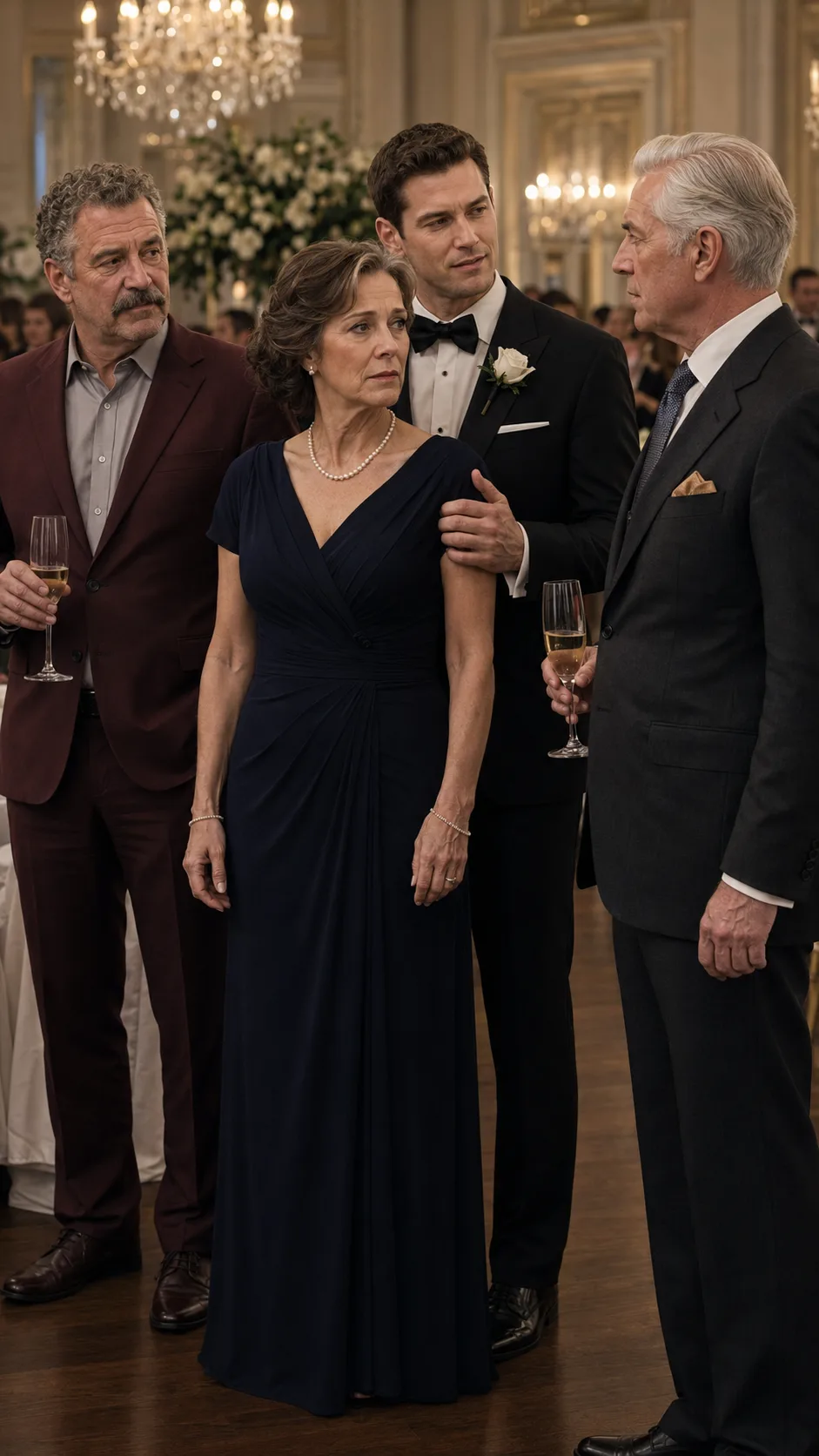
PART 2 — THE NAME THAT CHANGED THE ROOM
Reginald moved naturally, the way men of his standing always move in rooms, without urgency and without performance.
Chapter 2
PART 2 — THE NAME THAT CHANGED THE ROOM
Reginald moved naturally, the way men of his standing always move in rooms, without urgency and without performance.
He turned slightly to his left and introduced me to the two associates still flanking him.
First name only.
No title offered.
No context given.
“Verlain.”
The way you introduce someone whose name is expected to do its own work.
It did.
The first associate, a compact man in a charcoal suit, extended his hand and said, “I didn’t realize that was all.”
Three words carrying the specific weight of someone recalibrating a room they thought they already understood.
The second associate, a woman with close-cropped hair and reading glasses pushed up on her forehead, held my hand a half second longer than a standard greeting required.
“ODM Capital,” she said quietly.
Not a question.
I smiled and said it was good to meet them both.
Across the room, Deshawn had not moved.
Courtland found me within minutes. He came close enough that his voice would not carry and tilted
his head toward Reginald with the expression he always used when he wanted to appear casual about something that was eating at him.
“How do you know that man?” he asked.
I looked at him and let the question sit for exactly one beat.
Then I smiled, the same smile I had been giving Courtland for thirty-two years when I decided a conversation was not worth having.
“We’ve crossed paths.”
He waited for more.
I picked up a fresh glass from a passing tray and turned slightly toward the room.
That was the end of that.
What I noticed next was Amara.
She had positioned herself near her father with the practiced ease of someone close enough to observe and far enough not to intrude. She was studying his face the way you study something that is behaving outside its pattern.
Reginald Whitfield had attended dinners with senators, closed rooms
with developers worth nine figures, and stood in circles that moved serious money. Amara had watched all of it. She knew exactly how her father looked in those rooms.
He had never looked at anyone the way he had just looked at me.
I watched her watching him, and I remembered something.
Three weeks before the wedding, at a dinner in Deshawn’s home, someone had directed a question toward me about my background. Amara had answered before I finished my first sentence. Smooth. Warm. Seamless. Then she had steered the table somewhere else entirely.
She had not been cruel about it.
She had simply decided in that moment that my answer was not necessary.
I had filed it then.
I filed this moment now.
Same drawer.
No urgency.
The band shifted into something slower. Conversations resumed their natural shape around us. The room settled back into its version of normal.
It was not the same room it had been forty minutes earlier.
Only two people in it understood that fully.
Reginald caught my eye from across the space. A single glance, unhurried and deliberate, and then he nodded once.
The specific nod of a man confirming something that did not need to be spoken aloud.
I nodded back.
Deshawn saw it.
I know because I saw him see it.
The stillness moved through his body like something cold, finding no exit. He did not know what had just passed between us.
He knew it mattered.
Reginald Whitfield did not summon me. He simply began moving toward the quieter end of the room and left just enough space beside him that the invitation was clear without being stated.
That was the language of a man who had never needed to ask twice for anything.
I followed.
We settled near a stretch of wall away from the band, away from the bar, away from the warm cluster of wedding noise. He turned toward me with the full attention of someone who had been waiting to have this conversation longer than I had known it was coming.
“Your attorney is Apprentice Ware?”
Not a question.
“Has been for twenty-two years,” I said.
He nodded once, the way men nod when a detail confirms something they already suspected.
“Eight years ago, my team was working a Southeast Corridor acquisition,” he said. “Different asset class, different market position, but the same structural fingerprint as a repositioning that had moved through Charlotte a few years earlier. My attorney flagged it. Said the prior move was cleaner than anything he’d seen in that space.”
He paused briefly.
“He reached out to Apprentice’s office for background. She said the principal preferred to remain private. My team respected that.”
A faint shift appeared at the corner of his mouth.
“I remembered the name anyway.”
“ODM Capital,” I said.
“Odum Capital,” he repeated. “And then tonight, your son introduced you, and you said your last name.”
He stopped.
A short exhale through the nose. Almost a laugh, but quieter than that.
“That was all it took.”
I had said my name the way I always said it. Plainly. Without decoration.
I had not known that one word had been sitting in Reginald Whitfield’s professional memory for eight years, waiting for a face.
“The Charlotte repositioning saved that project,” he said. “I don’t use that word loosely. Half the room thought the corridor had peaked already. You moved before the institutional money caught up.”
He looked at me directly.
“That changed the outcome for everyone downstream from it.”
“It was a calculated decision,” I said. “The fundamentals supported it.”
“They did,” he agreed. “But plenty of people see fundamentals and still hesitate. Timing is usually where people fail.”
There was no performance in the conversation. No showing off. No need to establish credentials either of us already understood.
We spoke in the natural shorthand of people who had spent years reading the same landscape from different corners of it.
It was the most honest conversation I had been part of in years.
No translation.
No softening.
No careful editing of myself before the words left my mouth.
I had forgotten what that felt like.
I became aware of Deshawn before he spoke. He had positioned himself close enough to hear fragments and far enough away to pretend he was not listening.
What he was hearing made no sense to him.
I could feel it in the way he kept shifting his weight, recalibrating, trying to find an angle that made this version of his mother fit the one he had carried his entire adult life.
It did not fit.
It was never going to fit.
He stepped forward finally and touched Reginald’s arm lightly.
The social interruption dressed as familiarity.
“Mr. Whitfield, I hope she’s not talking your ear off.”
A laugh followed it, rehearsed, landing badly.
Not cruel enough to challenge directly. Just dismissive enough to shrink the moment back into proportions he understood.
Reginald turned slowly toward him.
The expression on his face was not unkind. That would have been easier for Deshawn to process.
It was something more unsettling than unkind.
Patient. Measured. Completely without social cushioning.
The look of a man quietly reassessing another man in real time.
For a brief second, nobody spoke.
Then Reginald said very evenly, “Your mother and I were discussing a project that impacted half this corridor.”
Nothing aggressive in the sentence.
That was what made it land.
Deshawn’s smile faltered almost invisibly at the edges. He glanced at me then, quickly, instinctively, like he was checking whether I intended to rescue him from the moment or expose him further inside it.
I did neither.
Reginald returned his attention to me with calm finality, and Deshawn’s laugh disappeared before it fully finished.
Amara Whitfield Odum had been watching her father since she was four years old. I knew this the way you know things about people who have never spoken them to you. Through observation. Through pattern. Through the specific quality of attention a daughter gives a father she has spent her whole life studying.
She knew every register of Reginald Whitfield.
She knew what his face did when he was being polite to someone unimportant.
She knew what his posture did when he was genuinely engaged.
She had been reading him across rooms since before she understood what reading a room meant.
Which is why when she found him between conversations near the back of the venue, she was not asking casually.
I was twenty feet away with a clear sight line and nothing to do but watch.
I could not hear them.
I did not need to.
Amara asked something direct. Chin level. Hands still. The body language of a woman who wanted a real answer and intended to know whether she was receiving one.
Reginald listened to the full question before he responded.
He answered carefully. Measured words. Deliberate pacing. The specific delivery of a man who was not lying, but was not volunteering everything either.
He was handing his daughter the tools and letting her build her own conclusion.
She was her father’s daughter.
She would build it correctly.
She returned to Deshawn’s side three minutes later. To anyone else in that room, she looked exactly the same. Composed. Beautiful. The bride at her own reception, moving through the evening with ease.
But I had been watching her before she went to her father, and I was watching her now.
Her posture had changed by three degrees.
Something behind her eyes had quietly rearranged itself.
Deshawn did not notice. He was already mid-story with two friends from his professional circle. One hand gesturing. The other holding his glass at the angle he had always held it when he was performing comfort.
I watched him reach the part of whatever story he was telling that required a light reference to me.
I knew the shape of it before the words arrived. I had heard its variations for years, and he delivered it with the easy confidence of a man who had never once been challenged on that particular material.
His friends laughed.
Amara picked up her glass and looked at the table.
Not at him.
Not at his friends.
At the table.
The white linen. The centerpiece. Somewhere that was not the source of the laughter.
That was the first time she did not follow him.
Small. Quiet.
Most people in that room would have missed it entirely.
But I have been reading small and quiet my entire life.
Small and quiet is where everything that matters begins.
She had not turned. Not yet.
But she had stopped moving in the direction she came in.
And in my experience, when a woman of her particular intelligence stops moving in one direction, she is already choosing another.
The evening wound toward its close. The band softened. Guests began the slow drift toward exits.
Reginald found me one final time near the entrance hall, unhurried and deliberate, as though he had been saving this moment.
“I’d like to send something to your office next week,” he said. “If that’s agreeable.”
“That’s fine,” I said.
Neither of us explained what that meant.
Neither of us needed to.
His associate, the woman with the reading glasses from earlier, approached, and I gave her my professional contact.
Not my home number.
My office line.
The one that rang at Apprentice Ware’s suite on Tryon Street.
I felt Deshawn watching from across the room.
I did not look up.
What was tightening in his chest at that moment was his own business.
I had spent enough years managing his comfort.
Tonight, that work was finished.
Three weeks after the wedding, Deshawn hosted dinner.
That was how I knew he was unsettled.
Deshawn did not host family dinners out of warmth. He hosted them out of strategy. When something in his world shifted outside his control, he pulled people back into a room he owned and reset the order of things from the head of his own table.
I had watched him do this since he was twenty-six years old.
I recognized the move the moment the invitation came.
I came anyway.
I always came.
His home was handsome. Good furniture. Good lighting. The kind of deliberate, tasteful arrangement that announced ambition without quite achieving ease.
Amara had set the table herself. She greeted me at the door with both hands and held the contact a half second longer than she used to.
I noted it.
Said nothing.
The guest Deshawn had invited was a man named Gerald Fitch, a commercial real estate broker in the Southeast Corridor with fifteen years in the market.
Deshawn introduced him with the specific energy of someone displaying a new connection, the Whitfield name already doing its work in the introduction.
Gerald Fitch had the handshake of a man who understood that tonight’s dinner was partly social and partly evaluation.
The meal moved the way those meals always move. Careful conversation. Probing questions dressed as small talk. Everyone performing a version of themselves slightly more polished than the one they arrived with.
Courtland talked about his years in corporate.
Deshawn talked about his current projects.
Gerald Fitch listened well and chose his moments.
His moment came over the main course.
He was discussing the Southeast Corridor, the market shifts, the developments that had shaped parts of its trajectory over the last decade. When he mentioned the Charlotte repositioning, he did not do it dramatically. He said it the way professionals reference deals that quietly changed how people in their field thought afterward.
He named the development. Described the point where financing tightened and several firms backed away. Described the repositioning structure that stabilized it before the wider market fully understood where the corridor was heading.
He shook his head once.
“That was one of those deals people still bring up in investment conversations,” he said. “Not publicly. Most people outside commercial real estate wouldn’t know it. But in the market, people remember who moved early.”
Courtland leaned forward slightly.
“Who was behind it?”
Gerald Fitch cut into his food before answering.
“Private investment group. ODM Capital.”
The words landed lightly from his mouth and heavily everywhere else.
He continued without noticing immediately what had happened at the table.
“They kept a low profile. Didn’t chase publicity. That’s part of why people respected the move so much. No interviews, no conferences, just good positioning and good timing.”
The table went quiet.
Not the quiet of an empty moment.
The quiet of a specific weight settling over specific people, each processing the same two words at different speeds.
I reached for the bread basket, passed it to Amara, and kept my eyes on my plate.
Gerald Fitch looked between us then, finally sensing the shift.
Deshawn picked up his wine glass too quickly.
“You’ve mentioned them before,” he said, aiming for relaxed and landing somewhere noticeably tighter.
Gerald nodded.
“Anybody who spent enough time around Southeast commercial development has heard the name at some point. Mostly through attorneys, lenders, acquisition circles. Nobody really knew much about who was behind it.”
Courtland looked at me.
I met his eyes for exactly one second.
No expression offered.
Nothing confirmed.
Nothing denied.
Then I returned to my plate.
The name was already in the room.
It did not need my help to land.
The dinner ended forty minutes later. No one proposed dessert. No one suggested coffee.
Deshawn walked Gerald Fitch to the door with the nicely flattened energy of a man whose evening had not gone the direction he intended.
Amara cleared the table in silence.
Courtland drove us home without speaking.
The house was dark when we arrived. I went upstairs, changed, and got into bed.
Two hours later, I came down for water.
He was at the kitchen table, both hands flat on the surface, the same untouched glass from before dinner still in front of him.
He looked up when I came in and opened his mouth.
I looked at him gently.
“Get some rest, Courtland.”
Then I went back upstairs.
He was still at the table when I reached the top of the stairs.
I could feel it without looking.
Reginald Whitfield hosted the way he did everything else, without waste.
His home was substantial without being excessive. The kind of space that announced its owner had nothing left to prove.
Forty guests, maybe forty-five. The professional community that moved in his orbit. Developers. Attorneys. Fund managers. People whose names appeared on buildings and legal structures rather than social pages.
The kind of room where conversations meant something because everyone in it understood the cost of words that did not.
I had been in rooms like this before.
Not as a guest of Reginald Whitfield.
As myself.
That distinction mattered tonight.
Within twenty minutes of arriving, I had been pulled into three separate conversations that had nothing to do with introductions and everything to do with recognition.
Not celebrity recognition.
Professional memory.
A developer from Huntsville mentioned a secondary market repositioning from eleven years earlier and asked whether I still believed smaller corridor acquisitions were being undervalued in the current market.
A woman who managed a regional fund referenced Apprentice Ware in the shorthand of someone who had crossed paths with her firm repeatedly over the years.
Another man, older and careful with his words, listened to me speak for less than two minutes before saying quietly, “ODM Capital. I thought that might be you.”
No one made a spectacle of it.
That was what made it real.
Rooms like this did not gasp.
They recalibrated quietly.
I received each conversation the way I received all accurate things. Directly. Without performance.
Deshawn stood twelve feet away and watched all of it.
I did not look at him.
I did not need to.
I could feel the specific quality of his stillness from across the room. The stillness of a man realizing the room was responding to his mother before it was responding to him.
That was new for him.
Reginald found Deshawn near the bar midway through the evening. I observed it from a distance.
A brief exchange.
Reginald’s posture open and cordial. Nothing in his body language would signal to anyone watching that this was anything other than a father-in-law making conversation with his daughter’s new husband.
He asked Deshawn something.
Deshawn answered.
Reginald nodded once and asked another question, slower this time. Something longer.
Deshawn responded with the slightly elevated energy of a man trying to sound more informed than he actually felt.
Reginald listened completely. Not interrupting. Not correcting.
Then he asked one final thing.
I saw Deshawn hesitate before answering that one.
Only for a second.
Most people would have missed it.
Reginald did not miss it.
He gave that same deliberate nod I had already learned meant confirmation rather than discovery. Then he said something brief, touched Deshawn lightly on the shoulder, and moved back into the room.
Deshawn remained at the bar alone for several seconds longer than was natural.
Not embarrassed.
Disoriented.
That was the word for it.
For the first time in his adult life, he had entered a room where his understanding of status did not fully apply. The hierarchy he had built his confidence around was shifting beneath him in real time, and he did not yet know where to stand inside it.
He found me before the evening ended.
His approach was different from every approach he had made toward me in his old life.
Less momentum.
More caution.
The way you approach something you have recently learned may contain more history than you were given.
“What do you and Reginald talk about at these things?” he asked.
“Work,” I said.
He waited.
I let him wait.
Nothing else came because nothing else was necessary.
His jaw moved slightly. He nodded in the way people nod when they are accepting an answer they do not know how to challenge.
Then he asked something he had never asked me before.
“How long have people known your company name?”
Not accusatory.
Not even defensive anymore.
Just trying to understand the size of the room he had walked into without realizing it.
“A long time,” I said.
That answer unsettled him more than anything else I could have offered.
He and Amara left forty minutes later. I watched them from near the entrance as they said their goodbyes.
Deshawn’s hand was at Amara’s back, the same practiced placement he had used to steer me across the wedding reception six weeks before.
She moved with it.
But her eyes were elsewhere.
I learned what happened in the car three days later from Amara herself.
Deshawn had said her father seemed unusually interested in his mother.
Amara had looked out the passenger window for a long moment before she answered.
“Maybe he just recognizes quality.”
Deshawn had said nothing for the rest of the drive.
The car had been very quiet.
Click the blue “PART 3” below to read the next part: 👉 PART 3 👈
Chapter complete
You have reached the end of this chapter.
Continue reading
A few more worlds to get lost in after this chapter.