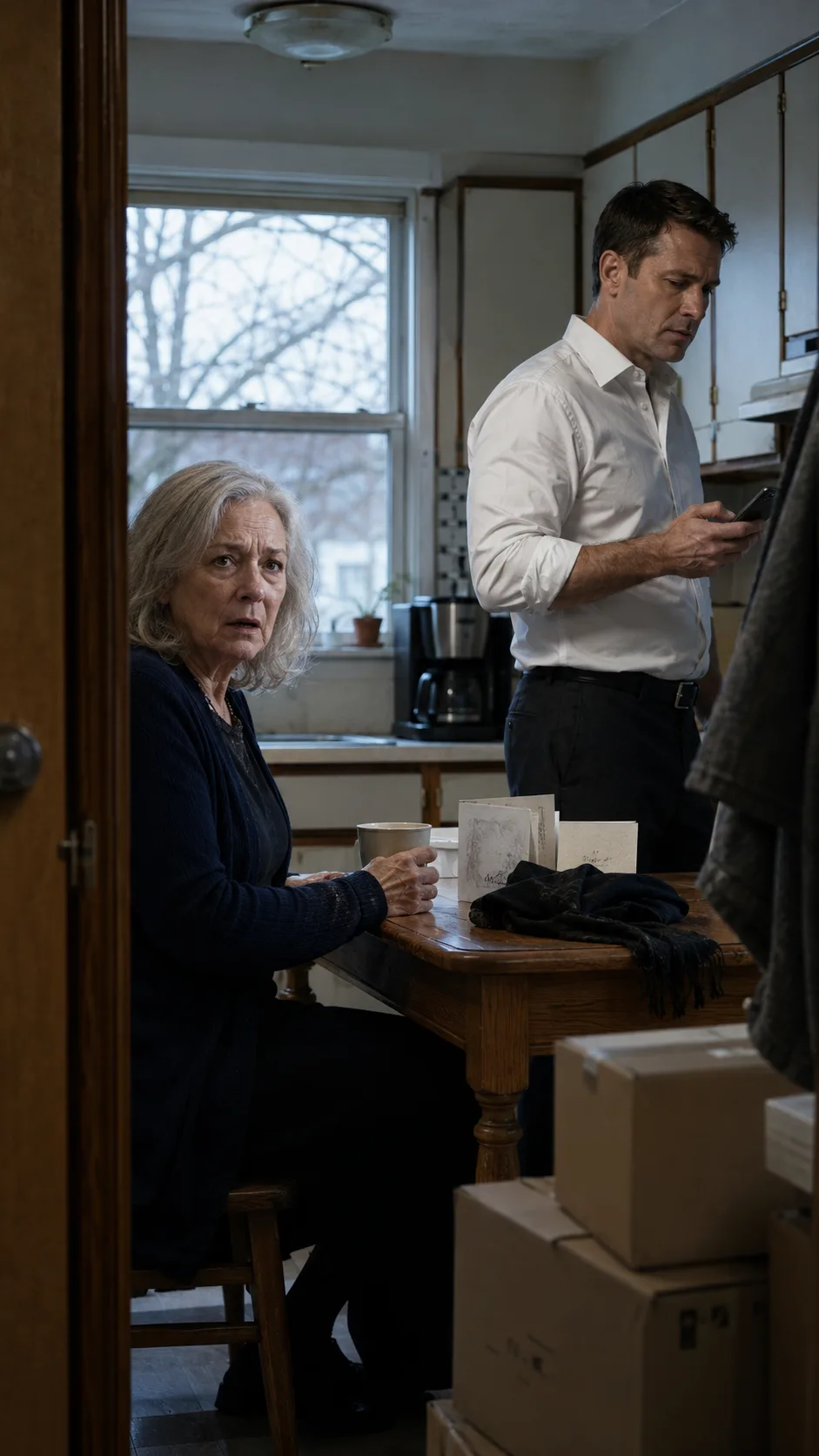
AFTER MY HUSBAND PASSED AWAY, MY SON TOLD ME TO GET A JOB OR LEAVE HIS HOUSE
— PART 3: THE QUIET LIFE I BUILT AFTER MY OWN SON TRIED TO ERASE ME
It was a Thursday afternoon when I made the final decision.
Chapter 3
AFTER MY HUSBAND PASSED AWAY, MY SON TOLD ME TO GET A JOB OR LEAVE HIS HOUSE
— PART 3: THE QUIET LIFE I BUILT AFTER MY OWN SON TRIED TO ERASE ME
It was a Thursday afternoon when I made the final decision.
I had just come back from Sandra’s office with the last set of legal documents. We had reviewed everything. The forged signatures. The unauthorized withdrawals. The mortgage Bradley had taken out behind my back.
She had prepared the motion to nullify the refinance and reclaim my financial authority.
It was time to act.
Back at Terry’s, the house was quiet. The sun poured through the living room window, casting long patterns across the carpet.
I made tea, sat at the dining table, and pulled out the envelope I had been adding to for weeks.
Inside were copies of every document Sandra and I had filed, along with a letter I had written by hand.
No accusations.
No anger.
Just the facts.
A mother explaining what her son had done to her and why she had no choice but to stop him.
I sealed the envelope and set it aside.
Then
I walked into the den, opened Charles’s old laptop, and logged into my joint accounts for the last time.
I transferred the remaining balance to the new trust Sandra had helped me create.
The name on the trust was not mine.
It was simply titled the Merrick Fund for Women Starting Over.
It was not large, but it was real. Enough to support a small group of women each year. Women who had nowhere else to go.
Women like me.
I had added Terry’s name as co-founder, not because he asked, but because I wanted someone beside me who knew what it meant to rebuild quietly.
The next day, I returned to the house where Bradley and Melanie lived.
It was late morning. The driveway was empty.
I let myself in using the key I had never returned. Everything was still in its place. The furniture. The faint scent of
cinnamon from the plug-in near the hallway. The framed school pictures of the kids on the wall.
I stood in the foyer and took a deep breath.
I did not walk past the living room.
I did not go upstairs.
I walked to the kitchen table and placed the envelope in the center.
Then I took off my house key, laid it beside it, and turned to leave.
I paused at the door.
Just a second.
Just long enough to feel the full weight of the moment.
I was not running. I was not hiding.
I was stepping away from something that had already let me go a long time ago.
Back at Terry’s, he was finishing lunch. He looked up as I walked in, gave a small smile, and patted the chair next to him.
We did not talk about where I had been.
That evening, I sat on
the porch and watched the sky turn from gold to blue.
The quiet did not feel like loneliness anymore.
It felt like space.
The kind you make when something ends.
The kind you need when something new is about to begin.
I had no interest in revenge.
I did not want a confrontation.
I wanted closure.
Not for them.
For me.
I thought of Bradley and how he would react to the letter. Whether he would deny it. Whether he would feel anything at all.
But then I let that thought go.
It did not belong to me anymore.
What mattered was that I had spoken.
I had moved.
I had drawn the line.
And it would hold.
It was just after breakfast when Terry slid a small box across the table.
He did not say a word. He just looked at me with that same calm steadiness I had come to know again. The one that never asked for anything but always left room for everything.
The box was dark wood, polished but simple.
Inside was a ring. Gold, delicate, with a single sapphire in the center.
I recognized it immediately.
It had belonged to his mother. I had seen it once when we were both still teenagers, back when marriage was something we whispered about under porch lights, not something we thought would circle back to us in our seventies.
I picked it up and let the weight of it settle in my palm.
He said only one thing.
He told me there was no rush. That it did not have to mean anything more than what we already were. But that if I wanted, we could share the rest of the days we had.
I did not cry.
I did not need to.
I nodded once.
That was all.
The following week, we married quietly at the courthouse.
No flowers. No formal vows. Just the two of us, the judge, and one woman from the front office who kindly agreed to take our photo.
I wore a blue dress I found at the back of my closet. Terry wore a gray suit that did not quite fit at the shoulders but made him look proud.
When we walked outside, the sky was overcast, but the air was soft.
We held hands all the way back to the car.
Back at the house, I made lunch while he sorted through a stack of music sheets he had kept over the years.
He had started playing again.
Not often, but enough.
Sometimes just a phrase. Sometimes a full piece.
He told me he wanted to host something small. A gathering. Nothing big. Just people he trusted and music.
A few of his old students had stayed in touch. They had offered to help if he ever decided to play again.
I agreed quietly.
Happily.
We set a date, sent out a few handwritten invitations, and called it an evening recital.
No fundraiser. No speeches.
Just music.
I spent the following days preparing the house, polishing the piano, rearranging the chairs, setting out glasses for tea and sparkling cider.
Terry practiced in the afternoons. I could hear the notes drifting through the rooms, sometimes shaky, sometimes strong.
The day of the recital came, and the house filled with soft voices and warm light.
Terry played three pieces.
One was a composition I had never heard before.
When it ended, he looked at me, then at the room, and said the title.
“Joanne in Spring.”
There was no applause.
Not right away.
Just stillness.
Then one person clapped. Then another. Soon, the whole room was echoing with gentle hands.
I stood in the corner watching, letting it all pass through me.
Not pride. Not surprise.
Just something fuller.
Something real.
After everyone had gone, Terry and I sat on the couch with our shoes off and our legs stretched out.
We did not talk much.
We did not need to.
I had started this year feeling like a shadow, fading into the corners of a life I thought no longer had space for me.
But here, in this house, in this quiet, I had found a rhythm again.
Not the same one I had before.
But mine.
The letter came three days after the recital.
Postmarked from our old neighborhood.
No return address. Just my name, written in a handwriting I had known since the day I taught him how to hold a pencil.
I opened it alone, standing by the kitchen sink.
The paper was stiff, folded twice, the ink pressed hard against the fibers like the words had been written through clenched teeth.
Bradley did not apologize.
He said he had seen the changes to the accounts. He said the lawyer had called him after receiving official notice of the fraud investigation.
He said the mortgage company had frozen the property and he was being audited.
He called it an overreaction.
He said I had humiliated him.
There was no mention of the money he had taken. No mention of the signature he had forged. No acknowledgment of the lies.
He only said I had made things worse by involving strangers. That this was a family matter. That I should have come to him like a mother, not an accuser.
I read the letter twice.
Then I folded it again and slid it into a drawer without a label.
I did not feel angry, not in the way I used to.
But something settled.
A kind of finality.
Later that afternoon, I took a slow walk to the mailbox. A soft wind moved through the trees, and the sky held that late autumn blue that makes the edges of everything feel closer.
There was a single envelope inside. A thank-you card from one of Terry’s former students. She had signed her name and included a photo of herself with her daughter.
In the background, I saw the edge of Terry’s piano, the same one that now stood in our living room.
I placed the card next to the music sheets he had left out and sat down to write my own letter.
It was to Bradley, but it was not a response.
It was the letter I had never written.
The one I needed to.
I told him I remembered the way he used to cry when he was scared of thunderstorms. How he would run into my room and climb under the blanket without asking.
I reminded him of the time he broke his wrist on the school playground and begged me not to tell his father because he did not want to look weak.
I reminded him I never told.
I told him I had loved him every day of his life, even on the days he made that love hard.
But I also told him the truth.
Love is not permission.
Family is not ownership.
Respect is not optional.
I told him I was not disappearing.
I was not being erased.
I was choosing myself quietly, deliberately.
I did not send the letter.
I placed it in the same drawer as his, right on top.
That evening, Terry made soup. We ate by the window, listening to the wind move across the glass.
I watched the trees bend gently and returned to stillness.
I thought of all the years I had waited for permission to take up space. To speak. To hold my own line.
Now I knew better.
Some storms you do not hide from.
Some storms you walk through.
And on the other side, the air always feels sharper, cleaner.
You breathe in.
You keep walking.
Winter came soft that year.
The snow arrived late, barely covering the yard by Christmas. But there was enough to hush the streets, to blanket the trees in a way that made everything feel slower.
Terry liked to sit by the front window with a blanket across his knees, watching the sky shift from gray to white and back again.
He had taken to composing again.
Nothing too elaborate. Little things. A melody here. A few bars there.
Sometimes he hummed while I read. Other times, he simply tapped rhythms against the arm of the chair with his fingers.
I knew better than to ask what he was working on.
He would share when he was ready.
I started volunteering at the local library twice a week.
The mornings were quiet, mostly seniors who came in for audiobooks or to use the printer. There was something grounding about being around shelves of stories that had nothing to do with mine.
I was not Joanne the widow.
I was not Joanne the caretaker.
I was just a woman who shelved returns and gave people directions to the history section.
One afternoon, as I was checking the return bin, I found a familiar name on the spine of a book.
It was one of Terry’s old students, a woman who had gone on to publish three volumes of poetry and a memoir.
I remembered the night she came to the recital. She had worn a yellow scarf and clapped with both hands above her head when Terry finished his last song.
I placed the book on the new releases table with quiet pride.
At home, Terry and I spent New Year’s Eve with no countdown, no noise. Just a pot of stew, an old jazz record spinning low, and the warmth of knowing the year behind us had been one neither of us had expected.
He raised his glass halfway through dinner.
“It has been a long road,” he said.
I agreed.
He said he wished Charles could see me now. That he would be proud.
I did not respond right away.
I just looked around the room at the life we had quietly built.
No declarations. No milestones.
Just days filled with presence.
Later that week, I received a letter addressed to the Merrick Fund.
It was from a woman in Ohio, early sixties, recently divorced. She had read about the foundation through a local newsletter.
She wanted to know if it was real. If the application form on the website was active.
She ended the letter by saying she was not looking for pity, just a place to begin again.
I printed the form myself, wrote a note by hand, and told her we would be honored to have her apply. That starting again was not weakness.
It was courage.
I signed it with both our names.
That night, I sat with Terry by the fireplace. The air smelled of pine, the kind that lingers on coats and scarves.
I thought about all the ways a life could shift without warning.
How a woman could be pushed out of her own home and somehow find herself walking back into one where she was not only seen, but chosen.
I thought about the line I had drawn, not to keep people out, but to keep myself in.
Spring came quietly.
No big announcements. Just a slow warming.
Patches of green pushed through the frost. Birds returned one by one.
I found myself waking earlier each morning, not out of duty, but out of ease.
Terry’s health held steady. He walked a little slower and paused more often, but his mind stayed sharp, and his music grew fuller.
He had begun composing again with purpose, one piece at a time.
He said he was not chasing brilliance. He was just letting the years settle into notes.
We took walks when the weather allowed.
Down quiet roads. Past houses with porches and tulips in bloom.
People waved. Some recognized him. Others smiled just because we looked peaceful together.
I no longer felt the need to explain who I was or where I had come from.
One afternoon, I returned home to find a package at the door.
Inside was a printed copy of a small local paper.
On the front page was a photo from the recital. Me and Terry, side by side.
The headline read: A New Kind of Beginning.
I folded the paper gently, placed it on the table, and sat down next to it.
Not proud.
Just still.
There are parts of me that still ache when I think of my son.
Not because I want to return, but because I remember who I was when I believed he would never hurt me.
That ache no longer runs the show.
It is just a thread in the cloth.
And the cloth keeps growing.
Some days, I still write letters I never send.
But more often now, I write things for others.
Notes of encouragement. Welcome letters to women applying to the fund.
Little reminders that beginnings come in quiet forms, too.
Sometimes all a woman needs is one open door, one chair pulled out, one moment of being seen without being asked to shrink.
That is what this life has become.
A space that does not ask me to earn it.
Just to live it.
And I do.
Every day.
No one gets to decide when your story is finished.
Not your child.
Not your grief.
Not the house you had to leave behind.
Sometimes life waits until you are certain nothing is left, then opens a door you thought had closed fifty years ago.
And when it does, you do not have to crawl back to anyone.
You can stand.
You can breathe.
You can begin again, quietly and boldly, in your own name.
***THE END.***
Chapter complete
You have reached the end of this chapter.
Continue reading
A few more worlds to get lost in after this chapter.




