PART 2 — THE MILLIONAIRE WHO KEPT HER NOTE
The next morning, Emily returned to her normal life.
Chapter 2
PART 2 — THE MILLIONAIRE WHO KEPT HER NOTE
The next morning, Emily returned to her normal life.
Graham was gone.
He had checked out before sunrise. No message. No note. No trace. His room was cleared, his name crossed off the log.
When Emily asked Jenna at the front desk if he had said anything, Jenna only shrugged.
“Nothing. Handed me the key and walked out. Didn’t even ask for a receipt.”
A strange feeling bloomed in Emily’s chest. Not sadness exactly, but hollowness, like waiting for a reply that never came.
She told herself she was being foolish. He was a stranger, a man she had seen once. It was silly to expect a sign, a thank you, a smile.
Still, she had hoped for something.
Instead, all she got was silence.
Days passed.
She went back to the chaos of her life. Bookstore shifts in the morning. Café work in the evenings. Library hours squeezed between. Her bank balance dropped. Her tuition bill loomed. Her
college adviser warned that without payment, her enrollment might be suspended.
The pressure pressed down harder.
She tried to forget room 204.
But sometimes, when she was closing the café alone, wiping down counters to the hum of a floor fan, she would remember the rain-soaked man on the balcony, the one with eyes like doorways to nowhere.
She wondered, not constantly, but in quiet flashes, whether the note had mattered. Whether he had read it. Whether he was okay.
She would never know.
But deep down, she hoped, desperately and silently, that those twelve words had held him just long enough.
That maybe, just maybe, they had caught someone on the brink.
Two months passed since that rainy night. Emily folded the memory of Graham into a quiet corner of her mind, filed somewhere between fleeting curiosity and silent hope.
Life had not slowed down. If anything, it had
grown heavier. Tuition fees mounted. Her café shifts grew longer, and the bookstore had cut back her hours because of low sales.
So when she opened her email one morning and saw a message titled Employment Opportunity: Assistant to Executive Director, she assumed it was spam until she read the details.
Her full name was spelled correctly. The message mentioned a personal recommendation. The sender was a major corporation in the health tech sector: Atherion, a company she had only vaguely heard of from the news.
She reread the email three times.
She had never applied for the job.
A contact number was listed. She dialed it with shaking fingers, half expecting a machine to answer.
“Good morning. This is Catherine from Atherion,” a cheerful voice said. “Is this Miss Emily Clark?”
“Yes,” she stammered.
“We’re delighted you received our message. We’d like to invite you for an in-person meeting
with our executive director regarding the assistant position.”
“I think there’s been a mistake,” Emily said. “I never applied.”
There was a pause.
“Actually, you were referred by someone who asked to remain anonymous for now.”
Emily agreed to the meeting, unable to explain why, her heart thrumming with unease and something dangerously close to excitement.
Three days later, she stood in front of Atherion’s gleaming headquarters, wearing her best secondhand blazer and the only heels she owned. The lobby was polished marble and glass. Every step she took echoed.
She was escorted to the executive floor.
“Wait here,” the assistant said, gesturing to a door.
Emily stepped inside.
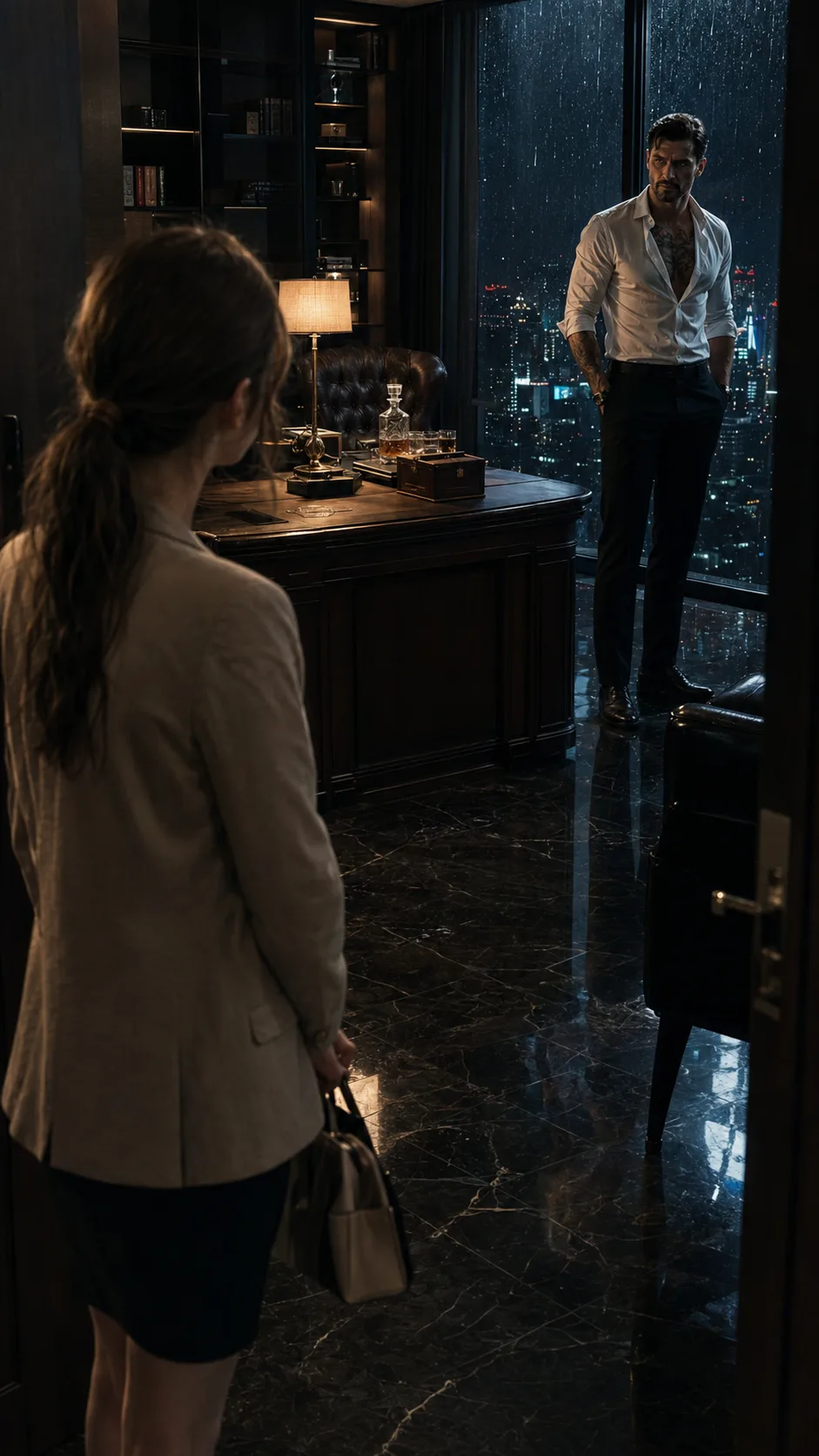
The office was flooded with light from ceiling-high windows, modern and minimal. At the far end, behind a sleek desk of black walnut, stood a man in a tailored suit, his back turned as he looked out over the skyline.
He turned.
Emily stopped breathing.
It was him.
Graham.
But not the man from room 204. This version stood tall, shoulders squared, clean-shaven, hair neatly styled. His eyes still held depth, but now they were awake.
He smiled gently.
“Hello, Emily,” he said.
She blinked, stunned.
“You? You work here?”
“I run it,” he replied. “Atherion was my company from the start. I’ve just returned.”
She could barely find words.
“I don’t understand.”
Graham stepped forward, pulling something from his jacket pocket.
A folded piece of paper.
It was worn at the edges, water-stained, but still legible.
Her handwriting.
If you are still alive today, you are braver than you think.
“I kept it,” he said softly. “I read it three times that morning. Then I got up, packed my bag, and checked out. Not because I felt better, but because I realized someone out there believed I might be worth saving.”
Emily stared at the note in his hand, her chest tightening.
“I had planned,” he continued, “to end everything that night. I will not lie to you. I was not in pain. I was numb. I believed nothing mattered. But that line you wrote.”
He looked at her now, his voice trembling just slightly.
“It interrupted that silence in my mind. It was the first voice that didn’t sound like judgment or shame. It was hope.”
Emily swallowed hard, emotions rising.
“I just—I didn’t know. I was scared. You looked like someone who needed to hear something real.”
“You were right,” Graham said. “And I needed more than anything to hear that I wasn’t invisible.”
Silence fell between them, thick and sacred.
Then he said, “I asked the hotel staff for your name. I didn’t want to intrude, so I waited until I had something real to offer.”
He motioned toward the desk.
“This position is yours if you want it. Not as charity, not as repayment, but because I believe you belong in a place where your voice matters.”
Emily looked at him.
Really looked.
He was still the man from that rainy night, but so much more.
And somehow, so was she.
Working beside Graham became the most unexpected routine of Emily’s life. Each morning, she entered the towering Atherion building with quiet resolve and left each evening feeling as if she had stepped into someone else’s story.
But it was not fantasy.
It was real, and it was happening to her.
Graham, now back in his full role as CEO, was nothing like the cold executive she had imagined from the outside. He was respectful, composed, and there was a warmth beneath his calm that showed itself in small gestures.
He brought her hot tea at exactly 3:00 p.m. every afternoon. Chamomile, because he had remembered her mentioning she did not like caffeine. When it rained, he was already at the entrance with an umbrella, holding it above her head with the same quiet expression, as if it were the most natural thing in the world.
Every time she achieved something small, a well-organized file, a last-minute meeting arranged, he would smile and say, “Thank you, brave one.”
At first, she thought it was only a callback to the note. But after weeks of hearing it, the way he said it started to sound different, like a truth he genuinely believed about her.
Every time she heard it, she stood a little taller.
They developed a rhythm.
He invited her once to a street food cart after work, a tiny vendor tucked between two buildings and known for the best grilled corn in the city. She laughed when he did not know how to eat it without getting chili powder on his shirt.
He laughed too.
Full and real.
On other evenings, they stayed behind in the company’s small employee library, helping the volunteer staff reshelve books after hours. Graham never announced his presence there. He only rolled up his sleeves and sorted biographies by spine color instead of author name, grinning like a child when corrected.
One night, as they walked out, they passed an older security guard struggling with his shoe. The sole had come loose, flapping awkwardly.
Graham stopped without a word, knelt down, and used a spare roll of strong tape from his briefcase to bind the man’s shoe tightly.
“That’ll hold for a few days,” he said kindly, then patted the man’s shoulder.
Emily watched, her heart clenched.
It was not about status or performance. It was simply who he was. Someone who noticed the unnoticed. Someone who remembered what it was like to feel invisible.
Maybe that was why he saw her.
They began to talk more, not only about work, but about memories, childhood fears, and what they had wanted to be before life forced them into survival mode.
But there was always a line neither of them crossed. It sat there, quiet but heavy, between their chairs and meetings, in the pauses between jokes, in the small silences after laughter.
Neither acknowledged it.
Both felt it.
One evening, as they waited outside in the company’s side garden, a narrow green strip between buildings with two worn benches and a single cherry tree, Emily broke the silence.
Her voice was soft.
“I used to sell bottled water in movie theaters.”
Graham turned, brows slightly raised.
“I wore a uniform three sizes too big,” she said. “My shoes always squeaked when I walked. I dropped a whole tray once and cried in the breakroom for an hour.”
He said nothing, only waited.
She looked away, fiddling with the sleeve of her cardigan.
“I never finished college,” she continued. “Couldn’t afford it. Most days, I still don’t know half the jargon people use here. I Google things when I get home. I rehearse answers before meetings.”
Graham’s voice was low.
“You are doing more than fine.”
She smiled, but it did not reach her eyes.
“I just—I don’t belong in a place like this. Not really.”
Then, almost in a whisper, she added, “I’m just a girl who once sold water at the movies. I don’t belong in your world.”
Graham turned fully toward her. His expression was not pity. It was something deeper, something careful.
He opened his mouth to respond, then paused.
Instead, he reached into his pocket and pulled out the same note she had written, the one he still carried, folded with care.
He did not say anything.
He did not need to.
In that moment, Emily was not sure whether she felt comforted or more afraid of how deeply this man could see her.
It was late, well past office hours, and the building had fallen into a gentle hush. Outside the window, the city glowed softly, muted under the falling dusk. Emily and Graham sat across from each other in the small breakroom, half-empty mugs of tea between them.
Graham looked tired, but not the kind of tired that came from long meetings or endless emails. This was a weariness born deep in the bones, the kind that settled in the soul.
“I owe you a story,” he said quietly, eyes fixed on the swirling tea in his cup.
Emily tilted her head, listening.
“You know I’m the CEO,” he said. “But you don’t know why I wasn’t here until recently.”
She nodded slowly. She had always wondered about the gap, the whispers around the office, the half-finished sentences in articles she had found online.
He leaned back in his chair, the lamplight catching the sharp planes of his face.
“Six months ago, a device my company developed, an advanced implant for post-surgical monitoring, malfunctioned during a routine operation. The patient died on the table.”
Emily’s breath hitched.
“The failure wasn’t caused by our core technology,” he said. “It was a defect in a third-party component, something we should have caught but didn’t in time.”
He paused.
“The media didn’t care about nuance. Headlines screamed. Tech CEO Plays God with Human Lives. Atherion’s Gamble Turns Fatal. I became the face of greed, arrogance, and reckless ambition.”
He swallowed.
“Investors fled. Our stock collapsed overnight. I stepped down to protect what little integrity the company still had.”
Emily sat in stunned silence.
“But that wasn’t the worst part,” he said, his voice dropping, almost to a whisper. “The brother of the man who died found me. Waited outside the courthouse. He didn’t scream. He just looked me in the eye and said, ‘I hope you live long enough to feel the guilt I do every day.’”
A long, still silence passed between them.
“That night,” Graham continued, “was the first time I didn’t sleep at all. The guilt, it ate through me like acid. Not because I pulled the trigger. Because I built the gun, and people trusted me with it.”
He looked down at his hands.
“I started drifting, walking through days like they weren’t real. I stopped taking calls. I couldn’t touch a prototype without shaking. I told myself I was a disease in the shape of a man. Everything I created hurt someone.”
Emily’s eyes burned.
“And then,” he said, smiling faintly, “I checked into a small hotel. No luggage. No return ticket. I didn’t plan to check out.”
She knew.
Her heart thudded.
“But under the door,” he said, pulling the now crumpled note from his wallet, “this was waiting for me.”
He handed it to her.
She took it with shaking fingers.
If you are still alive today, you are braver than you think.
“I read it,” he said. “I read it ten times. I cried for the first time in weeks. And then I ordered breakfast.”
Graham leaned back again, his voice steadier now.
“That day, I decided to stop hiding. I hired independent investigators, forced open sealed reports, reran every test. It took three months, but the truth came out. It wasn’t our tech. It wasn’t my team. It was a flaw in one supplier’s code, buried under ten layers of subcontracting.”
Emily was silent.
“I didn’t sue. I didn’t announce anything. I took the report to the victim’s family myself. I sat with them every week for two months until their son’s name didn’t taste like acid when I said it.”
“And the company?” she asked quietly.
“It’s recovering,” he said. “Slowly. We’ve rebuilt most of the trust. But I came back different. I came back knowing power isn’t about vision. It’s about responsibility.”
He looked at her then, his voice lower.
“And that’s when I found you again.”
Emily’s hands trembled slightly as she placed the note down on the table. Her throat tightened and her chest ached in a way she could not explain.
She had walked into this job thinking she was only a helper, a lucky girl, an afterthought.
But sitting across from this man, she realized something powerful.
He was not a hero.
He was a survivor.
And so was she.
To be continued… Click “PART 3” to read the final part: 👉 PART 3 👈
Chapter complete
You have reached the end of this chapter.
Continue reading
A few more worlds to get lost in after this chapter.




