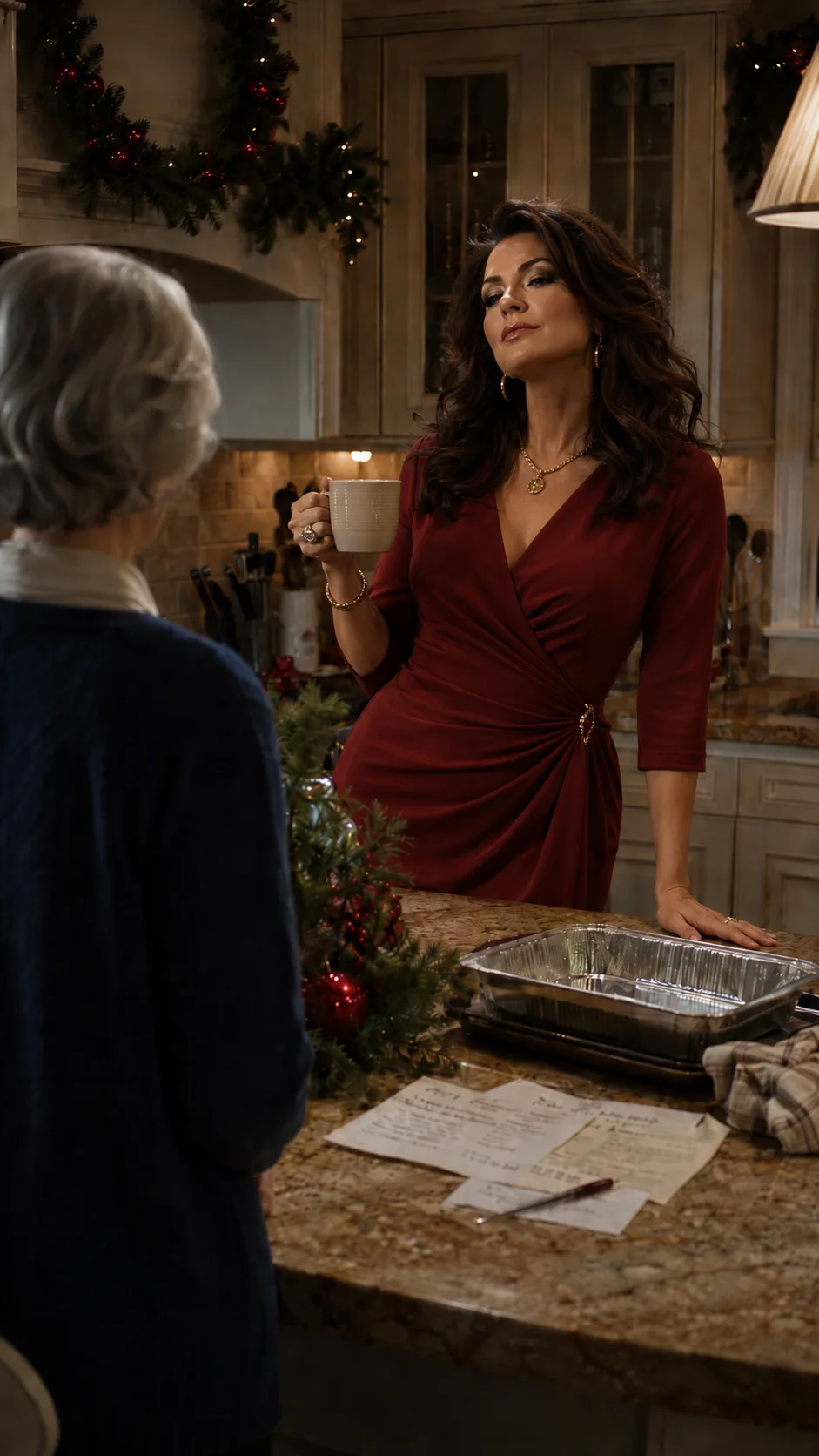
PART 3 — THE HOUSE FINALLY SHELTERED THE RIGHT PEOPLE
The front door slammed hard enough to shake the glass.
Chapter 3
PART 3 — THE HOUSE FINALLY SHELTERED THE RIGHT PEOPLE
The front door slammed hard enough to shake the glass.
No one spoke.
Outside, her car started.
Tires hissed against the wet street.
The sound faded into the dark.
Only then did Mateo begin to cry.
Angela knelt and pulled him close, murmuring in Spanish against his hair.
Kevin stood frozen, one hand touching the mark on his cheek.
I crossed the hallway and reached toward him.
He looked at my hand as though he did not deserve it.
Maybe, in that moment, he didn’t.
But I was still his mother.
I touched his cheek lightly, just beneath the red mark.
He closed his eyes.
“I let her do this,” he said.
I did not soften the truth.
“Yes.”
His face crumpled again.
“But you can decide what you do next.”
He nodded, once, like a child trying not to fall apart.
Marianne stayed for another hour.
Papers were signed at the dining room table beneath the glow of the
chandelier.
Angela wrote her name carefully, stopping twice to wipe her eyes.
Kevin kept to the kitchen, washing dishes that were already clean, then drying them with the towel I had folded earlier.
At one point, I found him standing over the sink, holding a plate in both hands.
“I used to think this house was mine because I grew up here,” he said without turning around.
I leaned against the doorway.
“And now?”
He looked over his shoulder.
“Now I think maybe I was only ever a guest in what you survived.”
The words entered me slowly.
Painfully.
Not enough to erase anything.
But enough to begin somewhere.
Near midnight, Angela and the children settled into the upstairs guest room.
Marianne left with the folder tucked under her arm and promised to call in the morning about the police report.
Kevin stood by the front door with his coat
on.
“I’ll go to the apartment,” he said.
“You can stay in the den tonight.”
He shook his head.
“I don’t think I should sleep comfortably here.”
The sentence hurt, but I understood it.
He opened the door, then stopped.
“Mom?”
“Yes?”
He turned.
The porch light drew tired lines across his face.
“When Dad died, did you ever hate me for needing so much?”
My breath caught.
There it was.
The oldest wound.
Not mine.
His.
I walked toward him slowly.
“You were nine years old.”
“I know, but you gave up everything.”
“I gave up things,” I said. “Not everything.”
He swallowed.
“What didn’t you give up?”
I placed my hand over his heart.
“This.”
His eyes filled.
“You were never the burden, Kevin. The burden was being alone. There’s a difference.”
He pressed his lips together, nodding too quickly.
“I don’t know how to fix what I
let happen.”
“You start by not asking me to make it easier for you.”
He absorbed that.
Then he whispered, “Okay.”
He left quietly.
This time, the door did not slam.
Christmas morning arrived pale and cold.
I did not wake to the panic of timers, ovens, and Tiffany’s texts asking whether the cranberry sauce was homemade.
I woke to the sound of a child laughing downstairs.
For a moment, I lay still beneath my quilt, listening.
Mateo’s voice.
Angela’s gentle warning.
The soft thump of small feet near the tree.
I turned my head toward Robert’s empty side of the bed.
“You should see this,” I whispered.
Downstairs, Angela stood in the kitchen wearing one of my aprons, looking horrified when I entered.
“I was only making coffee,” she said quickly. “I didn’t want to wake you.”
I smiled.
“Coffee is not a crime.”
She lowered her eyes.
“I still feel like I shouldn’t touch anything.”
I walked to the cupboard and took down two mugs.
“When I first moved into this house, I felt the same way.”
She looked surprised.
“You?”
“Robert and I bought it with a cracked foundation, peeling wallpaper, and one working burner on the stove. I was terrified of breaking anything because we had no money to fix it.”
Angela smiled faintly.
“What changed?”
I handed her a mug.
“I broke things anyway. Then learned the house could survive.”
Her eyes shimmered.
In the living room, Mateo sat cross-legged before the tree.
He had found the box of ornaments I never finished hanging.
One by one, he lifted them as if each had a secret.
Kevin arrived just after nine.
He carried no gifts, only a paper bag from the bakery and a face that looked like he had not slept.
Angela stiffened when she saw him.
He noticed and stopped at the threshold.
“I’m sorry,” he said immediately. “I should have called before coming.”
I watched him.
So did Angela.
She studied him for a moment, then nodded once.
“It’s your mother’s house,” she said.
Kevin looked at me.
“No,” he said quietly. “It’s her decision.”
That was the first gift he gave me that morning.
I let him in.
We ate bakery rolls at the kitchen table.
Nothing matched.
No one performed happiness.
The coffee was too strong, the butter too cold, and the silence sometimes awkward enough to make Mateo whisper questions into his mother’s sleeve.
But no one ordered me to cook.
No one handed me a list.
No one sat at my table pretending my labor was invisible.
Later that morning, Kevin’s phone rang.
Tiffany.
He stared at the screen until it stopped.
Then messages began arriving.
His jaw tightened as he read them.
“She told her family I had a breakdown,” he said.
I sipped my coffee.
“And?”
“And they’re all coming here anyway.”
Angela looked up sharply.
Kevin stood.
“No. I’ll handle it.”
The doorbell rang before he reached the hall.
Then came pounding.
“Tiffany said you lost your mind!” a man’s voice shouted from the porch. “Open the door!”
Angela gathered her children instinctively.
Kevin looked at me, panic and shame flashing across his face.
I stood.
This was the confrontation Tiffany had left behind like a lit match.
I opened the door.
Tiffany’s parents stood on the porch, along with her brother, sister, and several relatives bundled in expensive coats, carrying foil-covered dishes and righteous expressions.
Tiffany stood at the center of them, eyes red in a way I suspected had taken effort.
“There she is,” Tiffany said, voice trembling beautifully. “Ask her what she did.”
Her mother pushed forward.
“Eleanor, we have always respected you, but throwing your family out on Christmas is disgraceful.”
Kevin stepped beside me.
“She didn’t throw anyone out.”
Tiffany’s brother scoffed.
“Man, she’s got you trained.”
Kevin’s face tightened.
I lifted one hand.
“No shouting on my porch.”
Tiffany laughed bitterly.
“Your porch. Your house. Your rules. We all know.”
“Yes,” I said. “Now you do.”
Her mother blinked.
I continued, “Tiffany attempted to use my email address and a false authorization to request sale documents for this property.”
The porch went silent.
Tiffany’s father turned toward her.
“What?”
She shook her head rapidly.
“No. She’s confused.”
Marianne’s car pulled up at the curb.
For the second time in twelve hours, Tiffany’s confidence faltered.
My attorney stepped onto the walkway carrying a folder.
“I’m not confused,” I said.
Marianne joined us at the porch and removed several printed pages.
“I represent Mrs. Morgan,” she said. “The title company has preserved the inquiry records. Device information, recovery number, IP metadata, and message screenshots have been provided for review. A police report is being filed.”
Tiffany’s brother stepped back.
Her mother’s hand went to her throat.
Tiffany stared at the papers as if hatred alone could burn them.
Kevin looked at her family.
“She lied to you,” he said.
Tiffany spun toward him.
“Don’t.”
“No,” he said. “I helped make it easy for her by not asking enough questions. That’s mine. But this part is hers.”
Her father’s face had gone gray.
“Tiffany,” he said. “Tell me you didn’t.”
She opened her mouth.
Nothing came out.
That silence ruined her more completely than any confession.
Her mother stepped away from her.
Just one step.
But Tiffany felt it.
Everyone did.
The little empire she had built out of charm, pressure, and borrowed authority cracked in front of the people she had invited to admire her.
“You’re all taking her side?” Tiffany whispered.
Her father looked devastated.
“Did you forge that woman’s signature?”
Tiffany’s eyes filled, finally with real tears.
“I was trying to save my marriage.”
Kevin stared at her.
“You were trying to fund a life you wanted with money that wasn’t yours.”
Her face twisted.
“Because you were too weak to ask for it.”
The last mask fell.
There was no gasp dramatic enough for it.
Only silence.
A hard, stunned silence that made the winter morning feel colder.
Kevin nodded slowly.
“Thank you,” he said.
Tiffany frowned.
“For what?”
“For saying it in front of everyone.”
Marianne stepped forward and handed Tiffany an envelope.
“This is notice that you are not permitted to enter this property. Further contact regarding Mrs. Morgan should go through counsel.”
Tiffany did not take it.
Her father did.
His hand shook.
“Tiffany,” he said quietly, “get in the car.”
She looked around at all of them, searching for one face still willing to obey the story she had told.
She found none.
Her downfall was not loud.
It was worse.
It was witnessed.
She walked down the porch steps alone, her red dress bright beneath her open coat, her heels slipping slightly on the wet stone.
No one reached to steady her.
By New Year’s, Tiffany had moved out of the apartment.
Kevin filed for separation.
The title company cooperated fully, and while I did not take pleasure in the investigation, I did not stop it either.
That was another kind of freedom.
Letting consequences belong to the person who earned them.
Kevin began coming by every Saturday morning.
The first time, he brought groceries and placed the receipt in front of me.
“I bought these,” he said.
“I see that.”
“Not for praise,” he added quickly. “Just so you know I’m not assuming.”
We learned each other awkwardly.
Like people meeting after a long war.
Some mornings we spoke about practical things—the trust, repairs, Angela’s school schedule, his counseling appointments.
Other mornings, he sat at the table with his hands around a mug and told me pieces of his marriage I had never known.
How Tiffany mocked him when he worried about money.
How she called his tenderness “mother damage.”
How he had mistaken peace for obedience because he had grown up watching me survive quietly.
That one hurt.
Not because he blamed me.
Because he was partly right.
“I thought silence was strength,” I told him one morning while snow dusted the porch rail. “Maybe sometimes it was. But I should have shown you that boundaries are strength too.”
He shook his head.
“You were doing the best you could.”
“So were you,” I said.
He looked up.
I let the words sit between us.
Then I added, “But best does not mean harmless.”
His eyes lowered.
“No,” he said. “It doesn’t.”
Angela flourished slowly.
Not dramatically.
Not like a movie montage where every wound disappears under warm music.
Some nights I heard her crying in the upstairs bathroom with the shower running.
Some mornings she apologized three times for using too much milk.
Mateo hid crackers in his pillowcase for weeks before he believed food would still be there tomorrow.
Healing had its own small sounds.
A lunchbox zipper.
A kettle boiling.
A child asking for seconds without fear.
In March, Angela passed her first nursing exam and cried so hard over the results that Mateo thought something terrible had happened.
Kevin brought flowers.
Not for me.
For her.
He left them on the porch with a note that said, “For the first of many victories.”
Angela read it twice and said nothing, but she put the flowers in the blue vase Robert had bought me on our twentieth anniversary.
One evening in April, Marianne called me to her office.
There, she placed an old envelope on the desk.
“This was in the final archive box from the trust paperwork,” she said. “It appears Robert wrote it before he died.”
My fingers went cold.
The envelope was yellowed at the edges.
My name was written across the front in his handwriting.
Eleanor.
For a while, I could only touch the paper.
Marianne stepped out, closing the door softly.
I opened it with trembling hands.
Inside was one page.
My dearest Ellie,
If you are reading this, then I suppose the house is still standing, and so are you.
I know you. You will try to keep every board, every bill, every memory, because you think love means holding on until your hands bleed.
But this house was never meant to be a shrine to me.
It was meant to shelter life.
If one day it becomes too heavy, let it become useful to someone else.
Let it hold children again.
Let it hear laughter that does not have to ask permission.
And please, my love, do not mistake being needed for being loved.
You deserve both.
I pressed the letter to my mouth.
The sound that came out of me did not feel like crying at first.
It felt like something breaking open after being locked for decades.
When I showed Kevin the letter, he read it standing by the kitchen window.
By then, spring rain was tapping against the glass.
He reached the final line and covered his eyes.
“Dad knew,” he whispered.
“Yes.”
He handed it back carefully.
“I think he was writing to both of us.”
I looked at him.
He wiped his face with his sleeve, embarrassed and no longer hiding it.
“I thought inheritance meant getting the house,” he said. “Maybe it meant learning what it was for.”
That summer, the first official dinner at the house was held in the backyard.
Not Christmas.
Not Thanksgiving.
No assigned labor.
No performance.
A folding table sat beneath strings of warm lights.
Angela made arroz con pollo.
Kevin grilled vegetables badly and accepted instruction from Mateo, who had become very serious about seasoning.
Marianne brought pie.
Two nursing students approved for future residency came with nervous smiles and left with leftovers.
I sat beneath the maple tree Robert had planted the year Kevin was born.
For the first time in years, I watched people move through my home without feeling myself disappear.
Kevin came and sat beside me as dusk settled.
“You okay?” he asked.
I looked at the glowing windows, the children chasing fireflies, Angela laughing with her head tipped back.
“No,” I said.
He stiffened.
I took his hand.
“I’m better than okay.”
His fingers closed around mine.
Across the yard, Mateo held up a jar with one firefly blinking inside.
“Mrs. Morgan! Look!”
I smiled.
“Let it go before it thinks it lives there.”
He considered that seriously, then opened the lid.
The firefly rose into the blue evening, blinking once, twice, then disappearing into the warm dark above us.
Kevin leaned his shoulder lightly against mine.
Not asking.
Just there.
And for once, the house behind me did not feel like proof of everything I had lost.
It felt like a promise finally kept.
A place where love no longer required silence.
A place where no one had to earn a chair.
A place where the door opened, the lights stayed warm, and every person who entered knew the truth before crossing the threshold.
This was not our house because someone claimed it.
It was our house because, at last, it sheltered the people who understood what that word truly meant.
THE END.
Chapter complete
You have reached the end of this chapter.
Continue reading
A few more worlds to get lost in after this chapter.




