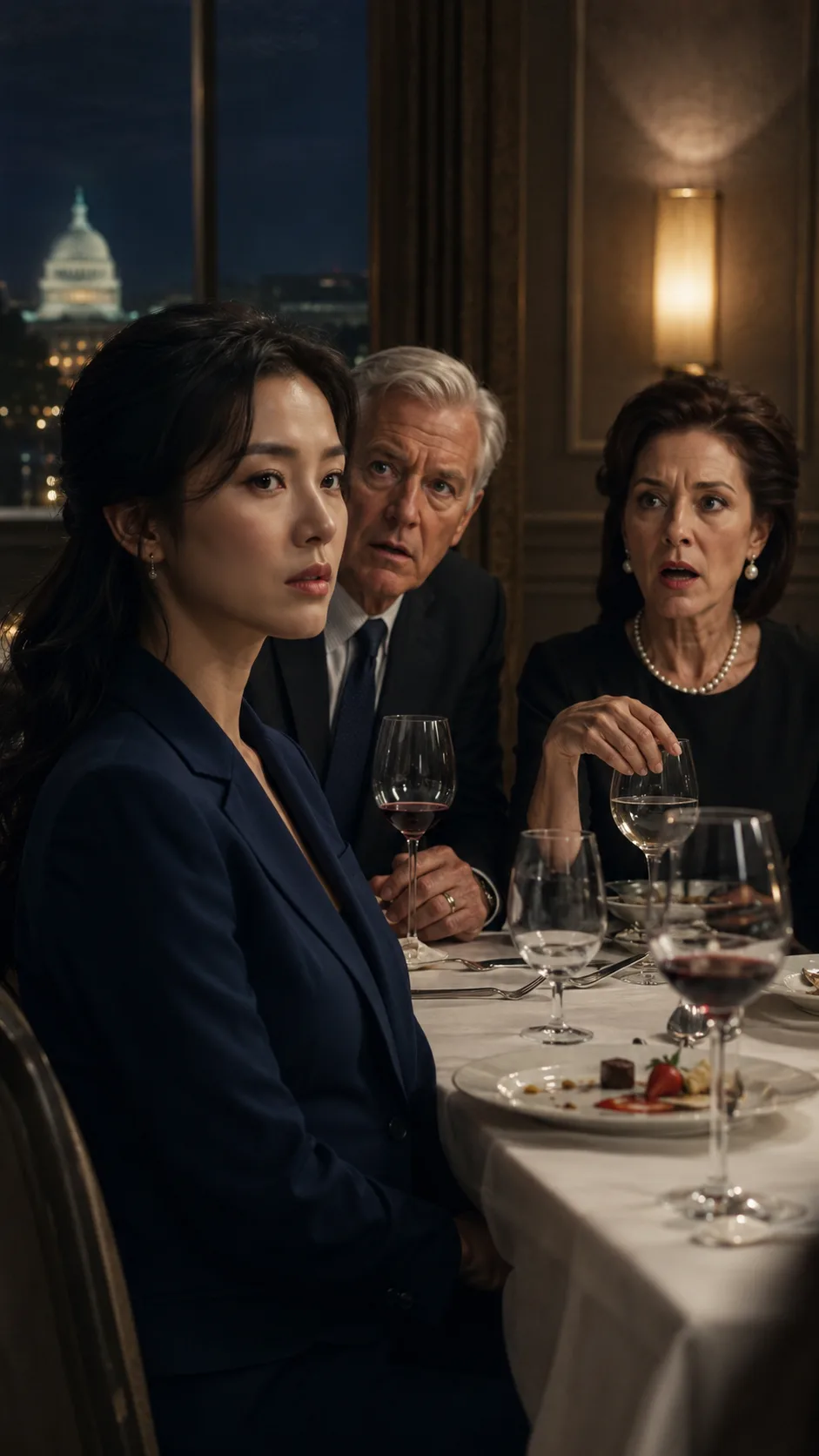
At 2:03 a.m., my mother warned me, “Don’t embarrass us,” before a dinner where I was already rewritten into someone smaller, quieter, safer—but the moment I tried to speak, she cut in, smiling, until the judge across the table froze, stared straight at me, and said, “You were the one who stopped that case from being buried, weren’t you?” and in that instant, the version of me she created started collapsing in front of everyone
My parents called me at 2:03 a.m.
Not a text—a call. I was awake in my Washington, D.C. apartment, reviewing case files at my kitchen counter. Sleep usually lost when my work crossed military and federal lines.
My mother didn’t ask how I was.
“Tomorrow night, you can come to dinner with your sister’s fiancé’s family.”
Can. Like permission.
“What’s the catch?” I asked.
A pause. “Stay quiet, Rebecca. Don’t make this about you.”
I leaned back. “Why would I do that?”
“Because you can be difficult when people start asking questions.”
That had always been her word for me. Difficult meant precise. Private meant I didn’t perform on command.
“My sister’s fiancé?” I asked.
“Nathan. His father is a federal judge,” she said. “Don’t embarrass us.”
Us. Not Lauren. Us.
By noon, Lauren texted: They already know a little about you.
“What does ‘a little’ mean?” I replied.
Mom said you do legal-administrative work with the
military and that you’re very private.
I stared at the message. Not exactly a lie—but carefully reduced.
I was a JAG officer. My work involved fraud, violence, witness protection. But “administrative” made it small. Harmless.
I almost didn’t go.
Instead, I showed up late, just like my mother preferred—after everyone was seated, after roles were set.
“This is our older daughter, Rebecca,” she said. “She works with the military.”
That was it.
Every time someone asked me something, my mother answered first. When Nathan asked what I did in D.C., she jumped in. When the judge mentioned federal coordination, I added one brief comment—just one—and she laughed it off.
“Rebecca gets buried in technical details.”
Then I noticed the judge watching me.
Not casually. Carefully.
He leaned forward.
“Wait… I know you.”
The table froze.
“Were you involved in the Archer Dynamics review two years ago?” he asked.
The name
hit like a shockwave.
“Yes,” I said slowly. “I was on the legal team.”
“You gave the briefing,” he said.
My mother cut in quickly. “Rebecca gets very wrapped up in work. We don’t usually go into details.”
But he didn’t look at her.
“You were the one who objected when they tried to close the financial side before the assault evidence expanded.”
The word assault landed heavily.
Lauren stared at me. “Assault?”
I met her eyes.
“Yes.”
And for the first time that night, no one spoke over me.
The silence stretched, thick and suffocating.
My mother’s wine glass hit the table with a sharp clink. “Well,” she said, her voice bright, brittle, and desperate. “That sounds terribly heavy. Let’s not ruin a celebratory dinner with grim court talk, shall we?”
She reached for the wine bottle, attempting to pour a distraction, but Judge Harrison held up a hand.
“Helen, with all due respect,” he said, his voice carrying the effortless authority of a man used to commanding courtrooms, “there is nothing grim about courage.”
He turned his full attention back to me, his polite, conversational mask dropping into an expression of profound professional respect. “They were prepared to bury three victims under NDAs and shell companies. The DOJ was going to let the financial settlement wipe the slate clean. Then your brief hit my desk.”
“It wasn’t just my brief, Your Honor,” I said smoothly, leaning into the space my mother had tried to keep me out of. “I had a dedicated investigative team. But the timeline was… tight.”
“You drafted a sixty-page injunction in forty-eight hours,” he countered. “And you stood up to a two-star general to file it.”
Nathan let out a low whistle. Lauren, my sister, was staring at me as if a stranger had just taken off a Rebecca-shaped mask.
“A general?” Lauren echoed. She looked across the table at our mother. “You said she filed paperwork for base housing.”
The color drained from my mother’s face. “I said she did administrative work. I didn’t want to bore anyone with the minutiae.”
“It’s not minutiae, Mom,” I said, my voice quiet but carrying perfectly in the silent dining room. “It’s military law.”
“It is the defense of the defenseless,” Judge Harrison corrected, raising his water glass to me. “It is a genuine honor to finally put a face to the name, Captain.”
“Major, actually,” I replied gently. “As of last month.”
My mother's mouth opened, then closed. She had no script for this. The version of me she had spent years carefully curating—the difficult, quiet spinster sister who shuffled papers so as not to overshadow the family—had just been obliterated by the highest-ranking person at the table.
The rest of the dinner shifted fundamentally. Nathan asked me about D.C., and this time, he waited for my answer. Lauren asked about my promotion, her eyes shining with a mix of pride and dawning realization at how much she had been kept in the dark by our parents' narrative.
Every time my mother tried to steer the conversation back to safe, shallow waters—wedding flowers, country clubs, weather—the table politely acknowledged her before returning to me. I didn't boast. I didn't perform. I just answered their questions with the exact precision my mother had always loathed. Slowly, inevitably, she was shrinking into the very corner she had designed for me.
When the dessert plates were cleared, I checked my watch. 9:45 PM. The case files on my kitchen counter were waiting.
I stood up, smoothing my napkin and placing it on the table. “It’s been a wonderful evening, but I have an early briefing at the Pentagon tomorrow.”
Judge Harrison stood up with me, extending his hand. “Major. If you ever decide to leave the military, my chambers are always looking for unparalleled legal minds.”
“Thank you, Your Honor. I’ll keep that in mind.”
I walked over to my sister, kissing her cheek. “Congratulations, Lauren. He’s a good man. I’m happy for you.”
Finally, I looked at my mother. She sat rigidly, staring at her half-eaten slice of cake, the illusion of her control completely shattered.
“Goodnight, Mom,” I said.
She didn't meet my eyes. “Goodnight, Rebecca.”
I walked out of the restaurant and into the cool, humid D.C. night. The air tasted sharper, cleaner. As I stood on the curb waiting for a car, my phone buzzed in my pocket. It was a text from Lauren.
Lauren: We are getting lunch tomorrow. Just us. You’re telling me everything.
I smiled, typed back a simple Yes, and stepped into the car, heading back to the work that mattered—perfectly fine with being difficult.




