My name is Charlotte Whitmore.
Chapter 1
My name is Charlotte Whitmore.
I am seventy-three years old, and for most of my life, I believed I had done one thing right.
I had raised a good son.
Daniel was my only child. His father, Robert, and I built our entire life around him. We were not born rich. Robert and I met at Arizona State when our pockets were empty and our plans were bigger than our bank accounts. He was the dreamer. I was the one who remembered the bills, the deadlines, the permits, the repairs, the late-night phone calls from tenants when an air conditioner died in July.
Together, we built a commercial real estate business across Phoenix and Scottsdale. Twelve properties. Years of risk. Years of work. Years of missing vacations because a building needed saving.
When Robert died suddenly eight years ago, it felt like the floor vanished beneath me. He had been standing in our kitchen with
a coffee cup in his hand, asking me whether I had seen his reading glasses. Then he was gone before the ambulance even reached the house.
People said he didn’t suffer.
They always say that, as if it helps.
What helped me survive was Daniel. For years after Robert’s funeral, it was just the two of us. Every Sunday, he came to dinner. Sometimes I made pot roast. Sometimes lasagna. Sometimes we sat over takeout and talked until the candles burned low.
He told me about work, about women he dated, about how one day he wanted to start his own consulting firm. He asked me for advice. He still called me “Mom” in that soft voice he had used since he was a boy.
I thought grief had made us closer.
Then Vanessa Hart entered his life.
Daniel told me about her three months after they had already started
dating. That should have warned me. My son had once called me because he couldn’t decide whether to buy a blue tie or a gray one for an interview. But he had dated this woman for a quarter of a year and said nothing.
Still, when he called with excitement in his voice, I swallowed my unease.
“Mom, she’s different,” he said. “She understands me.”
The first time Vanessa came to Sunday dinner, I understood something too.
She was beautiful in a polished, expensive way. Sleek brunette hair. White smile. Designer heels tapping across my foyer like she owned the floor. She looked around my home not like a guest, but like a woman estimating value.
Her eyes paused on Robert’s Southwestern paintings. Then the antique credenza. Then the silver candlesticks. Then the crystal vase Robert had given me for our twenty-fifth anniversary.
“Original?” she asked, touching the wood.
“Yes,”
I said. “Robert and I bought it years ago.”
“Interesting,” she replied, though her tone made it sound more like profitable.
At dinner, every question I asked her slid away before it gave me an answer.
Where was she from?
“Back East, mostly.”
Where did she study?
“A small school. You wouldn’t know it.”
What exactly did she do in marketing?
“Brand strategy. Very boring.”
Then she would touch Daniel’s arm and redirect him, as if turning a key.
Within months, Sunday dinners became less frequent. Daniel was suddenly busy. Then Vanessa was busy. Then they were both busy. When they did come, Vanessa made little comments about my furniture, my curtains, my cooking, my routines.
“This house has so much potential,” she once said, smiling at Daniel. “If someone modernized it.”
Daniel laughed awkwardly but said nothing.
The money conversations started soon after.
They wanted to start a consulting firm. They needed capital. Vanessa said two hundred thousand dollars as if she were asking for a glass of water. I offered to look at a business plan and consider a smaller loan from my personal savings.
Her smile tightened.
That was the moment I knew she had not come for dinner.
She had come for Robert’s money.
Robert had left Daniel a trust, but not an open checkbook. Four million dollars in protected assets, plus income from the properties. Robert had made me trustee because he knew love could make Daniel foolish.
“Promise me,” Robert had once said, two years before he died. “Don’t let him be pressured into money before he is ready.”
I promised.
I never imagined keeping that promise would mean standing against my own son.
Three months later, Daniel called again.
He proposed. Vanessa accepted. They were having an engagement party at a Phoenix country club connected to her parents. Her family would cover the venue, he said, but the flowers, food, bar, and details were expensive.
“Maybe you could help with twenty thousand,” he said.
Twenty thousand dollars. For a party. Not a wedding. A party.
I said I would give ten.
There was a silence long enough to tell me Vanessa was standing beside him.
“I’ll tell her,” Daniel said.
Then he hung up without saying goodbye.
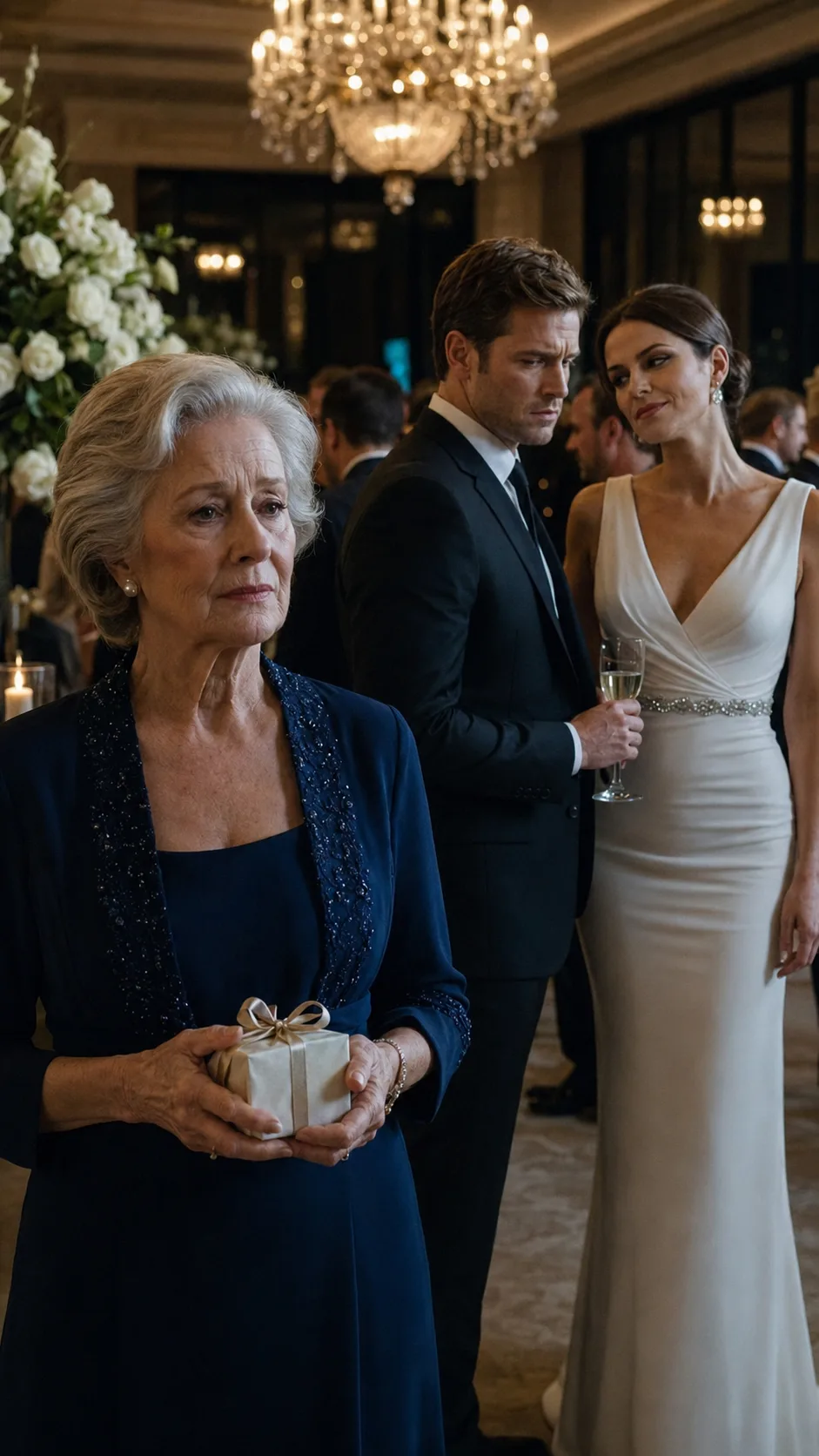
The party was on a Saturday evening in October. I bought a navy dress because it was elegant but quiet. I did not want to compete with Vanessa. I bought her a custom bracelet, platinum with small diamonds, because I still wanted to believe welcome could soften whatever was hard inside her.
I arrived thirty minutes late because Daniel had suggested it was easier if I drove myself.
The ballroom was stunning. White roses. Gold light. Champagne glasses. Jazz music. Rich people laughing like no one in the room had ever begged for anything.
Daniel stood near the bar in a black suit. Vanessa clung to his arm in a white dress so dramatic it looked like she was already trying to be the bride.
She saw me first.
She leaned toward Daniel and whispered.
He turned.
For one second, I looked for joy on my son’s face.
I found irritation instead.
I walked toward them with the gift bag in my hand.
“Congratulations,” I said, reaching for Daniel.
Vanessa stepped between us so smoothly that no one else would have called it rude.
“Charlotte,” she said. “You came.”
Not we’re happy you’re here.
Not welcome.
Just: You came.
I gave her the bracelet.
She opened it in front of her friends, glanced inside, and smiled like I had brought her something from a discount bin.
“How traditional,” she said.
Someone behind her laughed.
Daniel held the box after she handed it to him. He did not thank me. He did not defend me. He just stood there as if silence were easier than love.
For the next hour, I was treated like furniture that had been delivered by mistake. Vanessa’s friends asked me what I “used to do.” Her mother looked at my dress and asked if it came from a department store. Her father shook my hand as if he wanted proof he had touched it as little as possible.
Still, I tried one last time.
I found Daniel beside Vanessa and said softly, “Maybe next Sunday, the three of us could have dinner. I would love to get to know Vanessa better before the wedding planning becomes too busy.”
Vanessa laughed.
It was sharp enough to cut skin.
“Sunday dinners?” she said, loud enough for everyone nearby to hear. “Daniel, you never told me your mother was still doing that.”
Her friends smiled.
I felt my cheeks burn.
“It’s just our tradition,” I said. “Something we’ve done for years.”
“Done,” Vanessa corrected. “Past tense. Daniel has a new life now.”
I looked at my son.
Please, Daniel.
Just one word.
But he stared into his drink.
Vanessa kept going. She said a grown man should not be guilted into dinners with his mother. She said I was suffocating. She said Daniel was too polite to admit how controlling I had become.
By then, the room had gone quiet.
Everyone was watching.
I turned to Daniel with tears in my eyes.
“Is that how you feel?”
He finally looked at me.
But the shame in his face was not for Vanessa.
It was for me.
“Mom,” he said, low and cold, “you’re making this difficult.”
“She just insulted me in front of everyone.”
His jaw tightened.
“Please leave.”
A gasp moved through the room.
I stood still, certain I had misheard him.
“What?”
“You’re embarrassing me,” he said. “Just go.”
My son. My boy. The child I had held through fevers and heartbreaks. The man whose father had trusted me to protect him.
He was asking me to leave his engagement party because his fiancée had decided I no longer belonged.
I looked at Vanessa.
She was smiling.
Not politely.
Triumphantly.
Something inside me went very still.
I did not cry. I did not beg. I did not shout.
I simply picked up what dignity I had left and walked out of that ballroom while my heels echoed across the marble like a countdown.
Behind me, the music slowly started again.
Chapter complete
You have reached the end of this chapter.
Continue reading
A few more worlds to get lost in after this chapter.




