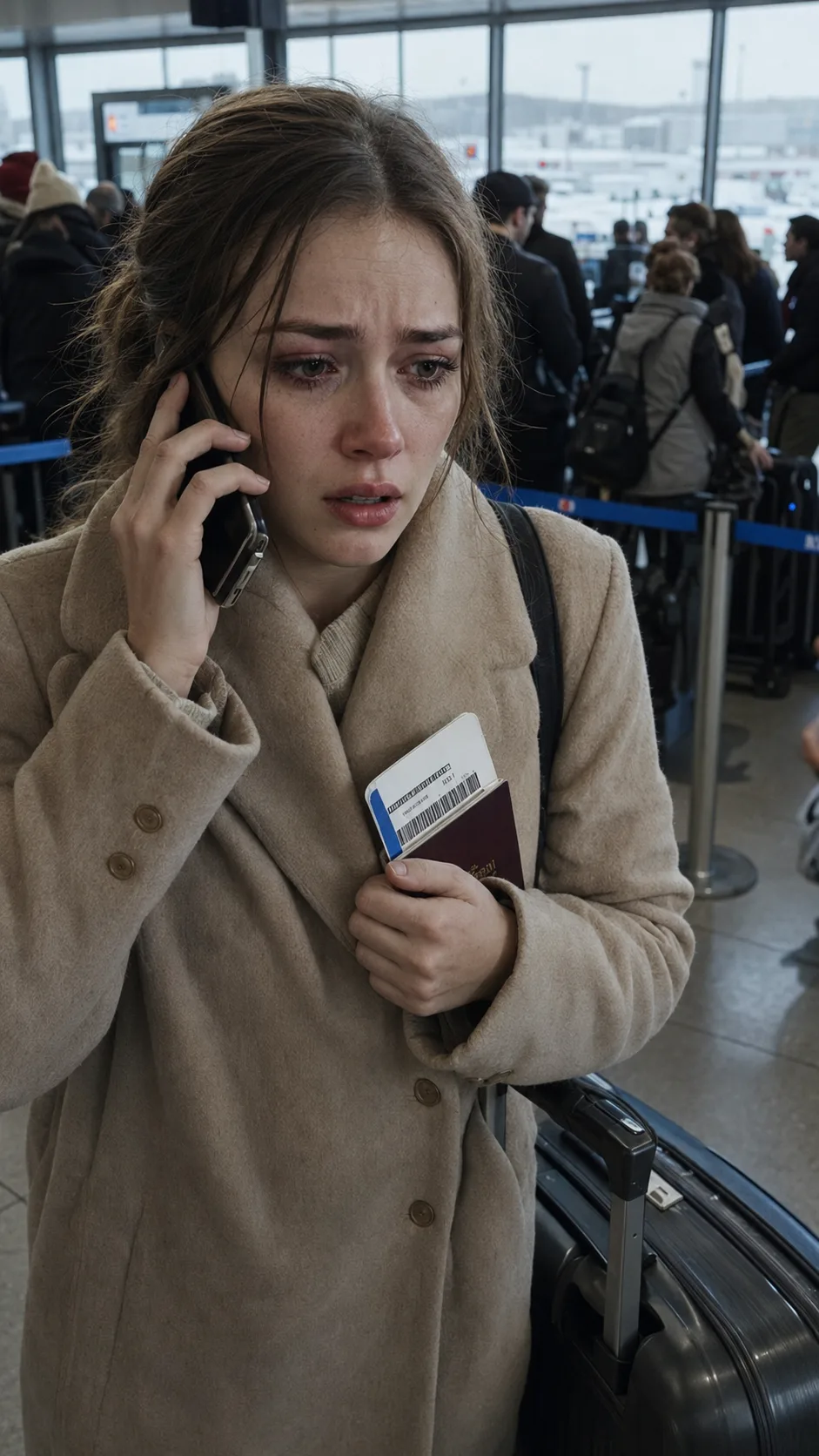
PART 2: THE STRANGER FROM THE AIRPORT
It was not the paralysis of someone offended, startled, or deciding.
Chapter 2
PART 2: THE STRANGER FROM THE AIRPORT
It was not the paralysis of someone offended, startled, or deciding.
It was the paralysis of someone who did not expect to be touched that day. I felt, with my forehead against the fabric, his chest hold its breath and not release it.
I heard a small choking sound behind him, which I would later understand was the man with the red notebook covering his mouth. The other 2 men in suits looked at each other over my hair. They did not push me. They did not speak. They waited for someone to decide something for everyone.
5 seconds.
I counted later, sitting on a boarding gate bench, and I came to 5.
5 seconds is enough time to be embarrassed for an entire country.
He raised his arms slowly, like someone lifting an unknown weight. His hands hung in the air behind me, deciding where to land. They fell finally, with a rigidity that seemed more like a rehearsal than
a gesture, as if he did not know where another person’s spine began.
He wrapped his arms around me without letting our bodies touch. It was like being hugged by a high fence made of suit fabric, and I, who had asked for a second, closed my eyes and filled his shoulder with tears and mascara and the choking sound that had replaced my nose.
Somewhere in my head, I registered that he smelled like cedar and clothes washed with very expensive soap.
“Ma’am.”
The voice came from behind me, discreet, low, somewhere above the level of my left ear. I turned my face, still pressed to the suit, and saw 1 of the men in dark suits, the tallest 1, with a bulldog expression that would have terrified anyone at any other moment. He held, between his thumb and index finger, a white cloth handkerchief folded into 3 equal
parts.
The corners were exact. It looked like it had been ironed that morning.
He held the handkerchief out toward me without changing his expression, without saying anything else. I reached out and took it. I let go of the lapel for just a second to blow my nose into another stranger’s handkerchief.
I handed it back to the bulldog man, saw the corner of his mouth twitch in something that did not quite reach a smile, and saw the handkerchief vanish into an inside pocket of his coat, back into mystery.
When I looked forward again, the man in the suit had lowered his chin. His gray eyes were on me with the same calculation as before, but something in them had cracked by a millimeter. Maybe it was the mascara on his lapel. Maybe it was the wet shoulder. Maybe it was the strangers all around pretending not
to see, and pretending well.
I stepped back. I let go of the lapel. I looked at the stain I had left on the dark fabric, then at his face, and laughed.
I laughed because laughter is the first thing that comes out of me before I cry again, and because I had to choose 1 of the 2 quickly.
“You have a very good shoulder,” I said, still sniffing, “for someone who looks so unfriendly.”
He opened his mouth as if he were going to respond.
He did not.
The woman in front of me moved forward another 3 steps. The line had moved. The counter was calling me with that little airport protocol voice.
“Next, please.”
I remembered, with the absolute clarity of someone who has just cried in public, that I had a flight to catch.
I grabbed my suitcase. I pushed forward. I moved to the counter. I handed my boarding pass to the man who looked at me with well-trained professional compassion and asked no questions. I checked my bag. I received the stub.
When I turned to find the exit, I looked over my shoulder just once.
The man in the suit was still standing in the same spot. His arms had fallen to his sides. The 2 men in dark suits were trying, unsuccessfully, to speak quietly to him. The man with the red notebook had already opened it and was writing something with such speed that the pencil was trembling.
He looked at me.
I did not wave.
He did not wave.
I walked to the boarding gate without turning around again.
It was only when I sat on a green plastic bench that I realized 2 things.
I had not asked his name.
And my hand smelled like cedar.
I rubbed my palms on my jeans.
Nothing came off.
The agent called the flight for Boston. I stood and walked through the jet bridge with the firm step of someone who had decided, in 5 seconds of a line, that I was going to forget that in a week.
I was good at forgetting. I had forgotten worse things.
I sat in the window seat. I leaned my forehead against the cold acrylic and brought my hand to my nose without thinking, just to check.
The scent was there.
The plane landed at Logan at 7:30 in the evening, and Boston greeted me with the kind of cold that enters through the cuff of your sleeve and never leaves. I grabbed my suitcase from the carousel, crossed the lobby without looking sideways, got into a taxi, and gave the address of the hotel in Back Bay without any fuss.
The driver thanked me for my silence with more silence. It was the most polite thing that happened to me all day.
The hotel was on a narrow street of brick buildings with tall windows and snow packed into the railings of the external stairs. The receptionist called me Ms. Holloway with the practiced intonation of someone who had trained their pronunciation, and that, at that moment, was almost enough to bring a tear of gratitude.
She handed me a key card and wished me rest. I gave a curt nod and headed for the elevator.
The room was small, brown, and symmetrical. A queen bed in the center, a lamp on each side, a desk under the window. I left my suitcase near the door without unpacking. I took off my coat. I sat on the edge of the bed and stared at the carpet as if it were going to tell me something about what I should do with the next 2 hours.
That was the moment I called Wren.
Wren answered on the 2nd ring, as always. In the background, I heard the noise of her newsroom: phones, someone laughing loudly, the old printer they never retired. Wren was an assistant editor at a magazine no one read, and she loved that magazine no one read with a loyalty she did not dedicate to any other item in her life, including boyfriends.
“Holloway, you’re in Boston. I know you are because I put you in that taxi myself this morning. Why are you calling me before 9:00? I’m in the middle of a piece about a senator who didn’t read her own bill.”
“Wren.”
I said her name, and my voice broke in the middle.
There was a pause on the other end of the line. I heard her chair scrape. Wren always stood up to receive bad news. She said sitting made her soft.
When she spoke again, the sarcasm had vanished entirely.
“Eve, what happened?”
I told her.
I told her about the line, the audio, the number of seconds in the audio, the ridiculous sentence about moving things out of my apartment that week. I told her about the crying in the middle of the lobby, and I told her slowly, with the feeling of reporting someone else’s dream, about the man in the black suit jacket, the unfriendly face, the handkerchief folded in 3 that came from behind. I told her about the smell of cedar on my hands.
Wren stayed silent until the end.
“Eve,” she said after a long breath, “you hugged a stranger at the airport.”
“I asked for a hug.”
“You hugged a stranger at the airport,” she repeated. “That is the most non-you thing you’ve done in your entire adult life. I don’t know whether to compliment you or commit you.”
“It can be both.”
“Preston is an insect.”
“Wren, no.”
“Let me talk.”
Her voice gained that oath-like firmness she reserved for the moments I needed most.
“Banana, I’m only going to repeat this once for you to remember. Preston is an insect. You are not going back. You are not going to text. You are not going to reply if he texts. You are in Boston. You’re going to work. You’re going to sleep. You’re going to eat. And when you get back, we’re going to open a bottle, and you’re never going to think about him again. Is that clear?”
It was.
I hung up after a few more minutes, promised to send a photo of the room window, promised not to do anything stupid, and promised I would eat something before lying down.
I did not keep the last promise.
Instead, I grabbed my phone, opened the gallery, and went to the folder marked with Preston’s name.
They were all there. Vermont. Brooklyn. His building’s rooftop on his birthday. The photo of his finger holding an engagement cake at a wedding that was not ours, but that I had kept because, without admitting it, I wanted it to be ours one day.
I selected everything.
I deleted it.
The screen asked if I was sure.
I pressed yes without hesitating.
When the last file disappeared, I lay on the bed on my back, my coat still open, and closed my eyes. I brought my hands to my face.
I smelled them.
The cedar was fainter, but it was there.
Friday dawned with light snow and a gray light so constant it looked painted. I showered, put on the black pants and light-gray blouse that required the least effort for me to look professional, tied my hair in a low bun, and went down to the hotel lobby without eating. Something in my stomach had closed during the night and showed no signs of wanting to open.
The meeting address was 2 blocks away. I went on foot. The air bit at the skin on my face, but it was exactly the kind of bite I needed.
I crossed the first corner, then the 2nd, and stopped in front of a red brick building with tall arched windows and a dark wood door with a worn bronze handle.
I stopped there.
It was not the elegant pause of someone checking the address. It was a physical pause, as if something from my shoulder to my knee had decided to refuse to enter before my head gave permission. The snow fell on my coat in small dots. I looked at the facade and had the exact, ridiculous, out-of-place impression that I had already cried on that sidewalk once.
I did not know when.
I could not remember.
I just knew.
I pushed the door.
The reception was spacious, with high ceilings, dark wood floors, and a central oak desk where a woman in her 40s typed with the deliberate speed of someone who had seen everything walk through that door. Behind her, on the wall, a simple logo stood in bronze letters. I could not read it immediately because the window light hit it at the wrong angle.
I walked to the desk.
“Good morning. I’m Evelyn Holloway. I have a meeting scheduled for 10:00.”
The woman raised her eyes from the keyboard and stopped typing. It was a short interval, but noticeable. Her fingers rested on the edges of the keys and stayed there. Her eyes went over my face and the temporary badge I held between my fingers as if they wanted to check one against the other.
“Holloway.”
“Yes. Holloway with an H.”
I tilted my head half a centimeter.
“With an H,” she said. “Excuse me.”
She stood from her chair and went through a side door behind her without looking at me again.
I stood still in front of the desk, badge in hand, trying to understand why the lobby suddenly seemed too full of air.
The footsteps returned in less than a minute, but it was not her.
The woman who came to reception must have been about 60. Gray hair tied in a bun similar to mine. Thin-rimmed glasses hanging on a chain. A sand-colored turtleneck. Hands of someone who had worked there so long she knew every wall.
She stopped in front of me.
I saw her eyes find my face and fill with moisture she did not let fall.
“My God,” she said softly. “You’re the spitting image of him.”
I opened my mouth, and nothing came out.
She placed 1 hand lightly on the edge of the desk, like someone asking the furniture’s permission to touch it, and took a deep breath. She composed herself before I had time to react.
“Ms. Holloway, I’m Hadley. I worked here for many years with your father. I…”
She stopped, pressed her lips together for a moment, and spoke again with a slightly firmer voice.
“I am so sorry for your loss. I am so sorry we’re meeting like this.”
The sentence entered me slowly, word by word, and each word rearranged the furniture in my head to a different place than it had been a second before.
“Here,” I repeated finally.
“Here,” she said. “This is Holloway Design Studio, miss. It was your father’s. Before here, it was down the street. They moved to this building 20 years ago. I…”
She stopped again, this time to look at the receptionist who had returned to her chair and was pretending to type with such concentration that you could read the secondhand embarrassment in every keystroke.
“I think you might want to sit down.”
They had not told me the name of the company. The contract had reached my office through an acquisitions intermediary with the typical discretion of such cases, and no one at any point had pronounced the word Holloway to me. I had not asked. No one asks. You sign the NDA, you board a plane, and you find out the names in the room.
Even if they had said it, I would not have recognized it. I knew my father had an office in Boston. I had known since I was a child, in the way you know an absent father works somewhere far away. I had never looked for the name. I had never typed Arthur Holloway into a search bar.
I had spent 20 years training the reflex of not looking. At some point, the reflex became a wall, and I had walked around that wall so many times I forgot it existed until the moment I bumped into it.
I held the edge of the desk for the same reason Hadley had.
“I’ll sit down,” I said.
She took me to a side waiting room, closed the door behind us, served me a glass of water with steady hands, and sat in the chair opposite. For a few minutes, I could not ask any questions. All I could do was look at the angle of the rug and try to understand why the angle of a rug remains the same in any part of the world.
“I didn’t know,” I said finally. “I came to the meeting without knowing it was my father’s.”
“I know you didn’t know, dear.”
“How do I end up here without knowing?”
Hadley adjusted her glasses on the chain. She looked at me for a long second.
“The company went through a complicated sale process. The family lawyer, Ms. Beckwith, isn’t in Boston this week. When you can, call her. She’ll explain it to you in more detail than I can. I’m just the secretary.”
“You were my father’s secretary.”
“I was, yes.”
She lowered her gaze for a moment. Then she looked up again, and this time she held my gaze with a firmness that came from far away.
“Ms. Evelyn, I need to tell you something, and I need you to remember this when Ms. Beckwith calls you. Your father kept a box for you in the office, on top of the old filing shelf. It had your name written in pencil on the lid, in his handwriting. I saw it many times. I dusted it every week for over a year after he passed.”
I gripped the glass of water a little harder.
“And?”
“And when the new administrator came in last year, the box wasn’t on the shelf anymore. I looked. I didn’t find it. I was sent to another floor for those months, and when I came back, it was gone.”
Her voice was restrained, but there was a trace of pent-up anger I recognized, because it was the same texture my voice had when I was about to do something difficult.
“I don’t know if it was moved. I don’t know if it was put away. I wanted you to know.”
I stayed in silence for a long time.
“Hadley?”
“Yes.”
“Who is the buyer?”
She hesitated, looked at the closed door, then looked back at me.
“I can’t tell you right now, dear. You signed a term, and so did I. The presentation is scheduled for Monday. I’m so sorry.”
I swallowed that slowly, because it was like swallowing a stone, but I swallowed it.
“I’m going to call Ms. Beckwith,” I said.
“Today?”
“Call her, dear. Call her.”
I called from the side hallway, with Hadley standing at a respectful distance, pretending to check a plant. Adair Beckwith answered on the 5th ring. Her voice was low and careful, the kind that knows unexpected phone calls rarely bring good news.
I scheduled for the next week in Boston, her first available window. I hung up.
I looked at Hadley. Hadley looked at me.
“I’ll be back Monday,” I said. “I’ll present the redesign Monday as agreed.”
“All right, dear?”
“All right.”
I shook her hand. Her hand was small and warm and dry, and when I walked out the front door of the building that had belonged to my father, I did not cry on the sidewalk.
I turned the corner, walked half a block, and only then stopped in front of an empty storefront to lean my forehead against the cold glass and breathe.
I walked back to the hotel. I went up to the room without greeting the receptionist, closed the door, and sat on the bed in the same spot where I had called Wren the night before.
I could grab my suitcase, go back to the airport, let Adair resolve it by mail, and in 6 months I would be fine.
Or I could stay.
I looked at the stained ceiling, at the crooked lamp, at my closed suitcase.
I chose to stay.
I was going to work. I was going to understand. I was going to find out what had been taken from the shelf and by whom.
It was the first decision of mine in a long time that did not depend on anyone else.
I stood, took off my coat, hung it up, took off my shoes, and went to the window. I watched the snow fall over the roof of the building across the street, arms crossed around my own body, feeling that for the first time in 24 hours the air was actually reaching all the way down.
I brought my right hand to my face without thinking, an old gesture.
I smelled it.
The cedar was weaker, but it was there.
I closed my eyes against the cold window and thought, with a small and new anger, that Monday I would walk in with my hair tied back, my gray suit, my business card perfectly aligned, and the man on the other side of the table, whoever he was, would not discover for a single second that I had cried in the middle of an airport on Thursday morning.
At least that was what I swore to myself with my forehead pressed against the glass.
I turned off the light shortly after. I slept on my back, my coat still folded on the chair, without unpacking the suitcase.
I woke on Monday before the alarm, with the metallic taste of someone who had slept little and yet dreamed too much.
The hotel room in Back Bay had that muffled silence of Boston mornings in February, a silence that seemed to predate the world, Preston, the audio, and the man in the suit jacket. I sat on the edge of the bed and looked at the gray suit hanging on the wardrobe door. It was the most expensive piece I owned: heavy fabric, straight cut at the shoulders, thin belt at the waist.
I secretly called it my armor.
I had never needed it as much as I did that morning.
I fixed my hair slowly because haste right then would betray me. I combed and tied it in a low bun with that severity that makes it look like you know exactly what you are doing. I put on discreet lipstick. I checked in the bathroom mirror to see if my eyes still gave away the airport.
They did.
It did not matter. The Boston client was going to see me as a designer, not as a woman who had broken down in a lobby the week before.
I went down to the lobby, grabbed a black coffee from the machine, and walked the 2 blocks to the red brick building. The air bit at my face. I wanted it to bite more. I wanted it to hurt enough to keep me awake, alert, ready for what was coming.
Hadley was at reception, a navy-blue shawl covering her shoulders. She saw me arrive and said nothing. She just tilted her head like someone recognizing a soldier entering formation. I returned the silent greeting and climbed the wooden stairs to the meeting-room floor.
The largest room had big windows facing the street. That was where my father received clients, according to what Hadley had whispered on Friday. I did not want to think too much about that that morning.
I placed my laptop on the table, connected the projector cable, and opened the presentation. The slides with the floor plans, mood boards, and sketches of custom furniture were all in their exact places. I had worked through the entire weekend.
15 minutes left.
I sat in the corner chair and took 3 deep breaths.
I did not think about Preston. I did not think about the audio. I did not think about the scent of cedar that still seemed to linger on my fingertips no matter how many times I washed my hands.
I thought about only 1 thing.
The buyer client was a man whose name had not even been told to me until Friday. The intermediary had spoken only of an American technology group. To me, at that moment, the buyer was an acronym, a probable logo, a chair to be occupied by someone in a suit and a narrow tie. I had already presented to about 20 of them in the last year.
It was just 1 more.
5 minutes left.
Hadley appeared at the door and asked softly if I wanted more coffee. I said I was fine. She looked at me a second longer than she needed to and left.
1 minute left.
The door opened.
Theodore entered first with that posture of someone preceding something. Red notebook under his arm, earbud in his ear, eyes sweeping the room at calculated angles.
I recognized him before I processed what I was recognizing.
The assistant.
The man who had covered his mouth with the notebook at the airport.
Behind Theodore came 2 advisers I had never seen: leather folders, quick greetings, professional smiles.
And behind the advisers, him.
Mason Whitlock entered the room as if the room had not been waiting for him for decades. Black suit jacket, white shirt buttoned to the top, hair combed back with a precision that seemed anatomical. His gray eyes passed over the advisers, the slides on the wall, the table, and landed on me.
They landed on me and did not leave.
I froze.
It was not a social pause. It was full paralysis from my feet to my jaw, as if someone had turned off the motor that kept my body running. The coffee cup was in my right hand. I felt the heat through the porcelain and could not remember how to set a cup down on a table.
Mason also stopped.
It was not visible to the others, but it was visible to me. His shoulders stiffened. His breath seemed to catch in his chest. His mouth opened and closed without having said anything.
The advisers continued talking to each other, oblivious. Theodore behind him let the red notebook slip from his forearm and caught it at his knee in a circus-like move, recomposing himself as if that were part of the costume.
It was Mason who recomposed first. I saw his jaw relax, saw his gaze drop to the papers on the table, saw his right hand tuck itself into his jacket pocket. In 3 seconds, he had rebuilt the entire facade.
It was terrifying.
It was impressive.
It was the most professional thing I had ever witnessed.
I followed his lead. I placed the cup on the table with the care of someone diffusing a bomb, offered a short greeting to the 2 advisers, and sat down.
“Good morning,” I said, my voice in the right tone. “May I begin?”
Theodore pulled out a chair for Mason. Mason sat. The advisers sat. No one asked my name again. Hadley must have made the preliminary introduction via email.
I began.
I spoke about the 3 concepts for the office redesign. I spoke about the type of lighting we would use in the rooms facing the street, the floor replacements in the common areas, the reorganization of the central break room, and the choice to paint the mezzanine wall a dark forest green because it was a color that respected the building’s memory without surrendering to it.
I presented mood boards. I showed preliminary budgets. I did not tremble. I did not waver. I kept my gaze firm on each slide and on the eyes of the 3 men in front of me, in the rotation taught in the early years of a career.
Mason listened without taking his eyes off my face. It was a gaze that did not allow itself to explore. It did not drift to my hands, my mouth, or my hair. It stayed there, in the space between my eyebrows, with a fixity that could have been cold if I did not know what that suit jacket had felt like the week before.
His fingers rested on a pen. They did not write. They did not spin.
They just held.
The advisers asked questions about deadlines, vendors, and the feasibility of keeping the original floor in the partners’ room. I answered each one without hesitation.
Mason did not interrupt once.
When the presentation ended, he tilted his head an inch and said, in the first sentence he directed to me in public, “Excellent work, Ms. Holloway.”
His voice was exactly like it had been at the airport: gravelly, low, controlled.
I thanked him with a nod and looked away to close my laptop, because if his gaze remained on me for 2 more seconds, I was going to laugh out of nowhere, and I knew what that laughter was.
“Gentlemen,” Mason said without looking away from me, “I would like to continue the conversation in private with the project team. Theodore, please lead the gentlemen to the break room.”
Theodore’s eyes widened for a tenth of a second. He recomposed himself. He stood. The advisers stood. Hadley, from the door, seemed to want to say something and did not.
They left in a line.
The door closed with a polite click.
It was just the 2 of us.
The room, without those 3 additional presences, became enormous. The large windows let in a blue-gray light from a Boston morning. I saw the dust dance in thin layers in the beam that cut across the table. I heard the central heater working behind the wall.
Mason stood. He did not move his chair. He did not take his hands out of his pockets. He just turned his body a quarter in my direction and said softly, “I didn’t know it was you.”
I closed my laptop slowly. I looked at him. Finally, without the suit of the table between us and without Theodore’s presence to provide context, he seemed like someone else. Not smaller, but lonelier. Hands in pockets, jaw locked, gray eyes with something that could have been an apology if he knew how to apologize.
“I didn’t know you were anyone in particular,” I replied.
It was the phrase that came to me. I did not even think. It came out already formed, with that balance some phrases have when the body is tense enough.
I saw the shadow of a smile pass across his mouth and die before it arrived.
“Mason Whitlock,” he said, extending his hand across the table. “Formal introduction, since the previous one was too informal.”
I looked at his extended hand. I remembered the weight of that hand resting on my back at the airport, the rigidity of his fingers when they had finally decided to land, the small tremor I had felt in his forearm through the lapel.
I extended mine.
I shook it.
The grip lasted half a second longer than a professional handshake. It was nothing a 3rd party would have seen. It was everything I felt. His palm was dry, warm, wider than mine. His fingers closed with a calibrated firmness. And when I went to withdraw my hand, he let go a millisecond after I expected.
Not long enough to embarrass.
Long enough to register.
I pulled my hand back and closed it over the edge of the table.
“Evelyn Holloway,” I replied. “But you already knew that.”
Mason remained standing on the other side.
“I wanted to ask,” he said, “if you are all right.”
I laughed. It was not nervous laughter. It was short and contained, more from the nostrils than the mouth, with a trace of irony that surprised me coming out of me at that hour of the morning.
“I am,” I said. “And you? Are you going to return the lapel I stained?”
His mouth twitched. It was the closest to a smile I had seen him get. It did not arrive. His gray eyes, however, lit up a tenth, and it was enough for me to feel the heat rise through the base of my neck toward the exact spot where my mother’s necklace rested under my collar.
“The lapel is at a dry cleaner in Manhattan,” he replied with ridiculous seriousness. “I fear the fabric will never be exactly the same.”
“I insist on covering the costs.”
“It’s not necessary.”
“I insist.”
He looked at me calmly, without haste. His shoulders relaxed a millimeter.
“We’ll agree to this,” he said. “You continue the project under my direct supervision. I will personally follow every stage, and we both pretend, in front of the team, that this is the first time we’ve met.”
“That is exactly what I intended to do.”
“I’m relieved.”
“You don’t look relieved.”
“I never do.”
Then the laughter came again, small, controlled, at the tip of my lips. I swallowed it before it turned into something else.
Mason slowly circled the table and stopped 3 feet from me, no closer, no farther. The exact distance at which a client clarifies a technical detail with a designer.
“Do you intend to go back to New York today?” he asked.
“Late afternoon.”
“I am as well.”
“What a coincidence.”
“It isn’t. I’m taking my jet, for real this time.”
He seemed to hesitate before the next sentence.
“Last Thursday it was undergoing maintenance. That’s why you found me standing in a line. It doesn’t usually happen.”
“I imagined it didn’t.”
“You can come with me if you’d like. Theodore can arrange it.”
I looked at him, at the black suit jacket, at the long sleeve that I now knew hid the simple watch that was never seen. I thought about the whole sequence: the airport, the hug, the audio, the check-in line, the morning of coffee spilled on myself because the person I trusted had talked to my life in 40 seconds.
“No, thank you,” I replied. “I did just fine with my commercial ticket.”
“You don’t owe me anything.”
“I know.”
“It was a professional offer.”
“I know. And the answer is no.”
Mason tilted his head. He did not insist. I had expected him to insist.
He stepped back, returned to the side of the table where his chair was pulled out, and adjusted a loose paper inside his briefcase. I saw his fingers align the paper parallel to the edge of the briefcase with a precision that bordered on the comical.
When he realized I saw, he stopped. He looked at his own hand. Then he went back to aligning the paper.
“Some things you just don’t turn off,” he said without facing me.
“I noticed.”
He raised his eyes, and there, in that half second when he looked at me without the facade’s suit jacket, I saw exactly what I had seen at the airport: a man who did not know what to do with his hands when what was in front of him was a person.
“Miss Holloway,” he said, “it will be a pleasure working with you.”
“It will be a job,” I replied. “We’ll see about the rest.”
He tilted his head. He picked up his briefcase and walked to the door. When his hand touched the handle, he stopped. He did not turn around.
“You said at the airport that I had a very good shoulder for someone who looks so unfriendly.”
“I did.”
“I wanted to thank you.”
I did not answer. I did not trust my voice.
Mason opened the door.
He left.
I stayed in the empty room for about 2 minutes without moving. I looked at the cold coffee cup, at the closed laptop, at the large windows facing the Boston street. My fingers, when I finally moved them, were trembling slightly.
It was not fear.
It was something else.
Something older that I had not felt in 3 years.
I gathered my things. I left the room. I walked down the wooden stairs.
In the ground-floor hallway, near the break room, I found Theodore standing. His red notebook was open on his forearm, and he was writing quickly. He saw me arrive and closed it with a gesture that tried to be casual and was not.
Too late.
I had already seen, at the top corner of the page, a single word underlined 3 times in red.
Airport.
Behind Theodore, leaning against the break-room doorframe with a cup of tea in her hands, Hadley arched 1 eyebrow so slowly it looked like she was conducting an orchestra.
Theodore swallowed hard. He murmured good afternoon. He left through the side door.
Hadley approached me, leaned in, and said in a whisper that was more laughter than voice, “What kind of man is this, Evelyn?”
“I don’t know, Hadley.”
“Liar.”
“A professional one, then.”
She looked at me with that look of someone who has seen Boston born for 2,000 winters in a row.
“Your mother used to laugh like that.”
I did not have time to process the sentence. Hadley gave 2 small taps on my arm and went back to reception, leaving me alone in the hallway with my heart racing again.
I left the building. I reached the sidewalk. The cold hit my face. I took my phone out of my pocket and dialed Wren’s number before I even thought about it.
“Wren,” I said when she answered.
“What is that voice?”
“It’s him.”
“What do you mean it’s him?”
“The buyer.”
Silence on the other side.
“Say that again.”
“The buyer of my father’s company is the man from the airport.”
Wren was silent for 5 more seconds. Then she let out a single word in a tone that was half shock and half angry laugh.
“No.”
“Yes.”
“Evelyn, I know you are in trouble.”
I looked at the red brick building behind me. At the large windows on the 2nd floor, where about 5 minutes earlier I had shaken the hand of a man who did not know what to do with his hands. At the door where he had walked out with his briefcase millimetrically aligned.
“I know,” I repeated lower. “That’s exactly it.”
I was in trouble.
For the first time since Preston’s audio, I felt something rise through my chest that was not grief.
It was curiosity.
It was the most dangerous thing that could have risen.
The next 3 weeks had, in my memory, the texture of a repetitive dream. I went to Boston 3 days a week, slept in the same hotel, returned to Manhattan on Thursday night. It should have been a simple routine, and perhaps it would have been if Mason Whitlock had not developed the improbable talent for appearing in Boston for reasons that dissolved in thin air.
Phase 2. Contracts that needed review. New England vendors. Teleconferences scheduled in the wrong time zone by Theodore.
Each time, I listened to the justification in silence and returned to my corner of the room. Theodore, in the opposite corner, noted down what I pretended not to note in the red notebook with letters so small they looked like trained fleas.
It was on the Wednesday of the 3rd week, February 25, that the blizzard arrived.
By around 5:00 in the afternoon, it was already impossible to see the other side of the street through the window. The team left in a line while there was still a window of time, and Theodore, who according to himself would arrange alternative transportation, disappeared to the ground floor to give us privacy.
I had given up arguing.
We ended up the 2 of us in the floor’s break room. Mason was facing away, examining the Italian espresso machine with the posture of someone handling a controlled substance.
“I don’t think,” he said without turning, “that this machine was designed with human beings in mind.”
“Italian machines assume you grew up watching your grandmother use one.”
“I grew up watching Theodore use one.”
“Is Theodore capable?”
“Theodore is capable of many things. But not machines.”
I laughed.
The coffee he made was bitter.
The 2nd one I made.
At some point between the first cup and the 2nd, Mason leaned his hands on the marble counter, lowered his head, and let out a short laugh from his chest. A sound that seemed rusty from being kept away for so long.
“I haven’t laughed like that in about 22 years,” he said afterward.
I did not answer.
There was nothing to say to a sentence like that.
We sat at the round table, 1 on each side, with the window of snow in the background, and drank in silence.
“Can I ask you something?” Mason said.
“Yes.”
“Do you still love Preston?”
“No. But it hurts because I thought I knew someone and I didn’t.”
He was silent for a long time. When he finally spoke, it was almost a murmur.
“I understand that better than you imagine.”
I did not ask what he meant. I felt, with the clarity of a trained intuition, that asking right then would close the door.
The blizzard passed near midnight. Mason accompanied me along the covered walkway to the hotel door. He did not try to touch me. He only said, as he said goodbye, “Good night, Evelyn.”
It was the first time he called me by my first name.
I closed the door before processing what that had done to my pulse.
On Thursday, he appeared in my room with a folder tied in black ribbon. He asked me to check some numbers. He held out the folder. His fingers touched mine during the transfer, half a second too long. Again, we both looked away at the same time, and he left without comment.
On Friday, he invited me to dinner.
He said it was work. He said there was a restaurant in Beacon Hill that served the best lamb in Boston, and that he was going anyway, with or without me.
I accepted.
I told myself it was professional courtesy, and I believed the sentence for the 15 minutes the makeup lasted.
The Quill was on a narrow cobblestone street, with the kind of low lighting that forgives everything except lies. Mason was already at the table when I arrived. We ordered lamb. We talked first about cheap things: the team, the vendors.
At some point between the appetizer and the main course, he told me, without taking his eyes off his plate, that his mother had died of cancer when he was 12, and that the watch he wore on his left wrist, the brushed steel one that was never seen, had been hers.
I gripped the edge of the necklace with my mother’s ring under my collar in an involuntary gesture.
He noticed.
He did not comment.
“I don’t talk about her,” Mason said, “and I don’t know why I’m talking about her with you at a restaurant in Beacon Hill on a Friday night.”
“It’s okay.”
“It isn’t. That’s exactly what’s strange.”
I was about to ask more when a voice interrupted from the side of our table.
“Mason?”
A man about his age, maybe a year older, stood with a coat on his arm, light brown hair, discreet glasses, and a friendly smile without the marketing. Mason introduced us with an economy of words I was already learning to recognize as affection.
“Feelan Sterling. Best friend. Evelyn Holloway, lead designer for the Holloway project.”
“Holloway?” Feelan asked. “As in Arthur Holloway?”
“He was my father.”
Feelan blinked. He looked at Mason. Mason held his gaze with the calmness of someone who had already predicted every move of that encounter. Feelan smiled very slowly and looked back at me.
“What a pleasure, Evelyn.”
We talked for 15 minutes. Feelan was an engineer, had a small hardware startup, and had known Boston since college. He had a clean way of speaking without unnecessary irony. I liked him in 3 sentences.
When dessert came, Feelan stood. He said he was leaving, that he had an early meeting, that it was a pleasure. Mason walked him to the door. I stayed at the table watching. I saw the 2 of them talk standing near the entrance. I saw Feelan say something low with his hand on Mason’s shoulder. I saw Mason nod once in silence.
When it was time for us to leave, Mason went to pay the bill, and Feelan, who had taken his time leaving on purpose, approached me in the narrow hallway leading to the door.
“Can I say something quick, Evelyn?”
“You can.”
He looked at Mason, who was facing away at the counter. He looked back at me.
“He’s different.”
Feelan lowered his voice even further.
“It’s been a long time since he’s been different. I’ve known him since he was 12. I was at his mother’s funeral. I’ve been there for most of his days since then, and in 15 of them, I saw something like what’s happening now.”
He paused.
“I don’t know what happened, and it’s none of my business, but if you ever need someone who knows the shortcuts to his head, I’m in Boston.”
He took a card from his inside coat pocket and handed it to me. It was simple, white paper, just his name and a number.
“Why are you giving me this, Feelan?”
“Because Mason doesn’t ask for help,” he said, smiling joylessly. “And because I’m tired of seeing what happens when he doesn’t.”
Mason finished at the counter and returned to us. Feelan smiled, gave Mason a handshake, opened the door, and stepped out onto the narrow cobblestone street. The streetlamp light caught him for a second and returned him to the dark.
In the taxi back to the hotel, I kept the window open an inch. The freezing Boston air cut at my neck. Mason was beside me in silence, briefcase on his lap. Somewhere between Beacon Street and Commonwealth Avenue, I took my phone out of my pocket and messaged Wren.
I am in trouble.
She replied in 40 seconds.
I know. The hard part is admitting it.
To be continued… Click “PART 3” to read the final part: 👉 PART 3 👈
Chapter complete
You have reached the end of this chapter.
Continue reading
A few more worlds to get lost in after this chapter.




