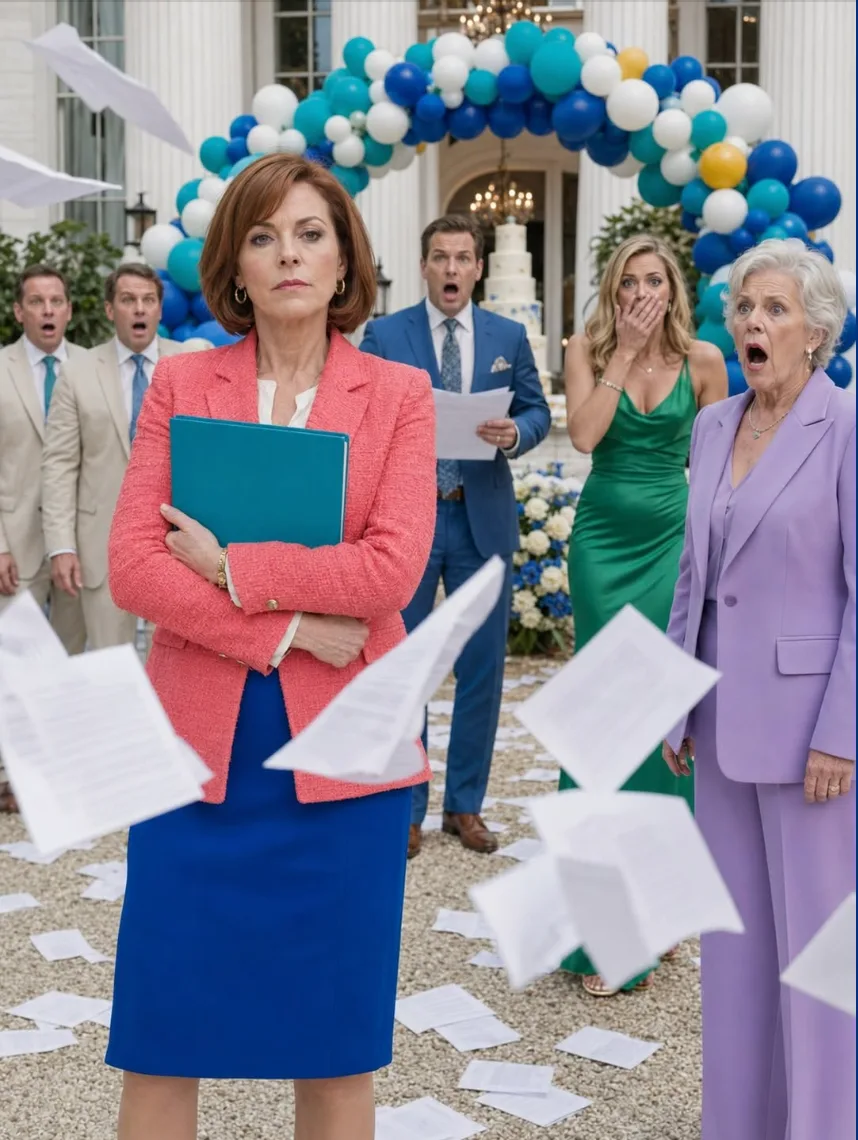
Howard’s words seemed to remove all the air from the room.
Chapter 2
Howard’s words seemed to remove all the air from the room.
“That isn’t the original.”
Maren’s smile did not disappear immediately. It remained fixed on her face for two or three seconds, almost elegant in its certainty, before the meaning reached her.
I looked from the brass key in her hand to Howard.
“What do you mean, there’s another one?”
Howard closed his briefcase.
“I mean,” he said calmly, “that the document in the deposit box was never the controlling original.”
Dylan stared at him.
Pamela stopped crying.
Even Noah, too young to understand the words, seemed to sense that something had changed. He held tighter to my leg, his little fingers curling into the fabric of my trousers.
Maren gave a quiet laugh.
“You expect us to believe that?”
Howard turned to her.
“I don’t particularly care what you believe.”
The rain had stopped outside, but gray water still ran down the windows in thin streams. Behind us, birthday balloons
floated beneath the chandelier. A half-finished table of pastries and juice boxes stood beside a silver bowl of flowers.
It was almost obscene how normal everything looked.
Howard removed a sealed plastic sleeve from his case.
Inside was a notarized document.
“The governing copy of the usufruct and beneficial-use agreement,” he said, “has been held in escrow by my firm since the day it was executed.”
I felt my pulse quicken.
“You never told me.”
“You never asked where the backup was.”
“That’s not the same thing.”
“No,” he said. “It isn’t.”
There was something strange in his voice.
Not evasive exactly.
Measured.
That bothered me.
Maren walked toward him.
“Let me see it.”
Howard did not move.
“You have no legal right to touch it.”
Her face hardened.
“You people think pieces of paper make you powerful.”
“No,” I said.
She looked at me.
“I think knowing what you
signed makes you powerful.”
For the first time that morning, Maren’s expression cracked.
Only slightly.
But I saw it.
And Howard saw it too.
Dylan stood.
“What did she sign?”
No one answered.
“Mom?”
I looked at Howard.
He was watching Maren.
“I think,” he said, “we should finish this in private.”
Maren folded her arms.
“I’m not going anywhere.”
Howard nodded to one of the court officers.
The man stepped forward.
“Ma’am, under the supervision order, nonresidents without documented ownership interest may be required to leave the premises.”
Maren’s lips parted.
“This is my daughter’s home.”
“It is currently an asset held by Tolbert Family Holdings,” Howard replied.
Pamela stared at me.
“You’re throwing my mother out?”
“No.”
I looked at her.
“I’m giving her the same privilege she gave me.”
The words came out quieter than I expected.
Pamela flinched.
Maren did not.
She simply picked up her
handbag.
“Fine.”
Then she turned to Dylan.
“You’ll regret this.”
He looked exhausted.
“I already regret enough.”
Something moved through Maren’s face then.
Anger.
Not at me.
At him.
It was the first time I realized that whatever influence she had over this family, she had expected it to be permanent.
She walked toward the foyer, heels clicking against marble.
At the door she stopped.
Without turning around, she said, “Gwen, you should ask your lawyer why he kept secrets from you.”
Howard’s jaw tightened.
Maren smiled at the door.
Then she left.
The court officer followed her outside.
I waited until the door shut.
Then I turned to Howard.
“What was that supposed to mean?”
Howard looked at Dylan and Pamela.
“First, I need the two of you to answer something.”
Pamela wiped her face.
“What?”
“How many loan applications were submitted?”
She said nothing.
Dylan stared at her.
“Pamela.”
“Three.”
Howard’s expression did not change.
“Are you sure?”
“Yes.”
“Absolutely sure?”
Pamela hesitated.
That hesitation chilled me more than anything Maren had said.
Dylan stepped closer.
“How many?”
Pamela looked toward the dining room, where Noah had gone back to the gifts.
Then she whispered, “Five.”
Dylan went still.
Howard’s voice sharpened.
“You said three.”
“Three went through the property portal.”
“And the other two?”
“My mother handled them separately.”
“Through whom?”
“I don’t know.”
Dylan slammed his hand on the table.
The cake plates rattled.
“You don’t know?”
Noah looked up.
I immediately raised my voice.
“Dylan.”
He saw his son and stopped.
Pamela covered her mouth.
“I thought she knew what she was doing.”
“That seems to be the family motto,” I said.
Pamela looked at me with wounded anger.
But I had no sympathy left for wounded pride.
Only facts.
Howard opened a folder and spread several pages across the dining table.
“Three applications attempted to pledge the house. Two were flagged because the ownership chain didn’t match the signatures. One got far enough to trigger the automated corporate notification that reached my office.”
I looked at him.
“You knew before last night?”
“Yesterday afternoon.”
My stomach tightened.
“And you didn’t call me?”
“I was trying to determine whether it was fraud or a clerical error.”
“And you decided to wait?”
“Yes.”
I stared at him.
Howard had been my lawyer for fourteen years.
He had represented me when my husband died.
He had helped restructure my company.
He had sat beside me while I signed the papers that rescued Dylan.
I trusted him more than almost anyone.
And suddenly I was aware of how dangerous that sentence was.
I trusted him.
Maren’s words returned.
Ask your lawyer why he kept secrets from you.
Howard must have seen it in my face.
“Gwen, don’t confuse caution with betrayal.”
“I’m not confusing anything. I’m asking questions.”
He nodded.
“Good. Keep asking.”
That answer disturbed me more than defensiveness would have.
Dylan lowered himself into a chair.
“How bad is this?”
Howard looked at Pamela.
“That depends on what your wife tells us next.”
Pamela swallowed.
“There’s nothing else.”
Howard slid one page toward her.
“Then explain this.”
She looked at it.
The color drained from her face.
I leaned over.
It was a wire-transfer receipt.
$612,000.
Recipient: Belltower Strategic Partners.
I had never heard of them.
Dylan whispered, “What is that?”
Pamela began shaking her head.
“No. No, that wasn’t supposed to be connected.”
Howard sat across from her.
“Connected to what?”
Her eyes moved toward me.
I saw something there.
Fear.
Real fear.
Not embarrassment.
Not shame.
Fear.
“Pamela,” I said. “Tell me.”
“My mother said the house was sitting on too much value.”
“She said what?”
“That nobody uses assets correctly in this family. She said wealthy families leverage everything.”
Dylan laughed once.
It was a miserable sound.
“We’re not wealthy.”
Pamela looked at him.
“Your mother is.”
Silence.
There it was.
The sentence beneath every Christmas smile.
Every private complaint.
Every expensive renovation.
Every assumption.
My money had become part of their identity while I myself became optional.
Howard tapped the transfer page.
“Where did the six hundred twelve thousand dollars come from?”
Pamela stared at her hands.
“A bridge loan.”
“Secured by?”
She said nothing.
Howard asked again.
“Secured by what?”
Pamela whispered, “The lake property.”
My blood went cold.
I owned a forty-acre property outside Fremont.
My late husband, Charles, and I had bought it when Dylan was twelve.
It was where Charles taught him to fish.
Where we scattered part of Charles’s ashes after the funeral.
I had never transferred it into the family company.
It was mine.
Personally.
“No,” I said.
Pamela looked at me.
“Yes.”
“You cannot borrow against my property.”
“I didn’t.”
“Then who did?”
She closed her eyes.
“My mother.”
Dylan stood again.
“How?”
Howard answered before she could.
“She couldn’t.”
He looked at me.
“Not without documents.”
A pressure built behind my eyes.
“What documents?”
Howard hesitated.
Then he opened a second folder.
That was when I knew.
He had brought it with him.
He had already suspected.
Inside were photocopies of a deed authorization, a power-of-attorney instrument, and an identity certification.
Each carried my name.
Each carried my signature.
At least, something that looked like my signature.
I touched the photocopy.
“I never signed this.”
“I know.”
“How?”
“Because this version names me as witness.”
I looked at him.
“And?”
“I was in Montreal on the date shown.”
Dylan whispered a curse.
Pamela started crying again.
I ignored her.
“Howard, who filed this?”
“A document service in Council Bluffs.”
“Who hired them?”
“They won’t disclose without a subpoena.”
“Get one.”
“I already requested it.”
Again.
Already.
I looked at him.
“You came here expecting more than a property audit.”
“Yes.”
“What did you expect?”
Howard leaned back.
“That someone had been systematically building authority around your assets.”
My skin prickled.
“What does that mean?”
“It means these aren’t random attempts to borrow money.”
He pointed to the documents.
“Someone has been creating a paper trail suggesting you authorized other people to act for you.”
“Why?”
“To move money. Sell assets. Secure debt.”
Dylan looked sick.
“Steal from her.”
Howard did not answer.
He didn’t need to.
From the next room came Noah’s laughter as he opened a toy.
The sound broke something inside me.
Because suddenly I understood the scale of it.
My exclusion from a birthday party had been ugly.
But it had also been useful.
If Dylan had not sent that message at two in the morning, I would not have called Howard.
If I had not called Howard, the audit might have waited.
If the audit had waited—
How much more would they have taken?
I turned to Pamela.
“Did your mother tell you to keep me away today?”
She looked at me.
“What?”
“From the party.”
“No. I mean… she said it would be easier.”
“Easier for what?”
Pamela hesitated again.
Howard went still.
“Pamela.”
She whispered, “There was supposed to be a meeting.”
Dylan stared at her.
“What meeting?”
“With a lender.”
“In the house?”
“Yes.”
“During Noah’s birthday?”
“After the guests arrived. Mom said nobody would question people coming and going.”
I felt almost dizzy.
The party.
The balloons.
The cake.
My grandson’s seventh birthday had been camouflage.
Howard leaned forward.
“Which lender?”
“I don’t know.”
“You keep saying that.”
“She never told me names!”
“What were they financing?”
Pamela’s shoulders collapsed.
“I thought the house.”
“You thought?”
“She said there was a way to restructure everything at once.”
Dylan’s face twisted.
“What does ‘everything’ mean?”
Pamela said nothing.
I suddenly knew.
“Your business.”
Dylan turned toward me.
“What?”
I looked at Pamela.
“She was going to use the house to finance Dylan’s company.”
Pamela burst into tears.
“She said we could save it!”
Dylan stepped backward.
“What did you tell her?”
“Your numbers were worse than you admitted.”
“You went through my accounts?”
“You left the statements in your office!”
“So you gave them to your mother?”
“I was trying to help!”
He stared at her as if she were a stranger.
I understood that feeling.
Howard interrupted.
“This isn’t about saving a business. If Maren was preparing a refinancing package using forged authority over Gwen’s assets, then she needed Dylan’s financial information to justify the transaction.”
Pamela looked up.
“She said once the loan closed, everything would be stable.”
“Stable for whom?” I asked.
No answer.
I walked into the study.
My study.
At least I still thought of it that way, even though I had not lived in that house for years.
The room had once belonged to Dylan when he was rebuilding his life. I had chosen the desk myself.
Now a framed photograph of Maren and Pamela sat on the bookshelf where a picture of Charles used to be.
I removed it.
Behind the frame was a small white device plugged into the wall.
I stared at it.
“Howard.”
He entered.
“What?”
I pointed.
He examined it.
Dylan followed.
“It’s a Wi-Fi extender.”
Howard leaned closer.
“No.”
He unplugged it.
There was no manufacturer label.
A tiny storage slot sat along one edge.
Howard’s face changed.
“What is it?”
He turned it over.
“Potentially a network capture device.”
Dylan stared.
“A what?”
“Something that may log traffic or credentials.”
Pamela appeared in the doorway.
The moment she saw it, she whispered, “Oh God.”
Every head turned.
“You’ve seen this before?” Howard asked.
Pamela shook her head too quickly.
“No.”
“You just reacted.”
“My mother has little devices like that.”
“Where?”
“At her house. In her office.”
Dylan sat on the edge of the desk.
“So she’s been spying on us?”
Howard looked at me.
“Possibly.”
I thought of every time I had used the house computer.
Every time I had opened a bank portal.
Every time I had logged into the family company dashboard while visiting Dylan.
“Maren knew my passwords,” I said.
Howard froze.
“What?”
“Not all of them. But she made comments.”
“What kind?”
“Two months ago she joked that my investment account was doing well.”
“Did you ever tell her the balance?”
“No.”
Howard placed the device into an evidence bag.
The room suddenly felt contaminated.
Every polished surface.
Every lamp.
Every familiar chair.
I had bought a house to protect my son, and someone had turned it into an observation post.
Dylan looked at Pamela.
“How long?”
“I don’t know.”
“How long has your mother been doing this?”
“I don’t know!”
“Stop saying you don’t know!”
Noah appeared at the door.
“Dad?”
Dylan closed his eyes.
I went to my grandson.
“Hey, sweetheart.”
“Is my party canceled?”
That question nearly destroyed me.
I knelt.
“No.”
He looked at the officers in the hall.
“Are those policemen?”
“They’re helping Grandma with some boring grown-up paperwork.”
He frowned.
“Is Grandma Maren coming back?”
I glanced toward Pamela.
“Not right now.”
He thought about that.
Then he whispered, “She said you weren’t coming.”
Every adult in the room went silent.
I kept my voice soft.
“What else did she say?”
Noah looked down.
“She said you were angry because Dad liked her more.”
Pamela’s face crumpled.
I touched Noah’s cheek.
“Grandma Maren was wrong.”
“Are you angry?”
“At you? Never.”
He nodded.
Then he handed me a folded card made from blue construction paper.
“I made this for you, but Grandma Maren said not to give it.”
I opened it.
Inside, in crooked pencil, Noah had written:
GRANDMA GWEN THANK YOU FOR MY HOUSE.
Below it was a drawing of three stick figures standing in front of a giant square building.
Me.
Noah.
And Dylan.
Pamela was not in the picture.
Neither was Maren.
I looked at my son.
His eyes were wet.
“He knows?” I asked.
Dylan nodded.
“I told him you helped us when things were bad.”
Pamela looked at him sharply.
“You told him?”
“Yes.”
“Mom said we weren’t supposed to talk about that.”
Dylan turned slowly toward his wife.
“Why would your mother decide what my son is allowed to know about my family?”
Pamela opened her mouth.
Nothing came out.
Then the doorbell rang.
Everyone froze.
One of the officers moved toward the entrance.
Howard checked his watch.
“Guests?”
“No,” Pamela whispered.
“What?”
“The party doesn’t start for another forty minutes.”
The officer opened the door.
Two men stood outside beneath black umbrellas.
Dark coats.
Leather folders.
No balloons.
No gift.
One of them gave his name.
“Martin Vale. We have an appointment with Mrs. Maren Whitlock.”
Howard stepped into the foyer.
“Regarding?”
The man looked past him.
“Private lending arrangements.”
Howard smiled without warmth.
“I’m Howard Jenkins, counsel for Tolbert Family Holdings.”
The second man immediately stiffened.
Martin Vale looked toward Pamela.
“Has there been a problem?”
“A small one,” Howard said.
“The person who arranged your meeting does not own this property.”
Martin’s expression changed.
“We were told she represented the beneficial owner.”
“She does not.”
“We have executed authorization.”
Howard held out his hand.
“Then I’d very much like to see it.”
Martin hesitated.
That hesitation was enough.
The court officer stepped forward.
“Sir, this property is under supervised audit.”
Martin looked at his colleague.
Then at Howard.
Finally, he handed over the folder.
Howard opened it.
I watched his eyes move across the first page.
Then stop.
“What?” I asked.
He did not answer.
“Howard.”
He handed me the document.
At the top was a legal authorization appointing an asset representative.
The representative’s name was not Maren Whitlock.
It was not Pamela.
It was not Dylan.
It was Howard Jenkins.
I looked up slowly.
No one spoke.
Howard’s face had gone pale.
Dylan whispered, “What the hell?”
Martin Vale stepped back.
“We were told Mr. Jenkins was acting as independent fiduciary.”
Howard snatched the next page.
“I did not sign this.”
I looked at the signature.
It looked perfect.
Too perfect.
Howard turned pages faster.
Then stopped again.
I saw genuine fear in his eyes for the first time in fourteen years.
“What is it?”
He lowered the folder.
“This authorization was notarized by Eleanor Briggs.”
The name meant nothing to me.
But it meant something to him.
“Who is that?”
“My former paralegal.”
“Former?”
“She disappeared four years ago.”
Dylan stared.
“Disappeared?”
Howard looked at me.
“She took money from a client escrow account and vanished before investigators could question her.”
The room seemed to tilt.
I thought of Maren’s brass key.
The hidden device.
The forged deed.
Howard’s signature.
My signature.
This was larger than Maren.
Much larger.
Martin Vale cleared his throat.
“For what it’s worth, we have no interest in participating in fraud.”
Howard turned sharply.
“Who referred this transaction to you?”
“Our intermediary.”
“Name.”
“I’ll have to consult counsel.”
The officer spoke.
“You may want to do that quickly.”
Martin’s colleague whispered something to him.
Then Martin sighed.
“Victor Hale.”
Howard became completely still.
I knew that look.
Recognition.
Not uncertainty.
Recognition.
“Who is Victor Hale?” I asked.
Howard did not answer.
“Howard.”
He closed his eyes briefly.
Then he said, “He worked with your husband.”
My breath stopped.
“Charles?”
“Yes.”
“Doing what?”
Howard glanced toward Noah.
“Not here.”
I stepped closer.
“My husband has been dead for eleven years. You tell me now.”
Howard lowered his voice.
“Charles had a silent partner in three land-development ventures before he died.”
I stared at him.
“He never had a partner.”
“He did.”
“You handled his estate.”
“I know.”
“And you never told me?”
“He asked me not to.”
Rage rose so quickly inside me that my hands trembled.
“You’re telling me my dead husband hid a business partner from me, and you helped him do it?”
Howard looked ashamed.
“Yes.”
Dylan stared between us.
“What was the partner’s name?”
Howard answered.
“Victor Hale.”
The name seemed to stay in the room.
Heavy.
Alive.
Martin Vale shifted toward the door.
“I think we should leave.”
“No,” I said.
He stopped.
“You came here to close a loan against my property. You’ll stay until the officers finish taking your information.”
The officer nodded.
Martin said nothing.
Howard looked older than he had an hour earlier.
I said, “Tell me everything.”
He rubbed his forehead.
“Charles and Victor developed industrial parcels west of Omaha. Charles provided capital. Victor found acquisitions.”
“How much money?”
“Millions.”
“How many millions?”
“I don’t know exactly.”
“You were his lawyer.”
“I was not counsel on those ventures.”
“But you knew.”
“Yes.”
“Why was none of this in the estate?”
Howard hesitated.
Because, apparently, that had become the answer to every important question in my life.
Finally he said, “Charles liquidated his interest before he died.”
“To whom?”
“Victor.”
“For how much?”
“Gwen—”
“How much?”
“Eight million dollars.”
Dylan inhaled sharply.
I heard Pamela whisper, “Oh my God.”
Eight million.
Charles died with less than three million in liquid assets.
I personally reviewed the probate documents.
I knew every account.
Every property.
Every insurance payment.
There had been no eight million dollars.
“Where did it go?”
Howard looked at me.
“I never knew.”
“Did you ask?”
“Yes.”
“And?”
“Charles said it was taken care of.”
I laughed.
There was no humor in it.
“Taken care of.”
Howard’s face tightened.
“He was sick. He didn’t want you dealing with business disputes while he was dying.”
“So he lied to me.”
“Yes.”
The word hurt more than I expected.
Not because I needed Charles to have been perfect.
He wasn’t.
But because death had frozen him in my memory as something complete.
Now cracks were appearing in a man who could no longer explain himself.
Dylan looked at Howard.
“What does this have to do with Maren?”
“I don’t know.”
I turned.
“Yes, you do.”
Howard looked at me.
“You recognized her warning.”
He frowned.
“What warning?”
“When she told me to ask why you kept secrets.”
“I thought she knew about the escrow copy.”
“Why would she?”
He said nothing.
“Howard.”
“I don’t know.”
Again.
That phrase.
I suddenly hated it.
Then Pamela spoke from behind us.
“My mother knows Victor.”
Every face turned toward her.
Howard said, “What?”
Pamela looked terrified.
“I heard the name once.”
“When?”
“Last Christmas.”
“Where?”
“At Mom’s house.”
“What did you hear?”
“She was on the phone. She didn’t know I was in the hallway.”
Dylan moved closer.
“What did she say?”
Pamela closed her eyes, trying to remember.
“She said, ‘Victor, I’m tired of waiting. Gwen is not going to die soon enough for your plan.’”
The silence that followed was so deep I could hear the clock in the kitchen.
Tick.
Tick.
Tick.
Howard’s face changed.
Dylan grabbed the back of a chair.
I did not move.
Pamela started crying again.
“I thought she was talking about inheritance. I thought she was being horrible, but I didn’t think…”
“You didn’t think what?” Dylan asked.
She looked at me.
“I didn’t think they were planning something.”
Howard pulled out his phone.
“I’m calling the county attorney.”
I stopped him.
“No.”
He stared at me.
“Gwen.”
“If Victor Hale believes today’s transaction is still going forward, then he doesn’t know we’ve uncovered him.”
Martin Vale spoke carefully.
“That may not be true.”
I looked at him.
“Why?”
He pointed toward the front window.
Across the street, parked beneath a dripping oak tree, sat a black sedan.
I had noticed it earlier.
I thought it belonged to one of the guests.
Martin said, “That car followed us here.”
Howard stepped toward the window.
The sedan’s engine started.
“Officer.”
One of the court officers hurried outside.
The black car pulled away.
Not fast.
Not dramatically.
It simply turned the corner and vanished.
Howard immediately began making calls.
I stood beside the window.
Noah came up behind me and slipped his hand into mine.
I looked down.
“Grandma?”
“Yes?”
“Why is everyone scared?”
I crouched.
“We found out some adults have been telling lies.”
“Big lies?”
“Yes.”
He thought for a moment.
“Dad says big lies always fall apart.”
I looked toward Dylan.
He had heard it.
His face crumpled.
“Your dad is right.”
Noah smiled.
Then ran back toward his gifts.
Click the blue “PART 3” below to read the next part: 👉 PART 3 👈
Chapter complete
You have reached the end of this chapter.
Continue reading
A few more worlds to get lost in after this chapter.




