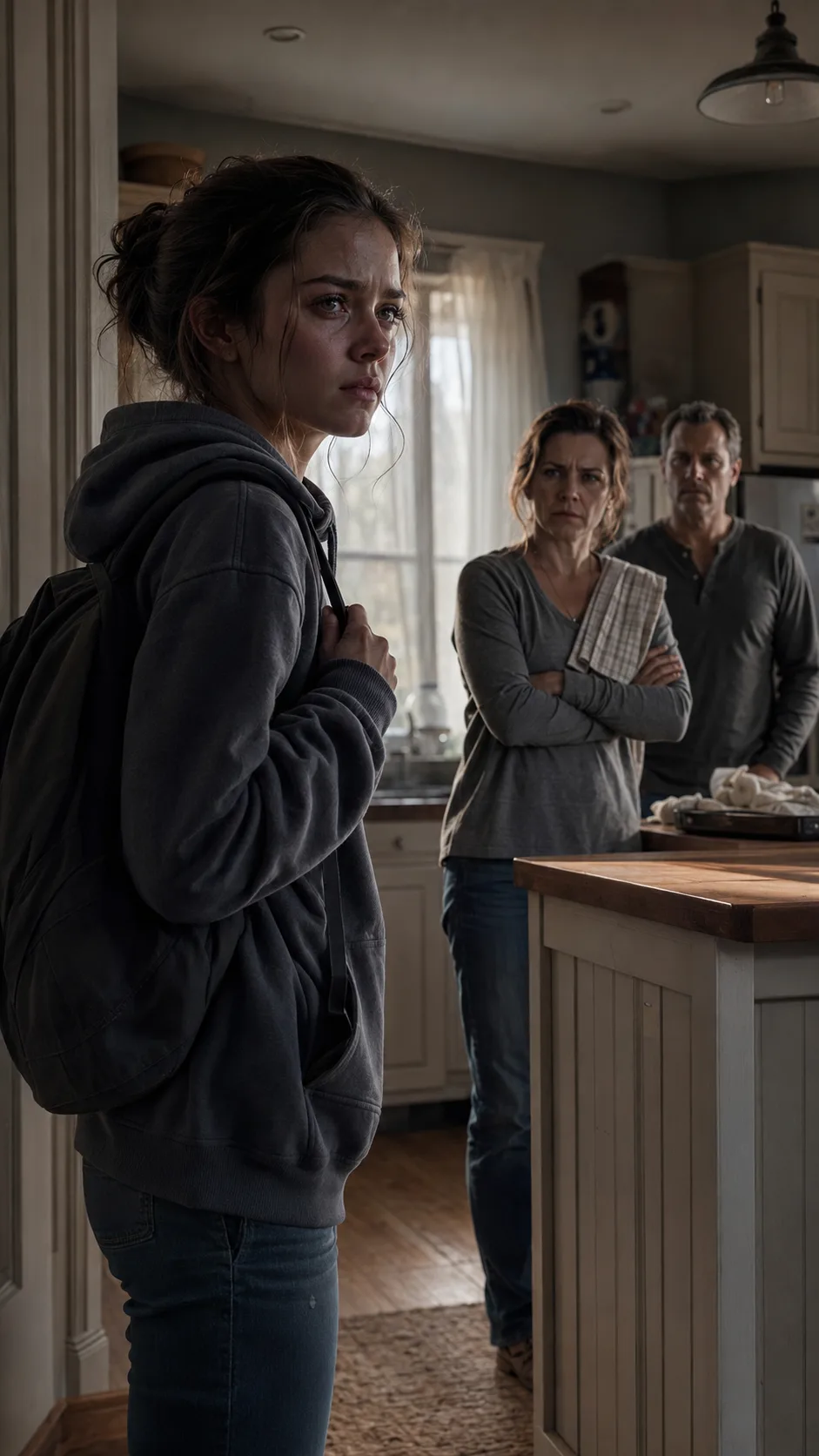
I took a deep breath, my heart pounding.
Chapter 2
I took a deep breath, my heart pounding.
“I need a little more time,” I said.
My father frowned.
“We gave you a week. That’s plenty of time.”
“I know. I just need to figure out my finances.”
My mother sighed, exasperated.
“This isn’t complicated, Ellie. Either you contribute to this family, or you pay your fair share. It’s that simple.”
I bit my tongue, swallowing the words I wanted to say.
“I’ll let you know by Sunday,” I said.
They seemed satisfied with that answer, and I escaped to my room before they could press further.
Sunday.
My move‑out date was Saturday.
On Friday, I confirmed everything with the moving company. They would arrive at ten in the morning, right after my parents left for their weekly Costco run and Khloe took the girls to a playdate at the indoor playground across town.
I had timed it perfectly.
That night, I barely slept. I lay in bed
staring at the ceiling, my mind racing with a thousand what‑ifs.
What if something went wrong?
What if they came home early?
What if I couldn’t actually go through with it?
But beneath the fear was something else.
Excitement.
Hope.
For the first time in years, I felt like I was taking control of my life.
Saturday morning arrived, and I woke up before anyone else.
I showered, dressed in jeans and a hoodie, and made myself a cup of coffee, savoring the quiet of the house while the sun rose over the cul‑de‑sac.
My parents left at 9:30, keys jangling, arguing good‑naturedly about which route to take. Khloe bundled the girls into her SUV shortly after, balancing a Starbucks mobile order in one hand and her phone in the other.
“See you later, Ellie,” she called as she walked out the door.
I waved, my heart pounding.
As soon
as her car disappeared down the street, I sprang into action.
I pulled the boxes out from under my bed and started carrying them downstairs. The movers arrived exactly on time in a rattling truck with a Missouri plate and a faded company logo, and within an hour, everything I owned was loaded into it.
I stood in my empty room one last time, looking at the bare walls, the dent in the carpet where my bed had been, the old poster tape marks from my first semester.
This had been my home for two years, but it had never really felt like mine. It had always felt like I was living in someone else’s space, following someone else’s rules.
Not anymore.
I locked the front door behind me and left my key on the kitchen counter.
I didn’t leave a note.
I didn’t owe them an explanation.
By noon,
I was standing in my new studio apartment, surrounded by boxes.
The space was tiny, barely bigger than my old bedroom, but it was mine. The walls were white and plain, the hardwood floor was scuffed, and the kitchenette consisted of a hot plate, a mini‑fridge, and a chipped laminate counter.
I didn’t care.
I sat on the floor, leaning against the wall, and let out a long breath.
I had done it.
I had actually done it.
For the first time in months, I felt like I could breathe.
I spent the rest of the day unpacking.
I hung my clothes in the small closet, arranged my books on a makeshift shelf made from stacked milk crates, and set up my bed in the corner.
It wasn’t much, but it was enough.
As the sun began to set, I stood by the window and looked out at the city—at the red‑brick buildings, the distant skyline, the glow of traffic on the highway.
Kansas City stretched out before me, full of possibilities.
I didn’t know what would happen next. I didn’t know how my family would react when they realized I was gone.
But for the first time in a long time, I felt hopeful.
My phone buzzed.
A notification from Khloe.
“Hey, can you watch the girls tomorrow? I have plans.”
I stared at the message, then deleted it without responding.
Tomorrow, they would wake up and find my room empty. They would realize I was gone and they would have to figure out their own lives without me.
I smiled, set my phone down, and went back to unpacking.
Sunday morning arrived, and I woke up in my new apartment feeling lighter than I had in years.
Sunlight streamed through the small window, casting soft shadows across the bare walls. The only sound was the hum of the fridge.
No crying children.
No demanding voices.
Just peace.
I made myself a simple breakfast using the hot plate and the few groceries I’d picked up the night before from a nearby Walmart Neighborhood Market.
As I ate, I kept glancing at my phone, half expecting a string of frantic calls or angry messages.
The screen stayed dark.
They didn’t know yet.
I imagined what was happening back at the house.
Khloe probably woke up late, stumbling downstairs in her pajamas to find the girls already awake and demanding breakfast. She would call for me, expecting me to appear like I always did.
But this time, I wouldn’t come.
She would climb the stairs, knock on my door, and push it open to find the room empty, the bed stripped, the closet bare.
And maybe, just maybe, she would realize what she had lost.
I smiled at the thought.
I spent the morning organizing my new space, rearranging the furniture, and finding homes for my belongings. It was small, but it was mine. I could walk around without tiptoeing. I could play music without worrying about waking anyone up. I could just exist without constantly being on call.
Around noon, my phone buzzed.
I picked it up and saw a text from Khloe.
“Where are you? The girls are driving me crazy. Can you come watch them?”
I stared at the message, my heart pounding. I could picture her standing in the kitchen, frustrated and overwhelmed, expecting me to drop everything and rush over.
I didn’t respond.
A few minutes later, another text came through.
“Ellie, seriously, where are you? I need help.”
Still, I didn’t reply.
Then came the calls.
Khloe’s name flashed across the screen again and again. I let each call ring until it went to voicemail.
She called. My mother called. My father called.
I ignored them all.
Finally, a text from my mother appeared.
“Ellie, why aren’t you answering your sister? She needs you.”
I set the phone down and went back to unpacking.
By late afternoon, the messages had escalated.
My mother called three times.
My father sent a terse text asking where I was.
Khloe sent a string of increasingly frantic messages, alternating between pleading and anger.
“Ellie, please. I don’t know what to do. The girls are crying for you.”
“Where the hell are you? This isn’t funny.”
“I can’t believe you’re being this selfish.”
I read each message with a strange sense of detachment.
Part of me felt guilty. They were my family, after all.
But another part of me—the part that had been used and ignored for so long—felt vindicated.
They didn’t care about me.
They cared about what I could do for them.
I turned off my phone, grabbed my jacket, and went for a walk.
The neighborhood around my new apartment was unfamiliar but welcoming. There were small shops and cafes, a taco truck parked on the corner, and tree‑lined streets filled with people walking dogs or pushing strollers.
I stopped at a coffee shop, ordered a latte, and sat by the window watching the world go by.
For the first time in months, I felt like I could breathe.
When I got back to my apartment, I turned my phone back on.
The screen lit up with notifications—dozens of missed calls, countless texts.
I scrolled through them, my stomach twisting. Most were from Khloe, her messages growing more desperate.
“Ellie, please, I’m begging you. I don’t know how to do this alone. The girls are crying for you. Mom and Dad are furious. You need to come home.”
But it was the last message that caught my attention.
It was from my father, and it was short and cold.
“If you don’t come back by tonight, don’t bother coming back at all.”
I stared at the message, my hands trembling.
This was it. The final ultimatum. The moment where I had to choose between them and myself.
I chose myself.
I typed a single message and sent it to the family group chat.
“I moved out. I won’t be coming back.”
Then I turned off my phone again and set it on the counter.
The rest of the evening passed in a blur. I tried to distract myself by watching a movie on my laptop, but I couldn’t focus. My mind kept drifting back to my family, to the chaos I had left behind.
I wondered if they were angry.
I wondered if they were worried.
I wondered if they even cared.
But more than anything, I wondered if I had made the right choice.
As the night grew darker, I climbed into bed and stared at the ceiling.
The apartment felt too quiet, almost eerie.
I was alone in a way I had never been before.
But I wasn’t lonely.
For the first time in years, I felt free.
The next morning, I woke up to silence.
No alarms. No crying. No demands.
Just silence.
I stretched, rolled out of bed, and made myself breakfast.
As I sat by the window, sipping my coffee and watching the city wake up, I realized something.
I didn’t miss them.
I didn’t miss the constant pressure, the endless demands, the feeling of being invisible.
I didn’t miss being treated like a servant instead of a daughter.
I missed my nieces, yes. I missed their laughter, their little arms around my neck, the way they mispronounced my name.
But I didn’t miss the way my family had used them as a weapon against me.
I turned on my phone and braced myself for the onslaught.
To my surprise, there were only a handful of new messages.
One from Khloe.
“You’re unbelievable. I hope you’re happy.”
One from my mother.
“How could you do this to us?”
And one from my father.
“Don’t expect any help from us ever again.”
I read each message, then deleted them without responding.
They still didn’t get it.
They still thought this was about them.
It wasn’t.
It was about me.
It was about finally choosing my own life over their expectations.
The days that followed my move were a strange mix of relief and anxiety.
I threw myself into my routine—classes, work, studying at the campus library until it closed, grabbing dollar slices of pizza on the way home.
I tried to drown out the lingering guilt that gnawed at the edges of my mind.
But no matter how hard I tried, I couldn’t shake the feeling that something was brewing.
My phone stayed mostly silent. Khloe sent a few more bitter messages, but they grew less frequent as the days passed. My parents didn’t reach out at all.
It was as if I had been erased from their lives, cut out like a bad memory.
Honestly, I was okay with that.
Or at least I told myself I was.
On Wednesday evening, I was walking home from campus, my backpack digging into my shoulders, when I heard my name.
“Ellie?”
I turned and saw an old friend from high school standing outside a coffee shop, scrolling through her phone.
Her name was Brooke. We’d been close once—shared AP classes, late‑night study sessions, whispered secrets about getting out of this town—before life pulled us in different directions.
She looked up just as I passed by, her face brightening.
“Oh my God, it’s been forever,” she said, pulling me into a hug.
I smiled, genuinely happy to see her.
“Brooke, hey. How have you been?”
She insisted on buying me a coffee, and we sat by the window, watching cars roll past in the fading Midwestern light.
She told me about her job at a marketing firm downtown, her recent breakup, her plans to travel to Europe next summer.
I told her about school, my job, and—hesitantly—my recent move.
“Wait, you moved out?” she asked, eyes widening. “Why didn’t you tell me?”
I hesitated, unsure how much to share.
“It’s complicated,” I said. “My family and I had some issues.”
She leaned in, her expression softening.
“What happened?”
I gave her the short version, leaving out the most painful details but explaining the ultimatum, the free babysitting, the way they treated me.
She listened intently, nodding along.
“That sounds awful,” she said when I finished. “But honestly? Good for you. It takes guts to walk away from something like that.”
Her words were comforting, and for the first time since I had left, I felt like someone actually understood.
We talked for over an hour, and by the time we said goodbye, I felt lighter.
It was nice to be reminded that I had people in my life who cared about me, even if they weren’t family.
But the relief was short‑lived.
The next day, I was at work when my phone buzzed with a call from an unknown number. I ignored it, assuming it was spam. It rang again. And again.
Finally, I stepped outside onto the sidewalk and answered.
“Hello?”
“Ellie?” The voice on the other end was breathless and panicked.
It took me a moment to place it.
It was Gregory.
“Gregory? What’s going on?”
“I need to talk to you,” he said. “It’s about Khloe.”
My stomach dropped.
“What about her?”
He hesitated, then sighed.
“She’s losing it. Ever since you left, she’s been a mess. The girls are out of control, and she can’t handle it. She’s been calling me constantly, crying, begging me to come home early from trips. I don’t know what to do.”
I felt a pang of guilt, but I pushed it down.
“Gregory, that’s not my problem,” I said.
“I know,” he replied quickly. “I’m not asking you to come back. I just thought you should know what’s going on. She’s also been bad‑mouthing you to everyone—saying you abandoned the family. Your parents are backing her up.”
My jaw tightened.
“Of course they are,” I said.
“Look, I don’t agree with what they did to you,” Gregory continued. “I told Khloe she was being unreasonable, but she won’t listen. She thinks you owe her.”
“I don’t owe her anything,” I said firmly. “I spent a year doing everything for her, and she never even said thank you.”
“I know,” he said. “And for what it’s worth, I’m sorry. I should have stepped in sooner. I should’ve told her to hire a babysitter instead of dumping everything on you.”
His apology caught me off guard.
“Why didn’t you?” I asked.
He was quiet for a moment.
“I don’t know,” he admitted. “I guess I was too busy with work. And honestly, Khloe made it seem like you didn’t mind.”
I almost laughed.
“She was wrong.”
“Yeah,” he said softly. “I see that now.”
We talked for a few more minutes before I ended the call.
His words stayed with me for the rest of the day.
Khloe was bad‑mouthing me.
My parents were backing her up.
They were painting me as the villain—the selfish daughter who abandoned her family in their time of need.
I wasn’t surprised.
That’s what they did. They twisted the narrative to suit themselves, making me the problem so they didn’t have to face their own failures.
I refused to let it get to me.
I had made my choice, and I wasn’t going to second‑guess it.
That evening, I was sitting in my apartment studying for an exam when I heard a knock on the door.
I froze, my heart racing.
No one knew where I lived.
I hadn’t given my address to anyone.
I crept to the door and peered through the peephole.
Khloe.
She stood in the hallway, arms crossed, face twisted into a scowl. Behind her, I could see my mother.
My first instinct was not to answer, to pretend I wasn’t home and hope they went away.
But before I could move, Khloe knocked again, louder this time.
“Ellie, I know you’re in there. Open the door.”
I took a deep breath, steeling myself, and opened it.
“What are you doing here?” I asked, my voice cold.
Khloe glared at me.
“What am I doing here? What are you doing here?” she snapped. “You just left. No explanation, no warning. Do you have any idea what you’ve put us through?”
“I sent a message,” I said. “I told you I moved out.”
“A message?” my mother interjected, stepping forward. “You call that an explanation? You owe us more than that, Ellie.”
“I don’t owe you anything,” I said, my voice rising despite my efforts to stay calm. “I paid rent. I did everything you asked. And you still treated me like I was nothing.”
“We gave you a home,” my mother snapped. “We supported you.”
“You used me,” I shot back. “You made me your live‑in babysitter and then threatened to kick me out when I couldn’t do it anymore. That’s not support. That’s manipulation.”
Khloe’s face twisted with anger.
“You’re so selfish,” she said. “You have no idea how hard it is to be a mother.”
“And you have no idea how hard it is to be me,” I replied. “I was trying to finish school, work, and raise your kids. Your kids, Khloe. Not mine.”
“They’re your nieces,” she said, her voice breaking. “They love you. And you just left them.”
The words hit me like a punch to the gut.
I loved my nieces. I did.
But I couldn’t sacrifice my entire life for them.
“I’m sorry,” I said, my voice softening. “But I had to do this. I couldn’t keep living like that.”
My mother shook her head, her expression hard.
“You’re making a mistake, Ellie. You’ll regret this.”
“Maybe,” I said. “But it’s my mistake to make.”
Khloe opened her mouth to say something else, but I stepped back and closed the door in her face.
I leaned against it, my heart pounding, and listened as their footsteps echoed down the hallway.
They were gone.
And I was still standing.
The encounter left me shaken, but it also solidified something inside me.
I had made the right choice.
Seeing them at my door, demanding answers and trying to guilt me into coming back, only confirmed what I already knew.
They didn’t care about me.
They cared about what I could do for them.
The next few days, I was on edge.
Every time my phone buzzed, I braced myself for another confrontation. Every time I heard footsteps in the hallway, I wondered if it was them coming back.
But days turned into a week, and they didn’t return.
Instead, the texts started.
Not from Khloe. Not from my parents.
From extended family members.
Aunts.
Uncles.
Cousins I hadn’t spoken to in years.
All of them had heard the story—twisted and distorted—and they all had opinions.
“Your mother is heartbroken. How could you do this to her?”
“Family is everything. You should be ashamed.”
“You need to apologize and go home.”
I deleted each message without responding.
They didn’t know the full story, and I wasn’t about to waste my energy explaining it to people who had already made up their minds.
But there was one message that stood out.
It was from my aunt Joyce, my mother’s older sister.
Joyce had always been the black sheep of the family—the one who moved across the country to the West Coast, built a life on her own terms, and only came back to Missouri for the occasional holiday.
We weren’t close, but I had always respected her.
Her message was short and to the point.
“I heard what happened. Ignore everyone else. You did the right thing. Call me if you need anything.”
I stared at the message for a long time, feeling a surge of gratitude.
It was the first time anyone from my family had acknowledged that I might not be the villain in this story.
I saved her number and made a mental note to call her when I had the courage.
Meanwhile, I focused on rebuilding my life.
I picked up extra shifts at the bookstore, stocking shelves and ringing up students buying overpriced textbooks and KU vs. Mizzou hoodies. I stayed on top of my coursework, determined not to let my personal drama affect my grades.
Slowly, I started to feel like myself again.
The real turning point came two weeks after I moved out.
I was sitting in my apartment one evening, scrolling through social media, when I came across a post from Khloe.
It was a photo of her and the girls at a park, smiling for the camera on a sunny Midwestern afternoon, plastic playground in the background.
The caption read:
“Just us girls today. Sometimes you have to do everything yourself. #MomLife #StrongMom”
I stared at the post, my blood boiling.
She was painting herself as a martyr, as if she had been doing everything alone all along.
Then I scrolled down and saw the comments.
One of Khloe’s friends wrote, “Where’s Ellie? Doesn’t she usually help with the girls?”
Khloe had replied, “She moved out without warning. Left us high and dry, but we’re managing.”
Another friend replied, “That’s so messed up. Family should stick together.”
I felt a surge of anger, but I didn’t respond.
I didn’t need to defend myself to strangers on the internet.
Instead, I kept scrolling.
That’s when I saw it.
A post from a mutual friend of Khloe’s and mine named Jessica.
She had posted a screenshot of a conversation she’d had with Khloe months before I moved out.
In it, Khloe was laughing about how she had “gotten rid of daycare forever” because I would never dare move out.
“She’ll never leave,” Khloe had written. “Ellie’s too scared to be on her own. She’ll do whatever we tell her. It’s perfect.”
I stared at the screenshot, my hands trembling.
She had planned this.
She had manipulated me, used me, and laughed about it behind my back.
And now she was playing the victim.
Something inside me snapped.
I took a screenshot of Jessica’s post and saved it to my phone. Then I started digging.
I went through old text messages, looking for every instance where Khloe had taken advantage of me.
I found dozens.
Texts where she asked me to babysit at the last minute.
Texts where she canceled plans with me because she’d “forgotten” she had other commitments.
Texts where she complained about how hard her life was while I was in the middle of finals week.
I compiled everything into a folder and sat back, staring at the evidence.
This was it.
This was the proof I needed to show everyone what had really happened.
Then I hesitated.
Did I really want to do this?
Did I want to air our dirty laundry for the world to see?
I thought about it for a long time.
Part of me wanted to take the high road, to let it go and move on with my life.
But another part of me—the part that had been silenced for so long—wanted justice.
I wanted people to know the truth.
So I made a decision.
I opened a new document on my laptop and started writing.
I wrote about everything—the years of being overlooked, the months of being used as free childcare, the ultimatum my parents had given me in that kitchen.
I wrote about Khloe’s manipulation, about the screenshot Jessica had posted, about the way my family had painted me as the villain.
I wrote until my hands hurt and my eyes burned.
When I was done, I saved the document and set it aside.
I wasn’t ready to share it yet.
But I would be.
The next morning, I woke up to a text from Gregory.
“Khloe hired a nanny. She’s freaking out about the cost, but at least the girls are being taken care of. Thought you’d want to know.”
I smiled.
Good.
They were finally facing the reality of their situation.
I texted back, “Thanks for letting me know.”
He responded a few minutes later.
“For what it’s worth, I think you made the right call. Khloe needed a wake‑up call.”
I didn’t respond to that, but his words stayed with me.
Maybe I wasn’t the villain after all.
The following week, I focused entirely on myself.
I went to class.
I worked my shifts.
I spent my evenings in my small apartment, enjoying the peace and quiet—cooking simple meals, watching Netflix, studying at my tiny table.
For the first time in over a year, I wasn’t constantly worrying about someone else’s needs.
I could study without interruption.
I could sleep without being woken up by crying children.
I could exist without feeling like I was perpetually on call.
It was liberating.
But in the back of my mind, I knew this wasn’t over.
Khloe and my parents hadn’t given up.
They were just regrouping, figuring out their next move.
I needed to be ready.
On Friday morning, I woke up to find that Khloe had posted another photo on social media.
This time, it was a picture of the girls at a playground, their faces smudged with ice cream.
The caption read:
“Doing my best to keep smiling through tough times. Being a ‘single mom’ isn’t easy, but my girls are worth it. #Blessed #FamilyFirst”
I rolled my eyes.
Single mom.
Gregory was still very much in the picture, even if he traveled for work.
But of course, Khloe had to play the victim.
The comments section was filled with sympathy.
“You’re so strong.”
“Those girls are lucky to have you.”
“Some people just don’t understand family loyalty.”
I knew that last comment was directed at me.
I closed the app and went about my day, refusing to let it get under my skin.
Later that evening, I received a message from Jessica.
“Hey, Ellie. I just wanted to say I’m sorry for what you’ve been going through. I didn’t realize how bad things were until I saw that old conversation. Khloe’s always been self‑centered, but this is a new low.”
I stared at the message, surprised.
Jessica and I had never been particularly close, but her words felt genuine.
“Thanks,” I typed back. “I appreciate that.”
She responded almost immediately.
“If you ever want to talk, I’m here. And for what it’s worth, I think you did the right thing.”
Her support meant more than I expected.
It was a reminder that not everyone believed Khloe’s version of events.
Over the weekend, I met up with Brooke again.
We grabbed lunch at a small café near campus, an old brick building that served sandwiches and iced tea in mason jars.
I told her everything—the screenshot, the messages, the way my family was twisting the narrative.
“You need to set the record straight,” Brooke said, her eyes blazing with indignation. “They’re making you look like the bad guy when they’re the ones who treated you like garbage.”
“I know,” I said. “I’ve been thinking about it.”
“Well, stop thinking and start doing,” she replied. “You have the proof. Use it.”
Her words echoed in my mind for the rest of the day.
She was right.
I had the evidence.
I had the truth.
All I had to do was share it.
That evening, I sat down at my desk and reviewed everything I had compiled—the screenshots, the text messages, the timeline of events.
It was all there in black and white.
I drafted a post, carefully worded, factual and calm instead of angry and explosive.
I explained my side of the story.
I provided the evidence.
I made it clear I wasn’t looking for sympathy.
I just wanted people to know the truth.
I read it over a dozen times, tweaking and refining until it felt right.
Then I saved it and closed my laptop.
I wasn’t ready to post it yet.
But I was getting there.
The next morning, I woke up to a series of missed calls from my mother.
I ignored them and went about my day, refusing to let her disrupt my peace.
That evening, she showed up at my apartment.
Alone.
I opened the door reluctantly, crossing my arms.
“What do you want?” I asked.
She looked older than I remembered, her face lined with stress, her hair not as perfectly styled as it used to be for Sunday service.
“I want to talk,” she said.
“There’s nothing to talk about,” I replied.
“Please, Ellie. Just give me five minutes.”
I hesitated, then stepped aside to let her in.
She sat on my small futon, looking out of place in the cramped space. I remained standing, leaning against the counter.
“I know you’re angry,” she began. “And I understand why. But you have to see this from our perspective. Khloe is overwhelmed. She needs help. We’re family.”
“I was helping,” I said. “For over a year, I helped. I gave up my time, my energy, my sanity. And you never once acknowledged it. Instead, you threatened to kick me out.”
“We didn’t mean it like that,” she said quickly. “We just needed you to understand how important this is.”
“No,” I said firmly. “You needed me to do what you wanted without question. And when I finally stood up for myself, you punished me for it.”
She was quiet for a moment.
“What do you want from us, Ellie?” she asked finally.
“I want you to leave me alone,” I said. “I want you to stop trying to guilt me into coming back. I want you to accept that I have my own life and it doesn’t revolve around Khloe.”
She stood up, her expression hardening again.
“You’re being selfish,” she said.
“Maybe I am,” I replied. “But I’d rather be selfish than miserable.”
She left without another word.
I closed the door behind her, my hands shaking.
That night, I made my decision.
I was done being silent.
The next morning, I woke up with a sense of purpose.
I opened my laptop, reviewed the post I had drafted one final time, made a few last‑minute edits, and took a deep breath.
Then I hit “publish.”
The response was immediate.
Within an hour, the post had been shared dozens of times. Friends, acquaintances, and even people I didn’t know commented, offering their support and expressing their outrage at how I had been treated.
“I had no idea you were going through this.”
“Your family should be ashamed.”
“You’re so brave for standing up for yourself.”
Not everyone was supportive.
Some of Khloe’s friends rushed to her defense, accusing me of airing private family matters and trying to make her look bad.
“This is so petty.”
“You’re just trying to get attention.”
“Family issues should stay private.”
I ignored the negative comments and focused on the positive ones.
For the first time, people were hearing my side of the story—and they believed me.
The real fallout came that afternoon when Khloe called.
I answered, bracing myself.
“How dare you?” she hissed. “How dare you post that? Do you have any idea what you’ve done?”
“I told the truth,” I said calmly. “That’s all.”
“You’ve humiliated me,” she said, her voice breaking. “Everyone is talking about it. My friends are asking questions. Even Gregory is questioning me.”
“Good,” I said. “Maybe now you’ll see how it feels to be judged unfairly.”
“You’re ruining my life,” she cried.
“No, Khloe,” I replied. “I’m just not letting you ruin mine anymore.”
She hung up.
I sat there, my heart pounding.
I had done it.
I had finally stood up to her.
Over the next few days, the post continued to spread.
More people reached out to me, sharing their own stories of being taken advantage of by family members.
It was a reminder that I wasn’t alone, that there were others who had faced similar struggles.
The most surprising response came from Aunt Joyce.
She called one evening, her voice warm and reassuring.
“I saw your post,” she said. “I’m proud of you, Ellie. It takes courage to stand up for yourself like that.”
“Thanks, Aunt Joyce,” I said, my voice thick with emotion.
“You know,” she continued, “your mother and I had a falling out years ago for similar reasons. She’s always been about appearances—about making sure everything looks perfect on the outside—but she never cared about what was happening on the inside.”
Her words resonated with me.
“I didn’t know that,” I said.
“Well, now you do,” she replied. “And I want you to know that you’re not alone. If you ever need anything—anything at all—you call me. Okay?”
“Okay,” I said, tears streaming down my face.
After we hung up, I felt a weight lift off my shoulders.
I had lost my immediate family, yes.
But I had gained something more valuable.
My freedom.
And the support of people who truly cared about me.
The following week, I received a message from Gregory.
He asked if we could meet for coffee.
Curious, I agreed.
We met at a small café near campus. He looked tired, dark circles under his eyes, his dress shirt wrinkled like he’d slept in it.
“I wanted to apologize,” he said as soon as we sat down. “For everything. I should have stepped in sooner. I should have told Khloe to stop taking advantage of you.”
“Why didn’t you?” I asked.
He sighed.
“Honestly? I was avoiding the problem,” he said. “I travel so much for work, and when I’m home, I just want peace. It was easier to let things slide than to confront Khloe.”
“That’s not good enough,” I said.
“I know,” he replied. “And I’m sorry. For what it’s worth, I’ve told Khloe she needs to hire help. We can afford it. She just didn’t want to spend the money.”
I shook my head.
“Of course she didn’t,” I said.
“She’s been spiraling since you left,” he continued. “The nanny helps, but Khloe is struggling to adjust. She never realized how much you were doing.”
“That’s not my problem,” I said.
“I know,” he said. “But I thought you should know. And I wanted to thank you, actually.”
“Thank me?” I repeated, surprised.
“Yeah,” he said. “You standing up for yourself forced us to face reality. Khloe is finally taking responsibility for her own life. It’s been hard, but I think it’s necessary.”
I didn’t know how to respond.
Part of me was glad that my leaving had forced change.
Another part of me was still angry that it had taken this long for anyone to acknowledge my pain.
We talked a while longer, and by the time we parted ways, I felt a sense of closure.
Gregory wasn’t perfect, but at least he was trying.
That evening, I sat in my apartment and reflected on everything that had happened.
I had lost my family, yes.
But I had gained something more important.
Myself.
I was no longer the girl who sacrificed everything for people who didn’t appreciate her.
I was someone who stood up for what she deserved.
And that was worth more than any family approval.
Life settled into a new rhythm after that.
I continued working at the bookstore, picking up extra shifts whenever I could. My classes kept me busy, and I found myself genuinely enjoying the work without the constant weight of obligation dragging me down.
My grades improved.
My stress levels dropped.
For the first time in years, I felt like I was actually living instead of just surviving.
About a month after I moved out, I was sitting in a coffee shop near campus, working on an essay, when my phone buzzed with a notification.
It was a message from Jessica.
Chapter complete
You have reached the end of this chapter.
Continue reading
A few more worlds to get lost in after this chapter.




