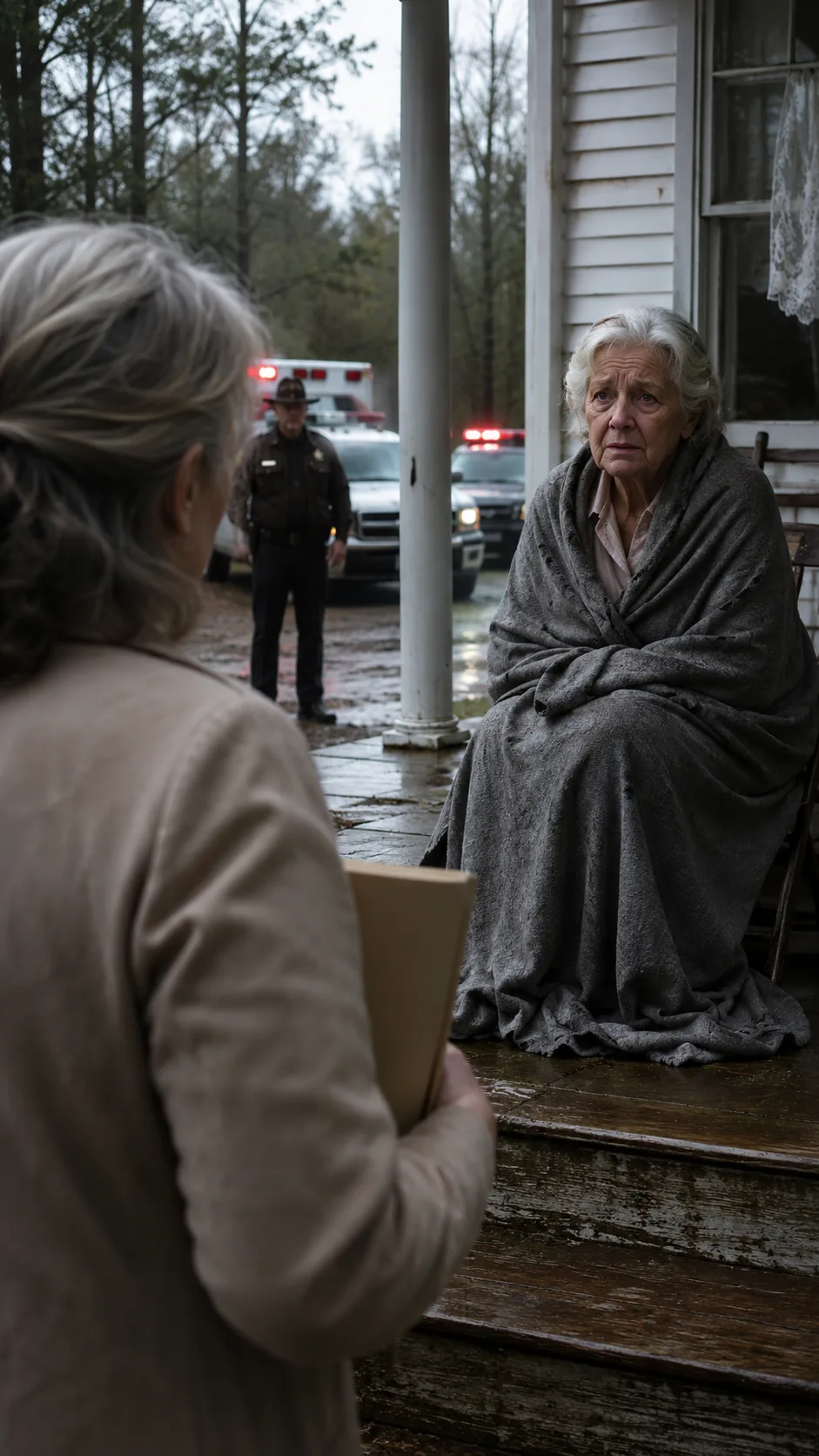
At first the neighbors kept their distance, unsure what story to believe about the old woman in the farmhouse and the widow from Memphis who suddenly started appearing every month.
Chapter 3
At first the neighbors kept their distance, unsure what story to believe about the old woman in the farmhouse and the widow from Memphis who suddenly started appearing every month.
Small rural places are kind and suspicious in equal measure. But Sheriff Cooper’s quiet word travels with authority. So does consistency. After a while the women from the church down the road brought casseroles. A man named Carl fixed Lorraine’s fence and refused payment because “Miss Lorraine’s been out here longer than most of us.” A teenage girl mowed in summer for extra cash. The world, once let in, turned out not to be waiting to punish her. That revelation made Lorraine cry three separate times, and each time she apologized for it as if tears still required permission.
One July afternoon, while we shelled peas on the porch, she asked, “Do you think Clare would have hated me?”
The question broke my heart because it came from so old a wound.
“No,” I said immediately.
“You don’t know that.”
“I know my daughter.”
I meant that. Clare was many
things—sharp, righteous, impatient with hypocrisy—but she was not mean. She had an instinctive loyalty to the vulnerable that once got her suspended in tenth grade for punching a boy who was tormenting a smaller girl in the cafeteria. She knew how to hold contradiction without letting it curdle into cruelty.
“She would have been furious with Cameron,” I said. “And confused. And heartbroken. But hatred? No. Not for you.”
Lorraine looked out across the field. “I wish I could’ve heard her call me anything once. Even by mistake.”
I reached over and covered her hand with mine. There are sentences no one should have to say that late in life.
As for me, my grief changed texture but never left.
That may disappoint people who prefer endings that resemble closure. I found no pure release, no day when I woke and discovered that betrayal had become wisdom and loss had
become gratitude. What I found instead was range. I became able to hold more than one truth at a time without feeling flayed by the effort.
Cameron loved me.
Cameron lied to me in a way that desecrated our marriage.
Cameron loved Clare.
Cameron stole her from another mother.
Cameron grieved our daughter with genuine devastation.
Cameron denied another daughter even the dignity of a name.
Cameron was capable of tenderness.
Cameron was capable of sustained moral horror.
Living with that list stopped being impossible once I gave up trying to resolve it into a single verdict. Some people die and leave behind clean stories. Others leave messes so immense the survivors must become archaeologists of motive and damage. I was the widow of one of the second kind.
A year after Sheriff Cooper’s call, I stood once more on the porch at Cypress Hollow with a glass of sweet
tea sweating in my hand. The house looked different now. Not transformed beyond recognition—houses keep some of their history whether you want them to or not—but eased. The blue paint on the porch ceiling was brighter. Wind chimes turned softly near the corner. The garden below was alive with zinnias and beans and the kind of effort that says a place belongs to the living again.
Lorraine moved slowly through the yard with a cane, checking tomato vines and muttering to herself about aphids. She had put on a little weight. Her color was better. From a distance she looked almost like any other elderly woman tending land she had long ago come to understand. That ordinariness moved me every time.
Sheriff Cooper had stopped by earlier with peaches from his sister’s orchard and a report update that changed nothing legal but added one small grace. The state had agreed to amend archival hospital notation so that my stillborn daughter’s existence was finally recorded correctly in the system. It was not a body. Not a grave. Not justice. But it was record. The world would no longer contain only Cameron’s preferred version of those days.
I went inside and took from my bag a folded piece of paper I had been carrying for weeks.
It was a letter to Grace.
I had not meant to write it. It simply began one night at the kitchen table in Memphis when sleep would not come and the house felt too full of unsaid things. I wrote to the daughter who had no funeral, no cradle memory, no first photograph. I told her about Clare, who might have been her sister or might simply have been the girl whose life grew where hers ended. I told her about the yellow blanket, the birch tree, the shape of my hands, the fact that I still sometimes wake thinking I hear a newborn cry when pipes settle in old houses. I told her that grief does not require time with a person to become real. I told her that being unnamed does not mean being unloved. I wrote six pages and wept over every one.
That afternoon at Cypress Hollow, I walked out to the birch tree and buried the letter at its base.
When I came back, Lorraine was standing on the porch watching me.
“For Grace?” she asked.
I nodded.
She opened the screen door and held it while I came in. “Good,” she said. “She deserved words.”
Yes, I thought. That was exactly it. She deserved words.
Later, as the sunset bled orange and pink across the fields and frogs started up in the low wet places, Lorraine and I sat side by side in rocking chairs and spoke of the future, which still felt to me like a strange daring concept.
She wanted to start attending church again, maybe the small Methodist congregation down the highway. Not because she had become pious in isolation—she liked to say she’d spent too many years arguing with God for that—but because she wanted to be where songs happened. I offered to drive down for the first few Sundays if she liked. She accepted.
I wanted, tentatively, to begin telling the truth in small controlled circles back in Memphis. Not to everybody. I had no interest in turning my life into local fascination. But to a few old friends who deserved to know why I had changed. Why widowhood had not looked like widowhood. Why I sometimes went still at the word family now as if listening for an insult under it. Lorraine said the truth grows less sharp once it has more than one room to live in. I think she was right.
At one point she turned to me and said, “Daisy, can I ask something selfish?”
“Of course.”
“If Clare had known—if she’d somehow known everything—do you think she still would’ve called you Mama?”
I looked out at the field for a long moment before answering because that was not a question to meet casually.
“Yes,” I said at last. “I do.”
Lorraine’s eyes filled.
“And I think,” I added, “if she’d had time, and if Cameron had not stolen so much from all of us, she might have found a way to call you something too.”
That made both of us cry, but gently. Not the violent tears of revelation. The softer kind that come when you finally allow yourself to imagine love where history withheld it.
The dead remained dead.
That never changed. No amount of truth gave me back Clare with her fierce clever mouth and impossible laugh. No discovery gave me the warm weight of Grace for even one second. No understanding restored my marriage to innocence. Some damage does not reverse; it only becomes more accurately described.
But accurate description is not nothing.
Because once I knew the truth, I could stop building my life around a false center. I could stop protecting Cameron from judgments he had earned. I could stop treating my own confusion as disloyalty. I could stop imagining that fidelity to his secrets was some noble extension of love.
Love does not require complicity with harm. Marriage does not sanctify erasure. Promises extracted through fear are not sacred.
These were the lessons widowhood gave me in place of peace.
The last time I stood at Cameron’s grave before writing this, I brought no flowers.
I stood in the clipped green cemetery under a sky the color of pewter and looked down at the stone bearing his name, dates, and the phrase beloved husband and father. The stone was not wrong. It was simply incomplete. I considered, for one wild second, saying all of it aloud there. Every accusation. Every question. Every word that began with how could you and ended nowhere. Instead I said only this:
“I know.”
Then I turned and left.
That is perhaps the truest ending I can offer.
Not forgiveness.
Not revenge.
Not neat closure tied with a moral ribbon.
Knowing.
Knowing what he did.
Knowing what he was.
Knowing what he was not.
Knowing who Clare was to me.
Knowing who she was to Lorraine.
Knowing Grace existed.
Knowing silence had preserved the wrong things for too long.
Knowing that truth, even late, can still alter the landscape of a life.
At Cypress Hollow, the birch tree is taller now.
Its leaves flash silver-green when the wind turns them, and Lorraine says that on quiet evenings it makes a sound like whispering. I like that. It feels fitting. Some daughters arrive in the world only to leave before they are held. Some daughters arrive by deception and are loved beyond blood and paperwork. Some mothers are made by labor. Some by years of bedtime stories and doctor visits. Some by a porch in Arkansas and thirty-two years of impossible waiting. Most by some painful, unphotographed combination of all of it.
When I raise a glass now—to Clare, to Grace, to the life that remains—I do not toast justice, because justice did not come.
I toast truth.
I toast the women who survived a man’s choices and refused to let those choices be the final authors of their lives.
I toast record, because there are holy things in being written down correctly at last.
And I toast the future, not because I am naive enough to think the past loosens its hold easily, but because the future belongs more honestly to us once the lies are named.
That evening on Lorraine’s porch, as the sun lowered and the swamp took on that deep reflective stillness it has before night, I lifted my sweet tea toward the darkening fields.
“To truth,” I said.
Lorraine touched her glass to mine. “To truth,” she echoed.
The glasses clicked softly. Somewhere out beyond the birch tree, frogs began calling from the water. The air smelled of earth, green things, and late light.
For the first time since Cameron’s dying breath, I did not feel like I was standing inside a secret.
I felt like I was standing, finally, in my own life.
THE END
Chapter complete
You have reached the end of this chapter.
Continue reading
A few more worlds to get lost in after this chapter.




