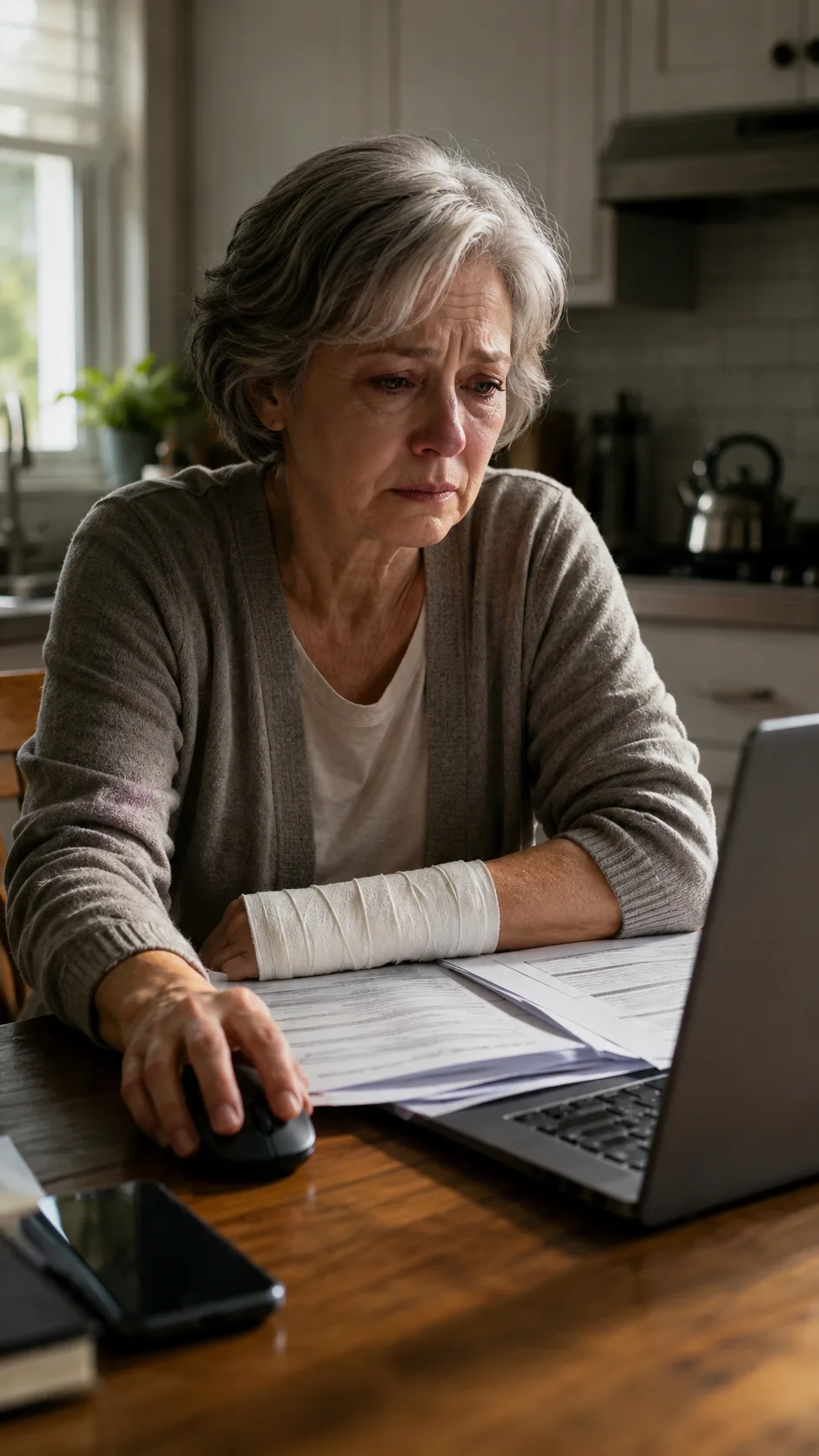
He told the truth.
Chapter 3
He told the truth.
All of it, or enough of it. That Ellie had struck me. That he had heard and done nothing. That I had been injured. That he chose silence and distance when he should have chosen his mother. That Ellie lied about a pregnancy. That I withdrew my financial support because trust had been broken. That he had let people think I abandoned him when in fact he had helped push me out. He did not dramatize. He did not weep on cue. He simply laid the truth on the table in front of the rolls and the coffee cups and the pastel napkins where everyone could see it.
By the time he finished, my sister-in-law was crying openly into a tissue. One of my nieces looked confused enough that someone gently sent her back to the den. Rachel stared down at her hands, blinking hard. Elaine, who had once nearly
run her cart into the freezer section on my behalf, looked ready to march out and commit a felony against Ellie on principle.
Jacob turned to me.
“I was a coward,” he said. “I was weak where I should have been loyal. I am sorry.”
No embellishment. No qualification. Just the words.
The silence after that was fuller than any noise could have been.
Then I reached across the table and put my hand over his.
His fingers trembled under mine.
Forgiveness is not a switch. It is not one dramatic scene where violins swell and everybody emerges transformed. It is slower than that. More conditional. More practical. What I felt in that moment was not total absolution. It was the first clean stone laid in a foundation that might hold something again.
And that was enough.
After everyone left that evening, I washed the last dishes in quiet. The
house had that tender, exhausted smell it gets after a successful meal and a difficult truth. Coffee, baked sugar, dish soap, ham. I dried my hands, went upstairs, and took the ring box from the dresser drawer.
I stood in my closet for a long moment holding it.
Then I placed it on the highest shelf, behind the winter blankets in a small locking case I had bought two days earlier. Safe. Out of reach. Not hidden out of fear, but protected out of respect.
A week later, Rachel came for tea.
Spring had fully arrived by then. The backyard was green again. New leaves flickered on the maple. The air smelled like cut grass and damp earth and the first bold flowers along the fence line. I set out a little tray with tea, shortbread, and sliced strawberries. We sat in the garden in the late afternoon sun while
a neighbor’s wind chimes stirred faintly two houses over.
Rachel wrapped both hands around her mug and looked at me over the steam.
“Do you ever wish you’d handled it differently?” she asked.
I leaned back in my chair.
The question deserved a real answer. Not a righteous one.
I thought about the urgent care clinic. The mortgage portal. The folder burning in my fireplace. The screenshot on my phone. The letter with black ink. Jacob crying into the receiver. The ring returning in the same velvet box it had left in. I thought about my own face in the mirror the morning after Ellie hit me, bruised and older and more awake than I had been in years.
“No,” I said.
Rachel waited.
“Because sometimes,” I continued, “the only way people learn is when they lose access to the things they thought they were entitled to. If I had fixed it quickly, they would have called that grace and learned nothing. They had to feel the weight of what they broke.”
Rachel nodded slowly, as if those words fit into a place in her that had been waiting for them.
Then she smiled, small and real. “I’m glad you didn’t shut me out too.”
I reached over and squeezed her hand. “You told the truth when it mattered.”
A little later, we heard a car door.
Jacob came through the gate carrying flowers, awkwardly cradled because he still didn’t know the best way to hold them without looking faintly embarrassed. Daisies and tulips, nothing extravagant. He looked over and smiled that tentative smile of someone reentering a room he nearly lost the right to enter.
“Am I late?” he asked.
“For what?” I said.
He lifted the flowers. “I wasn’t sure. Making peace? Spring? Mom’s garden? Pick one.”
Rachel laughed.
I did too.
We sat together for hours that evening. Not in some miraculous movie version of family restored, but in the quieter, more valuable way. Jacob helped me carry the tea things in. Rachel watered the herbs on the back steps because she said she liked the smell of basil on her fingers. We talked about ordinary things. Work. A new bakery opening downtown. The azaleas blooming early. Jacob’s therapy, which he mentioned without shame for the first time in his life. He said he was learning the difference between keeping peace and abandoning truth. I told him that was a lesson many people die without managing.
At one point he stood at the kitchen sink rinsing cups, sunlight gold on his shoulders, and I felt a small hard knot inside me loosen another degree. Not disappear. Loosen. Healing, I have learned, is rarely a trumpet blast. It is tiny muscles unclenching over time because the danger has actually receded.
That night, after they left, I walked through my house slowly turning out lights. Dining room. Hall. Kitchen. The familiar rituals of evening settled around me like a blanket. When I reached the front window, I paused and looked out at the darkening street.
For the first time in a long, long while, it felt like a family again.
Not because blood had erased betrayal.
Not because time had made the slap unreal.
Not because pain had politely wrapped itself up and left.
It felt like family because the lies were gone. The manipulation was gone. The false peace purchased by my silence was gone. What remained was smaller than what I had once imagined family should be, but it was truer. And truth, I had learned, makes better shelter than fantasy ever will.
People like Ellie count on the terror other people feel at the thought of conflict. They thrive in the space where decent people hesitate, hoping not to make things worse, hoping kindness will be recognized, hoping if they just stay calm enough and patient enough and useful enough the cruelty will eventually embarrass itself into stopping. But some cruelty does not stop until it hits a wall. Some manipulation does not retreat until the bridge is burned behind it. Some people only understand boundaries when they finally find one that does not move.
I used to think strength meant enduring. Endure the insult. Endure the ingratitude. Endure the eye roll, the sharp tone, the condescension, the casual taking. Endure because love was bigger. Endure because family was messy. Endure because women like me were raised to believe that holding things together was our highest virtue, even when what we were holding together was slowly strangling us.
I do not believe that anymore.
Strength is also refusal.
Refusal to finance your own mistreatment.
Refusal to keep translating your pain into something more comfortable for the people who caused it.
Refusal to pretend an apology counts when it is only another transaction.
Refusal to let your silence become the story somebody else tells about your surrender.
I looked down at my wrist sometimes in those months and still saw the faint memory of where the cast had sat, the skin there pale and tender long after the bone had knitted. Bodies heal with visible reminders. So do hearts, if we are lucky. The goal is not to erase the mark. The goal is to stop mistaking the mark for weakness.
Weeks later, early one Saturday, Jacob came by to help me move a heavy planter from the back porch to the side yard. He wore old jeans and work gloves and arrived with coffee in a cardboard tray exactly the way he used to when he was in college and wanted to soften me before asking for something. Only this time he was not asking. He was just helping.
We set the planter down together, both of us breathing hard. Dirt smudged one side of his jaw. A cardinal flashed red at the fence line. Somewhere down the block a dog barked twice and gave up. I took the cup he handed me and leaned against the porch rail.
“You know,” he said after a while, “for a long time I thought love meant staying. Staying no matter what. Letting things pass. Not making people choose.”
I waited.
He looked out over the yard. “Therapist says sometimes that’s not love. Sometimes it’s fear dressed up as loyalty.”
I nodded. “Your therapist is earning the fee.”
He smiled faintly.
Then he turned serious again. “I don’t expect everything to be fixed.”
“No,” I said. “You don’t.”
“But I’m glad you didn’t let me stay the man I was becoming.”
That sentence nearly undid me.
Not because it repaired the past. It couldn’t. But because it told me he was finally looking at himself without the fog of Ellie’s chaos or my protection between him and the mirror.
“I’m glad too,” I said.
We drank our coffee in silence after that, the good kind.
By summer, the divorce was moving steadily forward. Ellie, according to what little filtered back through Rachel, had already attached herself to someone else and was revising history in every direction she could find. In one version, Jacob was controlling. In another, I was unstable. In another, she had left to protect herself from our family’s toxicity. The details changed depending on the audience because truth had never been her native language. I stopped caring. People like Ellie don’t really leave a story; they simply go audition for the lead role in a new one.
My concern was no longer her.
It was the life growing back in the space she left.
Jacob started coming for dinner every other Wednesday. Nothing formal. Chili. Roast chicken. Pasta. He fixed the loose gate hinge without being asked. He brought new batteries for the smoke detectors because he noticed one chirping and knew I hated that sound. He told me when therapy was hard. He told me when he dreamed about the baby that had never existed and woke up ashamed of missing a lie. I told him grief does not always distinguish between what was real and what we almost let ourselves love. I told him that being fooled does not make him foolish forever if he learns from it.
Rachel came too sometimes. She fit into the evenings with increasing ease, as if she had spent much of her life standing just outside windows waiting to see whether she’d be invited into warmth. I learned she loved gardening and hated thunderstorms and made the best lemon bars I had ever tasted. She started helping me with the spring flowers and later the tomatoes. More than once I caught myself looking at her and thinking how strange it was that honesty had arrived from the side of the family that had brought so much damage. But life is like that. It rarely sends repair from the same doorway the injury came through.
By the time autumn brushed gold into the trees, I could say without lying that peace had come back to my house.
Not the old brittle peace built on me swallowing things.
Real peace.
The kind that comes when your front door no longer opens to people who expect your kindness while resenting your dignity. The kind that settles in your chest when you know exactly who you are and what you will no longer permit. The kind that makes sleep easier and mornings lighter and even grief more manageable because it is no longer sharing your bed with humiliation.
Sometimes, in the quiet just before sleep, I still replayed the day in Ellie’s kitchen. Not obsessively. More like a scar that aches before weather changes. I would see the bright light on the counters. Feel again the shock of impact. Hear again the silence upstairs. And each time I returned from the memory with the same conviction:
That was the day something inside me finally stood up.
Not after the slap.
After the silence.
Because pain I understood. Betrayal I understood. But there comes a point in a woman’s life when the deepest transformation is not surviving what others do to her. It is deciding, without apology, that survival alone is no longer enough. That she wants justice. That she wants peace. That she wants respect. That she is done paying admission to relationships that feed on her while calling her difficult for bleeding.
The world tells women my age to be grateful for scraps. For partial apologies. For dutiful visits. For access to grandchildren if they ever come. For any family at all, even family that bruises. The world says forgiveness makes us noble and boundaries make us bitter.
The world lies.
Boundaries are not bitterness.
Sometimes they are the only honest prayer a woman has left.
And mine, once spoken, gave me back everything that mattered.
My son, not as a boy preserved in memory but as a man forced to become worthy of love.
A home that felt safe again.
A ring returned to its rightful place.
A table where truth could be spoken.
A garden where new life grew because the weeds had finally been pulled.
People ask, in quieter ways than Rachel did that afternoon over tea, whether I regret not signing. Whether I regret the fire, the withdrawal, the hard line, the conditions. Whether I ever look at the smaller rental where Jacob once ended up and wonder if I went too far.
I don’t.
Because Jacob did not lose a house because I was cruel.
He lost a house because he stood still while cruelty happened.
There is a difference.
And the day he learned that difference was the day his real life began.
Mine, in a way, began again too.
THE END.
Chapter complete
You have reached the end of this chapter.
Continue reading
A few more worlds to get lost in after this chapter.




