“No, sir.
Chapter 3
“No, sir.
She said nothing. But she saw.”
Duke returned to his study with Vivian’s note waiting on his desk.
He sat down.
For a long time, he did not move.
Part 3
At half past four, Duke took out a clean sheet of paper.
He dipped his pen.
The letter he wrote was brief.
Vivian,
I will not be coming again.
What existed between us is over. I wish you no harm and no humiliation, but you must not write to Alden House, and you must not expect me at yours.
This decision is final.
Duke Alden
He sealed the envelope.
When the footman came, Duke handed it over.
“Deliver this to Mrs. Rourke. Wait for no reply.”
The footman bowed and left.
Duke stood in the silence of his study, feeling not guilt exactly, but the strange emptiness that follows a decision made too late.
At six o’clock, he knocked
on the door of Claire’s sitting room.
There was a long pause.
Then her voice came through the door, soft and surprised.
“Come in.”
She was seated at a small traveling desk near the window. Not the polished mahogany desk the house had provided. A smaller one, old and scratched, with her own ink bottle beside it.
She stood when he entered.
The gesture struck him harder than it should have.
She stood as if she were a guest.
As if this room, this house, this marriage, even her own name newly joined to his, did not yet give her the right to remain seated.
“Please,” Duke said. “Sit down. This is your room.”
Claire sat.
Carefully.
He remained standing for a moment, then took the chair opposite her.
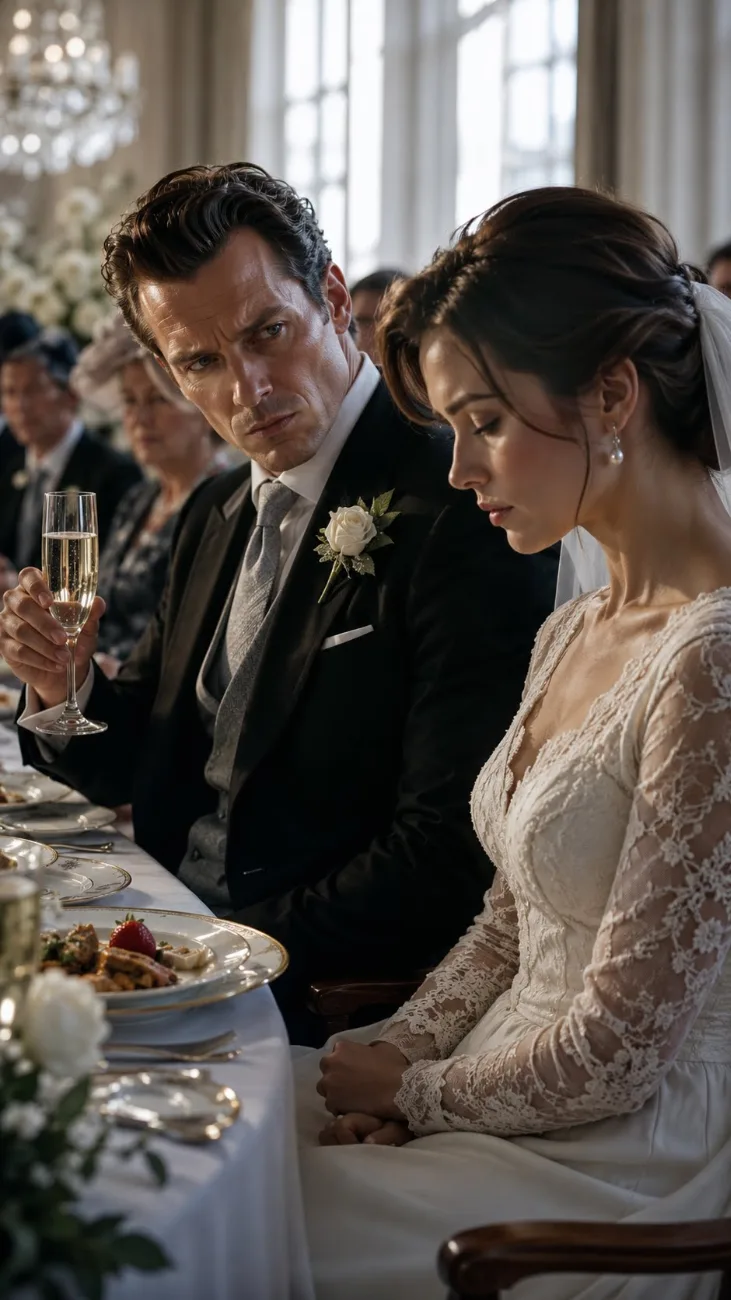
“I noticed,” he said, “that you did not speak at breakfast.”
Her eyes lowered.
“I noticed you did not eat. I
noticed you did not drink. I noticed that when people addressed you, you answered without answering.”
Her hands folded in her lap.
“I would like to understand why.”
The silence that followed was not empty.
It was crowded with all the things she was deciding whether to risk.
Finally, she said, “You did not marry me for conversation.”
Duke absorbed the blow because it was not cruel.
It was simply true.
“No,” he said. “I did not.”
“You married me because my father’s land touches yours. Because I am respectable. Because I would not cause trouble. Because you wished to install a wife in this house without altering the life you already preferred.”
She said it calmly.
That made it worse.
“I did not speak because you did not require me to speak,” Claire continued. “I understood the arrangement. I intend to fulfill it quietly.”
Duke looked at her.
Every
word was accurate.
Every word described the marriage he had built.
And hearing it in her voice made him ashamed of the architecture.
“You are correct,” he said. “That is what I intended.”
“Then I am behaving as intended.”
“Yes.”
Claire’s face did not change.
“But what I intended was wrong.”
Her hands tightened.
It was a small movement, nearly invisible, but he saw it.
“I wrote to Vivian Rourke this afternoon,” Duke said. “I ended the arrangement. She will not be part of this house. Or this marriage.”
Claire stared at him.
For the first time all day, her composure broke.
Not dramatically. She did not gasp. She did not cry. She did not thank him.
But her eyes widened just enough to reveal that she had not expected mercy from him.
“You did not need to do that,” she said.
“I know.”
“I would not have asked.”
“I know that too.”
“Then why?”
“Because that is precisely the problem.”
She looked away.
Duke leaned forward.
“I have spent the past few hours paying attention to you for the first time,” he said. “And I do not like what I have seen.”
Her face closed.
“Not you,” he said quickly. “Never you. What I do not like is what has been done to you. You have been taught to take up no space. You have been trained to make your needs so small that no one has to feel guilty for ignoring them.”
Claire did not move.
“And I chose you because of that,” he said. “Because I thought your silence would make my life easier.”
The words cost him more than he expected.
“I am sorry.”
Claire looked at him then.
Not with forgiveness.
Not yet.
With suspicion.
With wonder.
With the exhausted caution of a woman who had heard kind words before and learned to wait for the price.
“I do not know how to be different,” she said.
Duke nodded.
“I suspect I do not either.”
Outside, evening settled over Manhattan. Carriages and motorcars moved along the avenue. The city glowed gold under a sinking sun.
Inside the room, Claire’s letter lay half-written on her desk.
“Who were you writing to?” Duke asked.
“My sisters.”
“What were you telling them?”
“That the house is large. That Mrs. Hawthorne is kind. That the wedding was proper.”
“And what were you going to say about me?”
Claire looked at the page.
“I had not decided yet.”
“What would you say now?”
She considered.
“That you are more observant than I expected.”
It was not praise.
But Duke accepted it as if it were a gift.
“Would you have dinner with me?” he asked.
Her brows drew together.
“We already had the wedding breakfast.”
“No. Not a performance. Not with guests. Dinner. In the small dining room. Just us. You may speak if you wish. Or not. But if there is silence, let it be chosen, not required.”
Claire’s fingers rested on the edge of the desk.
Then, slowly, she nodded.
Part 4
They dined at seven.
Mrs. Hawthorne, informed with less than an hour’s notice that the newly married Duke and Mrs. Alden would eat privately, managed the change with the grim satisfaction of a general whose enemy had finally made a useful mistake.
The small dining room faced the garden behind the house. It was paneled in warm walnut, lit by candles, and set with pale yellow tulips instead of white roses. There were only two places at the table.
Claire paused when she saw it.
“Tulips,” she said.
“Mrs. Hawthorne has opinions about flowers.”
“She has opinions about many things.”
“That is the foundation of this household.”
Claire looked down, and there it was again.
The beginning of a smile.
Dinner began awkwardly.
Duke was a man skilled in conversation, but this was different. He could charm senators, negotiate with bankers, embarrass journalists, and silence enemies with one sentence. Yet he found himself nervous across from his own wife because, for the first time, he wanted the answer to matter more than the question.
“Tell me about your sisters,” he said.
Claire looked surprised.
Then she told him.
Lily was eighteen, restless, dramatic, convinced she was destined either for the stage or for disaster. Nora was sixteen, shy until provoked, then sharper than anyone expected. They wrote Claire letters every week, sometimes twice, often adding sketches in the margins when words were not enough.
Claire spoke of them with warmth she did not seem to know she was revealing.
She told him about Rosemere, her father’s Virginia estate, beautiful in spring, cold in winter, always short of money. Her mother had died when Claire was seventeen. After that, her father had retreated into grief, debt, and silence.
“So you ran the house,” Duke said.
“There was no one else.”
“At seventeen?”
“Yes.”
“And your father allowed it?”
Claire’s mouth tightened.
“My father did not notice it.”
Duke set down his glass.
She said it without anger, and that made him angrier on her behalf.
She told him about the tenants. About a lame girl she had taught to read. About broken fences repaired with money saved from household accounts. About reading agricultural reports her father discarded. About learning crop rotation, drainage, livestock care, and accounting because survival required more than embroidery.
“You know land management,” Duke said.
“A little.”
“No,” he said. “Not a little.”
Claire stopped.
Most people, he realized, had heard her intelligence and treated it as noise.
He listened to it as music.
By ten o’clock, the candles had burned low.
The servants had cleared the table twice.
Neither Duke nor Claire had noticed.
She was explaining how the lower fields at Rosemere flooded because the old drainage trenches had been cut too shallow.
Duke, who had sat through six meetings about the Hudson project, suddenly understood that the quiet woman he had married for access to land might understand that land better than the men he paid to advise him.
“You should look at Mercer’s plan,” he said.
“Your steward?”
“Yes.”
“Would he welcome my opinion?”
“No.”
Claire’s smile appeared fully for the first time.
It was small.
But it changed her face.
“Then I should very much like to see it.”
Before they rose, Duke said, “Write to your sisters again.”
“And say what?”
“That the Duke is a fool,” he said. “But he is learning.”
Claire looked at him for a long moment.
Then she said, “I think Lily would enjoy that.”
Part 5
Vivian Rourke arrived the next afternoon.
Duke had expected anger.
He had not expected her to come to Alden House.
She swept into the front hall wearing a cream suit, a black hat, and a smile sharp enough to cut ribbon. Mrs. Hawthorne attempted to stop her. Vivian ignored her with the practiced ease of a woman who had entered too many houses through side doors and now preferred the front.
Duke met her in the drawing room.
Claire was upstairs with her maid.
At least, he thought she was.
Vivian removed her gloves one finger at a time.
“So,” she said. “Marriage has made you sentimental.”
“No.”
“Then stupid.”
“Perhaps.”
Her eyes flashed.
“You ended two years in six lines.”
“I should have ended it before I married.”
Vivian laughed once.
“How noble. Did the little bride weep prettily?”
Duke’s expression hardened.
“Do not speak of her that way.”
Vivian studied him.
Then something in her face changed. She had come expecting inconvenience, perhaps guilt, perhaps a quarrel that ended with him kissing her anger away.
Instead, she saw a closed door.
“You cannot be serious,” she said.
“I am.”
“You married her yesterday.”
“Yes.”
“You do not know her.”
“I know enough to understand that I insulted her before she ever entered this house.”
Vivian walked to the window and looked out at the garden.
“You were never a romantic, Duke.”
“No.”
“That was what I liked about you.”
“I know.”
“She will bore you.”
“She has not so far.”
“She will disappoint you.”
“Then I will deserve the lesson.”
Vivian turned back, anger bright in her eyes.
“And what am I meant to do? Vanish quietly so your conscience may redecorate itself?”
“No. You may hate me if you wish. You may call me coward, hypocrite, liar. Some of it would be true. But you may not enter this house again.”
A sound came from the doorway.
Both turned.
Claire stood there.
She must have come down unnoticed. Her face was pale, but she did not retreat.
Vivian looked her over.
Slowly.
Cruelly.
“So this is the wife.”
Duke stepped forward.
Claire spoke before he could.
“Yes,” she said.
It was one word.
But it filled the room.
Vivian’s mouth curved.
“And does he already make speeches about honor?”
Claire looked at Duke.
Then back at Vivian.
“I do not know yet what kind of man my husband is,” Claire said. “But I know what kind he decided not to remain.”
The room fell silent.
Duke stared at her.
Vivian’s smile faltered.
Claire’s hands were trembling, but her voice had not.
“That may not be enough,” Claire continued. “It may not repair what was already disrespectful. But it is not nothing.”
Vivian’s eyes narrowed.
For a moment, Duke thought she might strike.
Instead, she put her gloves back on.
“How touching,” she said. “A silent wife with one sentence prepared.”
Claire’s chin lifted.
“I have several. I am merely choosing carefully.”
Mrs. Hawthorne, standing just beyond the door, made a sound suspiciously like a cough.
Vivian left Alden House five minutes later.
She did not slam the door.
Women like Vivian did not slam doors. They made departures that suggested the building had failed to deserve them.
When she was gone, Claire exhaled.
Duke turned to her.
“I am sorry you heard that.”
“I am not.”
“No?”
“No.” Claire looked toward the front hall. “I needed to see whether the door truly closed.”
“And did it?”
She looked at him.
“Yes.”
Part 6
Spring became summer.
Claire did not transform Alden House with noise or grand declarations. She changed it the way water changes stone: steadily, quietly, completely.
She began with the library.
The catalog was six years behind. She corrected it in three weeks.
She reorganized the linen rooms after Mrs. Hawthorne made one pointed comment and three silent ones. She learned the servants’ names. Not only the senior staff, but the kitchen maids, the stable boys, the footmen who had previously been treated as moving furniture in gloves.
When Ellen burned her hand, Claire noticed before anyone else and sent for salve.
When a young maid cried in the laundry room over a letter from home, Claire sat beside her until the girl could breathe.
Duke watched the household shift around her.
Not because she demanded authority.
Because she deserved it.
Her sisters arrived in June.
Lily and Nora came with four trunks, two hatboxes, a cracked violin, and the explosive energy of girls who had spent too long in a house where laughter was treated like disobedience.
They adored Claire.
They clung to her, teased her, interrupted her, kissed her cheeks, stole her ribbons, and filled Alden House with the kind of noise Duke had always believed he disliked.
Then one afternoon, walking past the garden hedge, he heard Lily say, “She laughs here.”
Nora replied, “I know. I almost cried when I heard it.”
Duke stopped.
On the other side of the hedge, Claire laughed again.
Not politely.
Not softly.
A real laugh, surprised out of her.
Duke stood there, unseen, and understood that his wife’s silence had not been her nature.
It had been captivity.
That evening, he found her in the library with Mercer’s drainage plans spread across the desk.
Mercer stood nearby, looking pained.
Claire held a pencil.
“I think the eastern channel should be widened by three feet,” she said.
Mercer cleared his throat.
“Mrs. Alden’s observation is interesting, sir, but the plan has already been reviewed.”
Claire looked at Duke.
“Would you like to hear my argument?”
Duke sat down.
“Yes.”
Mercer looked as if the world had betrayed him.
Claire spoke for twenty minutes.
She did not raise her voice. She did not apologize. She pointed to the slope, the soil density, the flood history, the tenant reports, and the cost of repairing damage later if they refused to spend money now.
Duke listened.
Then he looked at Mercer.
“Widen it.”
Mercer opened his mouth.
Duke lifted a brow.
Mercer closed it.
A month later, standing in the southern field after a hard rain, Mercer watched water flow exactly where Claire had said it would.
He removed his hat.
“Mrs. Alden was correct,” he said.
Claire looked at Duke.
Duke smiled.
“She often is.”
By autumn, Claire was writing letters to agricultural societies under her own name. One was published. Duke left the journal beside her breakfast plate.
She stared at it for almost a full minute.
Then she touched the printed words with the same reverence Mrs. Hawthorne had once described in the library.
“My father never read anything I wrote,” she said.
Duke sat across from her.
“Then your father missed a great deal.”
Claire looked up.
This time, when she smiled, she did not hide it.
Part 7
Raymond Whitmore came to Alden House in December.
Claire was expecting a child by then.
The news had changed something in Duke that he could not explain without sounding foolish. He had wanted an heir once because men like him were trained to want heirs. Now he wanted this child because it belonged to Claire, because it would carry her eyes or her intelligence or her quiet courage into a future that might be kinder than her past.
Raymond arrived with a stiff collar, tired eyes, and the defensive pride of a man who knew he had failed but hoped no one would mention it.
Claire received him in the drawing room.
Duke stood beside her.
For several seconds, Raymond seemed unable to reconcile the daughter he remembered with the woman before him.
Claire wore deep green silk. Her hair was pinned simply. There were no diamonds except her wedding ring. Yet she seemed more at home in Alden House than Raymond had ever seemed in Rosemere.
“You look well, Claire,” he said.
“I am well.”
His eyes moved over the room, the fire, the flowers, the books stacked beside her chair.
Then he said awkwardly, “Your sisters write that you are busy.”
“Yes.”
“With household matters?”
“With the estate. The drainage project. Tenant accounts. The library. Some correspondence.”
“Correspondence?”
Duke spoke then.
“Your daughter’s article was published by the State Agricultural Review.”
Raymond blinked.
Claire’s face remained composed.
“I did not know,” he said.
“No,” Claire replied gently. “You did not.”
It was not cruel.
That made it devastating.
Dinner that night was strained. Raymond tried to speak of weather, horses, old neighbors, anything except the years in which his eldest daughter had been mother, steward, accountant, nurse, and ghost inside his house.
Finally, after dessert, he looked at her and said, “I thought silence helped.”
Claire’s hand stilled.
Duke looked at him.
Raymond’s voice thickened.
“After your mother died. You looked so much like her when you argued. When you laughed. I could not bear it. So when you became quiet, I let myself believe you were stronger than the rest of us.”
Claire did not answer.
Raymond swallowed.
“But perhaps you were only alone.”
The fire cracked softly.
Claire looked down at her hands.
For once, they were not folded.
“Yes,” she said. “I was.”
Raymond closed his eyes.
“I am sorry.”
Claire’s face changed, but she did not cry.
Not because she was cold.
Because some apologies arrive too late to open the prison they helped build.
Still, they matter.
“Thank you,” she said.
He stayed three days.
Before leaving, he asked if he might write to her.
Claire looked surprised.
Then she said, “Yes, Father.”
His first letters were short and clumsy.
Hers were careful.
Over time, his grew longer.
Hers grew freer.
The child was born in February during a storm that turned Manhattan white.
A son.
They named him James Raymond Alden.
Duke had suggested the middle name. Claire had looked at him for a long moment, understanding what he was offering: not forgiveness on her behalf, but space for it if she ever wanted it.
When the baby was placed in her arms, Claire wept.
Duke sat beside the bed and held both of them, his wife and his son, and thought of the wedding breakfast.
The untouched plate.
The full glass.
The woman who had sat beside him like a shadow.
He bent and kissed Claire’s forehead.
“I nearly missed you,” he whispered.
Her fingers closed around his.
“But you noticed.”
Part 8
Two years after their wedding, Duke came home late from a board meeting and found Claire in the small dining room.
Not the grand ballroom.
Not the formal room with forty chairs and portraits staring from the walls.
The small dining room where they had first spoken honestly to each other.
Candles burned on the table.
Dinner waited beneath silver covers.
James slept upstairs.
Outside, rain tapped gently against the windows, softening the city into gold and shadow.
Claire stood near the glass, watching Fifth Avenue shine beneath the lamps.
She turned when Duke entered.
He stopped in the doorway.
“What is it?” she asked.
“You are speaking,” he said.
She glanced around.
“I am standing silently by a window.”
“No.” He smiled. “I mean you speak now. At breakfast. At dinner. To Mercer, who pretends not to fear you. To Mrs. Hawthorne, who openly respects you. To senators who deserve less mercy than you give them. You corrected Arthur Penn on railroad labor policy last week, and I thought he might faint into his soup.”
Claire laughed.
The sound still astonished him.
“You noticed?”
“I noticed you the day you did not speak,” Duke said. “It remains the most important thing I have ever done.”
She crossed the room and took his hand.
Not carefully.
Not as a duty.
As a woman certain the hand would close around hers.
“I was not silent because I had nothing to say,” she said.
“I know.”
“I was silent because no one had made it safe.”
His thumb moved over her fingers.
“And now?”
She smiled.
Full, open, unguarded.
“Now I have become rather difficult to stop.”
Duke laughed.
“I thank God for it.”
They sat down together.
For a while, they ate in quiet.
But it was not the silence of the wedding breakfast.
It was not fear.
It was not surrender.
It was the warm, chosen silence of two people who no longer needed to fill every space to prove they belonged there.
Later, Claire told him Lily was engaged to a young attorney who adored her opinions, Nora wanted to study medicine, Mrs. Hawthorne had declared the new linen system “acceptable,” which was the highest praise any living person had received from her, and Mercer had finally admitted that Claire’s second drainage proposal was also correct.
Duke listened.
He listened the way he should have listened from the beginning.
When dinner ended, they went upstairs together.
At the nursery door, they paused.
James slept with one fist curled beside his cheek.
Claire leaned against Duke’s shoulder.
“Promise me something,” she whispered.
“Anything.”
“If we have a daughter, and she has something to say, promise me we will never teach her to swallow it.”
Duke looked at his sleeping son, then at his wife.
“I promise,” he said. “And if our son becomes the sort of man who expects women to swallow their words, I will consider myself a failure.”
Claire smiled.
“Good.”
Years later, people would say that marriage had changed Duke Alden.
They would say he became less cold, less arrogant, more just. They would say his wife softened him, though that was not exactly true.
Claire did not soften him.
She sharpened what had been dull.
She awakened what had been asleep.
She taught him that attention could be an act of love, that silence could be a wound, and that power meant very little if it was not used to make room for someone else’s voice.
As for Claire, society eventually stopped calling her quiet.
They called her formidable.
Duke preferred another word.
Free.
And sometimes, at crowded dinners, when guests talked too loudly and men interrupted women out of habit, Duke would glance down the table and see Claire watching everything with those steady brown eyes.
Then she would speak.
The room would change.
And Duke, remembering the silent bride beside the untouched plate, would feel again the force of that first extraordinary lesson:
Sometimes love begins not with a kiss, not with desire, not even with kindness.
Sometimes it begins when someone finally notices you have stopped speaking and decides the world has lost something important enough to fight for.
Chapter complete
You have reached the end of this chapter.
Continue reading
A few more worlds to get lost in after this chapter.




